What he found, as he notes, is little reported in the media and when it is sneeringly so, as if organised by old men with beards behind the scenes (hello there)
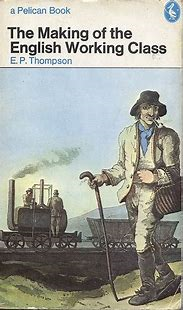
As E P Thompson wrote in the Making of the English Working Class of Richard Carlile’s radical paper shop in Fleet St in the 1820s, where those minding it were regularly arrested and jailed, it was in fact never left untended. As soon as someone was carted off someone else, unknown to them arrived to do it. They came out of a culture Thompson notes, and from all over England.
No doubt there was some organisation behind that but at root it was a reaction from below to events.
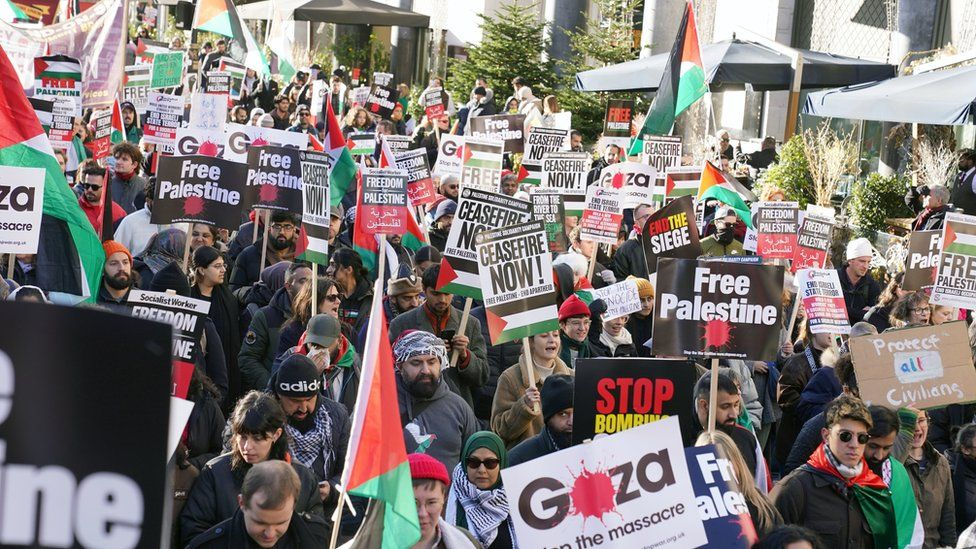
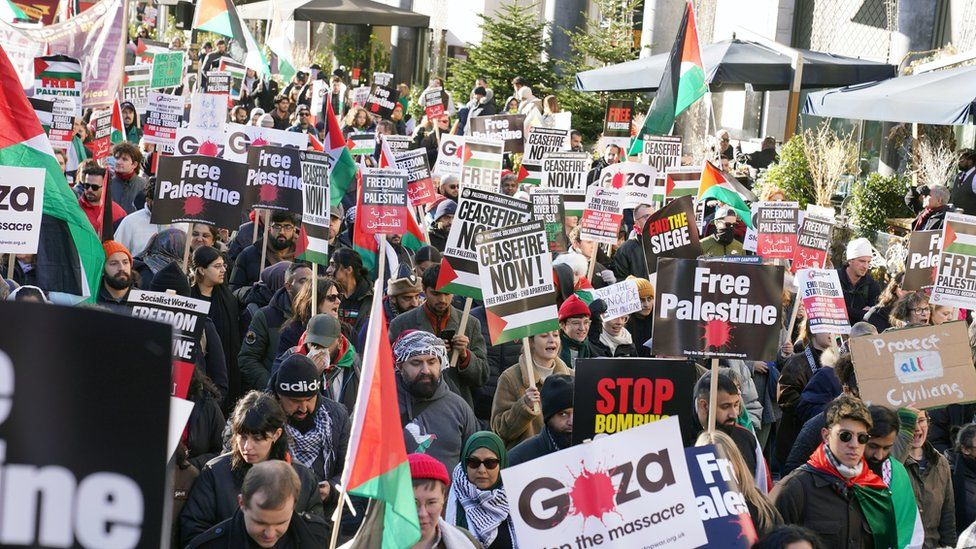
Chakrabortty found college students walking out to attend a mass rally on Gaza. They had no doubt heard the official words of Sunak and Starmer and then they had looked at their screens and talked to each other. Images of death and destruction to stretch the imagination, on the horror scale.
Official politics continues to make gestures about the murder of thousands of Palestinians and does little. The Luton students by contrast are taking action as are many others.
After eons of deliberation the UN has agreed that more aid be sent to Gaza. There is no ceasefire and the murderous forces of the IDF press on, even as Israeli Government’s lies are exposed even now in mainstream media. Palestine is the historical source of the Christmas story but there was no peace and goodwill from the Tel Aviv regime. Indeed Netanyahu made a Christmas Day appearance in Gaza to underline that genocidal actions will continue.
A political rage continues to grow, not in the corridors of power but in communities and on the street. Protest continued over the holidays, at companies making arms for Israel, at Barclays Bank which is funding it and New Year’s Eve Vigils. People will be on the streets again as the New Year gets going.
If we return to Thompson he made the distinction between what he called Experience 1 and Experience 2. Theoretically it can be discussed and challenged as a framework. In practice though it draws a distinction between what people are told is happening and what they actually see is happening. In the gap, yawning in the case of Gaza, politics develops. Whose politics is of course up for debate and discussion but it won’t be those of Keir Starmer who still hasn’t managed to call for an immediate ceasefire
The Beard Liberation Front, the informal network of beard wearers, has said that Wayne Rooney’s sacking as Birmingham City manager is likely to have been beard related.
Rooney was in charge at Birmingham for just 15 games during which time the club’s league position got worse rather than better.
The campaigners say that managerial beards can be a key to footballing success but they must be properly aligned in the context of the style of football a club plays. Rooney needs to learn from successful hirsute managers such as Jurgen Klopp and Ange Postecoglou
BLF Organiser Keith Flett said, Beard Power is a key factor in modern football but the reality is that Wayne Rooney had the wrong sort of beard for the situation he was in.
Of course what Israel is doing in Gaza is not war but genocide. However the adage that truth is the first casualty of war remains the case.
Israeli Governments have a long history of dissembling. That doesn’t mean to say that they never speak the truth but rather that they lie so much that it becomes impossible to know. Much media is at least aware of this point and seeks to verify statements from Tel Aviv.
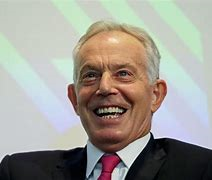
One statement recently made in Israeli media was that Tony Blair is helping to find countries people Israel wants out of Gaza to go to.
Interestingly, perhaps uniquely, this has resulted in a statement from the Tony Blair Institute which says it is a lie and confirms that people living in Gaza have a right to stay there.
Taken at face value the statement is welcome but the fog of war perhaps obscures other agendas. The Tony Blair Institute is a significant global business and while its possible that Blair has recalled that he once had an ethical foreign policy, its also possible that being linked with Netanyahu is bad for business*.
Blair of course was the Middle East Peace Envoy which seemed to make, shall we say, limited progress. But he did tell the Financial Times before Christmas that he had recently met Netanyahu.
Perhaps the reality is that Israeli action in Gaza means its just not convenient to pursue that in the public domain now.
*Middle East Countries the Tony Blair Institute advises (Times 2nd Jan)
Looking at some points in the voluminous archives of New Left Review I came across Richard Gott’s review of Anthony Selsdon’s 2005 book on Tony Blair.
Gott notes:
(Blair) had come to power in 1997 with a blank sheet that he had proved unable to fill. At home, he had no project of personal significance, and the Labour Party of the 1990s was bereft of ideas of its own. After 18 years marked by fierce internal discussions and arguments, Labour was fearful of anything that smacked of a real alternative to the Conservative programme. The promise to retain public spending at Tory levels for the first two years of Government was indicative of a wider lack of nerve.
2024. Beyond Westminster a new politics from below is emerging.
The Sunday Times on 31st December devoted extensive space to a poll that had been done in late November covering English Parliamentary Constituencies on whether Mr Suit or Mr Woodentop was preferred as the next Prime Minister.
Mr Woodentop had a good deal of support but second was not Mr Suit but people who either didn’t know or didn’t care.
Of course it might just be an ‘all politicians are the same’ perspective but although the differences between Sunak and Starmer are limited they do represent different interests in society. Sunak represents various fractions and factions of business (not all UK based). Starmer represents organised labour. Of course Starmer would rather he didn’t and would very much like to be the party of business. However for reasons he either doesn’t grasp or prefers not to think about that won’t happen. There is still a class divide in society even if Starmer tries hard to be on the wrong side of it.
On that basis its certainly worth keeping a focus on Labour actually doing something positive even if only in a minor key if it wins the Election.
But the really political story of 2024 is down below in the workplaces, colleges, cafes and on the streets. A lot of this is about Gaza and the continuing murder- hundreds every day- that Israel is carrying out. About this neither Sunak or Starmer have done anything more than say its all gone a bit far but done nothing.
That has created an anger moving towards rage seen not just in London demonstrations but in hundreds of local marches, protests at arms manufacturers and companies that back Israel. Little of this is reported in official media but its all over social media.
The new politics is also focused on public services and austerity and the need to stop the rich getting richer and the poor getting poorer.
Some of it may have an electoral focus particularly as its an Election year but its about more than that. Its about challenging and changing things from below light years away from the official world of Messrs Suit and Woodentop
Nesrine Malik has a good piece in the Guardian on this today
In the traditional calendar Christmas has twelve days, hence the partridge in a pear tree etc, and New Year is around halfway through.
As the Pope,the Archbishop of Canterbury, and the King all reminded us in various formulations on Christmas Day its a season of peace and goodwill. Some however did not get the message
Netanyahu: the current Israeli leader made a guest appearance in Gaza on Christmas Day to announce that his tour of death and destruction would go on.
Biden: the US President and gormless sidekick Blinken have continued to arm Israel and failed to call for a ceasefire in Gaza
Shapps. the latest UK Defence Secretary has used the season of peace and goodwill to threaten a bombing mission on Yemen. In a rather bizarre re-run of Suez 1956 this will include the US this time and, er, another European country. The UK has close links to Saudi Arabia so it can bomb Yemen but Shapps either doesnt know that or has forgotten. The Saudis no doubt grasp its mission impossible
Zelensky. Ukraine moved Christmas Day to 25th December from the Orthodox date (7th January) but didnt grasp that this meant peace and goodwill and continued make attacks on Russian positions. Russia of course was carrying on as usual since no one would ever associate Putin with either peace or goodwill
When New Year came the air was as thick as pea soup. No chance of getting away, our cabman ordered for one o’clock never arrived so the whole lot of us had to stop where they were. So we went on drinking, singing and card playing till half past five..it was after seven when we went to sleep and got up again at 12 or 1 to return to Pilsener etc.. I stuck to Claret till seven
Engels to Laura Lafargue and how he spent New Year’s Eve and New Year’s Day 1888/9
CAMPAIGNERS URGE CAUTION ON NEW YEAR TRADITION OF FIRST BEARDING DUE TO INCLEMENT WEATHER
The Beard Liberation Front, the informal network of beard wearers, has said that it is again reviving the ancient New Year tradition of First Bearding this year.
At midnight on New Year’s morning the first person with a beard across the doorstep of a house, or on this occasion only a false beard, must be given a glass of imperial stout or equivalent to marinade their beard in. In return the beard wearer will bring good fortune for the coming year.
First Bearding can be when a stranger with a beard comes to the house, as in first footing, or when someone with a beard already inside steps outside to return again.
The campaign group which opposes irrational prejudice against the hirsute says that the tradition of First Bearding is thought to have been as popular as first footing but declined with the more clean-shaven culture after 1945
BLF Organiser Keith Flett said, the weather will be wet and windy for many at midnight so we urge First Bearders to take care of their follicles. We expect many of those who have grown a beard over the Xmas holiday to participate this year for the first time in this ancient and now revived tradition.
GUIDELINES ON FIRST BEARDING
On or immediately after the stroke of midnight on December 31/January 1 await a knock on the door
If the person has a beard welcome them in as a First Bearder. Check first however that it is not Liz Truss wearing a fake beard.
Be sure to answer the door promptly as otherwise the First Bearder may sustain weather damage to the beard.
If they attempt to give you a lump of coal, ignore this. It is not part of the modern tradition of First Bearding
Give them a glass of imperial stout or equivalent to marinade their beard in & wish them a Happy Hirsute New Year
John Pilger the great campaigning journalist and activist has sadly died at 84.
In 2014, marking the 50th anniversary of E P Thompson’s Making of the English Working Class Pilger compared historians and journalists, seeing them as myth busters, who remembered what authority would prefer us either to forget or never know about
_________________________
Fifty years ago, E.P. Thompson’s ‘The Making of the English Working Class’ rescued the study of history from the powerful. Kings and queens, landowners, industrialists, politicians and imperialists had owned much of the public memory. In 1980, Howard Zinn’s ‘A People’s History of the United States’ also demonstrated that the freedoms and rights we enjoy precariously – free expression, free association, the jury system, the rights of minorities – were the achievements of ordinary people, not the gift of elites.
Historians, like journalists, play their most honourable role when they myth-bust. Eduardo Galeano’s ‘The Open Veins of Latin America’ (1971) achieved this for the people of a continent whose historical memory was colonised and mutated by the dominance of the United States.
The “good” world war of 1939-45 provides a bottomless ethical bath in which the west’s “peacetime” conquests are cleansed. De-mystifying historical investigation stands in the way. Richard Overy’s ‘1939: the countdown to war’ (2009) is a devastating explanation of why that cataclysm was not inevitable.
We need such smokescreen-clearing now more than ever. The powerful would like us to believe that the likes of Thompson, Zinn and Galeano are no longer necessary: that we live, as Time magazine put it, “in an eternal present”, in which reflection is limited to Facebook and historical narrative is the preserve of Hollywood. This is a confidence trick. In ‘Nineteen Eighty-Four’, George Orwell wrote: “Who controls the past controls the future. Who controls the present controls the past.”
The people of Korea understand this well. The slaughter on their peninsula following the second world war is known as the “forgotten war”, whose significance for all humanity has long been suppressed in military histories of cold war good versus evil.
I have just read ‘The Korean War: A History by Bruce Cumings’ (2010), professor of history at the University of Chicago. I first saw Cumings interviewed in Regis Tremblay’s extraordinary film, ‘The Ghosts of Jeju’, which documents the uprising of the people of the southern Korean island of Jeju in 1948 and the campaign of the present-day islanders to stop the building of a base with American missiles aimed provocatively at China.
Like most Koreans, the farmers and fishing families protested the senseless division of their nation between north and south in 1945 – a line drawn along the 38th Parallel by an American official, Dean Rusk, who had “consulted a map around midnight on the day after we obliterated Nagasaki with an atomic bomb,” wrote Cumings. The myth of a “good” Korea (the south) and a “bad” Korea (the north) was invented.
In fact, Korea, north and south, has a remarkable people’s history of resistance to feudalism and foreign occupation, notably Japan’s in the 20th century. When the Americans defeated Japan in 1945, they occupied Korea and often branded those who had resisted the Japanese as “commies”. On Jeju island, as many as 60,000 people were massacred by militias supported, directed and, in some cases, commanded by American officers.
This and other unreported atrocities were a “forgotten” prelude to the Korean War (1950-53) in which more people were killed than Japanese died during all of world war two. Cumings’ gives an astonishing tally of the degree of destruction of the cities of the north is astonishing: Pyongyang 75 per cent, Sariwon 95 per cent, Sinanju 100 per cent. Great dams in the north were bombed in order to unleash internal tsunamis. “Anti-personnel” weapons, such as Napalm, were tested on civilians. Cumings’ superb investigation helps us understand why today’s North Korea seems so strange: an anachronism sustained by an enduring mentality of siege.
“The unhindered machinery of incendiary bombing was visited on the North for three years,” he wrote, “yielding a wasteland and a surviving mole people who had learned to love the shelter of caves, mountains, tunnels and redoubts, a subterranean world that became the basis for reconstructing a country and a memento for building a fierce hatred through the ranks of the population. Their truth is not cold, antiquarian, ineffectual knowledge.” Cumings quotes Virginia Wolf on how the trauma of this kind of war “confers memory.”
The guerrilla leader Kim Il Sung had begun fighting the Japanese militarists in 1932. Every characteristic attached to the regime he founded – “communist, rogue state, evil enemy” – derives from a ruthless, brutal, heroic resistance: first to Japan, then the United States, which threatened to nuke the rubble its bombers had left. Cumings exposes as propaganda the notion that Kim Il Sung, leader of the “bad” Korea, was a stooge of Moscow. In contrast, the regime that Washington invented in the south, the “good” Korea, was run largely by those who had collaborated with Japan and America.
The Korean War has an unrecognised distinction. It was in the smouldering ruins of the peninsula that the US turned itself into what Cumings calls “an archipelago of empire”. When the Soviet Union collapsed in the 1990s, it was as if the whole planet was declared American – or else.
But there is China now. The base currently being built on Cheju island will face the Chinese metropolis of Shanghai, less than 300 miles away, and the industrial heartland of the only country whose economic power is likely to surpass that of the US. “China,” says President Obama in a leaked briefing paper, “is our fast emerging strategic threat.” By 2020, almost two thirds of all US naval forces in the world will be transferred to the Asia-Pacific region. In an arc extending from Australia to Japan and beyond, China will be ringed by US missiles and nuclear-weapons armed aircraft. Will this threat to all of us be “forgotten”, too?
Exclusive Dealing & Boycotts from the Chartists to South Africa & Palestine
On the last Saturday of 2023 I joined a protest outside Barclays Bank in Central Cardiff. The protest was over Barclays investments with companies that make weapons for Israel. I’m not sure if I was the oldest person present but I had a chat with several protesters about similar protests that had taken place 50 years ago over the same Bank and its then links with apartheid South Africa.
They probably regarded me as a relic of a bygone age of protest(!)but I well recall meetings as a student union officer in the 1970s with various men in suits from Barclays who arrived to find out why we were boycotting the Bank.
They had the excuse then, perhaps, that you could only find out about apartheid South Africa by searching out media reports or attending anti-apartheid events. When it comes to Gaza, they need only look at their smart phones.
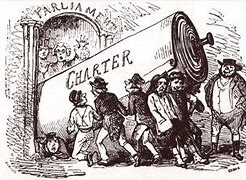
Even so the tactic currently called BDS has a long history stretching back at least to the Chartist movement in the 1830s and 1840s. The Chartists used the tactic of what they termed Exclusive Dealing. That is they would only use shops, traders and pubs that supported the Chartist demand for the vote.
Such boycotts are carried out individually of course but crucially in the context of collective campaigning. They are not often the decisive factor in achieving change but they are important to building the movements that do achieve it.
Collective campaigning against injustice is something disliked by most Tories on most occasions. The Commons on Wednesday 10th January gave a third reading to a Bill that aims to prevent public bodies from boycotting goods and services from countries because of their human rights records.
The Bill has been promoted by Gove for factional and ideological reasons and while it passed, Labour opposed it and eight senior Tories voted against. Objections were not only that it is an infringement of free speech and peaceful political activity but that it includes territories illegally occupied by Israel as part of that country. That contravenes international law, not something obviously that bothers Gove.
Boycotts in particular by local authorities of South African goods played a part in ending apartheid but not even Thatcher thought about banning them.
It underlines that historically the Chartist tactic of exclusive dealing, although it had a number of motivations, was a powerful one.
Update
McDonalds have admitted that boycotts due to its links with Israel have made it miss a key sales target