One of the legacies of the New Labour Governments from 1997-2010 has been public-private finance arrangements where private sector investment is used to fund a range of public projects and services. Most will be aware of the issue with this by now. The private sector is happy to make profit but as soon as there is an issue the risk falls firmly with the public sector side of matters.
Keir Starmer and Rachel Reeves in their bid to make Labour the party of business have been meeting a wide range of bosses.
In particular as the Financial Times(27th April) reports there have been meetings with Private Equity companies such as Blackstone. In essence Private Equity outfits have funds they are looking to invest somewhere with the aim of making a good return.
Labour has said that it sees Private Equity investment as a key way of boosting the economy and in the ‘energy transition’ The same issue still applies as it did after 1997. Private Equity companies operate on a global not a national scale. If things don’t work out well for them in the UK there are other countries.
The FT article concludes with a quote from Michael Moore CEO of the British Private Equity and Venture Capital Association:
While some aspects can be uncomfortable at times, the good news for us is that Labour has gone in 18 months from talking about ‘asset strippers’ to openly engaging with us on how the industry contributes to growth in the economy’
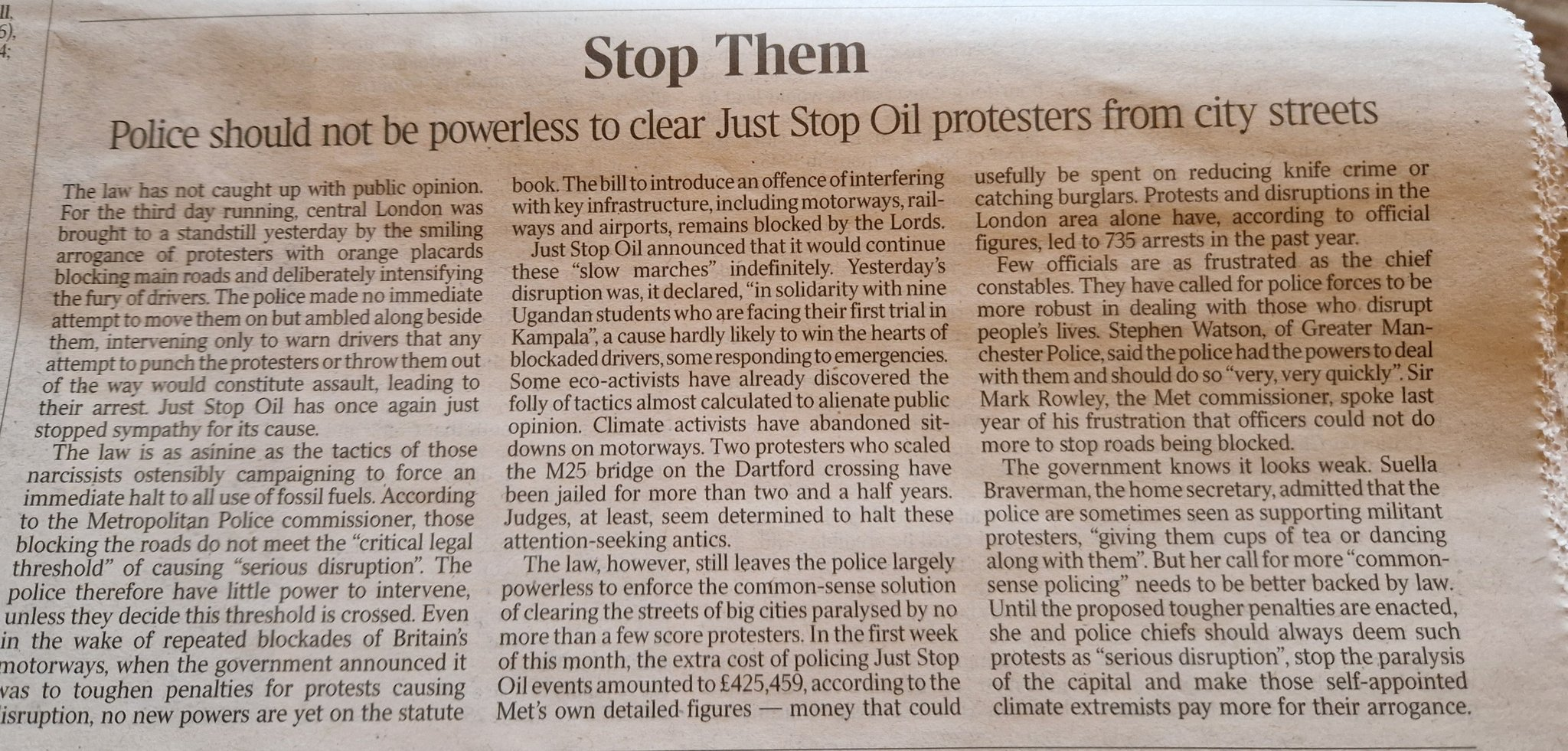
The Times has published yet another Editorial on Just Stop Oil(27th April). This time they are concerned that groups of protesters walking slowly on roads in central London are causing inconvenience. That of course is the point of the protest. After all if protest has no impact its ineffective.
At times when the British ruling class is concerned about protests it tends to think about new laws. It did so for example as long ago as 1848 with the Chartists, when the Treason Felony Act was passed in very short order in the wake of the Chartist protest for the vote on 10th April 1848.
In 2023 The Times has an ally in Suella Braverman who is keen to pass more and more laws banning protests.
However if the Times Editorial writer could stop fuliminating and do some journalism they would find that laws already exist to deal with the Just Stop Oil protests. A glance at the twitter timeline of the Met Police Events team shows that Section 12 of the Public Order has been used when protesters were deemed to be causing serious obstruction and on every occasion they moved off the road and on to the pavement.
That doesnt make the protests any less important by the way but the Times is engaged in culture war politics here
23 years after his death Sunak refuses acknowledge Bernie Grant’s call for a Government apology on slavery
Bernie Grant the late MP for my own Parliamentary Constituency of Tottenham died 23 years ago this month.
Amongst many other things he was a committed campaigner against racism and for Government recognition of what slavery and colonialism meant. Perhaps its no surprise that his call for an apology is still refused but its good to see that there are MPs still prepared to press the matter
Hansard 26th April 2023
Bell Ribeiro-Addy
(Streatham) (Lab)
This month marks 23 years since the passing of the late, great Bernie Grant, a former Member of this House and the founder of the reparations movement in the UK. In the last Prime Minister’s questions before his death, he asked for an apology to the people of African descent, living and dead, for our country’s role in slavery and colonialism, but since then Prime Ministers and Heads of State have only ever expressed sorrow or deep regret—not sentiments befitting one of the greatest atrocities in human history—and there has been no acknowledgment of the wealth amassed or of the fact that our country took out its largest ever loan to pay off the slave owners and not the enslaved. Will the Prime Minister do what Bernie Grant asked all those years ago, and what I and countless others have asked since, by offering a full and meaningful apology for our country’s role in slavery and colonialism and committing to reparatory justice? (Unique identification number 904690)
The Prime Minister
No, what I think our focus should now be on doing, while of course understanding our history in all its parts and not running away from it, is making sure that we have a society that is inclusive and tolerant of people from all backgrounds. That is something that we on the Government Benches are committed to doing and will continue to deliver, but trying to unpick our history is not the right way forward and is not something we will focus our energies on.
The Socialist Gardener: grassroots politics & weed heroes
Special Issue 26th April
The Socialist Gardener the occasional bulletin that promotes gardening from the roots up has backed the decision of the Chelsea Flower Show to support plants previously demeaned as weeds as an essential part of a progressive garden.
Plants like dandelions, brambles and bindweed can be a source of pollen for insects and bees and they are also important to the soil infrastructure of the garden.
Socialist Gardener Editor Keith Flett said, we say, hands off weeds. They have been downtrodden for long. They can now take their rightful part in a fully inclusive garden.
The 2023 Manifesto for a Socialist Garden
We demand that the new Government launches a massive programme of investment in public parks and provision for allotments so that all may enjoy the pleasure of gardens and gardening
We believe in the right to roam over the gardens of the rich
We support the nationalisation of the land and the creation of public parks and gardens as a matter of priority
We believe that real gardeners should eschew the use of garden centres. If you need a new plant, simply liberate it from the garden of a wealthy neighbour.
We support the hop family as the ultimate in grass roots garden plants
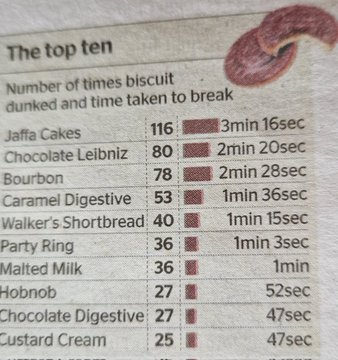
The Beard Liberation Front, the informal network of beard wearers, has declared the Jaffa Cake the most beard friendly biscuit.
The campaigners say that a major problem with biscuits is that they crumble and leave crumbs in the beard.
However research carried out across a range of biscuits, dunked in tea temperature water, found that the Jaffa Cake lasted the longest without flaking, over 2 minutes.
The Beard Liberation Front endeavours to promote beard friendly foods and is pleased to endorse the Jaffa Cake on this basis
BLF Organiser Keith Flett said, tbh the research appears less than robust here and we are of course aware of the 1991 Court case where McVitie’s avoided VAT on the Jaffa Cake as a biscuit by declaring it was a cake. That does not however detract from the fundamental beard friendly point here.
Below is an unpublished letter to the Guardian on the furore caused by a letter from Diane Abbott in Sunday’s Observer.
In the letter she appeared to suggest that there was a hierarchy when it comes to opposing racism. That is wrong. She has accepted her mistake and apologised.
Letters are ephemeral and I dont usually post those (quite a few!) that don’t get published. They are of the moment and when the moment has gone no further comment is needed.
However when it comes to racism and fighting it that is far from the case.
Unfortunately the three letters the Guardian has published are one-dimensional. They include one ‘apologist’. That is someone who does not accept Diane’s apology as genuine and will just keep pressing for more apologies. The benchmark of whether an apology is truly meant is whether or not there is a repitition.
While the issues with Diane’s letter are rightly called out unfortunately no comment is made on a different hierarchy of racism that Keir Starmer sometimes seems to display and indeed did display in his comments on the matter.
All racism is wrong and needs to be actively opposed. There should be no picking or choosing. Diane Abbott’s record on this over many decades is exemplary. That doesnt excuse her letter but neither should it be ignored
________________________________
What is lost in the furore over Diane Abbott’s Observer letter (Marcus Ryder 25.4) is that she was reacting to an article that seemed to downplay the impact of anti-black racism at a time when the anniversary of the murder of Stephen Lawrence by racists was being marked. She was wrong to suggest that there is a hierarchy of those who face racism and has rightly apologised for her comments. Unfortunately the comments of Keir Starmer the leader of a Labour Party whose own lack of focus on Islamophobia suggests a different hierarchy at work are no better. All racism must be opposed equally as Diane Abbott has shown many times in practical campaigining activity. Would that her critics were so minded.
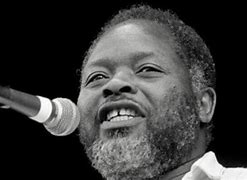
Its over 20 years since Alex Glasgow, probably most commonly associated with When The Boat Comes In, died but a song he wrote for the Alan Plater play Close the Coalhouse Door seems relevant today.
Perhaps the key point of the song is that while socialist politics is often discussed in pubs- and historically in coffee houses- the actual organising of socialist activity is best done before a visit. As the SpyCops inquiry has underlined the political police also frequented pubs where socialists drank keen to discover and sometimes influence what had been organised
Even so Alex Glasgow’s message (last line aside) still seems relevant
As Soon As This Pub Closes
I could have done it yesterday if I hadn’t a cold,
But since I’ve put this pint away I’ve never felt so bold.
So as soon as this pub closes, as soon as this pub closes,
As soon as this pub closes, the revolution starts
I’ll shoot the aristocracy and confiscate their brass,
Create a fine democracy that’s truly working class.
As soon as this pub closes, as soon as this pub closes,
As soon as this pub closes, I’ll raise the banner high
I’ll fight the nasty racialists and scrap the colour bar,
And all fascist dictatorships and every commissar.
As soon as this pub closes, as soon as this pub closes,
As soon as this pub closes, I’ll man the barricades
So raise your glasses, everyone, for everything is planned,
And each and every mother’s son will see the Promised Land.
As soon as this pub closes, as soon as this pub closes,
As soon as this pub closes … I think I’m going to be sick
Extinction Rebellion’s The Big One, the Medium, the Message & Media Coverage
XR’s 4 day Big One protest in Westminster has concluded. As XR posted the Government ignored their demands, hence further strategies to press the case for action on climate change are needed.
I’m not party to discussions, while supporting the protests. However I’ve been on and organised enough protests over more than five decades to know that there are parameters. Social movement theory covers much and Charles Tilly’s Repertoires of Contention looks at tactics and strategies albeit in a hierarchical and static way.
A key issue XR had with the Big One was a lack of media coverage. 60,000 or so (XR’s estimate) were at a Saturday protest in Westminster and perhaps 90,000 involved over the 4 days.
It’s an impressive number but not huge. In recent decades the anti-Iraq War demonstration in 2003 gathered over a million and several protests against Brexit attracted hundreds of thousands. These events attracted media attention, not just because of their size but also they related directly to political events that were happening at the time.
The Big One did attract some media attention. The Guardian ran several articles, the Morning Star had front page coverage, the BBC did post a report, albeit not prominently. Meanwhile the Mail went on about eco-zealots, while the Financial Times published an opinion piece arguing that protest on climate change was a good thing.
Mass coverage it was not, although there was of course a lot on social media. That however will have been seen mainly by those already aware and sympathetic.
As the social movement academic and activist Laurence Cox posted if you are relying on media coverage to put pressure on Government on climate change perhaps think again.
The issue of course is that peaceful protest, with the exceptions noted above, is not newsworthy. If there is no obvious threat to authority, then authority ignores matters.
The question perhaps is the nature of the threat. A major trade union, PCS, did support the Big One. However an industrial strategy, which XR has posted on, is absent. A strike on climate change issues could make a big impact but would be difficult, as any strike, to organise. French pension protests have for example blocked oil refineries, not specifically on climate change, but the very action provides space for the point to be raised and argued.
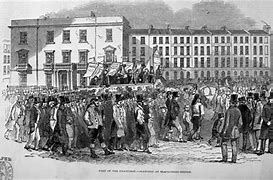
10th April 1848. Where did the Chartist protest for the vote go wrong?
178 years ago on 10th April 1848 the Chartists held a rally to demand the vote for working men on Kennington Common. It was the first demonstration in the world to be photographed and the original picture is held in the King’s Collection at Windsor.
This gives an indication of how seriously the ruling class took the threat of a revolutionary outbreak, with much of the rest of Europe in turmoil. The Queen departed for the Isle of Wight and troops and special constables were mobilised to protect key buildings and deal with any Chartist challenge to power.
The efforts of the State on 10th April 1848 are relatively well documented. The Chartist tactics for the demonstration has received less attention
The numbers on the day are disputed but certainly over 100,000 gathered on the Common. In the days before the telephone, let alone mobiles, organising such a protest had to be done in ways which are still in part familiar. London was placarded with details of the demonstration. Chartist branches around the Capital organised for the protest and passed details of it by word of mouth.
Unlike today it was a purely London demonstration. The idea of a London protest being a national focus was some time off. Train travel was in its relative infancy and the time and cost were out of the reach of workers.
The day chosen for the protest, a Monday, is also unusual to modern eyes. Strike action was not involved. Rather the practice of Saint Monday extending a day off on Sunday to the next day as well remained commonplace, certainly amongst the small scale trades that were a feature of the London working class in 1848.
The historic photograph of the demonstration is thought to have been taken before the numbers attending peaked but it reveals a number of speaking platforms across the Common. In the days before loudspeakers this was the only way that at least a portion of the crowd could hear.
Chartist leader Feargus O’Connor reached an agreement with the police that while the rally on Kennington Common could go ahead no mass demonstration to Parliament would be allowed. The Chartist left organised by the black leader of London Chartism William Cuffay were determined to march.
There were clashes with police and soldiers on the south side of Blackfriars bridge. As delegates at the Chartist meeting the following day noted as soon as marchers from various points north of the Thames had crossed bridges, the authorities moved in to bar the reverse journey.
In the event, something that is still very familiar to those who attend demonstrations today intervened. It rained and marchers dispersed.
The point about meeting south of the Thames was however raised.
A leader of left Chartism, George Julian Harney who worked with Marx and Engels, made his position on this clear at a Chartist delegate meeting on 11th April.:
‘He would never again consent to leave London to hold a meeting’ reported the Chartist Northern Star paper on 15th April 1848.
Harney was clearly not a fan of South London, although Kennington Common was a traditional radical meeting place when few were available. The Royal Parks for example were occupied by police and soldiers.
There is a question however of why the Chartists did not meet north of the river. Copenhagen fields in North London, scene of a mass rally to defend the Tolpuddle Martyrs was still available in 1834. The march to Parliament would have been a bit longer but no bridges were involved.