On from 15th February 2003: Remembering or Forgetting the history of opposition to war
Boris Johnson, echoed by backbench Tory MPs and commentators in the right-wing media, has consistently argued that when it comes to British history the entire story must be told with nothing left out. It is claimed the left engage only with partial history, which is another way of saying that while the entire Island Story should be told, there is no need to go on about racism and imperialism which in the eyes of Johnson and Co weren’t all bad.
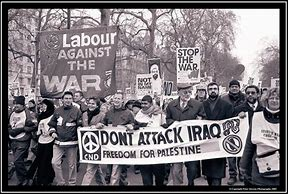
The 20th anniversary of the biggest ever protest march in British history fell on 15th February. On that cold Saturday 20 years ago well over a million marched in central London against war with Iraq.
In an important sense that day is not yet history. Firstly because those responsible for that illegal war and the death and destruction that followed have still not been called to account for it. Secondly because with conflict in Ukraine and sabre rattling on China it’s clear that the West and NATO remain firmly fixed on the same interventionist agenda.
It’s not history in another sense as well because many of those who were active in opposing or promoting the Iraq War are still around and able to add further discussion on it. However the practice of the National Archives is now to release at least some Government papers after 20 rather than the 30 years which was previously the case, meaning at least provisional history is being written sooner.
Hence the best way to look at it is that the history of 15th February 2003 is still being written. However if it is not remembered it won’t make more than a footnote in future British history.
Two daily papers managed to recall the 15th February. The Morning Star published an excellent supplement. The Guardian ran a piece picking up on the views of some of those who had marched. It also carried a comment piece by Lindsey German. No doubt the Guardian was mindful that many of its readers had marched in 2003 and would remember.
Lindsey German’s article in the Morning Star noted the complexities of putting together the Stop the War Coalition in the first place and the impact of the 15th February in cementing it. She rightly concluded that there are many warmongers out there who want that demonstration to be forgotten and the coalition of forces that brought it together destroyed. The Stop the War march on 25th February is one way of pushing back on that and making sure that anti-war history continues to be written.
The tenacity of warmongers in trying to undermine opponents of imperialist wars must not be ignored. They are trying to write their own version of history. Times columnist David Aaronovitch praised the united approach in Parliament not just, rightly to opposing Russian aggression in Ukraine, but also in support of NATO and a renewed arms race.
Aaronovitch saw backing for Western intervention in Ukraine as a welcome return to such efforts, after the strength of Iraq War protests had partly stopped Britain from involvement foreign military adventures
It was no accident either that Keir Starmer’s speech where he issued a diktat that Jeremy Corbyn would not be a Labour candidate at Islington North at the next Election was made on 15th February. Twenty years on from a march that Starmer himself was almost certainly on-he declared the Iraq War illegal in a Guardian article on 16th March 2003.
Starmer no doubt is trying hard to forget that he ever opposed the war. All the more reason to make sure the biggest protest in British history is remembered.