The 1976 Drought Act the wicket at Lords and drinking less beer.
The last time there was a drought serious enough to require immediate Government action was in 1976. The Drought Act was debated in the Lords and Commons and became law on 6th August 1976. At the end of the month Sports Minister Denis Howell assumed Ministerial policy.
The Commons debate which is on-line at Hansard contains little of great interest. MPs were agreed the Act was needed if perhaps late. A few far seeing MPs wondered if the climate might be changing but didn’t go further.
Concerns were raised that with a hosepipe and non-essential watering ban in place the pitch at Lords and Wembley might be impacted (they were excluded).It was also established that watering of golf fairways was not allowed but greens were ok.
Liberal MP Clement Freud (posthumously revealed as an abuser) noted that if people drank two pints of beer less a day it would save 23 gallons a person (11.5 gallons a pint) and six gallons saved in flushing the toilet twice.
In 2022 matters are much more serious. Expect however to see the same exhortations from Tory Ministers and the usual journalists to use less water by washing up less and indeed washing less. They will of course be doing nothing about either water companies or climate change
The Chartist London armed rising of August 1848. The coffee house or the pothouse conspiracy?
A research note
In August 1848 following the arrest of Chartist leader Ernest Jones and the passage of repressive legislation covering Ireland in Parliament plans were made for a general rising involving Manchester, Liverpool and London.
The Irish dimension, too often overlooked, was important here, as was the informal link to Chartism.
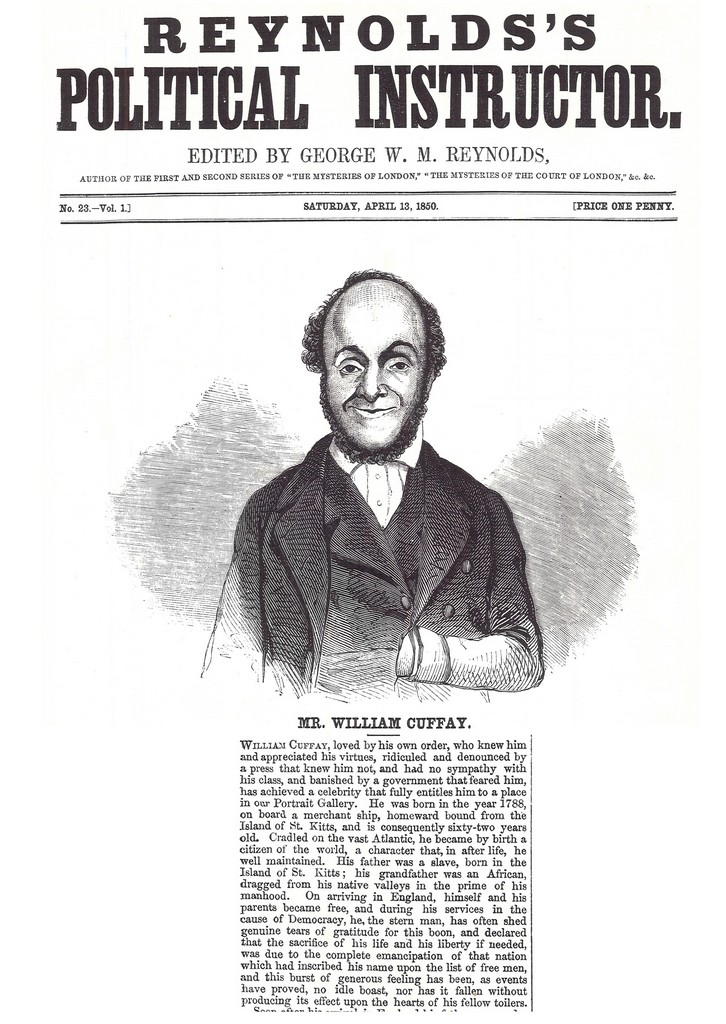
One of those arrested after the rising failed was the black leader of London Chartism in 1848 William Cuffay. His precise role in events remains open to interpretation.
The rising was only actually attempted in London and there is some detail about it. David Goodway’s London Chartism covers it briefly. He argues that it was probably the most well supported (but also the last) of attempts at insurrection in the Capital dating back to the 1790s and running through events like Cato St (1820). It was tradition of revolutionary conspiracy, rather than open organising.
A supposedly secret committee met to plan events on most days in the first half of August 1848. Meetings were actually mostly in coffee houses but some were in beer shops. The beer shop had come into being after the 1830 Licensing Act and might perhaps be likened to the modern micro-pub.
It’s true however that when the police and military moved to arrest the leaders of the conspiracy they were to be found in two pubs, one off Red Lion Square and the other off Blackfriars Rd. Neither is still there.
Goodway estimates that up to 5,000 Chartists and others gathered at Seven Dials in the West End and in Southwark. However with the leaders arrested the rising melted away into the mid-August night.
A good deal about what was intended during the August days in London in 1848 remains unclear. What is known is that the conspiratorial means of organising allowed significant infiltration by police and State agents. However as the current SpyCops Inquiry has underlined avoiding spies and undercover officers remains problematic even where much more open forms of organising are used.
We earnestly recommend all persons in the great towns of the kingdom, who in any way may have become informed of the haunts or proceedings of these pothouse conspirators to give timely warning to the police…
The Times 18th August 1848
Meeting Places for the August 1848 Rising in London
Seven Dials,(Covent Garden)
Strutton Ground (Victoria St)
Clerkenwell Green
Tower Hamlets(Bishop Bonners Fields, now part of Victoria Park)
Pubs where the leadership met
Orange Tree beer-shop, Orange St off Red Lion Sq. Licensee Robert Hodges
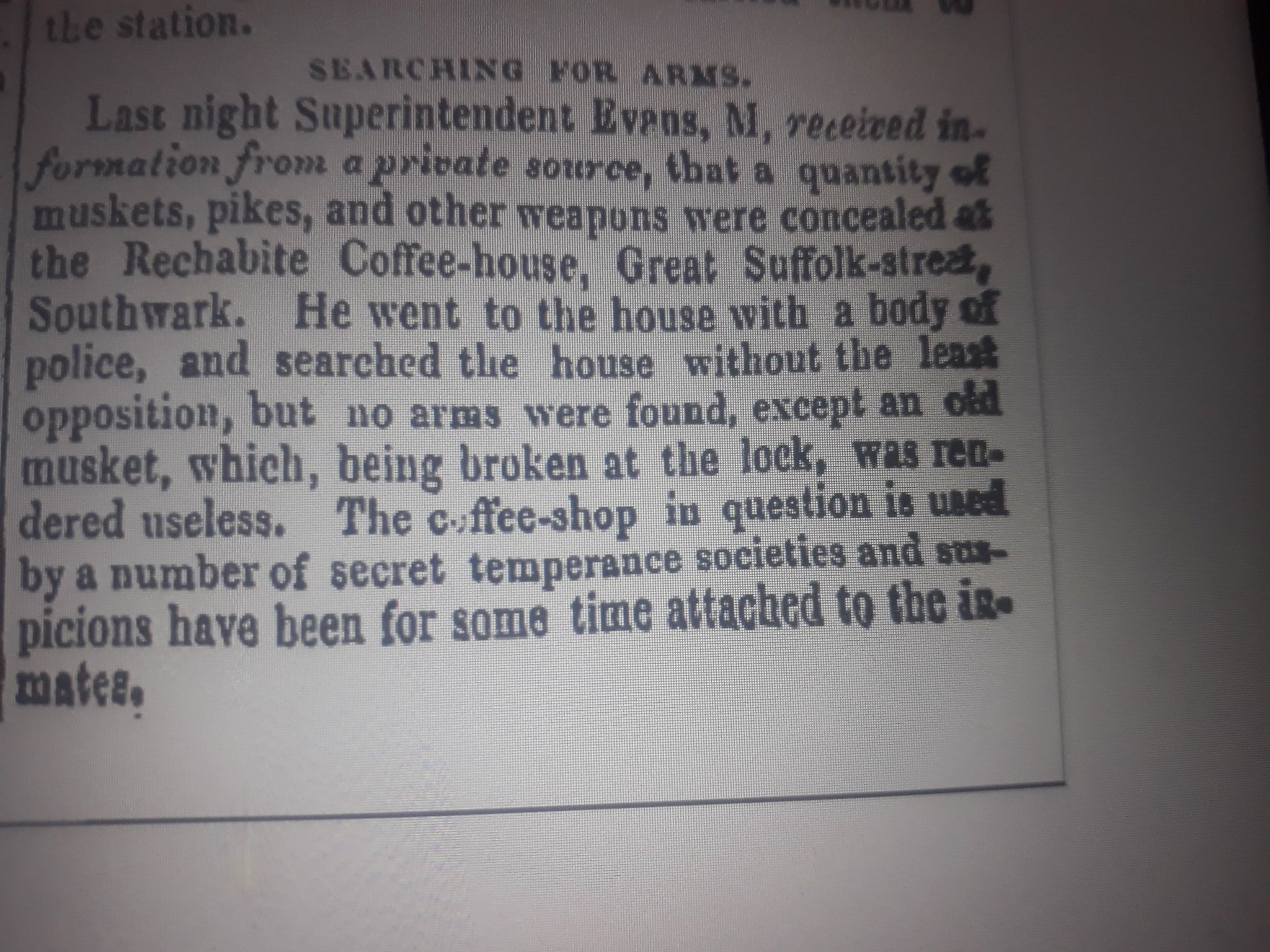
Lord Denman, Great Suffolk St, (the Ulterior Committee (organising team) met here on 15th August 1848. Government spies were also present. I can find no record of the pub (rather unusually) but the Northern Star (19th August 1848)reported the police had searched the Rechabite coffee house in Great Suffolk St for arms.
David Goodway in his book on London Chartism in 1848 lists the locations of Chartist organising meetings in central London in summer 1848. Many are not pubs but coffee houses. They were less regulated than pubs but there was also a strong temperance faction in Chartism even though the Chartist leader Ernest Jones argued that the ‘charter won’t be found at the bottom of a glass of water’. It does however beg the question of whether the armed rising of August 1848 was really a coffee shop conspiracy?
Between 20 July and 16 August, the conspirators held 16 meetings in one form or another, mainly in coffee houses (though occasionally in pubs).Past Tense blog
Dates and locations of the delegate meetings of the 1848 conspiracies, with those in attendance as known (taken from London Chartism 1838-48, by David Goodway)
Tuesday 6 June. Windsor Castle, Holborn
H Mander May (?), Plume (?).
Monday afternoon, 12 June. Albion, Bethnal Green Road.
25 present. M’Douall (chair), Henshaw, Honeybold, Percy, Pitt, George Davis.
Tuesday 13 June. Windsor Castle, Holborn
James Bassett (chair), Henshaw, Honeybold, William Lacey, Percy, Pitt, George Shell, George Davis.
Wednesday morning, 14 June. Literary Institute, John Street
14 present. M’Douall (chair), James Bassett (vice-chair), Child, William Lacey, George Bridge Mullins, Pitt, George Shell, George Davis.
Wednesday evening, 14 June. Lord Denman, Great Suffolk Street, Blackfriars Road
8 present. James Blight, George Davis.
Monday 10 July. George, Old Bailey.
13 or 20 present. Brewster, Lacey, Mullins, Payne, John Rose, Smith, George Davis.
Thursday 13 July. Lord Denman, Great Suffolk Street.
Brewerton, Morgan.
Thursday 20 July. Black Jack, Portsmouth Street, Lincoln’s Inn Fields.
14 present. William Allnutt, Bassett, Battice, Brewster, William Dowling, Mullins, Payne, John Rose, Davis, Thomas Powell (alias Johnson) (1st time).
Sunday morning, 23 July. Denny’s Coffee House, Great St Andrew’s Street, Seven Dials
Biden marked slavery remembrance day; Johnson ignored it
Slavery Remembrance Day is 20th August in the US and President Biden marked it with a statement about how important it is for a nation to acknowledge its own history.
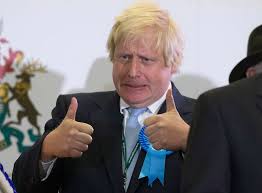
The day falls on 23rd August in the UK and despite Boris Johnson’s obsession with making sure all of British history is told, he said nothing. Nor for that matter did Keir Starmer.
It underlines, beyond fake culture wars, just how much work there is to do on the history of slavery, opposition to it and understanding of what it meant and who benefited. Olivette Otele a Professor at SOAS has a good piece in the Guardian on the matter. Work very much in progress
The Chartist London ‘pothouse conspiracy’ of August 1848.
A research note
In August 1848 following the arrest of Chartist leader Ernest Jones and the passage of repressive legislation covering Ireland in Parliament plans were made for a general rising involving Manchester, Liverpool and London.
The Irish dimension, too often overlooked, was important here, as was the informal link to Chartism.
One of those arrested after the rising failed was the black leader of London Chartism in 1848 William Cuffay. His precise role in events remains open to interpretation.
The rising was only actually attempted in London and there is some detail about it. David Goodway’s London Chartism covers it briefly. He argues that it was probably the most well supported (but also the last) of attempts at insurrection in the Capital dating back to the 1790s and running through events like Cato St (1820). It was tradition of revolutionary conspiracy, rather than open organising.
A supposedly secret committee met to plan events on most days in the first half of August 1848. Meetings were actually mostly in coffee houses but some were in beer shops. The beer shop had come into being after the 1830 Licensing Act and might perhaps be likened to the modern micro-pub.
It’s true however that when the police and military moved to arrest the leaders of the conspiracy they were to be found in two pubs, one off Red Lion Square and the other off Blackfriars Rd. Neither is still there.
Goodway estimates that up to 5,000 Chartists and others gathered at Seven Dials in the West End and in Southwark. However with the leaders arrested the rising melted away into the mid-August night.
A good deal about what was intended during the August days in London in 1848 remains unclear. What is known is that the conspiratorial means of organising allowed significant infiltration by police and State agents. However as the current SpyCops Inquiry has underlined avoiding spies and undercover officers remains problematic even where much more open forms of organising are used.
We earnestly recommend all persons in the great towns of the kingdom, who in any way may have become informed of the haunts or proceedings of these pothouse conspirators to give timely warning to the police…
The Times 18th August 1848
Meeting Places for the August 1848 Rising in London
Seven Dials,(Covent Garden)
Strutton Ground (Victoria St)
Clerkenwell Green
Tower Hamlets(Bishop Bonners Fields, now part of Victoria Park)
Pubs where the leadership met
Orange Tree beer-shop, Orange St off Red Lion Sq. Licensee Robert Hodges
Their schools & ours. The Cambridge’s move to Windsor & send kids to Lambrook School
The Duke and Duchess of Cambridge are to move to a house on the Windsor estate although they will of course also keep their two other residences as well.
Their children George, nine years, Charlotte, seven years and Louis, four years will be despatched to a co-educational school, Lambrook, near Ascot.
Not for the Royals the local comprehensive. Current fees per term at Lambrook are as follows:
Louis £4,389
Charlotte £6,448
George £6,999
What cost of living crisis?
Update: Lambrook School
The Times(23rd August)has published more detail on the school. It appears the Duke had paid an earlier visit to check with pupils how they found the Latin teaching. The school has a strong sporting presence with a cricket pavillion and a croquet lawn. The school has grounds of 52 acres and has as its strapline ‘with privilege comes responsibility. It has a 100% success rate in the Common Entrance exam that allows pupils to apply for public schools like Eton and Marlborough.
Morbid symptoms- the last days of the Johnson regime & Old Corruption
The Italian Marxist Antonio Gramsci wrote of the morbid symptoms that arise when an old political order is dying but a new one can’t be born. The parallel is not exact but there is a relation to the final days of Johnson as PM.
Johnson is reported to be looking to write a column for the Daily Mail in return for which its long time editor Paul Dacre will receive a Peerage. The Mail is currently full of drivel about unfairly Johnson is being treated.
Meanwhile on the right-wing talk radio station LBC Johnson’s sister Rachel has been speaking to Johnson’s father Stanley (who is in Greece) about how hard done by his son and her brother is.
There is a term for all this: Old Corruption. It describes the pre-democratic politics of England before the 1832 Reform Act where positions and titles were often handed out not on the basis of merit or work done but as personal favours. It is not a new development in British politics but with Johnson it has reached new levels of depravity
What would you call a country that gives the sister of a prime minister a regular slot in which she interviews the PM’s father about his Govt, having previously used the slot to argue the PM should not be removed & why her other brother deserved a peerage?
A few weeks ago the Ambridge Socialist was asked if there had ever been an anarchist in the Archers. Socialists and radicals there have been but not it seems anarchists.
Some progress was made at the village fete on Sunday when visiting celeb Toyah Wilcox quoted William Morris to forelock tugger Will Grundy:
“Have nothing in your house that you do not know to be useful, or believe to be beautiful.”
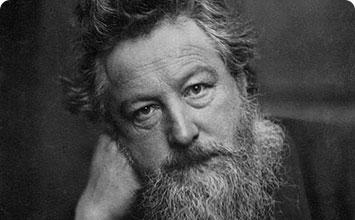
Grundy of course had never heard of the man he called William Morriston. Morris (1834-1896) may variously be described as a socialist, an extra or anti-Parliamentary socialist and an anarchist. In his utopian novel News from Nowhere he describes Parliament as having been replaced by a dungheap, an idea that would surely have an appeal in Ambridge
Central London August 1848- the last armed rising on English soil 1848 was a year of revolutions across Europe, except in Britain.
Here the Chartist demonstration for the vote on Monday 10th April 1848 did not lead, as the authorities feared, to an attempt to take power. The gathering on Kennington Common was the biggest demonstration in British history to that date, but rain intervened as well as a very serious mobilisation of police, army and special constables on the side of the authorities.
Yet that was not the end of the British 1848, even if Victorian chroniclers spent some effort in trying to suggest that it was.
Ireland faced a revolutionary threat and that found its echo on the mainland, particularly after 10th April when Irish nationalists [confederates] joined with the Chartists in many areas.
The Chartist protest of 10th April was repeated on 12th June with meetings this time around the UK.
The Liberal Home Secretary Russell banned these meetings and again mobilised the police and troops to stop them.
The Chartists gathered at Bishop Bonners Fields [now part of Victoria Park in the East End] in large numbers but did not attempt to have a meeting.
It was this sequence of events that led first the national Chartist leadership, and then as they were arrested, the London leadership to start planning an insurrection.
Planning or plotting meetings took place in pubs and coffee houses from June to August 1848. We know this because the meetings were infiltrated by several police spies.
The frustrations of the Chartists can be understood. They had seen revolutions sweep away autocratic regimes across Europe and in Britain they had faced bans and arrests if they protested peacefully.
In addition as the historian of London Chartism David Goodway points out, London had a conspiratorial political tradition to which some of those involved in 1848 were heirs.
William Cuffay the black leader of London Chartism became the effective leader of the attempt at revolution in the days up to the 16th August, although whether his aim was to control it or lead it has never been clear.
Even so there was a clear plan and this was to barricade an area of central London and take effective control of the Capital. There was also less clear plans to put effect to this by firing gas mains thereby causing fires and explosions.
The plan for a revolutionary rising was clear enough then. Victorian historians argued that very few supported it at the time and like 10th April 1848 it was a damp squib. As Goodway again points out this was not the case. He estimates that around 5000 Chartists and confederates were mobilised in London on 16th August. That number would certainly have been a good match for the authorities’ forces.
In reality neither side seemed prepared to actually do the deed. While the authorities had intelligence of what was planned the police who were mobilised at Seven Dials on 16th August neither went into action or, on the day itself, made arrests.
The Chartists who gathered at Seven Dials on the evening of 16th August around 9pm did not attempt to occupy it either. On word that the police knew of the plan they dispersed.
Arrests, including that of Cuffay and some others did take place in the days that followed.
Aside from being something that has been hidden from history and is worth recalling the events at Seven Dials 176 years ago this month have another resonance.
While the area is very different in some ways to how it was then- a very poor area with a pub on each of its seven corners- the actual physical layout of the space remains very much as it was. One of the pubs that was there in August 1848, the Crown, remains in place with essentially the same structure that it had then.
Paris has launched an App directing locals and visitors alike to locations related to the 1789 revolution. An equivalent London App must surely feature Seven Dials
This coming Bank Holiday weekend why not re-live a moment of London’s revolutionary past and stop off for a pint at the Crown as some of the Chartist insurrectionaries of that summer certainly did themselves.
Marx wrote to Engels on 14th August 1879 about a trip to Jersey. He travelled from Waterloo station to Southampton by train and then by boat to Jersey. The crossing wasnt ideal and neither was the food. His disdain for French holidaymakers no doubt reflected his experiences with the Paris Commune and the brutality of the French State in 1871
Our crossing from Southampton to Jersey was made altogether too watery by a tremendous downpour of rain; we arrived dripping wet at St Hélier where it was also ‘pouring’ hard. Since then the weather, after occasional vacillations and transitions and set-backs, has been very good. The farmers in Jersey thought the end of t h e world was at hand; they maintain that they’ve never had such a bad spring and summer. Tomorrow we a re moving to the Hôtel de l’Europe, St Hélier. We a re leaving our present lodgings in St Aubin’s because Tussy and I cannot stand the monotonous daily fare of lamb or MUTTON in consequence of which I have, during the past few days, become an involuntary VEGETARIAN. We could find nowhere else to stay—we spent a great deal of time hunting round—in these parts. When we arrived in Jersey, it was still comparatively empty, but as time went on there was immigration on a massive scale, notably of FRENCHIES. When we made inquiries at the Hôtel de l’Europe this morning, it so happened, fortunately for us, that 60 French people were just getting ready to leave
The Ambridge Socialist: Eddie Grundy’s advice to the rural oppressed- ‘keep yer bikes out of sight’
21st August
The World Goes on Much the Same
The cost of living crisis has yet to make a significant impact in Ambridge so it being mid-August the world is going on much the same:
Vaping
George & Brad have been experimenting with vaping flavours. Its one of those Archers story lines like the recent day at the motor racing. Anyway it did not end well with George heading to hospital. It did however provoke Eddie Grundy’s timeless piece of proletarian advice on bikes
Joy, Mick & Toyah
Joy may have found a new special friend Mick. Meanwhile it appears Toyah may appear at Sunday’s Fete
Toby is leaving home
Toby if off to Stratford (Upon Avon not the London Stadium) to help with his father’s whine business. Pip is not sure. Should he stay or should he go
Stella and water
Stella doesn’t like getting covered in water but a trip to the pool has convinced her that she can stand in for the Vicar and have things thrown at her at the fete
Tracy meets an HR manager at the chicken factory
The Ambridge Socialist despairs of the anti-union bias of BBCTheArchers. It was reported that Tracy’s supervisor Gemma had accused her of bullying. Any competent HR manager would have filed that complaint in the bin. Either Gemma is not competent to do her supervisory job or she wants Tracy sacked in which case performance is the appropriate process. Tracy attended a meeting with the HR manager without a union rep or friend. Why??? Fortunately in this unlikely BBC scenario it was determined to move Gemma and Tracy to different shifts so they no longer worked together. Presumably the chicken factory has a labour shortage