On Tuesday 16th February 2016 Michael Gove and his then wife Sarah Vine had (according to Tom Bowers biography of Johnson) joined him for a slow roast lamb dinner at his house in Islington. As the first of two BBC programmes on Brexit revealed the lamb was cooked by Johnson’s then wife Marina Wheeler KC. She confirms the account below BUT does not mention the presence of Lebedev. Both programmes are available on the IPlayer.
Present was the owner of the Independent and Evening Standard the future Lord Lebedev. According to Bower there was a Government lawyer on a speakerphone and those present were discussing what attitude to take on the forthcoming Brexit Referendum. Bower suggests that Johnson’s decision to back leave was based not on principle but on perceived personal political advantage.
Oliver Letwin had telephoned Johnson during the meal at the behest of Dave Cameron to check on Johnson’s likely view. There is also a story, elsewhere, that Johnson had prepared two articles on the referendum one backing remain and one backing leave which tends to corroborate it. This is confirmed by Johnson in the BBC programme.
What was Lebedev doing there? Bower does not comment and it may simply have been that as a newspaper owner it was hoped he could be a useful conduit for promoting the view of Johnson and Gove. In addition Lebedev had been a friend of Johnson since his days as London Mayor from 2008.
Was he also sending a message from Putin or promising funds? I’m not a conspiracy theorist so can merely comment that on this there is no evidence.
Clean Shaven Andrew Strauss wants a return of the Gillette Cup to English cricket
The man temporarily in charge of English and Welsh cricket has been floating plans to reform and revitalise cricket. According to a report in the Telegraph (15th March) one idea is to bring back the one-day knock out cup. This ran from 1963 until 2006 with the original sponsors to 1980 being Gillette.
It included all first class counties and minor counties and was seen as a cricketing version of the FA Cup, although giant killers were limited, perhaps notably Durham, now a first class county.
The Beard Liberation Front says that in 1963 Gillette sponsorship fitted the clean shaven image of cricket with perhaps just the odd aristocratic moustache wearer. Facial hair was generally frowned upon although by 1980 when Gillette bowed out, it had become relatively common.
BLF Organiser Keith Flett said, Andrew Strauss is permanently clean shaven and in suggesting a return to the cricket one-day cup he is sending a subliminal message that England cricket did better in the clean shaven days of the 1960s. By contrast we think beard power is essential to the modern men’s game.
This post was written after the original BBC Scotland programme on Brewdog and appears on the Culture Matters site. Its basic point that beer and craft beer need a change of culture still holds
In late January BBC Scotland broadcast a programme on Brewdog (available on IPlayer). The programme had three elements. It looked at Brewdog’s marketing and PR efforts, some of which have worked very well, others rather less so. It also looked at Brewdog’s business model. There wasn’t much that was specifically new here. The point was that the details will have reached a far wider audience than the ‘beer bubble’ that already knows about them. In particular since Brewdog plans to float itself as a public company there is the question of how much Equity for Punks shareholders might make from this.
The third and most important part of the programme focused on a number of testimonies from former (and one current) Brewdog worker about the toxic workplace culture at the brewer and bar chain. They echoed but much more directly the points made by Punks With Purpose last year. PWP is a group of people who have worked for Brewdog who decided to put in the public domain their experiences of the toxic workplace culture in the hope of forcing change.
At the time Watt initially reacted to Punks With Purpose by saying these were malcontents who were sacked for misconduct or theft and had a grievance against the company. That didn’t go down too well so he changed tack and announced a major exercise to review the culture of Brewdog and suggest changes, carried out by a third party. That reported recently and Watt apologised and promised to address issues.
On the BBC Scotland programme the same pattern repeated itself. At first James Watt denied all the issues raised and claimed again they were made by ill-intentioned malcontents. Legal action was threatened. It got a good deal of media coverage but little of it was good.
So again Watt has changed tack. He now agreed some of the staffing issues mentioned in the BBC programme might have had substance, apologised and promised to address issues.
After the BBC’s disclosure programme however the stories and allegations about a toxic workplace culture at the Scottish brewer have continued.
Janine Molineux who worked for Brewdog briefly as an accountant in 2017 and 2018 was according to Brewdog sacked for performance reasons. However she has said that James Watt bullied her in a sales meeting and the sacking came a day after she told Watt her father had cancer. She also says that she was warned never to catch the eye of Watt.
Separately Watt himself has commented further on a point in the BBC programme that he stared at employees. He claims that he was not staring but deep in thought.
Punks with Purpose have now linked with a third party to launch a portal where Brewdog workers from across its global locations can anonymously share issues.
While there has been a fair bit of media coverage, on the Equity for Punks forum- the site for the numerous Brewdog shareholders- reaction has ranged from critical to abusive. Many argue that Brewdog make good beer (a matter of opinion, but in my view the imperial stouts are often excellent) and therefore ‘so what’ about the workplace culture?
The reality is however that for many Brewdog represents craft beer in the UK. It’s certainly the biggest craft brewer, employing several hundred people. It continues however to be non-unionised despite the reality that Unite has decent membership amongst its workers.
If craft beer is meant to be modern and progressive, Brewdog are failing the test. Further as the beer writer Matthew Curtis has argued Brewdog are very far from alone in the sector in having a poor workplace culture. The silence from other brewers either about the Brewdog issues or in solidarity with Punks With Purpose has been notable.
Beyond pressing for union organisation, which is certainly key, what is to be done?
The Campaign for Real Ale CAMRA has issued a survey on Inclusivity, Diversity and Equality in Beer. It seeks to discover the views and experiences of people involved with CAMRA activities in any capacity about those issues. It won’t change the world and no one is forced to pay any attention let alone answer it, but it’s a step towards much needed change.
It has found a lot of support but it has also sparked off a wider craft beer culture war beyond Brewdog. The Daily Mail published a piece on it which was rather obsessed with beer and beards. In short it was stereotyping the beer drinker as someone with a beard and a beergut and implicitly questioning why others needed to be involved.
The beer writer Pete Brown deconstructed the beneath the line comments in the Mail piece on his blog. They are usual Mail fair (not that the Guardian is so different). I don’t comment in such forums. What I have to say always appears under my own name and is open to challenge. I suspect however there is a certain layer of commenters who pop up all over the place. Anyway the comments were of course complaining that the survey was ‘woke’ a precursor to revolution etc. It isn’t. It’s a survey. If you didn’t like it, you could ignore it.
Another beer writer Melissa Cole also wrote a piece in the Telegraph looking at the history of women in beer, and their current and future roles. A challenging piece for some Telegraph readers no doubt and the below the line mob were off again. Women don’t drink beer and as for the CAMRA survey…
It’s something of a craft beer culture war but its best to remember that like those that come from No.10 these things are made up to distract. Inclusivity, Diversity and Equality in beer are important and if more progress is not made in each area beer and pubs won’t have a great future.
It’s also best to remember that stereotypes are just that. I joined CAMRA in 1975, I have a beard and I’m a Marxist. I could recount a few discussions with senior CAMRA people I’ve had about that down the years, but perhaps best for the memoirs. Suffice to say however that CAMRA is not a revolutionary party. It is though trying to do the right thing in beer when far too many are not.
When one looks at the reactions on Brewdog’s Equity for Punk site or to the CAMRA survey it’s clear that there is a way to go to meet the idea that beer is for everyone. As with Boris Johnson and statues, culture wars are a distraction from other issues in beer, such as the continued rise of global Big Beer with brewery takeovers and mergers. That doesn’t mean though that beer culture wars can be ignored by the left. They have to be engaged with and our side needs to win for inclusivity, diversity and equality.
Tory MP has Commons evidence free rant about political impartiality & history teaching
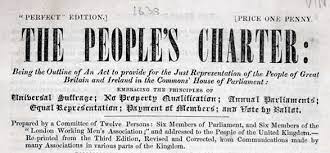
Michael Rosen wrote in the Guardian on 5th March about the range of existing legislation there is on political impartiality in schools, mentioning a question he himself was set as school homework, a few years ago, on the failure of Chartism. His later father Harold Rosen had questioned whether it had failed.
It’s a tricky area requiring careful thought which professional teachers do routinely. Below however is a rant a Tory MP had on the matter in the Commons today. The thing about Mr Gullis’s rant is that it is 100% assertion and completely free of evidence. A Tory Dave Spart
Political Impartiality in Schools
Debated on Monday 14 March 2022
Jonathan Gullis
(Stoke-on-Trent North) (Con)
21. What steps his Department is taking to help ensure political impartiality in schools. (Unique identification number 906056)
The Minister for School Standards
(Mr Robin Walker)
The Government are committed to ensuring that children and young people receive a balanced education. The Department has recently published new political impartiality in schools guidance, which will help support teachers in tackling sensitive issues in the classroom in a politically impartial way.
Jonathan Gullis
A minority of woke-warrior teachers think it is acceptable to push extremist nonsense on to pupils, such as white privilege, and try to cancel important historical figures, such as Sir Winston Churchill. However, these teachers are also aided and abetted by some trade unions, such as the Not Education Union. The failed and disgraced NEU demanded that the welfare state was reformed before approving of pupils going back to school with its ridiculous 100-point plan, and its president blames NATO instead of Vladimir Putin for the illegal and immoral invasion of Ukraine. Will my hon. Friend outline how we will hold politically motivated trade unions to account and prevent them from using teachers as a gateway to push their far-left agenda?
Mr Walker
I have to say that my hon. Friend always speaks out bravely from his own personal experience as a teacher, and I see that he has done so in his Telegraph article today. Pupils must form their own political views, and schools should not indoctrinate or encourage children to pin their colours to any particular political mast. The new guidance will help schools to make good decisions about working with external agencies and ensure that any engagement does not breach their legal duties.
Tony Benn 3 April 1925-March 14th 2014. History Man
Tony Benn died 12 years ago on 14th March 2014.
His published Diaries remain an important historical resource. The eleven published volumes represent a fraction of his total archive. It is to be hoped that just as the papers of Mrs Thatcher are being deposited in an academic archive and made available on-line by the Thatcher Foundation, so Benn’s equally if not more important- not least for its longevity- documentation can be made accessible to the public in its entirety.
Tony Benn was a rarity among modern politicians in that he also had a sense of history and specifically labour and democratic history.
Media commentary after his death suggested that he did not have a grasp of historical perspective when was a Labour Minister in the 1960s. Rather his experience of power led him to reflect on lessons that might be learnt from a study of the past.
Benn was not an historian, and nor did he claim to be.
He did not spend his time researching matters in archives or wondering if a study of history might throw up distinctly awkward questions for present practice.
He did understand the historical context he which he operated.
I’m grateful to Professor Owen Ashton, the Editor of the invaluable Merlin Press Chartist Studies series, for reminding me how much Benn focused on the Chartist movement.
Ashton has argued that Benn was in the tradition of dissenting ‘Gentleman Leaders; who were radical ‘Friends of the People’. In the nineteenth century one might look to figures like Henry Hunt who spoke at Peterloo, William Cobbett and the great Chartist leader Feargus O’Connor who became MP for Nottingham, as broadly comparable figures.
Benn himself saw the Chartists in the context of a broad democratic heritage including the Peasants Revolt the English Revolution of the 1640s and the Suffragettes of the early years of the twentieth century. It was an historical list he often spoke about and recounted in a 1999 article for History Today
He became he a regular attender at the TUC’s Tolpuddle Festivals in July and that was very much part of his awareness of labour history. He was also to be found often at the Durham miner’s gala for the same reason.
He also spoke at a London Socialist Historians conference on the history of the vote that we organised at the Institute of Historical Research
His Diaries contain several references to the Chartists. He wrote in 1981 about Paul Foot’s book Red Shelley and argued that Shelley’s influence on Chartism and the working-class movement had been all but hidden.
More poignantly in his General Election defeat in Bristol in 1983, on changed constituency boundaries, he nevertheless paid tribute in his after-poll speech to the Chartists and the suffragettes, who had fought for the democracy that had allowed him to stand.
Historians can argue that Benn’s understanding was too uncritical perhaps even to a degree hagiographic. Yet that itself misses the times in which Benn was active as a leader of the labour movement.
Relatively few other Labour MPs or Union leaders knew much if anything about labour history and even fewer made any reference to it when they spoke in public.
The importance of Tony Benn as an educator of the labour movement should not be overlooked. When he spoke at large public meetings and rallies about the Chartists or the Levellers he inspired numbers to go away and find out more about who those people were, why and how they fought and what they did and did not achieve.
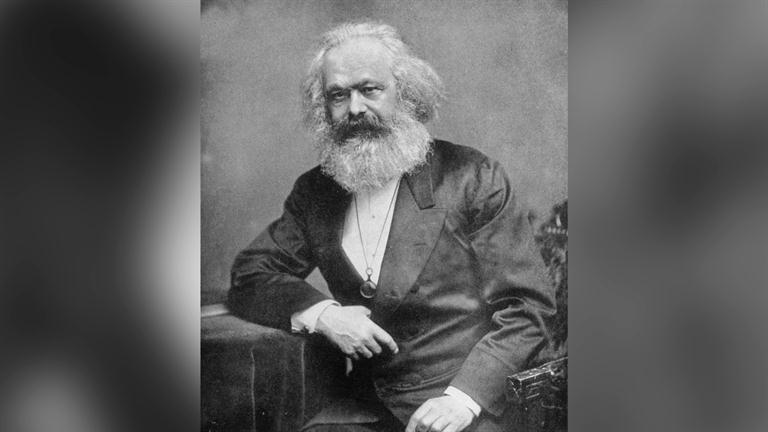
Marx d. 14th March 1883. Engels ‘intellect of genius had ceased to think’
Engels on the death of Marx 14th March 1883: this intellect of genius had ceased to think
Only someone who constantly kept company with him could have any idea of how valuable this man was to us in regard to theory and also, at every critical moment, in regard to practice. Along with him, his great breadth of vision will also disappear from the stage for years to come. These are things we others are not equal to. The movement will continue on its way but it will miss the calm, timely, considered interventions which have hitherto saved it many a weary digression.
Engels to Bernstein 14th March 1883
A reminder in the light of current obsessions and Russophobia. Marx was German
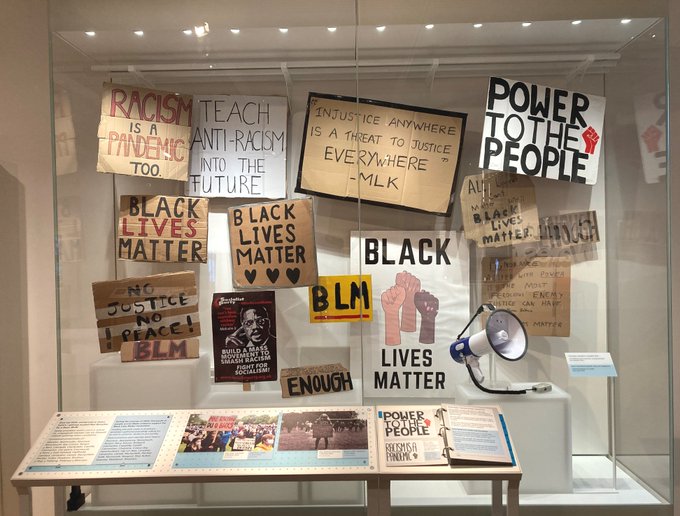
Historians back Black Lives Matter display at National Museum of Wales that Farage wants to cancel
The London Socialist Historians Group, which organises the socialist history seminar at the Institute of Historical Research, University of London, has backed the National Museum of Wales in Cardiff, in its decision to display posters and placards from Black Lives Matter protests.
Hard right politician Nigel Farage has criticised the display on his GB News programme claiming that BLM want to defund the police and in the US is ‘violent’.
The historians say that the St Fagans Museum deserves support for collecting and displaying the ephemera of Black Lives Matter protests. Too often such material is overlooked and means that not only important events are not captured historically but that future generations might not be able to obtain a full understanding of the ideas that motivated protests and how these were expressed.
LSHG Convenor Dr Keith Flett said, it is ironic but not surprising that Nigel Farage who complains a lot about people and ideas being ‘cancelled’ that he is now arguing for something he doesn’t like to be cancelled. The National Museum of Wales deserves support over its decision to display BLM materials.
Ambridge Socialist. Tracy & Jazzer. Ambridge needs to unionise!
Tracy Horrobin needs to join a union (as does Jazzer)
Tracy Horrobin who does front of house work at Grey Gables has been given a written warning by her employer Oliver Stirling. She has a right of appeal but would be well advised to accept the warning given the gravity of the disciplinary offence she was charged with, and which she admitted.
On Monday lunchtime Tracy was discovered in a spare bedroom at Grey Gables with her current partner Jazzer in the process of a liaison. It was her lunch break but having sexual relations at the workplace amounts to gross misconduct. This is usually a sacking offence not least because it raises questions in the employer’s mind about whether the individual can be trusted in future.
In this case there were some mitigating circumstances. Firstly while it was gross misconduct there was no reputational damage to Grey Gables since only three people know about it (aside from listeners to the Archers obviously) and none of them is likely to talk. Secondly Oliver is well aware of the nature of the person he employs-Tracy- and has continued and valued her employment partly because she adds something to the hotel.
Even so a further indiscretion and she could end up being dismissed and with Jazzer facing likely redundancy at Berrow pig unit (no doubt on statutory terms) the sooner both join Unite, the relevant union in both cases, the better they will be able to grapple with future events.
Ambridge Socialist Editor Keith Flett said, as a union officer in real life I have on occasion got people off gross misconduct charges, invariably because it hasn’t suited the employer to dismiss even they could have. Having union representation and advice was I’m certain invaluable to those individuals.
Kirsty to lead Ambridge re-wilding ‘revolution’
With Phoebe off to Scotland Rex has had to appoint a replacement with of course the approval of the Godmother. Phoebe’s mother Kate applied but so did Kirsty. Kate produced some second rate managerial BS while Kirsty was visionary. At this point Kate gave way to Kirsty. What is she up to.
Alice, Amy, Fallon and Christ too (once again)
Amy has left for Nottingham. Martha’s birthday party has passed with the usual gripes from Chris who may well wear a ‘down with miserabilism’ badge or at least should do.
Don’t Mention the War
No really don’t. Every else on the BBC is fixated with it, in Ambridge it’s the class war that matters
BEARD OF IRELAND 2022 POLL FINAL ‘BEARD OFF’ ROUND OPEN
The Beard Liberation Front, the informal network of beard wearers, has said that competition for the final of the Irish Beard of the Year 2022 is officially open
Academic Peter Coles and rugby player Jamison Gibson-Park won the first Trim Off round with Businessman Adohan Connolly and Northern Ireland Health Minister Robin Swann winning the second and completing the line-up for the Beard Off final
The 2017 winner was politician Colum Eastwood who bearded broadcaster William Crawley for the annual Award.
In 2018 the DUP’s Lee Reynolds shaved writer Dominic O’Reilly for the honour with Colum Eastwood in a steady third place.
In 2019 Lee Reynolds retained the title
The 2020 winner was Maynooth academic Peter Coles
In 2021 Aodhan Connolly shaved opponents to win the coveted title
The BLF says that while traditionally a land of predominantly clean-shaven cultures, Ireland has in recent times become something of a centre for stylish and trendy beards.
Contenders for the title in 2022 have included a diverse range of the hirsute- a golfer, rugby player, political and trade union activists, a broadcaster, an academic as well as a Health Minister.
The campaigners say the poll is specifically about the impact the beard of an individual has made in Irish public life and no other factor.
BLF Organiser Keith Flett said, competition for the 2022 Beard of Ireland Award will no doubt bristle with the winner announced on 17th March. The winners of the 2020 and 2021 title are on the poll can they be bearded?
There are two preliminary Beard Off votes between 5-7th March and 9-11th March. The top two from each round go on to the Best Beard of Ireland vote between 13-15th March
Lazy History. Putin is not Stalin or Hitler. He has his own post-1991 history
Takes that Putin is Stalin or sometimes Hitler have been quite common in the media and have even been echoed by several more serious commentators. They are wrong which is not to make any excuses for the vicious war he is waging in Ukraine.
A detailed analysis in the Financial Times (12th March) explains exactly what the history of Putin is
He was junior officer in the KGB and had no particular stake or central role in the former USSR. He has made very clear that he is entirely opposed to Lenin’s view of what the USSR was and might become. One might argue he has more in common with Stalin, except that the late dictator was about protecting the USSR, as an entity rather than as a beacon for world socialism. In any case Putin remains opposed.
To suggest that Putin is a fascist again is wide of the mark. It’s difficult to discern for example much of a cult of personality around him. The world has more than enough authoritarian despots to suggest that this doesn’t give them the particular characteristics of fascism or make Putin Hitler.
A third argument is that Putin is trying to recreate the imperial Russia of the Tsars. Again this seems wide of the mark, Putin is not planning to re-create the nineteenth century even if that, were it possible, be slightly preferable to his current activities
As the FT piece makes clear, to understand Putin and Putinism its best to study them and not rely on lazy historical analogies