E P Thompson on Ash Wednesday (March 2nd in2022) in Bristol in the eighteenth century
In his essay Patrician Society, Plebeian Culture E P Thompson notes the following:
Bristol in the early eighteenth century saw an annual pugilistic combat on Ash Wednesday between the blacksmiths and the coopers, carpenters and sailors, with the weavers sometimes joining in on the side of the smiths. His point is that as the working-class emerged its shape in terms of trades and allegiances also began to appear in this case in the form of a boxing match. One of those traditions that has become hidden from history, possibly in this case for the good. Its interesting to reflect however that while Ash Wednesday is meant to be a religious occasion marking the beginning of Lent the Bristol activities of 300 hundred years ago appeared
Michael Rosen’s Missing: A vital message for our times on refugees
The issue of refugees fleeing from wars and oppression has become even more of an issue with the Russian invasion of the Ukraine. There are regular (though often little reported) attempts by refugees from Libya and elsewhere to get into Fortress Europe. Not all make it.
Meanwhile in the parallel Fortress Britain Priti Patel has spent time dreaming of ever harsher measures against entirely legitimate refugees and Farage launched a campaign against the RNLI for saving lives.
To find out where this kind of politics leads, a read of The Missing is essential
I wrote the below two years ago on 6th February 2020 and all things considered, albeit with absolutely no thanks to Boris Johnson, it’s good that Michael Rosen is still around to speak about his family and the process of historical inquiry that led him over 20 years or so to piece together the story published as The Missing.
I went to school in Muswell Hill in the 1970s. It was a left-wing (comprehensive)school and the history of fascism and war was certainly not hidden. At the same time I did not start to learn about the Holocaust and its dreadful impact until I became active as a socialist in 1974.
There is some historical work needed to address what remains an absence in too many people’s understanding of recent history. I think the view was that as the Nazis had been defeated, the world had moved on from all that. In Britain with the demise of the Mosleyites, fascism while still around was a marginal presence. Then came the rise of the National Front from the early 1970s as a significant electoral force and to a degree as a street gang. I recall from that time in North London socialist meetings being attacked and smashed up by fascists. In those times I didn’t venture out without keeping a close eye on who was coming the other way and wearing a pair of DMs (Doc Marten shoes with steel toe caps not direct messages for younger readers). Yet the Cable St mural marking the victory of 1936 was not started until 1979.
Hopefully matters have in some ways improved a bit since, not least due to the efforts of Holocaust survivors and anti-fascists and anti-racists to make sure that the history of the Holocaust and what it meant is told and understood in each new generation.
Michael Rosen’s book is an important part of that. It tells a story of what happened to people simply because they were Jewish. Never again.
Amongst other things I’m a research historian. I convene the socialist history seminar at the Institute of Historical Research at the University of London School of Advanced Study and have done for many years.
As socialist historians we’re left-wing of course but we’re robust in our research. Rigour is expected as are awkward questions and uncomfortable findings.
Rosen is known as an author and broadcaster, a socialist and anti-racist and come to that a beard wearer and Arsenal fan.
He is not known as a research historian but that doesn’t mean he can’t be one. After all the great socialist historian E P Thompson started out teaching English literature and only stumbled into history as a byway initially.
The Missing is a brief volume of short chapters and some poems.
It does have references and an index at the end but it lacks the kind of academic apparatus that we look for in research history. Where for example are the footnotes??
Partly the answer is that the Missing is a book aimed primarily at young people, aiming to get across in deeply personal terms what the Holocaust actually meant.
But partly it doesn’t matter. Rosen has spent decades researching his family history and the research methods cannot be faulted.
Of course in the 2020s the internet can be helpful but can’t be relied on as a definitive source. Rosen doesn’t do that. He seeks out obscure books that mention his family and contacts libraries in France to see if they have any records.
What he finds doesn’t make for particularly happy reading but it is important, vital, even reading for our times.
He notes:
With every passing year, the number of Holocaust survivors gets smaller. We need to keep them the memory of them alive: the people who died and those who survived. That’s partly why I wrote this book.
The other reason, Rosen notes, is because the wider message of The Missing is about refugees and that is still with us, although those in political power in the UK at the moment would clearly prefer that it wasn’t.
That means the book is not only fascinating and important history but it has relevance now, as the best history should have.
And the awkward questions raised? Surely why there is not more research on this that gets out of the seminar room and into the public domain, because it needs to be read, understood, discussed and in times like these acted on.
The Real Shrove Tuesday tradition not just Pancakes but Subversion
In 2022 the moveable feast of Shrove Tuesday, the day before Lent, is known almost entirely for the consumption of pancakes.
Historically matters, in certain periods, particularly the early C17th, were a bit more exciting.
Shrovetide was the occasion for ball games, what Ronald Hutton in the definitive volume on British folk customs, Stations of the Sun, notes as ‘licensed misrule’.
By 1598 the ball games had started to develop into something wider. There were, Hutton records, riots on 24 out of the 29 Shrove Tuesdays in the early Stuart period (1600s). The riots took place mainly it seems in areas to the north of the City of London and involved centrally apprentices but also craftsmen.
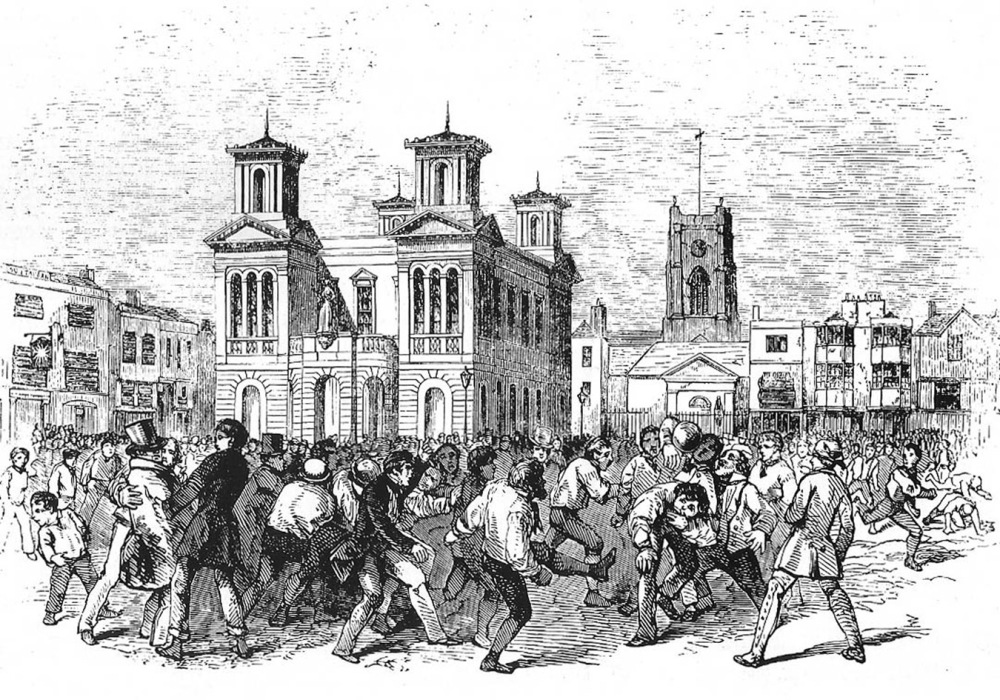
E P Thompson noted in his essay Patrician Society, Plebeian Culture about eighteenth-century England a Shrove Tuesday game of football which took place at Kingston in 1799, The magistrates banned it but the ‘populace’ and the ‘mob’ ‘triumphantly’ defied the ban.
Riots were not random but aimed at particular targets, in particular brothels and playhouses. Hutton records that between 1612-14 on Shrove Tuesday a Shoreditch brothel was attacked each year until it shut. On Shrove Tuesday 1617 a new Drury Lane playhouse was destroyed and prisoners freed from Finsbury prison by rioters.
Hutton notes that, while the targets may at least seem odd to modern eyes, they ‘fitted into a much older tradition of cleansing a community before Lent’. In other words the Shrove Tuesday crowd, in rioting, was seeking to destroy what it saw as the less moral parts of the early C17th economy.
The tradition of rioting died out only slowly and the mass playing of football on Shrove Tuesday still goes on in some places- Ashbourne in Derbyshire for instance- as a distant echo of earlier times. Shrove Tuesday football had no rules and no limit on the number of participants. The struggle (or fight) to get possession of the ball was at least as important as what was done with it afterwards.
That is also a reminder that Shrove Tuesday in the traditional calendar was the end of the reign of the world turned upside down figure of the Lord of Misrule, often appointed on the previous All Hallow’s Eve 31st October.
In short in the 1600s Shrove Tuesday was not about pancakes but about disorder, riot and subversion.
Michael Sheen shaves opponents to retain St David’s Day Beard of Wales title
The annual vote which aims to determine the St David’s Day Beard of Wales, the Welsh beard that offers the most positive national image, has concluded with actor Michael Sheen retaining the title he won in 2020 and 2021.
He shaved Senedd member Hefin David, James Dean Bradfield and Tom Jones in the on-line Beard Off Final vote.
The Beard Liberation Front says that images of St David suggest that the Welsh Saint himself may have had an organic beard
Welsh rugby prop Adam Jones won the Award in 2013, voted for by BLF supporters, just shaving former Archbishop of Canterbury Rowan Williams. Another rugby player Leigh Halfpenny won in 2014. In 2015 the Award went to Thee Faction musician Chris Fox in 2016 footballer Joe Ledley and in 2017 to Charcutier Illtud Llyr Dunsford, with Chris Fox winning again in 2018. In 2019 journalist Grant Tucker shaved the opposition to claim the accolade. Michael Sheen won in 2020 and went on to share the Beard of the Year Award with Michael Rosen in December 2020. In 2021 Michael Sheen again shaved opponents for a second time.
It is the tenth time the Award has been given following the traditional UK Beard of the Year at the end December each year and the BLF says it is a mark of Wales as a modern nation on St David’s Day that beards are now playing an increasingly significant role in national life.
BLF Organiser Keith Flett said, Congratulations once again go to Michael Sheen. His iconic beard has become a symbol of Wales, even though for acting roles, he doesn’t always wear it!
Two preliminary rounds leading to the final Best Beard of Wales 2022 vote between 25-27 February.
In the first round politician Hefin David and veteran musician Tom Jones shaved opponents to go through to the Beard Off Final, while in the second Michael Sheen and James Dean Bradfield were follicle favourites.
What would Gerrard Winstanley have said about Russian Oligarchs on St George’s Hill?
Russians and those from former Soviet states own more than a quarter of the 430 luxurious homes in St George’s Hill, a heavily guarded 964-acre estate near Weybridge, Surrey, where mansions have changed hands for more than £20m each.
In April 1649 a group of radicals, named the Diggers, including Gerrard Winstanley(1609-1676), occupied land on St George’s Hill in Surrey and planted vegetables with a view to subsisting on the land. Local landowners took legal action and hired thugs to physically attack the Diggers and by 1650 the exercise in communal life had been abandoned
The story in the Guardian (28th Feb) is focused on Russian oligarchs but in fact that majority of the very wealthy inhabitants of St Georges Hill now an exclusive gated area are from elsewhere.
Winstanley who believed property should be held in common would no doubt have had some fiery words to say on the matter. However given that even in 1649 he was harassed by wealthy landowners it’s a reminder that the world remains divided and the solution to it the same as well
CLR James on Sonny Ramadhin (1929-2022) race & class in cricket
The West Indian spin bowler Sonny Ramadhin has died at 92. He was the last surviving member of the West Indies cricket team who beat England three matches to one in 1950, their first series victory against them. He continued to take wickets against England in Tests, home and away throughout the 1950s. He played his last Test against Australia in December 1960. He took 158 Test wickets at an average of 28.98.
The 1950 victory was celebrated with a famous calypso song.
After the end of his Test career he settled in north-west England and played for Lancashire 1964-5 and Lincolnshire 1968-72 but mainly in the Lancashire Leagues.
In Beyond a Boundary CLR James mentions Ramadhin, both his Test career and his League experience.
Ramadhin played for the West Indies in the period when the team always had a white captain, despite a long running campaign to appoint Frank Worrell to the role. CLR James played a leading role in the campaign and argued that the failure to act had led to players losing confidence with West Indian cricket.
James wrote that Ramadhin’s brief move from League cricket to County Cricket was aimed at giving him the financial security and status that the West Indies had never been able to give him.
A reminder that beyond a boundary matters of race and class had played a significant role in a leading players career.
Socialist Historians back renewed UCU strike action. Conditions for historical researchers must be protected
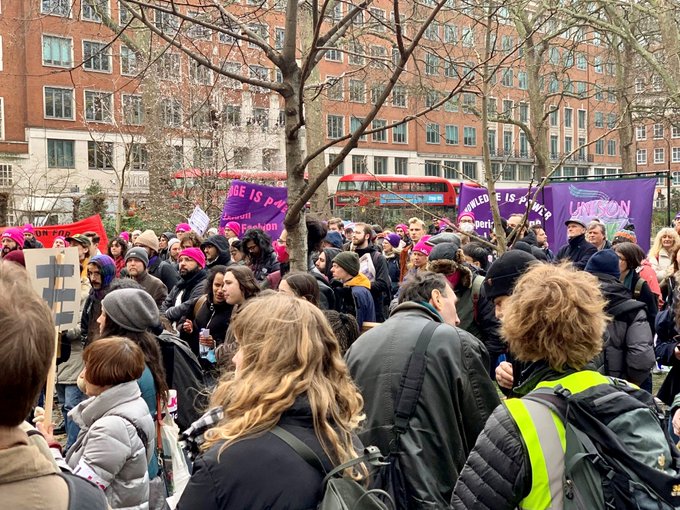
The London Socialist Historians Group, which organises the socialist history seminar at the Institute of Historical Research, University of London, has backed continued strike action by members of the University and College Union (UCU) which is taking place on 10 days between 14th February and 3rd March and begins its third period of action on 28th February
The academics and professional support staff are taking strike action over further planned cuts to pensions, and continuing attacks on pay and conditions.
The historians say that a continuing supply of historical research is at risk as academics are made redundant or look for jobs elsewhere in the face of a relentless attack by employers on their pay and pensions.
LSHG Convenor Dr Keith Flett, the reality of academic life in 2022 is very different from the liberal University of 50 years ago. It is a neo-liberal workplace where academics face pressure to work harder and harder for poorer terms and conditions, including a slashing of their pension by a third or more. The impact on things like historical research is significant. The UCU are right to strike and they continue to have our full support.
Why did Karl Marx have his iconic beard shaved off in April 1882?
The answer unfortunately as that we don’t really know. However below is an interesting speculation published in the Los Angeles Review of Books in 2018.
It’s a translation by Shelley Frisch of a section of Jurgen Neffe’s biography of Marx (2017)
Algiers, late April 1882. After an unusual period of cold weather with rain streaming down from black skies, a hot desert wind was driving temperatures up to more than 30 degrees Celsius. In his salon somewhere in the play of shadows on the cool back streets, a barber was sharpening his knives. Today they needed to be particularly sharp. An elderly gentleman with a bushy beard and white mane atop a strikingly high forehead had taken a seat in the barber’s chair, and this sedentary giant now looked far larger than when he entered the shop.
The man wished to shed his crowning glory, from his face and his head, probably on the advice of a doctor. He looked sickly, a little bloated, and drained by life. His eyes had lost their sparkle, but they flashed up briefly when he spoke and told jokes, thus providing the only indication of his true age. In a few days he would turn 64.
His overcoat, his demeanor, and his highly precise French identified him as a man from the north, yet with his bronzed complexion and dark brown eyes, he could have been from these parts. He also owed his nickname to the Moorish aspect of his features: his family and his German friend back home, now living in exile in London, called him “Moor.” That was how he signed his letters to his comrade there, and the name his three daughters had known him by since they were children. “Moor,” they said, “Moor is furious, Moor can go.” Not: “The Moor.” At the close of every letter he wrote them, he sent the young women his (always fond) regards, and signed his letters “Old Nick,” which, in English, stood for the devil.
Now the devil was playing his part. The knives were sharpened, white locks of hair were falling to the floor. In the mirror of an Arab beard shearer, Karl Marx saw himself taking leave of his familiar look. Like an actor who has finished performing and is sitting with his mask on, about to remove his makeup, he was bidding farewell to the character who had dictated his image throughout his life. He was destroying his image, his own graven image, molded after Zeus, a mighty bust of whom adorned his study at home. One last solitary act; World Theater without an audience.
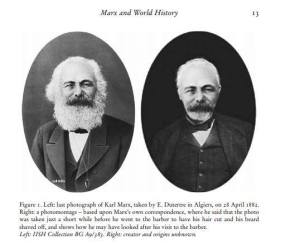
One man was always on hand, even if he was not with him at that very moment: Friedrich Engels, his companion in England. As soon as they were separated they wrote letters to each other, and had been doing so for four decades by this point. Correspondence functioned as a substitute for keeping a diary. “A propos,” Marx, a.k.a. “Old Moor,” confessed his outrageous hair-cutting act to “dear Fred” from afar: “because of the sun, I have done away with my prophet’s beard and my crowning glory, but (because my daughters would rather have it this way) I had myself photographed before offering up my hair at the altar of an Algerian barber.”
His clumsy language reveals the decline that was putting a damper on the final year of his life. A few months earlier, when Marx lost his life’s companion, his wife Jenny, who had succumbed to cancer, Engels said, “The Moor has died as well.”
“Offering up my hair”: was this haircut a radical step that anticipated his own death, where the customer doesn’t get away unscathed? Or was it a symbol of liberation and a new beginning, as his relatively young age would still permit?
For the first time he had left the confinement of Europe. His letters and activities reveal his unwavering zeal and curiosity about the world, in accordance with the diverse interests of a man who had been passionate about politics and was now retired. During the final decade of his life he was no longer publishing anything of crucial importance, but he did produce countless memos and letters.
He had his last known photograph taken in Duterte’s photo studio, shortly after his arrival in late February. This picture was intended for his children and for posterity. Gazing into the camera, and beyond it into the darkness of the time that lay ahead, was a marked man who somehow knew that the worst was behind him. He looked a bit lost in reverie, smiling through his suffering. He confessed to his friend, “I’ve still been putting a brave face on an evil game.”
That was how he wished to be remembered and how he will live on in people’s minds: as a wise old man, and the image of an era that would not dawn until a long time after his death. Such was the gradual evolution of his historic role as an immortal who became the resonant container of human hopes for a better world.
In China, which reveres the elderly and hallows its ancestors and still calls itself communist with a keen sense of irony, this portrait remains his most popular likeness.
The beard — which had been one of the best known beards of all time — was now off. Without his aureole, his mighty head seemed small, almost frail, by comparison. By dropping his mask, which also kept his facial expressions so well concealed, Marx was exposing himself and, in a touching way, making himself invisible as well: no one would recognize him, although his likeness would soon appear on millions of posters. Now he could stroll down our streets, clean shaven and short-haired, as his own revenant. Marx without a full beard was like a clown without make-up or the Great Dictator without a moustache: he was a different person.
Someone posted a portrait of the shorn Marx on the internet. It amounted to little more than an amateurish retouching effort….The man laid to rest at Highgate Cemetery in London barely a year after the final cut at the barbershop in Algiers bore only a faint resemblance to the Olympian father of the gods that posterity would remember. After his appointment at the photographer’s, no more pictures of him would appear. There is no surviving photograph, not even sketches or even any mention of the old man with the bare face.
It is possible that such documentation once existed. If it had, it was probably destroyed by his daughters after his death, like all personally compromising letters, especially those between Marx and his friend, and between Marx and his wife. In light of this situation, how is posterity supposed to get a realistic picture of Marx’s personal life and personality? Generations of biographers have grappled with the question. Most have wound up skirting the issue and presenting whatever was available as the full picture.
If Marx’s trip to the barber, where he got to peer behind his mask, is mentioned in the Marx literature at all, it receives only anecdotal treatment as a whimsical act brought on by some sort of medical issue, most likely a skin problem. Not a thought about what this new look meant for him; whether the loss of self he orchestrated may have shocked or amused him. There is no attempt to explore the inner life of Marx as an individual, which would surely be of great interest. Indeed, Marx would point the finger unerringly at the hypochondriatic aspect of his constant suffering: “My illness always comes from my head.”
In works about Marx, readers generally search in vain for a discussion of the self-perception of this rebel, who could philosophize so inimitably about man’s self-awareness as a “species being.” These works read as though someone was merely playing Marx’s role, as a man cast into the world by history in order to complete his assigned tasks, rather than as a flesh and blood human being with eyes that couldn’t escape his own reflection as a profoundly solitary man. The question arises of whether he was able to feel sorrow in the situations he found himself in, or merely rage……
The crisis in Ukraine, resulting from a Russian invasion, is a reminder that nuclear war remains a possibility. Putin has large numbers of Nukes, which he has reportedly placed on alert. The US and NATO have equally large numbers of them. Ukraine got rid of all its nuclear weapons some years ago.
Having an unpredictable hard right politician called Trump in the White House might have been the first time numbers of people felt that the world and with it their own lives could all end rather quickly in a nuclear war. In the event Trump pursued other preoccupations, but the possibility of war remains a very real one.
For those who are older there have been a number of such episodes since Hiroshima in 1945.
In the early 1950s the US came close to using nuclear weapons in the Korean War, which ended with the division of the country. In the early 1960s the Cuban missile crisis sparked real fear of a nuclear war between the US and Russia. This time the hawk in the White House was a Democrat- Kennedy. Not so long after in 1969 a Republican President, Nixon, was close to using nuclear weapons
The story goes that Nixon, a heavy drinker, ordered a nuclear strike while drunk one evening after North Korea had shot down a US spy-plane. The Generals sat on it until the morning when a hungover Nixon decided not to proceed.
All this serves as a reminder that we are approaching the 65th anniversary of the foundation meeting of CND in February 1958.
Its arrival as a mass campaigning force in British society- still very much with us- did not of course come from nowhere.
The spark for the organisation that led to CND was a series of nuclear tests in 1957.
In 1957 it was Britain that was testing a nuclear bomb in the South Pacific, and likewise these were not in any way officially sanctioned.
Part of the motivation after the debacle of Suez in 1956 was to put Britain back on a military footing with the US and this indeed was what happened.
The impact on the left was significant.
It was the 1945 Labour Government that had sanctioned the development of British nuclear weapons in the first place and around the nuclear tests a familiar discussion between multilateral and unilateral disarmers took place.
Nye Bevan, the de facto leader of the Labour left in the 1950s, was no fan of nuclear weapons but took the position that while others had them Britain needed them too. Whether or not he would have backed a ‘first use’ policy didn’t seem clear.
Beyond that however there were large numbers who simply wanted to get rid of all nuclear weapons and being in the UK, to start with British ones.
The moves that led to CND started with letters from Bertrand Russell in the Guardian and an article by J. B. Priestley in the New Statesman. Canon Collins, based at St Pauls, was also a key figure.
In other words the ‘great and the good’ of the liberal-left became attracted to the cause. But the foot soldiers were of course the left- many constituency Labour Party members and the wider left.
Peggy Duff a Camden Labour Councillor who had worked for Tribune and went on to become the first General Secretary of CND summed up in her autobiography what the original activists were like.
‘They belonged to no political party. Many of them belonged to no church. They had no politics. Their interest in banning the bomb was mainly ethical. They thought it was wrong. Most of them were young.. they believed that the bomb immediately threatened the future of civilisation, that it had to be banned very quickly or Armageddon would come’.
Current events should mean that a new generation will join those who first opposed the bomb 65 years ago.
Ambridge ruling class split over future of pig farming. We say: No Redundancies
Justin Elliott has told Borchester Land’s Martyn Gibson that the pig unit at Berrow Farm which is loss making must be shut or he will withdraw his investment. Gibson has raised the issue with Brian Aldridge who has overall responsibility for the operation (over a pint at the Bull obviously). Aldridge believes that pig farming has a future and plans to oppose Elliott’s closure plan at a BL Board meeting. The Ambridge Socialist demands that must be no redundancies at Berrow Farm and all workers must be redeployed or offered at least a year’s money in voluntary severance.
Tracy plans to resurrect the Ambridge cricket team
After two years of the pandemic Tracy is determined there will be an Ambridge cricket team this year. Jazzer is sceptical but Tracy underlines that it is a game for proletarians not toffs. The pitch uncovered since 2019 needs work and there is the matter of players..
Housing issues
There are not enough affordable homes in Ambridge and very little is ever done about it. However Chris has decided to turn down Brian’s offer of a free cottage at Home Farm, wanting to be free of the Archer Dynasty, a healthy proletarian instinct. Stella is moving into the bungalow at Brookfield, replacing Rex who is moving out- to a mystery location elsewhere in Ambridge..
Amy, Rex & Chris too…
Alice has engineered an evening out for Amy and Rex which appears to go well enough. Later it transpires that Amy has been in bed with Chris. This being Ambridge, Rex was not there as well and there was no shower scene. The Ambridge Socialist sends best wishes to all.