After Angela Rayner’s sacking, the history of the labour movement & ‘the provinces’
I don’t hold a brief for Angela Rayner who is certainly not my kind of socialist (i.e. an extra-Parliamentary one). Even so her sacking by Keir Starmer, who has developed quite a reputation for sacking people, is worthy of note.
Rayner after all comes from the north-west of England. Keir Starmer by contrast is definitively a man of the Metropolis and its environs. Very much a head office type one might say.
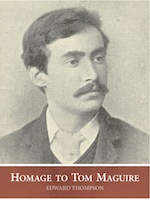
In that context its worth recalling these passages from E P Thompson’s Homage to Tom Maguire, a Leeds socialist and trade unionist who died too young and helped to found the Independent Labour Party
Provincial events are seen as shadowy incidents or unaccountable spontaneous upheavals on the periphery of the national scene, which the London wire pullers try to cope with and put in their correct historical pattern. And provincial leaders are commonly denied full historical citizenship; if mentioned at all, they are generally credited with various worthy second-class abilities..
…the ILP grew from the bottom up: its birthplaces were in those shadowy parts known as ‘the provinces’
The Guardian 200. EP Thompson on William Blake, Beast & Whore
As The Guardian marks 200 years of publication this week it has published both physically and digitally a large amount of archival material. I can’t claim at this point to have read every last word.
However its worth recalling some of the great radical figures who wrote for the paper both in terms of reviews and comment pieces
One was the historian EP Thompson. He wrote extensively about William Blake and the religious traditions he stood in. There is a review of his Witness Against the Beast from a Blake related website which gives a flavour in overview of what he was looking at:
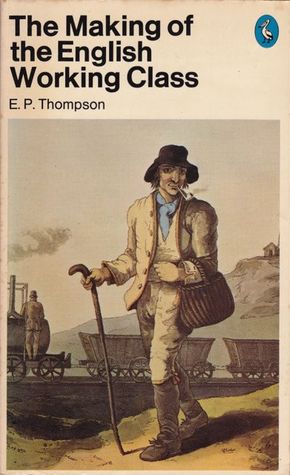
In another age these minority traditions were perhaps better understood. The paperback edition of Thompson’s Making of the English Working Class was published as the 1000th Pelican book in September 1968. To mark the occasion the Guardian published a special supplement to which Thompson himself contributed a piece headlined ‘Beast and Whore’. In Blakeian terms the reference was to Church and State but wonders if such a piece could appear now without attracting the attentions of Guido..
Below is a letter I wrote in 1993 to the London Review of Books defending Thompson’s treatment of Blake. Sadly he died later the same year.
It is thirty years since Edward Thompson first published The Making of the English Working Class, and while the phrase he uses to criticise what Post-Modernism has tried to do to William Blake, ‘the somewhat attenuated discourse of analytic academicism’, is perhaps not quite on a level with ‘the enormous condescension of posterity’, we may give thanks that Thompson’s brain is razor sharp still and that, unlike some of his contemporaries, he has never been bought off by academic life or cheap fame in the press. Where, however, are the Edward Thompsons for the Nineties and beyond?
Beard Power a factor in Welsh Labour Senedd victory
The Beard Liberation Front, the informal network of beard wearers, has said that Beard Power was a factor in Welsh Labour’s Senedd victory. Labour holds 30 seats, one short of an overall majority.
Huw Irranca-Davies, Hefin David and Vaughan Gething, well known beard wearers in the Senedd and previous contenders for the annual Beard of Wales title, were re-elected after Thursday’s poll.
Irranca-Davies got over 50% of the vote in Ogmore while Hefin David increased his share of the vote by 10.7% in Caerphilly. Meanwhile in Cardiff South and Penarth Vaughan Gething got just 0.1% under 50% of the vote.
Meanwhile both Plaid Cymru’s Luke Fletcher and Peredur Griffiths were elected on the Regional lists after losing out in their respective Constituency polls.
The campaigners say that this underlines that beards are electorally popular and are vote winners.
BLF Organiser Keith Flett said, of course there were many other reasons why Huw Irranca-Davies, Hefin David and Vaughan Gething triumphed on Thursday but clearly no one can say after this result that voters reject hirsute candidates.
I’m no fan of Starmer, as much for his inept leadership, as his policies-such as they are- but the piece is about wider questions around how Labour as an electoral party attracts working class voters in the 2020s.
Of course this question is not new. The historian Gareth Stedman Jones wrote (Why is the Labour Party in a mess,1982) that Labour was a political shell re-made in each generation by those involved.
Hence after the 1959 Election we had ‘Must Labour Lose’ and after 1979 and Thatcher and particularly after the SDP split there was a lot of pondering about Labour winning elections. Eric Hobsbawm wrote the Forward March of Labour halted while Marxism Today promoted New Times before disappearing.
My point is there is a history around such pieces. However towards the end Coman mentions E P Thompson as someone who defended communities against individualism, the market and capitalism.
Coman argues that Thompson was ‘progressive’ and in doing so risks pouring what the late historian himself referred to as the ‘enormous condescension of posterity’ all over his subject.
A case can be made for Thompson as an English regionalist, not keen on London and the Metropolis. Thompson saw himself as the extinct flightless bird the Great Bustard. However much European Marxist ideas interested him (and they did) he was stuck in England.
Yet Thompson was also the internationalist who formed European Nuclear Disarmament working across West and East against nukes. Yet again he was also firm opponent of the forerunner of the EU, the EEC, making the case against Europe in the 1974 Referendum
Thompson had grown up in the CPGB, with its traditions of the popular front formulated in the 1951 British Road to Socialism. Yet he walked out of the Party in 1956 and became a founder of the New Left. His relationship with the Labour Party was problematic, sometimes a member, sometimes not and certainly on the left or to the left of the Party. Not really perhaps someone who would obviously appeal to Sir Keir Starmer.
He was firmly on the side of the Have Nots against the Haves, strongly critical of the police and the authorities (including Directors of Public Prosecutions) and a firm defender of civil liberties.
At the same time he did see the need to build coalitions to win causes and promote progress as he saw it. Perhaps Starmer might like this Thompson more. He was a complex individual (who I knew only slightly) but certainly never an early centrist.
After Hartlepool: Starmer must ditch the suits & grow a beard
The Beard Liberation Front, the informal network of beard wearers, has said that after a resounding defeat in the Hartlepool By-Election, voters have sent a clear message to Keir Starmer that he needs a change of image.
His efforts to look like a smarter Boris Johnson, but with similar policies, over the last year have clearly failed. Voters appear to prefer the slightly dishevelled and more informal style of the current PM.
The BLF says out must go the sharp suits in favour of less formal jackets. Out too must go shaving with a beard an essential way for Starmer to lead on style over Johnson.
BLF Organiser Keith Flett said, while many political commentators focus on policies, style is a major part of modern politics in an increasingly visual age. The tough reality is that Johnson’s style is popular and Starmer’s is not. He needs to change.
Contact: BLF Organiser, Keith Flett on 07803 167266
At 75 Michael Rosen has achieved Peak Beard
The Beard Liberation Front, the informal network of beard wearers, has said that on his 75th birthday the author and broadcaster Michael Rosen has achieved Peak Beard.
After a period of very serious illness Rosen was voted Beard of Summer 2020 and then went on to be declared joint Beard of the Year 2020.
The campaigners say that Rosen’s beard has been tweaked, redesigned and remodelled over the years but its current status indicates that he has at 75 achieved Peak Beard.
BLF Organiser Keith Flett said, a beard can add gravitas and direction. We congratulate Michael Rosen on achieving Peak Beard and wish him a very happy birthday.
The importance of Pressure From Without in the age of Starmer
Up to and on May 6th people are out campaigning in the elections that take place across the UK’s four nations on that day. Many will be working for Labour victories and in places like Manchester, London and Cardiff Bay will hope to keep administrations in office that certainly do more for working people than any likely alternative would.
Others will be out supporting Communists, socialists, Greens and a range of independents. Victories will be won here and there but the main point will be to raise political ideas and strategies aimed at wider changes.
While a focus on electoral politics has been central to much of the left for over a century it has never been the only road taken
In his utopian novel News From Nowhere, William Morris wrote that the Westminster Parliament had been replaced by a more useful dung heap while democracy was in the hands of citizens assemblies across the country.
More recently Ralph Miliband in his 1961 history of the first half century of the Labour Party, Parliamentary Socialism, argued that Labour had always been the most dogmatic of parties, not about socialist ideas but about adherence to Parliamentary politics.
This is the context for what was known in the nineteenth century as ‘pressure from without’. Labour didn’t form a Government until 1924 and until then the hope of achieving change simply by argument and winning a vote in Parliament was limited at best.
Rather the idea was to exert various forms of organised mass pressure, petitions, demonstrations, strikes to fix in the minds of MPs that if some changes and concessions were not made from time to time the alternative could end up being much more radical.
With the Tories 80 seat majority in Parliament and Keir Starmer’s penchant for abstention or backing the Tories, pressure from without has reasserted itself over the last year with some success.
Arguably it started with Black Lives Matter. The Sewell report shows the disdain the Government has for this and Starmer is hardly an enthusiast either.
Yet and despite regular edicts from Culture Minister Oliver Dowden, the pressure from campaigners continues to see a succession of large companies, academic institutions and sporting bodies take action on statues, historic racist associations and policies.
Arising in part from this the Tories new Police and Crime Bill has seen protests around the UK. On this occasion Labour did oppose it, but it seems to have been the impact of demonstrations that has seen the Bill disappear off the immediate political agenda. When and if it returns may well be depend on pressure from without.
The other motor for the Bill was and is the climate change protests of Extinction Rebellion activists. Even during the pandemic these have continued, within the confines of safety restrictions. Changes in Government policy are the aim, but the pressure for change comes not from Parliament but from the streets.
This idea of not waiting for someone above to address matters has spread further still.
When the BBC decided to scrap every programme on every channel in favour of coverage of the death of Prince Philip on April 9th it received over 100,000 complaints. It still managed extensive coverage of the funeral but only on one channel. The protests worked, although politicians were mostly silent on the matter.
When a group of very rich football clubs announced a break away European Super League to make themselves even richer recently, Government action was promised. However fan protests got there first and the ESL was scrapped before any Minister actually did a thing.
A reminder that the power of collective action can change things now just as it did in the nineteenth century.
For those who make their living from fishing Boris Johnson’s Brexit ‘negotiations’ on fishing rights with the EU and how they ended are a very serious matter indeed.
Johnson though is not someone noted for taking things seriously
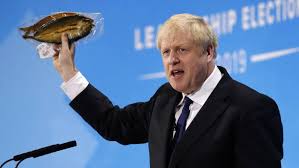
He has previously waved a kipper in the air as part of a stunt in a political speech
When he had dinner with EU President Ursula von der Leyen during the final Brexit negotiations before Christmas 2020 he reportedly dined on scallops followed by turbot. Both are fished in UK waters with scallops being a previous source of dispute.
In October 1939 Winston Churchill’s Parliamentary Private Secretary Sir Geoffrey Shakespeare received the following memo from Churchill.
One morning I found on my desk a pink tab with a memo to this effect: “I am concerned about the shortage of fish. Parliamentary Secretary will immediately take up the matter with the Assistant Chief of the Naval Staff and the head of the Mine Sweeping Division to see if any trawlers can be released for fishing. We must have a policy of “utmost fish.” Parliamentary Secretary will report to me by midnight with his proposals. WSC.
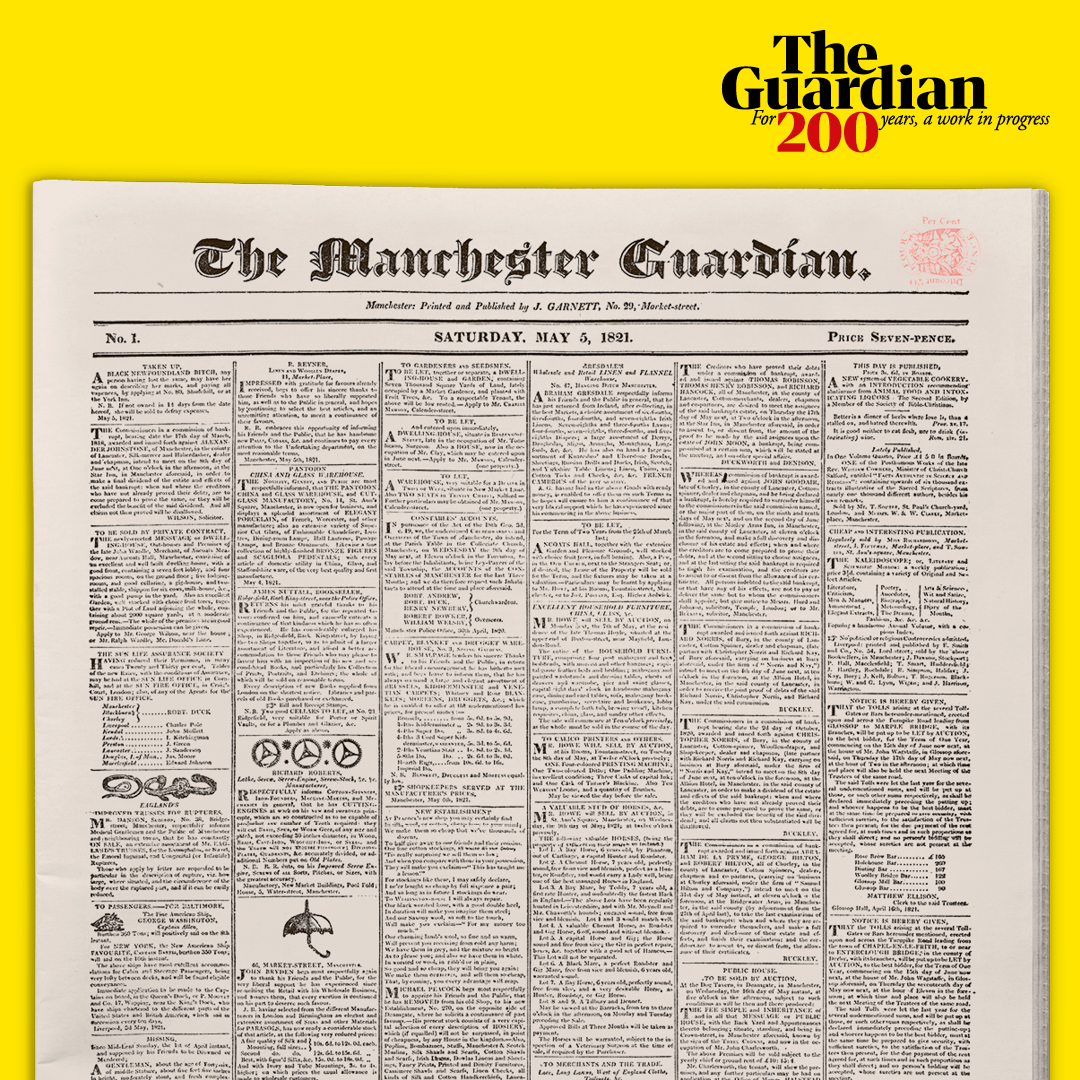
The Guardian was first published on 5th May 1821 and is marking the 200th anniversary with a facsimile of the first edition.
I’ve been reading the paper since the late 1960s and writing letters to it since the mid-1980s and as long as it continues (at least in print, although I mostly read e-editions) I plan to continue.
I haven’t yet seen but expect I will see pieces pointing out what a dreadful right-wing paper it is. Unhappy at best with Jeremy Corbyn, poor on South America, far too equivocal on trans rights. Definitely guilty on all counts I’d say but then the Guardian doesn’t pretend to be Socialist Worker or the Morning Star.
Historically it was a paper of the North (and in many ways I wish it still was) but for many years now its really been a paper of North London. I live there of course and I’m not complaining but I don’t really need a paper to tell me what people are thinking and doing there. Still..
Anyway if you are complaining that the Guardian is too right-wing or that its sold out you are missing the point both of its origins and what the paper was (and is) and also importantly of the strengths it has.
The paper came out of Peterloo but the legacy of that Manchester day was not straightforward. On the one side it led to Chartism and the early socialist movement. But on the other it was part of the precursor to what was (until the early 1980s) the modern Liberal Party (formed 1859). That tradition was that not of the 10 hour working day but of the Anti-Corn Law League. It was the tradition that saw the building of the Free Trade Hall (now a Radisson hotel) on the site of Peterloo.
As a tradition it had strengths. It was for peace and international conciliation, not war. It was against slavery (abroad, and the US Civil War was awkward). It was not for socialism.
As the twentieth century developed the two traditions existed side by side. The 100th anniversary of Peterloo in 1919 was celebrated in Manchester primarily by the Labour Party. J M Keynes was a Liberal whose economics did a good deal to inform Labour thinking.
When I first started reading it in the late 1960s the paper did support the Liberal Party. I don’t think one cared that much. The Liberals were electorally marginal and the paper employed some good to great journalists and columnists, none of whom from memory were Tories.(memory can be faulty though).
Matters became confused with the appearance of the SDP, which the paper also backed in the intertwining of Liberal and some Labour traditions.
It was never a paper of the left but in its pages one might find E P Thompson and Raymond Williams and others.
With the rise of the new Labour left in the 1980s (and given its strength in London- see above) the paper was perhaps associated to a degree with it. That didn’t I think influence editorial positions a great deal.
Once you can appreciate the origins and some of the traditions of the paper you can wish it happy birthday at 200 without complaining too much (but complaining is important too) about what it has never claimed to be.
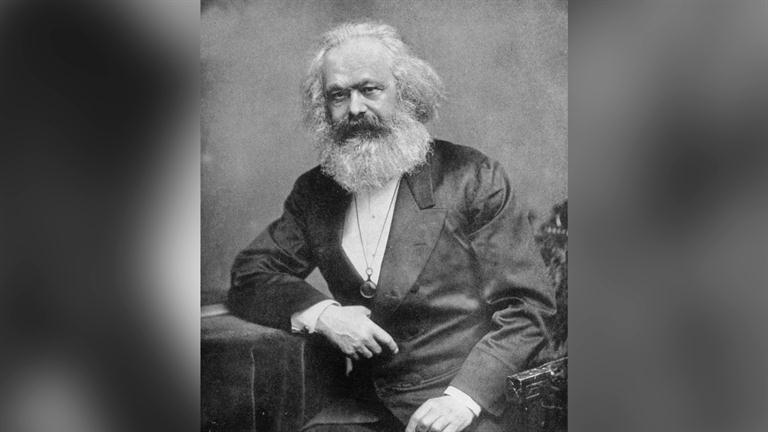
Engels to Marx on his 50th Birthday (5th May 1868)
Engels to Marx 6th May 1868
I congratulate ANYHOW on the half saeculum, from which, incidentally, I am also only a short span away. Indeed, what juvenile enthusiasts we were 25 years ago when we boasted that by this time we would long have been beheaded.