11th April 1820: the last of the revolutionary risings sparked by Cato Street in February 1820
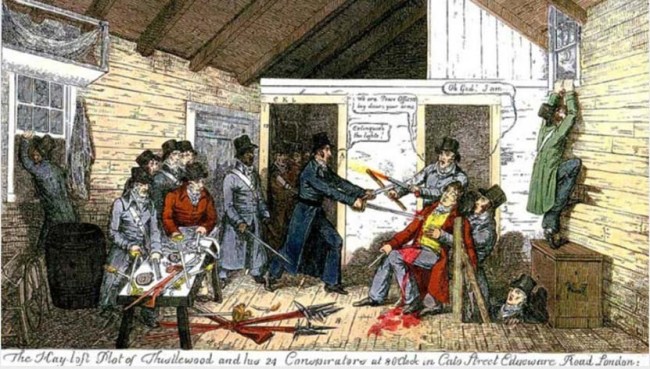
Following attempted risings at Huddersfield in on April 1st 1820 and a General Strike and armed battle in the West of Scotland from 4th April 1820, the night of April 11th 1820 saw the last attempted risings and strikes in Yorkshire.
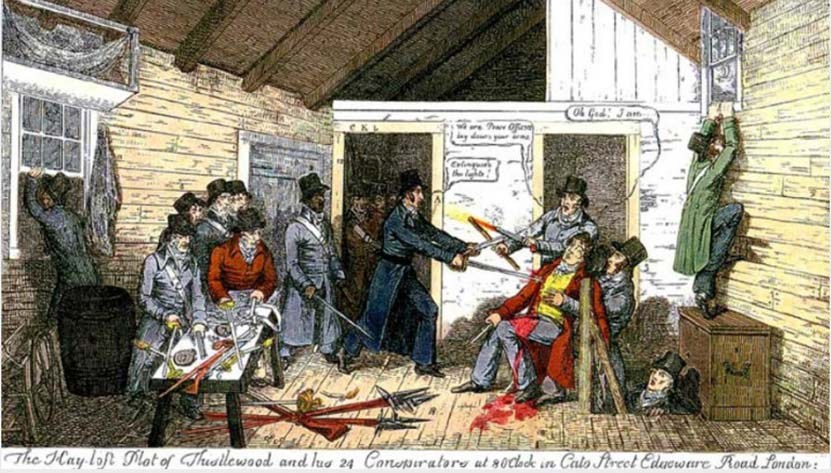
They had all been sparked by the Cato St Conspiracy in London on 23rd February 1820 which in turn was one reaction to the Peterloo Massacre in August 1819:
https://kmflett.wordpress.com/2020/02/23/the-cato-st-conspiracy-at-200-an-outcrop-of-peterloo-the-armed-tradition-in-working-class-politics/
Malcolm Chase makes the point in his book on the year 1820 that after Cato St Ministers expected and feared armed risings.
What E P Thompson made of the events of early April 1820 remains of interest and I’ll post separately on that.
The events of April 11th are detailed below by Fred Donnelly.
late in the evening of 11 April, the men of Barnsley assembled and met up with contingents from Dodworth and Monkbretton. They passed through Worsborough and went on towards Huddersfield at one a.m., now numbering perhaps 400 in all. Their military leaders were two local weavers (and ‘Waterloo men’), William Comstive and Richard Addy, who marched them along to the beat of a drum. The Dodworth men were likewise led by John Pickering, a 26-year-old weaver who had served in the infantry. They had flags with political slogans, which they had previously used at meetings in 1819. In addition to pikes and guns, the men carried various provisions in knapsacks on their backs. Scouts with local knowledge went ahead to identify houses where more guns might be seized. In true military style, the insurgents were equipped to issue civilians with receipts for any goods confiscated.
Arriving at Grange Moor in the early hours of 12 April, the Barnsley men were greeted by twenty local radicals from Huddersfield rather than the thousands they had expected. Comstive formed the men into a line and posted sentinels while the leaders discussed the situation. Thomas Farrimond cried out that they had been betrayed, and panic set in. Men fled in all directions, discarded their weapons, and dropped their flags. No military engagement took place, and the troops sent to confront the insurgents simply arrested seventeen persons and collected weapons from the ground. [Various depositions in T.S. 11 979/3573 which are more accurate than exaggerated accounts in Leeds Mercury, 15 Apr. 1820 and Leeds Intelligencer, 17 April 1820.]
Elsewhere in the clothing district, support for the uprising was guarded. At Mirfield and Dewsbury there were general strikes. [Byng to Harewood, 12 Apr. 1820, Harewood Mss.] At Halifax on 12 April 1820 there was a march of radicals who fired off a rocket and demonstrated loudly, but non-violently, on Beacon Hill before dispersing. [Leeds Intelligencer, 17 Apr. 1820.]
Indeed, the Grange Moor rising had turned out to be another failure. Yorkshire radicals did not come out in force to support the Barnsley men, and the anticipated support from Lancashire radicals never materialised. As one Yorkshire radical put it, somewhat cryptically, “…our Musick in Yorkshire [h]as played twise where yours in Lankshire has never struck at all. Is your Musicians sick [?]” [Message of J. Brooke contained in letter of J. Tyas, 14 Apr. 1820, T.S. 11 1013/4131.]