Articles

Peterloo: The Liberal Democrats forget their own history

In Uncategorized on August 16, 2019 by kmflett

Peterloo: The Liberal Democrats forget their own history

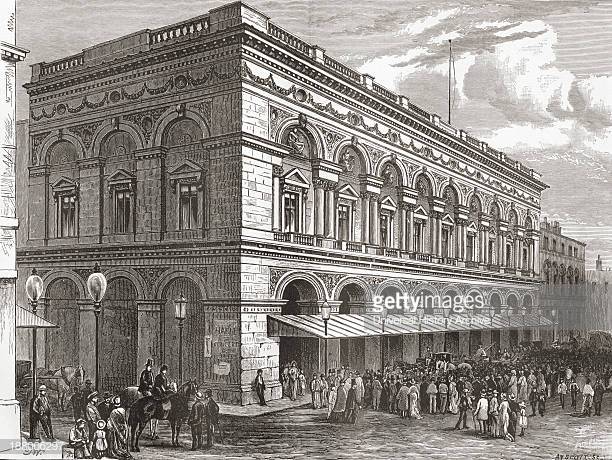
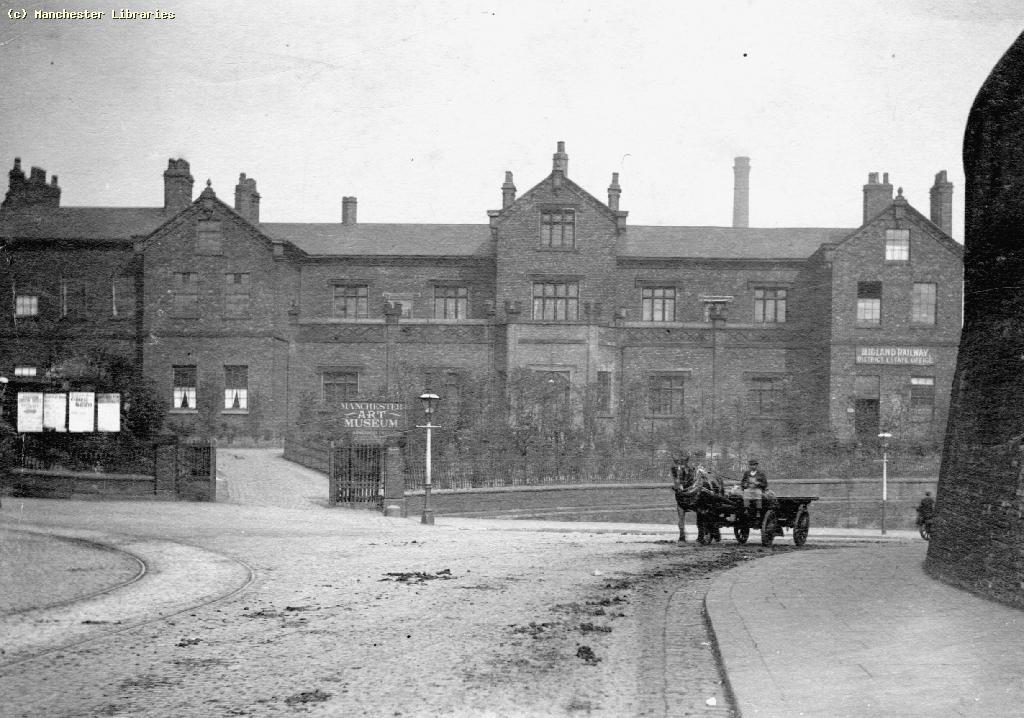
The Free Trade Hall, Manchester, England In The Late 19Th Century. From Our Own Country Published 1898 (Photo by: Universal History Archive/Universal Images Group via Getty Images)

Banners complaining about the price of bread were present at Peterloo and several working-class attendees are on record as going on to be activists in the Anti-Corn Law League.

The League was led by Richard Cobden and John Bright, Whig/Liberal politicians and its HQ was based on the site of St Petersfield. The aim of the location of course was to claim the heritage of Peterloo.

From 1853 the Free Trade Hall (now the Radisson Hotel) was built. An extract from the Wiki entry is below

The Free Trade Hall was built as a public hall between 1853 and 1856 by Edward Walters on land given by Richard Cobden in St Peter’s Fields, the site of the Peterloo Massacre. Two earlier halls had been constructed on the site, the first, a large timber pavilion was built in 1840, and its brick replacement built in 1842. The halls were “vital to Manchester’s considerable role in the long campaign for the repeal of the Corn Laws. The hall was funded by public subscription and became a concert hall and home of the Hallé Orchestra in 1858. A red plaque records that it was built on the site of the Peterloo Massacre in 1819.

By the time of the centenary in 1919 the labour movement and the Independent Labour Party were claiming to be the inheritors of the tradition of Peterloo with some justification. However the Liberals still had the ACCL era to claim as their own heritage and the current Liberal Democrat History site makes the point below

The League’s Manchester base had particular poignancy given the city’s reputation as a leading importer of raw materials and key centre of manufacturing. The site of the infamous Peterloo massacre, at St Peter’s Field, became home to the organisation, which was so large that no building in Manchester had the capacity to hold a full meeting of its members. The organisation therefore constructed it’s own accommodation and a temporary pavilion, opened in January 1840, was soon succeeded by a brick structure, before finally being replaced by a stone building in 1856.

Liberal Democrat History Group

Unfortunately while on the day of the 200th anniversary Jeremy Corbyn tweeted that Peterloo is part of ‘our history’ and Boris Johnson perhaps understandably said nothing (the magistrate who sent the Yeomanry in at Peterloo, Hulton, was a lifelong Tory) neither the current Liberal Democrat leader Jo Swinson or the Liberal Democrats themselves had a word to say

Articles

Aussies David Warner faces Ashes beard crisis

In Uncategorized on August 16, 2019 by kmflett

Beard Liberation Front

16th August

Contact Keith Flett 07803 167266

Aussies David Warner faces Ashes beard crisis

The Beard Liberation Front, the informal network of beard wearers, has said that Australian opening batsman David Warner faces a beard crisis as he was dismissed for just 3 runs by Stuart Broad at Lords on Thursday.

Warner was dismissed by Broad at Edgbaston for 2 and 8, on both occasions also by Broad.

The BLF says that after an incident that saw Warner suspended from Test cricket for a period, he grew a gravitas adding beard. It had been thought this would make Warner a key contender for the coveted Beard of the Ashes 2019 accolade.

However it became clear at Edgbaston that Warner had been trimming his beard and the campaigners say that the Aussie opener clearly does not have the right balance between beard and ball interaction at the moment.

BLF Organiser Keith Flett said, while we are not sure if Jonathan Agnew counts as a beard expert he was absolutely right after the Edgbaston Test to point out on Twitter that Warner’s beard is not helping his performance at the moment

Articles

On 200th anniversary historians call on Boris Johnson to apologise for Peterloo

In Uncategorized on August 15, 2019 by kmflett

London Socialist Historians Group

Media Release 16th August

Contact Dr Keith Flett 07803 167266

On 200th anniversary historians call on Boris Johnson to apologise for Peterloo

The London Socialist Historians Group, which convenes the socialist history seminar at the Institute of Historical Research, University of London has called on Boris Johnson to apologise for Peterloo on the 200th anniversary.

Many thousands had come from surrounding towns and villages to hear speakers including Henry ‘Orator’ Hunt at a demonstration demanding the right to vote held on St Peters Field in central Manchester on 16th August 1819.

They were cut down by Yeomanry on horseback using sabres and numbers died or were injured.

Wlliam Hulton the Chair of the Magistrates on the day who gave the order to send in the Yeomanry, was a lifelong Conservative.

Before the 1832 Reform Act Hulton was part of the ‘blue party’. His family owned a horse called Church and King. When the Tories lost to the Whigs (Liberals) in South Lancashire in the Election of that year, Hulton was a founding member of the South Lancashire Conservative Association.

According to his biographer Robert Walmsley (Peterloo The Case Reopened 1969)  Hulton did make an apology of sorts for Peterloo but this was lost on the reformers of Lancashire including The Guardian newspaper that perpetually referred to Hulton as a ‘foolish country squire’.

London Socialist Historians Convenor Dr Keith Flett said, in his Tory leadership campaign Boris Johnson talked of One Nation Conservatism. If he was serious he needs to recognise the important moment in the development of British democracy that Peterloo represented and apologise for the reality that the Conservatives and particularly Hulton were implicated in the dreadful events of that August day


Articles

Henry Hunt: from craft beer to Peterloo

In Uncategorized on August 15, 2019 by kmflett

Henry Hunt: from craft beer to Peterloo
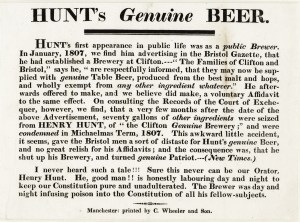
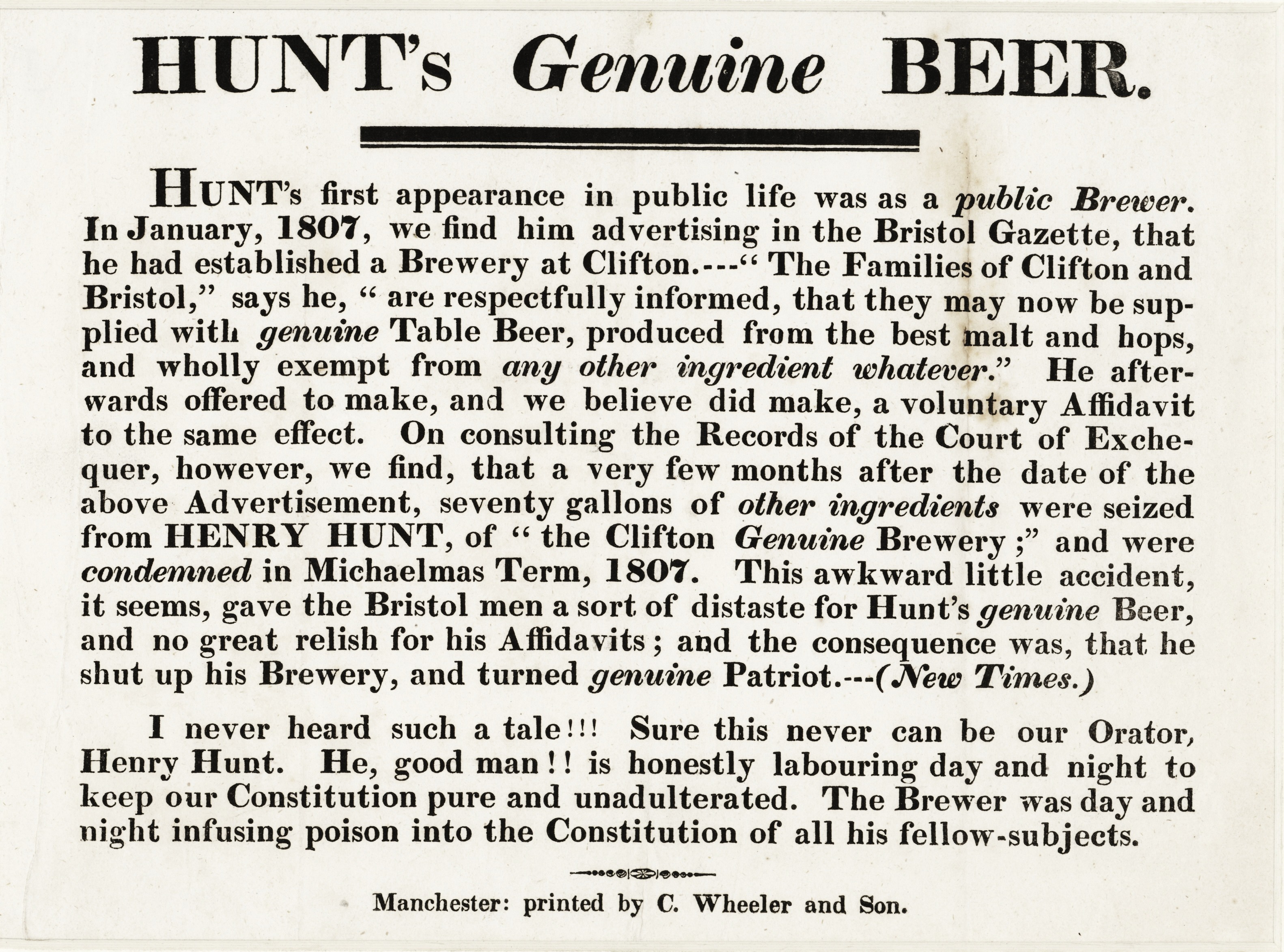
One of the flyers which circulated in Manchester before Henry Hunt spoke at Peterloo made critical reference to his time ten years earlier as a Bristol brewer. The flyer dated 7th August 1819 and signed A Patriot, claimed that Hunt had admitted to using ‘unwholesome drugs’ in the production of his porter. In fact, as below, this was a natural colouring as Hunt endeavoured to produce what today would certainly be styled craft beer

Henry ‘Orator’ Hunt (1773-1835) was one of the best-known English radical leaders of the first half of the nineteenth century, active before the Chartist movement. Hunt was a speaker at Peterloo in Manchester in 1819 and was jailed for the words he spoke there about the vote.

Hunt was a well to do West Country farmer, someone who William Cobbett looked to for agricultural advice, and after his political activities led to the decline of his farming business, he diversified into a range of other business activities including tea and coffee substitutes.

I’ve researched Hunt- the modern biography is by John Belchem-primarily because of an interest in political leadership and Gentleman Leaders, of whom Hunt was certainly one.

In doing so I came across his ownership, in the first years of the nineteenth century, of a brewery in Bristol. The connection between Henry Hunt and brewing is briefly mentioned in Mike Leigh’s film of Peterloo.

Belchem argues that a crisis in stewardship of the Bristol brewery he owned led Hunt to move from his Wiltshire farm to Bristol to assume direct control. It was in Bristol that he found an audience for his radical politics and began on the career that led him to Peterloo on 16th August 1819.

The Jacob’s Well brewery was based on the site of an old distillery at the foot of Brandon Hill on Jacob’s Wells Rd, Hotwells.

Hunt invested in the brewery at the behest of a relative and a young brewer was hired. Barley from Hunt’s farm was used, apparently of top quality and Hunt was keen that the beer produced was of a similar nature. The British Gazette reported it brewing a ‘genuine table beer produced from the best malt and hops and wholly exempt from any other ingredient whatsoever’.

Hunt was determined to avoid the use of additives in his beer and signed up with the Mayor of Bristol to this effect, but it appears the brewer had other ideas. Hunt had to intervene when losses at the brewery mounted and it became clear that the brewer was not only producing bad, adulterated, beer but also siphoning off cash as well. He fled and Hunt took direct control, moving from his farm to Clifton to do so.

I’ve found one further issue related to the brewery. Hunt began using a natural colouring to produce porter style beer. This drew the attention of the Excise- very probably a political interest- and barrels were confiscated from the brewery. Hunt contended, correctly, that he had done nothing illegal and a Court ordered the return of the beer with an apology.

The brewery, still loss making, appears to have been put for sale in 1809 (see below). The connection between beer and radical politics is well known, as is the Tory politics of most large brewery owners- the Beerage. However it is rare to find such a prominent radical figure as Hunt with a brewing heritage.

From Henry Hunt’s Memoirs Volume 2

The brewery was built upon the site of an old distillery, at the rising of a spring called Jacob’s Well, at the foot of Brandon Hill, and immediately below Belleview, at Clifton. The whole was soon completed under my own eye, and finished entirely on my own plan. I took advantage of the declivity of the hill, on the side of which the premises were situated, to have it so constructed that the whole process of brewing was conducted, from the grinding of the malt, which fell from the mill into the mash-tun, without any lifting or pumping; with the exception of pumping the water, called _liquor_ by brewers, first into the reservoir, which composed the roof of the building. By turning a cock, this liquor filled the steam boiler, from thence it flowed into the mash-tun; the wort had only once to be pumped, once from the under back into the boiler, from thence it emptied itself, by turning the cock, into the coolers; it then flowed into the working vats and riving casks, and from the stillions, which were immediately above the store casks into which it flowed, only by turning a cock. These store casks were mounted on stands or horses, high enough to set a butt upright, and fill it out of the lower cock; and then the butts and barrels were rolled to the door, and upon the drays, without one ounce of lifting from the commencement of the process to the end. This was a great saving of labour. I left the concern in the hands of my young friend, with every prospect of success, and I then returned to my farm at Chisenbury; having, as I was taught to believe, laid the foundation of a lucrative concern, from which I expected to derive a liberal interest for the money I had advanced, which was about eight thousand pounds, and at the same time afford a handsome income for my young friend. But such is the uncertainty and precarious state of all speculative concerns of this nature, and such the inconstancy of friendship, that, instead of ever receiving one shilling from this concern, I found it still continue to be a drain upon my purse. Bills were coming due, I was told, and they must be provided for, or the credit of the firm would be blasted. Duty, to a large amount, was to be paid every six weeks, and as often I was called upon to assist in making up the sum. I now began, although much too late, to curse the hour that I became connected with trade. I, however, did not despair. I met all the demands, till, having called in a considerable..


Hunt on the brewing of porter in Bristol in the early nineteenth century

When the act was passed, making it a penalty of two hundred pounds to use any _drug, ingredient_, or _material_, except malt and hops, in the brewing of beer, Alderman Wood obtained a patent for making of colouring, to heighten the colour of porter. This colouring was made of scorched or burnt malt, and it was mashed the same as common malt, which produced a colouring of the consistency of treacle, and having nearly its appearance. As this patent was very much approved of, almost every porter brewer in England used it in the colouring their porter; and amongst that number I was not only a customer of the worthy alderman for colouring, but I was also a considerable purchaser of hops from the firm of Wood, Wiggan & Co. in Falcon Square. I had just got down a fresh cask of this colouring, and it was standing at the entrance door of the brewery, where it had been rolled off the dray, when news was brought me that the new exciseman had seized the cask of colouring, and had taken it down to the excise office. I immediately wrote to Wood, Wiggan & Co. to inform them of the circumstance; upon which they immediately applied to the board of excise in London, and by the return of post I received a letter from Messrs. Wood, to say, that an order was gone off, by the same post, to direct the officers of excise in Bristol to restore the cask of colouring without delay; and almost as soon as this letter had come to hand, and before I could place it upon the file, one of the exciseman came quite out of breath to say that an order had arrived from the board of excise in London, to restore the cask of colouring, and it was quite at my service, whenever I pleased to send for it. I wrote back a letter by the fellow, to say, that as the exciseman had seized and carried away from my brewery a cask of colouring, which was allowed by the board of excise to be perfectly legal to use, as it was made of malt and hops only, unless, within two hours of that time, they caused it to be restored to the very spot from whence it was illegally removed, I would direct an action to be commenced against them. In less than an hour the cask of colouring was returned, and the same exciseman who had seized it came to make an apology for his error. His pardon was at once granted, and so ended this mighty affair; and I continued to use the said colouring, as well as did all the porter brewers in Bristol, without further molestation, as long as I continued the brewery; never having had any other seizure while I was concerned in the brewery.


Detail on the brewery

Henry Hunt announced he was quitting the business and put it up for sale in January 1809 (Bristol Mirror – Saturday 31 December 1808) but it looks to have been still unsold in 1810 ( Bristol Mirror – Saturday 10 March 1810). The brewery was in the hands of J Highett from Weymouth by 1811 (Bristol Mirror – Saturday 09 March 1811) but was put up for sale again the following year (Bristol Mirror – Saturday 29 February 1812). It was put up for sale again in 1813 by Joseph Pope, together with a ‘new copper furnace, never used’. By 1827 it was being described as a ‘late brewery’ (Bristol Mirror – Saturday 24 February 1827).


Thanks to Terry Collmann

Articles

The Peterloo Deniers: from the Telegraph in 1969 to The Times in 2019. Will 2025 find new deniers?

In Uncategorized on August 14, 2019 by kmflett

From the Telegraph in 1969 to the Times in 2019 the Peterloo deniers

16th August 2025 is the anniversary of Peterloo. Perhaps Nigel Farage will support the Yeomanry who cut down protesters for the vote on that Manchester Monday. Peterloo denial has a history

On the 150th anniversary of Peterloo The Times made no mention of the matter. The Telegraph by contrast focused on Peterloo as left-wing propaganda.

On the 200th anniversary The Times followed the Telegraph’s line.

Telegraph 15th August 1969

Be sure the Leftist legend of Peterloo will last a long time yet in undiminished vigour for all that any disobedient historian can do. This is not to say that the legend is wholly false that no poor under-nourished working men bled and died in St Petersfields, that the yeomanry at Peterloo were all enlightened Tory philosophers and the demonstrators all envious and deceitful radical mischief makers. That would be as absurd as the received account. History is not simple.

But it can be made to seem simple for purposes of propaganda-which to us now means Left-wing propaganda. That is one reason, perhaps the main reason why we celebrate the anniversary of Peterloo tomorrow,

The Times 3rd August 2019

it had no wider historical significance and did not “change Britain” beyond feeding a tendentious account by left-wing historians of Britain’s traditions of radical protest. The progenitor of this was the Marxist academic EP Thompson, whose book The Making of the English Working Class (1963) threw together wholly disconnected movements, from millenarian Protestant sects to Luddite croppers, and claimed they had been ignored by mainstream historians. Politicians such as Tony Benn and Jeremy Corbyn have since, with a ropey grasp of history, added further anachronisms to the mix, such as the Levellers and the Tolpuddle Martyrs.

Articles

Summer Holidays & the impulse of the market economy from 1850-2026

In Uncategorized on August 14, 2019 by kmflett

August is what was and perhaps in some places still is known as High Summer.

In England and Wales school students are on holiday and others are at the beach somewhere, probably not in the UK unless its Cornwall.

Obviously its also raining as is traditional in the English August (one wonders how Peterloo on Monday 16th August 1819 would have turned out if it had rained?)

Yet August is changing as the focus of the market economy changes. Not so long I would set time aside during the month for various longer term projects that I didnt get time to do during the rest of the year. Now I dont get time to do them in August either. Meetings and calls continue as normal,

The House of Commons is in recess but the political world rolls on too and has at least since the campaign for the Labour leadership in the summer of 2015 took place

Of course August was also traditionally the silly season. In 1997 while Mr Blair was elsewhere John Prescott was acting PM and wandering on a beach compared a crab he had found to Peter Mandelson. Cue hold the front page. I suppose the nearest equivalent we’ve had this month is Caroline Lucas’s proposal for a National Government excluding pretty much anyone except a narrow group of people who she thought might think like her. It was a diversion from the troubles of the world for a moment or two.

In Victorian times- the right to any time off for working people started with the 1871 Bank Holidays Act, August also meant work if you could get it.

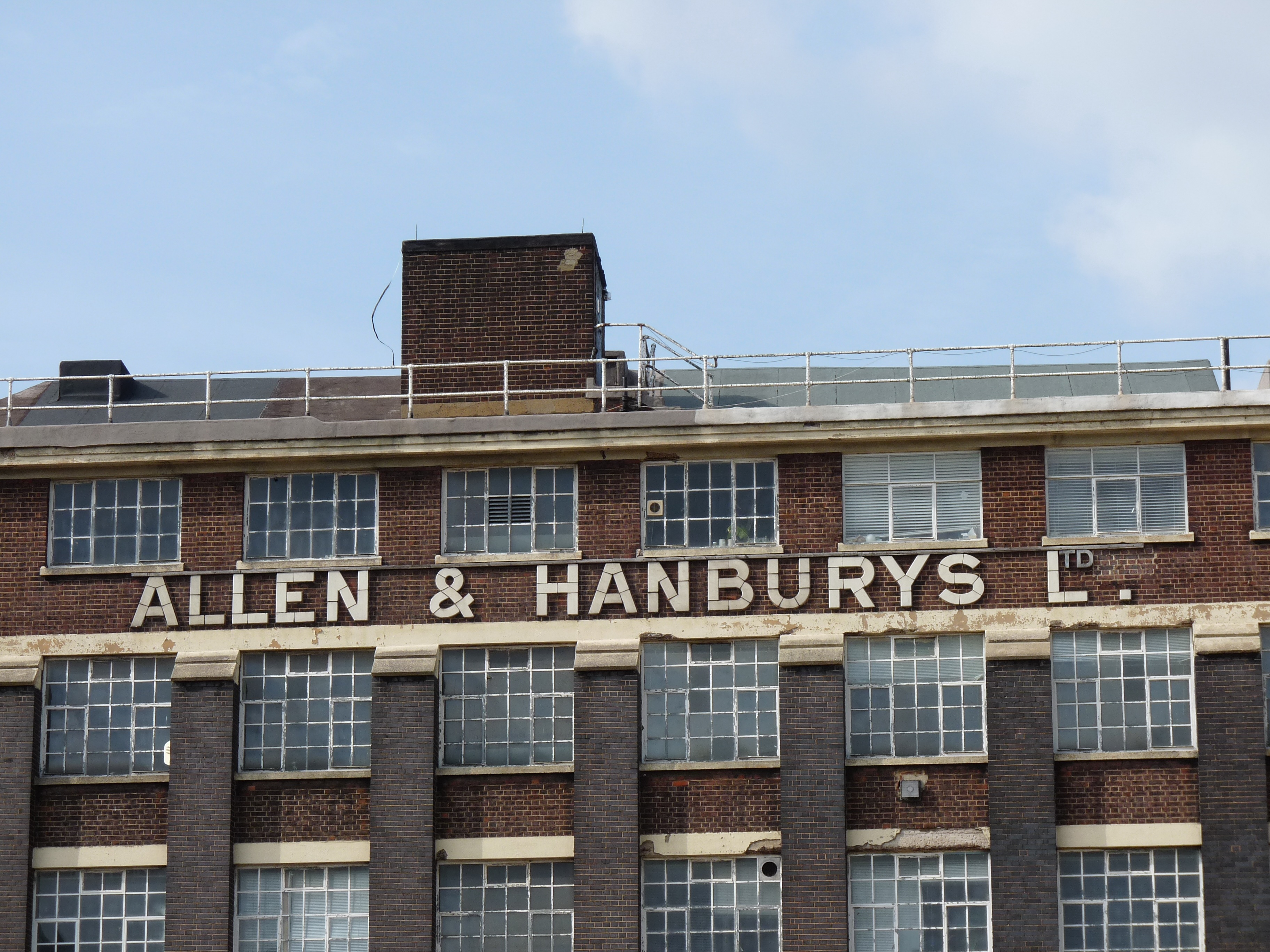
As Raphael Samuel noted in his long essay Comers and Goers during August the well off went on holiday and that meant less work for a range of occupations. He notes that the ‘indoor trades’ that provided goods for the world of rank and fashion found little business in August while women workers were particularly badly hit as those who used the services of hairdressers and laundresses went on holiday to the the UK seaside. Factory work was also hard to come by. Samuel notes that at one of the East End’s biggest employers Allen and Hanbury in Bethnal Green 25% of women workers were sacked every summer.

August it seems provides one of the conundrums of the market economy. Is it better to have regular work or have a holiday? Perhaps both wouldnt be a bad plan

Articles

After 200 years could the Peterloo Massacre happen again?

In Uncategorized on August 13, 2019 by kmflett

As the 200th anniversary of the Peterloo Massacre is marked on Friday one question that should be asked is whether something similar could happen again.

That is, the State turning on people peacefully protesting for democratic rights and leaving 18 of them dead and 700 injured.

Almost 60 years ago the late socialist historian E P Thompson argued that what the authorities took from Peterloo was that they could not get away with attacking peaceful protests and so didnt. Industrial disputes were different he noted.

Others might argue that events of recent decades in the UK and around the world bring that into question.

It is not a question that can be definitively answered and its one it’d be hoped never does have to be answered.

Surely however a key legacy of Peterloo is at least to ask and discuss the question, particularly as an Editorial in the Murdoch Times claimed there was no need to do so.

The Editorial and my response in the Morning Star are below

The Times 3rd August 2019

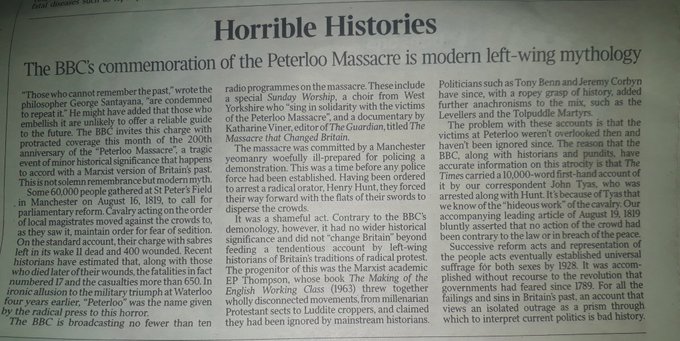
The Times view on the BBC’s commemoration of the Peterloo Massacre: Horrible Histories

This was a shameful act but the broadcaster’s treatment of it is modern left-wing mythology

“Those who cannot remember the past,” wrote the philosopher George Santayana, “are condemned to repeat it.” He might have added that those who embellish it are unlikely to offer a reliable guide to the future. The BBC invites this charge with protracted coverage this month of the 200th anniversary of the “Peterloo Massacre”, a tragic event of minor historical significance that happens to accord with a Marxist version of Britain’s past. This is not solemn remembrance but modern myth.

Some 60,000 people gathered at St Peter’s Field in Manchester on August 16, 1819, to call for parliamentary reform. Cavalry acting on the order of local magistrates moved against the crowds to, as they saw it, maintain order for fear of sedition. On the standard account, their charge with sabres left in its wake 11 dead and 400 wounded. Recent historians have estimated that, along with those who died later of their wounds, the fatalities in fact numbered 17 and the casualties more than 650. In ironic allusion to the military triumph at Waterloo four years earlier, “Peterloo” was the name given by the radical press to this horror.

The BBC is broadcasting no fewer than ten radio programmes on the massacre. These include a special Sunday Worship, a choir from West Yorkshire who “sing in solidarity with the victims of the Peterloo Massacre”, and a documentary by Katharine Viner, editor of The Guardian, titled The Massacre that Changed Britain.

The massacre was committed by a Manchester yeomanry woefully ill-prepared for policing a demonstration. This was a time before any police force had been established. Having been ordered to arrest a radical orator, Henry Hunt, they forced their way forward with the flats of their swords to disperse the crowds.

It was a shameful act. Contrary to the BBC’s demonology, however, it had no wider historical significance and did not “change Britain” beyond feeding a tendentious account by left-wing historians of Britain’s traditions of radical protest. The progenitor of this was the Marxist academic EP Thompson, whose book The Making of the English Working Class (1963) threw together wholly disconnected movements, from millenarian Protestant sects to Luddite croppers, and claimed they had been ignored by mainstream historians. Politicians such as Tony Benn and Jeremy Corbyn have since, with a ropey grasp of history, added further anachronisms to the mix, such as the Levellers and the Tolpuddle Martyrs.

The problem with these accounts is that the victims at Peterloo weren’t overlooked then and haven’t been ignored since. The reason that the BBC, along with historians and pundits, have accurate information on this atrocity is that The Times carried a 10,000-word first-hand account of it by our correspondent John Tyas, who was arrested along with Hunt. It’s because of Tyas that we know of the “hideous work” of the cavalry. Our accompanying leading article of August 19, 1819 bluntly asserted that no action of the crowd had been contrary to the law or in breach of the peace.

Successive reform acts and representation of the people acts eventually established universal suffrage for both sexes by 1928. It was accomplished without recourse to the revolution that governments had feared since 1789. For all the failings and sins in Britain’s past, an account that views an isolated outrage as a prism through which to interpret current politics is bad history.

The Murdoch Times rubbishes the paper’s own creditable history on Peterloo

Morning Star 13th August 2019

Dear Editor

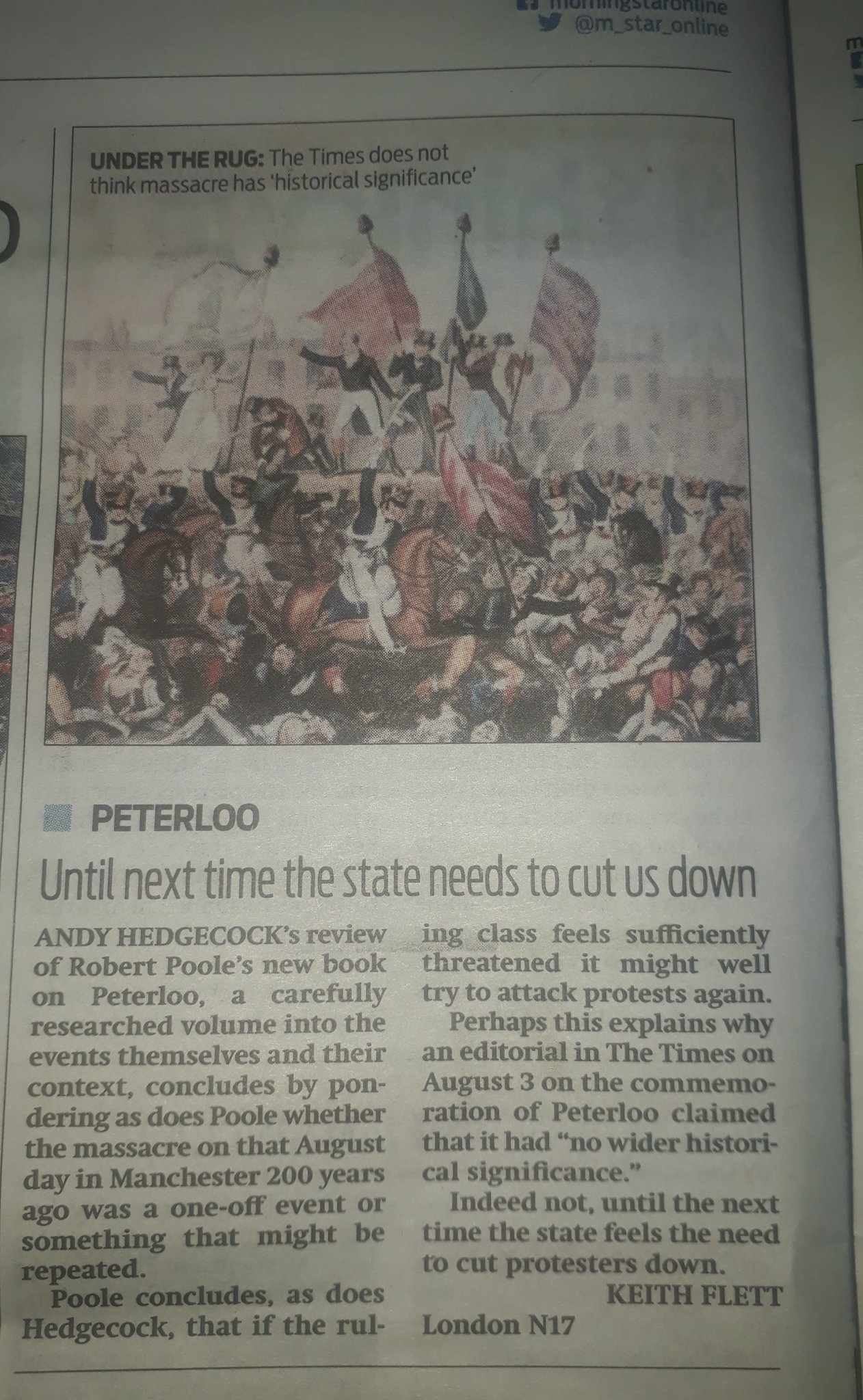
Andy Hedgecock’s review of Robert Poole’s new book on Peterloo, a carefully researched volume into the events themselves and their context, concludes by pondering as does Poole, whether the massacre on that August day in Manchester 200 years ago was a one off event or something that might be repeated. Poole concludes as does Hedgecock that if the ruling class feel sufficiently threatened they might well try to attack protests again.

Perhaps this explains why an Editorial in The Times on 3rd August on the commemoration of Peterloo claimed that it had ‘no wider historical significance’. Indeed not, until the next time the State feels the need to cut protesters down.

regards

Keith Flett


Articles

The politics of the price of a cup of coffee

In Uncategorized on August 13, 2019 by kmflett

The politics of the price of a cup of coffee

Banana Meinhoff

Ive noticed the price of a cup of coffee in chains such as Nero and Pret going inexorably upwards in the recent past. I paid £2.75 for a latte in a railway station Pret this week.

The reason why this is remains unclear but it is certainly not related to the cost of the coffee beans that are being used, as might be thought.

Earlier this year the Financial Times published a detailed piece on the state of the coffee market on 21st May. I’m not linking to it as most of the stuff the FT publishes is behind a paywall (I have a sub). However I pick up on relevant points below.

The price for coffee beans globally is ‘tumbling’ according to the FT even as more coffee from vanilla lattes to cold brews is being drunk.

The global coffee industry is worth $90bn having doubled since 2009 while global coffee output is at its highest since the 1990s. Demand has not kept pace so there is currently over supply leaving some coffee growers in financial trouble.

The problem apparently lies in the increase in supply of low grade arabica beans which has driven the price lower on the key trading benchmark the New York C. The average price for a pound of coffee beans here is around $1.20 with producers facing costs of $1.50 to produce the same. The problem arises particularly with the production of speciality coffee beans which cost more to produce but which don’t attract a premium price.

So while the coffee growers struggle to make a living increased costs of cups of coffee for the drinker doesn’t see more money reaching them. The FT notes that if an average cup of coffee costs £2.50 the cost of the coffee itself is 4% of that with rent, labour and tax being far the biggest elements of the cost.

If the coffee chains were paying their baristas a living wage or beyond that might be lived with. As it is the cost of a cup of coffee appears to have little relation to the actual cost of coffee

Articles

How the Chartists Grand National Holiday of August 1839 stopped Manchester

In Uncategorized on August 13, 2019 by kmflett

The Chartist Grand National Holiday was called for 12th August 1839, 180 years ago. The aim was to stop work, withdraw any savings and abstain from excisable products such as tobacco and alcohol until capitalism ceased to be.

As capitalism is still with us clearly it didn’t work.

However in the short term certainly in industrial districts it did.

The Times 14th August 1839 reported a successful effort by what would now be called a Chartist flying picket to shut down mills in Manchester:

‘A second party of Chartists..took the mills in Oldham Road and Ancoats. The party was up to 1,000 strong and marched in procession, headed by a band of music. A man named John Holmes..marched at the head of this procession with a banner on which was the cap of liberty with these inscriptions- on the obverse, ‘The earth, the right of man’ on the reverse ‘He that will not work, neither shall he eat’. This party had turned the hands out of six mills before they were interfered with by the police. They were ultimately attended by a body of about 60 policemen, supported by two troops of Dragoon Guards and a party of the 86th infantry’

Serious stuff indeed..

Articles

William Hulton: the man who sent the Yeomanry in at Peterloo on 16th August 1819. A lifelong Tory

In Uncategorized on August 12, 2019 by kmflett

William Hulton: the man who sent the Yeomanry in at Peterloo & lifelong Tory

This week we mark the 205th anniversary of the Peterloo Massacre.

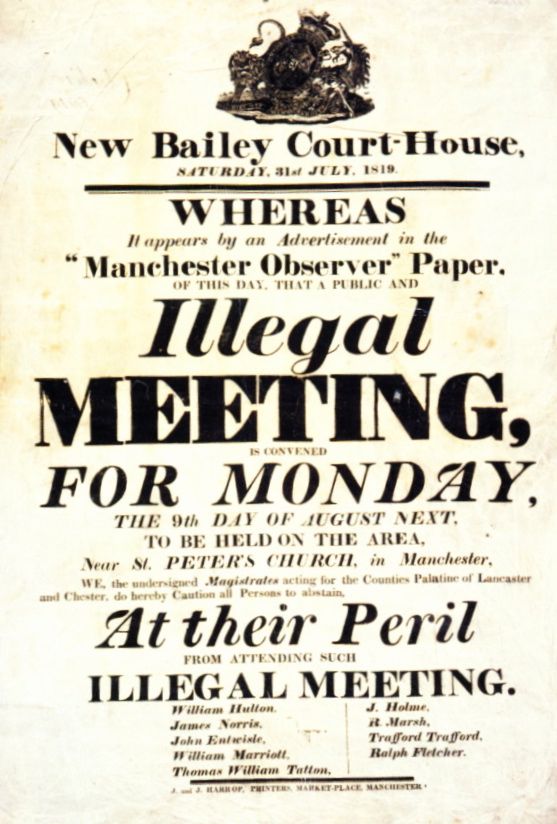
The event itself took place on Monday 16th August 1819 in central Manchester (very close to where the GMex conference hall now is). A peaceful protest for the vote left up to 18 dead and many hundreds injured as the local Yeomanry, military volunteers on horseback armed with sabres, were sent in to disperse the crowd after Magistrates determined that the meeting, as it  was deemed a tumultuous gathering, was illegal.

The Magistrate who gave the order to send the Yeomanry in was William Hulton (1787-1864).

It may be thought that I have been making a partisan political point in calling for Rishi Sunak, still Tory leader until November, to apologise for Peterloo 205 years on. Partisan, no doubt, but also historically accurate.

In a review of books published to mark the 150th anniversary of Peterloo in 1969 EP Thompson noted that Hutton’s mother had a prize horse called ‘Church and King’ providing a flavour of what the family was like. He noted that when it came to events like Peterloo it was not so much that Hulton would lie about what took place (he did) but that he was simply not interested in what the ‘plebs’, those fighting for the vote, said or did.

Hulton nevertheless had an interesting and lengthy life.

Educated at Brasenose College Oxford, in 1811 he became High Sheriff of Lancashire. In this capacity he sentenced four Luddites to hang at Lancaster Castle for arson at Westhoughton mill.

Hulton was then 24 but such was his reputation as a class warrior that by 1819 he was chair of Lancashire and Cheshire magistrates.

He was in charge of the magistrates that sat in a house overlooking St Peters Field in central Manchester on that August Monday 205 years ago as protesters gathered. EP Thompson suggests that it is likely that he had already had the backing of Home Secretary Sidmouth to disperse the crowd using force come what may.

Between 1.15 and 1.45 on the day, that is exactly what the Yeomanry on his order did.

The Peterloo Massacre as those events are known meant that Hulton became notorious and it meant that standing for public office was not an easy option for him.

Given his family background however this was not a problem.

The family estate Hulton Park was the site of no less than seven coal mines. In fact such was the extent of the workings that even before the Stockton to Darlington railway had been built George Stephenson had been engaged to build a rail line to take the coal to market.

In 1824 Hulton became Chair of the Leigh and Bolton railway company.

Hulton’s relations with his mining workforce were predictably dreadful. He paid them not in money but in kind until forced to change by the 1831 Truck Act. He refused entirely to countenance mining trade unionism.

In the twentieth century in 1910 there was a mining disaster leaving 344 dead at one of Hulton’s mines.

Matters did not however go well for the Hulton family. The mines were nationalised in 1947 and while compensation was paid the family source of continuing income was removed. By 2000 the Hulton family estate was up for sale.

Hulton left another legacy. As EP Thompson notes in 1832 the Reform Act, a result of Peterloo in 1819, saw the Tories lose South Lancashire. Hulton was one of those who met in a beer house to form the South Lancashire Conservative Association dedicated to defending, like the family horse, Church and King.

That organisation was one of the forerunners of the modern Tory Party.