Jacob Rees-Mogg & the Brexiteer narrative of British history
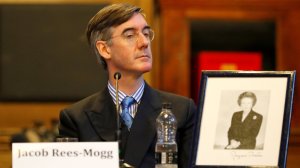
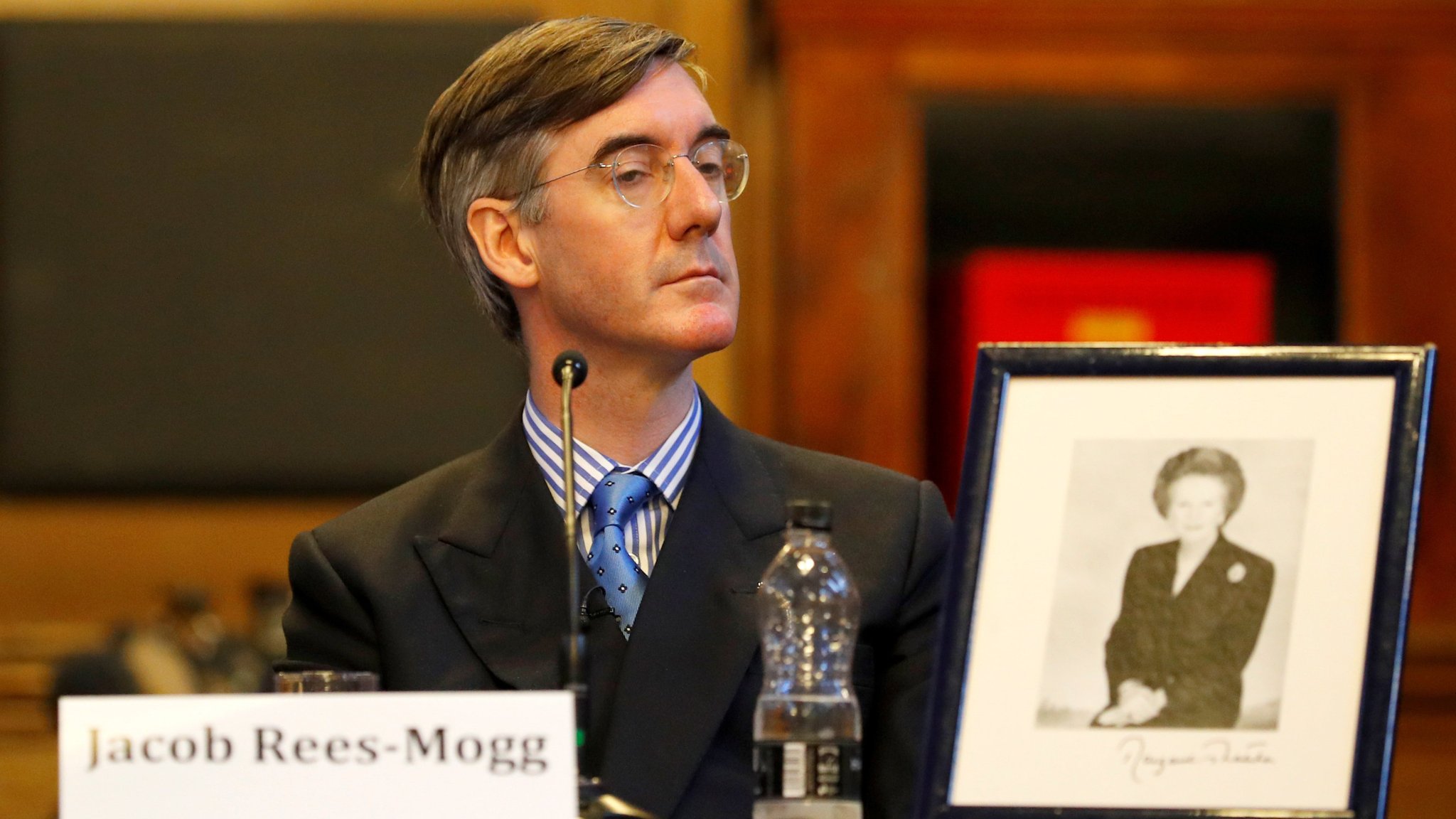
REUTERS/Phil Noble
Brexiteers have constructed a 2018 version of the imperial ‘Our Island Story’ to underline their views that Britain and British history is distinct from that of Europe. Boris Johnson and Michael Gove have been foremost in pushing Brexit history.
However let’s not forget the hard-right Tory MP Jacob Rees-Mogg, who spends his time as a businessman investing abroad while pushing for Britain to leave the EU. He also displays Victorian social attitudes.
Rees-Mogg father William was Editor of the Times whose most useful public act was to try and prevent the sale of the paper to Rupert Murdoch.
William graduated with a history degree and Jacob did the same from Trinity College, Oxford.
Little might be thought of Jacob Rees Mogg’s upper second class history degree were it not for the fact that he has recently started making historical comparisons with current events while making interventions on the EU debate from, of course the perspective of the hard right.
A number of well known MPs in recent years have held history degrees. George Osborne for example had one, although he displayed as much historical knowledge as did economic while Chancellor- that is none. Gordon Brown, also had a history qualification and to his credit had both written some labour history and showed some historical sense.
Rees-Mogg is in a slightly different class in the sense that it is difficult to work-out whether his occasional historical pronouncements are in fact related to historical knowledge he gained while studying for his degree or simply off the cuff comments.
His first historical comment on Theresa May’s Brexit plans was that they risked splitting the Tory Party in the way Peel had done in 1846 over the Corn Laws. Broadly this might seem a decent historical point. Peel repealed the Corn Laws which made bread cheaper (and hence allowed employers to lower wages) which was not in the interest of the landowning and farming elements of the Tory Party. It was however in the interests of British capitalism in general as the country became increasingly industrialised. To suppose that whatever Ms May thinks she is doing on Brexit is about the best future for capitalism is where Rees-Mogg’s point fall down. His line however is that in failing to pursue a hard Brexit May is facilitating a split in the Tory Party as Peel did.
His second historical intervention related to the Treaty of Goulet in 1200. While 1846, even if it is well over 150 years ago, is still very much within the broad economic and political framework in which, unfortunately, Britain still operates, the beginning the thirteenth century is not.
The Treaty was about King John handing over some English controlled land in France in return for French recognition of him as King of England. It will be remembered that in 1066 the French had successfully invaded and taken control of the English crown, so one might think that King John was not in the best negotiating position.
Rees-Mogg point was that the concessions made to the French were of the same scale as those made by Theresa May’s Chequers plan for Brexit. It is difficult to see this as a serious historical point.
That is perhaps the key thing about Rees-Mogg the history man. It is remarkably difficult to discover what period of history he actually studied at Oxford, although we do know that he spent time laying down the basis of his later Conservative political career.
I was able to track down someone who had been a fellow student in one seminar group at Oxford with Rees-Mogg who was studying Anglo-Saxon history pre-1066 but they remarked that the degree course was eclectic.
Most recently he has suggested that Theresa May’s EU deal will make Britain a slave State. The above student tweeted on 14th November that since they had studied slavery with him at Oxford he must know this is BS (notwithstanding one’s views on May’s deal).
Jacob Rees-Mogg does know some history but don’t confuse that point with his political pronouncements. Richard Evans one of Britain’s foremost modern historians made the point in the New Statesman (14th November)
Yet Brexiteer nostalgia goes back much further than the Georgian and Victorian eras. Jacob Rees-Mogg, for instance, proclaimed proudly to a fringe audience at last year’s Conservative party conference that Brexit would be “Magna Carta, it’s the burgesses coming at parliament, it’s the Great Reform Bill, it’s the Bill of Rights, it’s Waterloo, it’s Agincourt, it’s Crécy. We win all of these things… [Audience member: ‘Trafalgar!’] And Trafalgar, obviously.”
It would take too long to unpack all the historical errors in this catalogue in detail, but one might at least point out that Magna Carta, the Bill of Rights and the 1832 Reform Act all excluded the vast majority of the British population; Agincourt and Crécy were fought not to liberate England from foreign rule but actually in pursuit of an English claim to the throne of France. And, of course, rather inconveniently, Waterloo was won by the Prussians, not by the British. Wellington was a great defensive general and kept the French at bay, but the battle was only won when his allies Blücher and the Prussians arrived; and in any case Wellington’s allied army only included a minority of British troops. Trafalgar was fought to maintain the British empire, not to liberate Britain from French or European domination. As for “the burgesses coming at parliament”, who knows what that means?
Rees-Mogg’s bizarre catalogue is part of a larger Brexiteer narrative of British history that sees it as entirely separate from, or antagonistic to, the history of the rest of Europe.
Not all do we need historians like Richard Evans to unpack the factual inaccuracies and distortions on Rees Mogg’s history, socialist historians surely need to promote a genuine people’s history perhaps in the broad area of AL Morton’s Left Book Club edition