Review of Geoffrey Roberts Stalin’s Library A Dictator and his Books Yale New Haven and London (2022, 2025). 259 pages, some pictures.
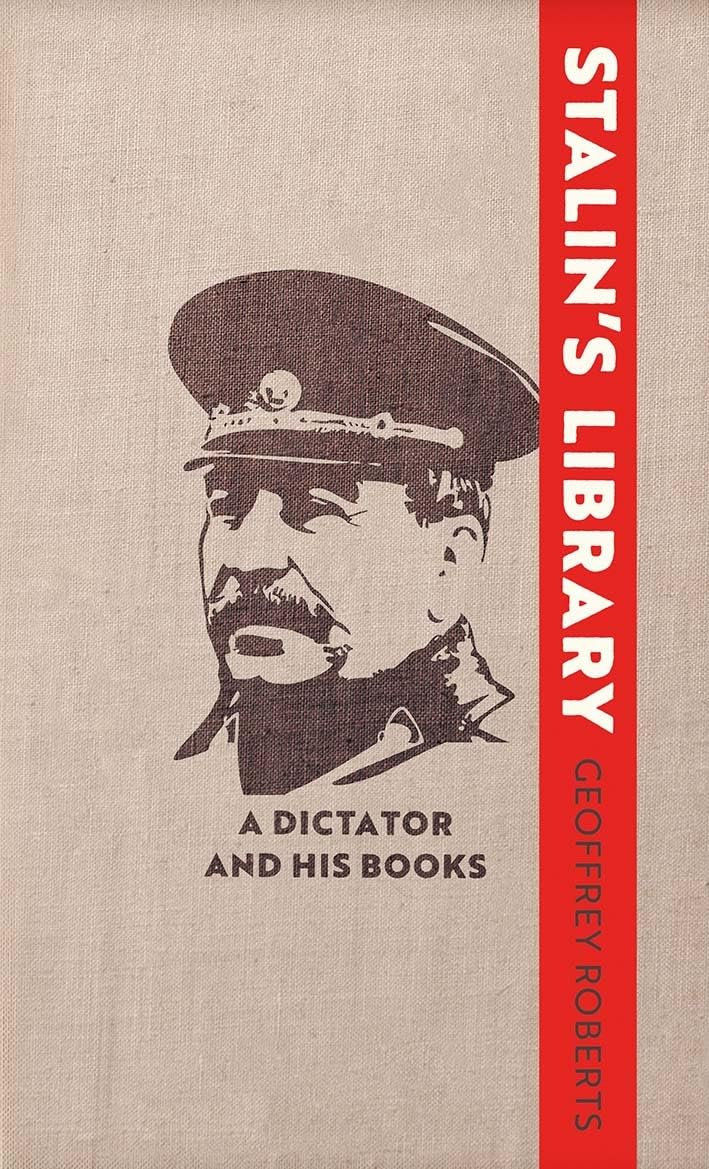
(For Keith Flett, London Socialist Historians’ Blog)
Richard Saville
Geoffrey Roberts’ writings on the Soviet Union come from a vast knowledge base, including a life of Marshall Zhukov, Soviet foreign policy, victory at Stalingrad and much else, Stalin’s Library likewise reflects huge reading and insight. But it’s method had to be different. Stalin amassed 25,000 books, journals, pamphlets and miscellaneous commentary. Inscribed on many books on politics and the military Stalin added his own thoughts, the Pometki, often in great detail. Not just the ‘hoo ha’, the line or asterisk next to some comment, many came with real clout. This tapestry was the inner thinking of a great leader of Russia, and covers in detail the revolution, the twenties and on after the second world war. This thinking, Stalin’s private thoughts, are part of the ideas emerging in his circles’ politics and adopted widely by the Soviet cadres who managed and implemented policy.
As Roberts works through these Pometki a picture emerges of a dedicated intellectual who ‘valued ideas as much as power’. Stalin read assiduously, even in the most difficult times of war, dividing his day to keep up the pace of study, cross referencing, indexing and framing his understanding. Years of Russian Orthodox training and the pressures of Tsarist rule seemed to galvanise the young Stalin; as with the wider group of the Bolsheviks in the Russian Social democratic Labour Party came serious mastery of Marx, Engels, Lenin, Plekhanov, Kautsky. The early years of the century saw Stalin devouring the classic Russian authors, including Tolstoy, Gogol, Chekhov, Dostoevsky, plus English, French and German authors abounding in Russian libraries. Bolsheviks fully understood the role of books and libraries and after 1917 invested in all sorts of new art and design for print materials. History, economic thought, art and architecture, various ways of seeing progress were strongly encouraged, for their own interest as also for supporting intellectual breadth and effort. In all this public libraries were vital; when the Nazis invaded they levelled and wrecked 4000, although in 1945 the Soviet Union still boasted 80,000.
Stalin possessed a phenomenal memory and entrenched the assets of Bolshevik training – always prepare in detail for any meeting, assess your audience, keep to succinct comments, back up points when asked, only returning if the audience needed reminding. As an orator and agitator, and leading Bolshevik propagandist, Stalin’s rigorous classical training paid dividends, and is a key reason why he was in such demand for agitational work, and many of his writings were translated to support the international struggle. One almost sees Stalin reading his way through his library, bringing some lengthy text down to the agitational level needed for different audiences. Perhaps this discipline, this thought about survival and struggle, the need to diffuse Marxist ideas, and the range of difficulties the young regime faced sees Stalin shifting the Pometki for his really critical post 1917 interventions – publishing in Marxism and the National and Colonial Question and the widely distributed Problems of Leninism of particular importance in the Indian Empire in forming the ideas of the nascent Communist Party of India, and of Nehru’s followers as they advanced to independence. And also via Great Britain and Europe, through the medium of ships’ crews, the to and fro of Indian students, the tourists and the thinkers behind Gandhi who were basic to the ongoing struggle for independence.
Stalin’s Library tackles the sheer volume of Pometki, and the range of comments by Stalin raise questions about who Stalin agreed with. This book touches on, often with lots of detail, the main questions concerning Russians from the revolution – on nationalism and the borderlands, on the varied types of socialism, including anarchist-socialism, on party organisation, democratic centralism and the damage from factional activity, the relationship of peasants to the working classes. Above all, perhaps, taking the view from Moscow, was the fierce antagonism from the second international, the attempted overthrow of the Soviets by the British invasion threatening Leningrad, the French assault on the Ukraine and the Crimea, the German and French and Polish nationalists fighting in the Ukraine and the Baltic states. This defence occupied the Bolsheviks for seven years, down to Lenin’s death in 1924. And defence involved the varied problems of class struggle, the Bolsheviks leaders grappling with the continuous upsets reported from the Soviet states. Indeed, one of the contributions Stalin made to political theory was over the ever-present fear of internal class conflict, Stalin realised that support for the Tsarist and capitalist and landlord claims were not squelched by the time Lenin died. The opposite in fact. Opposition intensified from reaction, aided as ever by foreign powers sheltering the royalists and the old rich living in Paris and London. So Stalin’s thought led to an intensification of the class struggle, especially in dealing with the kulaks.
Stalin read and notated all the key writings of the Bolsheviks and leading revolutionary theorists, Marx, Engels, and Lenin’s, plus those by Plekhanov, Rosa Luxemburg, Zinoviev, Bukharin, Kamenev, Molotov, Rykov, Lozovsky, and Kautsky. Roberts’ assessment is of a Stalin really trying to get a firm grip on what ‘worked’ and what was unlikely to work in practice. Predominately his reading was to learn and assess the correct ways forward. In all this Stalin held a high opinion of Trotsky’s writings and advice during the revolution and into the twenties, the Pometki endorsed Trotsky’s criticism of Kautsky over 1917, and on Trotsky’s assessment of the dictatorship of the Bolshevik party, ruling through the working class, and how the ‘Communists express the fundamental interests of the working class’. Roberts, in the lengthy chapter ‘Bah Humbug!, Stalin’s Pometki’ cites a range of the Pometki from other Bolsheviks’ writings, which confirm Stalin’s obligation to Trotsky on vital issues of the early twenties: to quote one important area, ‘At the Central Committee plenum of July 1926, Stalin claimed that he “held a moderate, not openly inimical stand against Trotsky” and had kept to this moderate policy. His close reading of Trotsky’s technical-economic writings of the mid 1920s – Towards Socialism or Capitalism? (1925); 8 Years: Results and Perspectives (1926); and Our New Tasks (1926) suggests to Roberts this might have been true. These works date from the period when Trotsky, having been forced to step down as war commissar in January 1925, was a member of the Supreme Council of the National Economy, which controlled Soviet industry.’ Stalin kept a close watch on the results of the New Economic Policy, and was particularly taken with Trotsky’s assessment that the NEP ‘over-empowered’ the kulaks and rich elements, including the vestiges of the landlord classes. Perhaps Stalin was more concerned with obtaining much needed resources for industrial construction, and was over confident of the powers of the working class in respect of the peasantry. By the close of the twenties NEP and courting the peasantry had to be replaced, with more state farming and collectivisation. Trotsky’s and other left views became more relevant.
Stalin’s views in the twenties grappled/morphed into three important theoretical positions: most often cited since the early twenties was ‘Socialism in one country’, a perhaps diplomatic position given the inevitable result of the military situation of those years, and the need for co-existence with international business. This involved the Comintern, a crucial part of the Bolshevik mantra by 1919. Gradually, in the mid-twenties the obvious strengths of western capitalism and their Empires led to a theory of the ‘stabilisation’ of capitalism, in recognition of the USA, France, Germany and Britain diversifying their economies with mass production and new lighter industries. The Soviet Union needed these trades, and had to buy the technology and know-how from the west. The second contribution came with Stalin’s acceptance of the views of Trotsky and other Bolsheviks that capitalism really had to be driven out of the Soviet Union, or the Revolution would be in danger. All Bolsheviks understood why some past revolutions failed, or faced compromise – Stalin’s library, and Soviet libraries generally, contained numerous works on failed revolutions, and recent times showed how difficult it was to sustain the overthrow of the landlord and capitalist classes. Constant struggle was required to suppress the older capitalist ideas and weed out its supporters. The third area of theoretical development was in Party organisation, with the full span of democratic centralism and a tight discipline on members. The Comintern tended to express this in a somewhat patchwork state, with queries expressed by Party delegates at Comintern congresses. It was obvious that efforts in China required a drastic overhaul after the brutalities inflicted by the Kuomintang, the situation in the Indian Empire called for a varied understanding; in India alone with 526 princely states, 65 language groups, three major religious groups, over 600,000 villages and small towns, and a well-armed and brutal police regime from the British and the princes, here and elsewhere slogans needed variety.
Geoffrey Roberts serious and dense research goes to the heart of major questions about the early years of the Soviet Union, and there is much on the later years which is also relevant and thought-provoking. For older comrades the small print of the paperback may require bright sunshine in order to read it, a timely reminder to the publisher that bigger print improves readability.
RIchard Saville is the son of the late Marxist historian John Saville and a distinguished economic historian in his own right. The book reviewed here represents research in the brief post 1989 period when Russian archives were fully open to Western scholars. Perhaps needless to say in my view any understanding of Stalin’s reading and theoretical understandings need to be balanced by the realities of the Moscow Trials and the Gulag