Hefin David 1977-2025. A politician with Hinterland
Beard Liberation Front
Contact: BLF Organiser Keith Flett @keithbeard.bsky.social
13th August
The Beard Liberation Front has paid tribute to Hefin David, a Labour member of the Welsh Senedd, who died on Tuesday at the far too young age of 47.
Hefin David who had represented Caerphilly in the Senedd since 2016 was one of the most well known beard wearers in Welsh public life. He shared the coveted Beard of Wales 2025 title with Sir Tom Jones in March and was an enthusiastic supporter of the BLF.
BLF Organiser Keith Flett said, Hefin’s death is a desperately sad event. Denis Healey used to speak of rounded politicians having ‘hinterland’ beyond their political careers. I often interacted with Hefin on Twitter not just about beards but also about real ales he was trying in his local club and other matters that went a long way beyond the strictly political. Political life in 2025 needs more people like Hefin David and his passing will be a time of reflection and memory for the impact he made.
Jeremy Corbyn’s potato husbandry has roots in British labour history
Jeremy Corbyn’s allotment gardening, theory and practice, has come under attack in the Guardian and he is rightly defended his allotment methods.
As he has written this week allotments were long fought for against the wealthy who saw land as a source of profit, a tradition of claiming people’s land that goes back to opposition to enclosure from the late eighteenth century and the Chartist Land Plan of the 1840s.
Historical accuracy however does require the footnote that William Cobbett argued potatoes were suitable for pigs not people.
The letter below appears in the Guardian 9th August together with several others including one from Toby Wood who suggests that the new ‘your party’ should be named the Allotment Party
I must respond to a scathing attack on my gardening knowledge and integrity. Dariel Francis claims I am wrong about “leaving spuds in the ground till February” (Letters, 6 August). I never said I would – and I reject this scandalous and deeply hurtful accusation. I said “digging ground for potatoes” in February. That means manuring and preparing the ground, before planting the potatoes in March or April. Save our potatoes – and save our allotments! Jeremy Corbyn MP Independent, Islington North
Research has underlined that Corbyn’s potato husbandry has roots in British radical history.
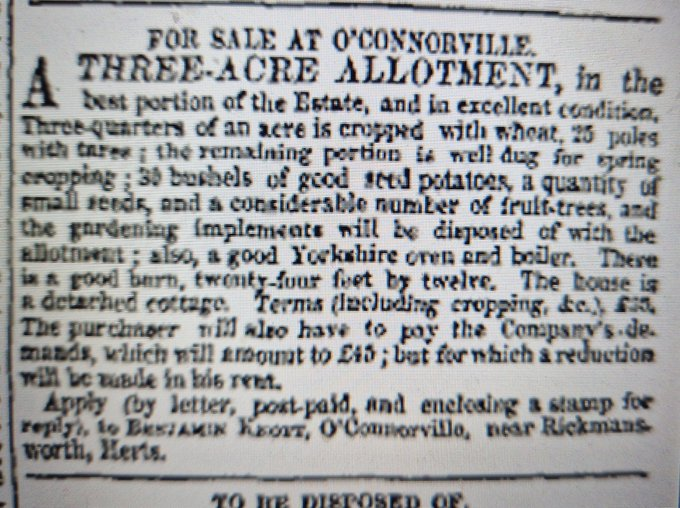
The weekly Chartist newspaper in 1849 carried an ad from a smallholder on the Chartist Land Plan estate at O’Connorville. The estate was in Rickmansworth (off the M25) and the Chartist dwellings still stand albeit as highly desirable properties.
The ad makes reference to potatoes being an important part of the small holding that was up for sale.
Jeremy Corbyn himself is part of labour history, albeit an active one, and his potato gardening underlines the point
Reading the Runes: The hard right figures JD Vance has met on his Oxfordshire sojourn
US VP JD Vance is on what might be described as a working holiday in England(& possibly Scotland).
Last weekend he stayed at the official residence of Foreign Secretary David Lammy in Kent. Lammy is my MP and coming from Tottenham he is not a Tory, but it might be reasonable to say that his main political principle has been to advance his own career. Reports suggest that he shares Christian beliefs with Vance, but that is a broad spectrum. Vance is a Christian Zionist, while I’ve never noticed that aspect to Lammy’s Christianity.
That said this is a footnote to Vance’s stay in Oxfordshire. He has met a number of hard right figures. On Monday evening he reportedly had a BBQ (well his staff did) and amongst others hard right Tory MP Danny Kruger and Cambridge academic James Orr were present. Orr’s ideas have been influenced by Vance’s Hillybilly Elegy and Lord Glasman’s Blue Labour and he in turn has influenced Vance. Also present according to the BBC was pillow salesman Thomas Skinner who is also a self-styled social media influencer. He appears to be on the hard right politically.
On Tuesday Vance met at some point Tory leader in waiting Robert Jenrick, whose politics are probably a little on the moderate side for Vance. Tory MP Chris Philp was also there presumably to carry Jenrick’s bag.
On Wednesday, again reported, Farage apparently met Vance. Farage said it was confidential and so far there is no visual evidence of the Reform CEO having been in Oxfordshire. It sounds more likely it was a breakfast phone call.
Reading the Runes on this it may be that in meeting Jenrick and probably being in touch with Farage, Vance is just keeping tabs on some of the players on the UK hard right. His meeting with Orr, and Kruger who has been associated with the National Conservatism strand in Tory politics is more likely where Vance’s actual sympathies lie. That is on the further shores of the Tory Party but a little bit more based on political ideas than Farage’s trademark bluster
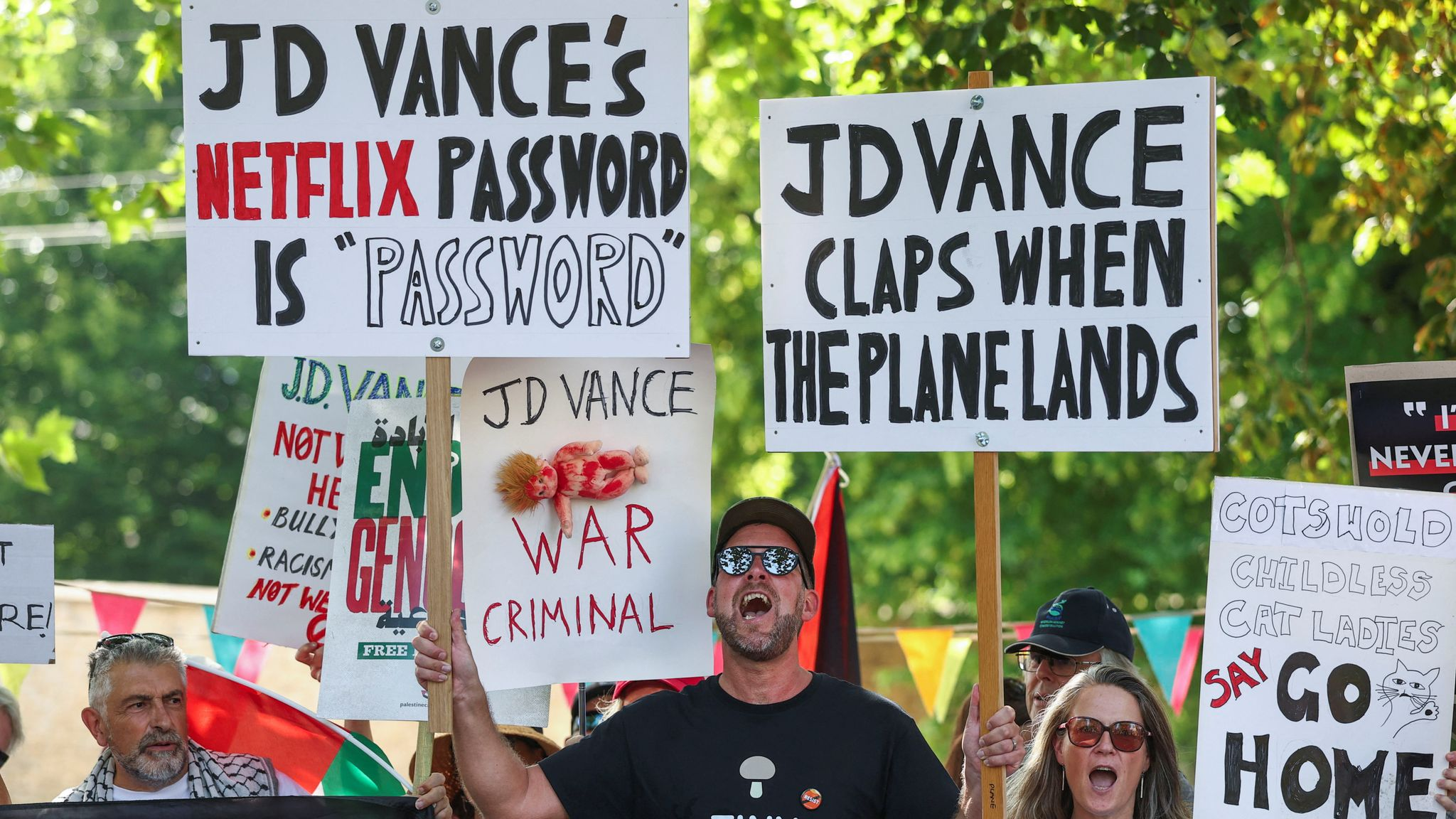
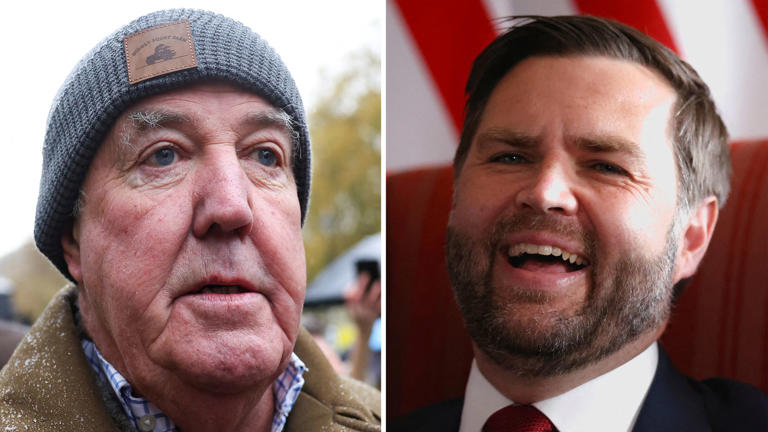
JD Vance US Vice President has been staying at a mansion in Dean in the Cotswolds. Its near to Jeremy Clarkson’s hobby farm Diddly Squat. Clarkson has been complaining about the disruption caused by Vance (& earlier his beard).
As Marx reminds us the bourgeois are a band of warring brothers.. in this case bigoted ones.
Both Clarkson’s farm and Vance’s holiday mansion are close to the late 1840s Chartist Land Settlement of Minster Lovel (10.5 miles)l which aimed, with limited success, to allocate small holding to workers opting out of industrial capitalism.
August is holiday season for many. On 12th August 1839 the Chartists declared a Grand National Holiday to bring down capitalism
Yet 187 years ago at the start of the development of the liberal market economy the Chartists tried a very different kind of idea of a holiday
The Grant National Holiday has been ignored or derided as a failure by many historians but it was an early attempt at a General Strike- its aim being to bring down capitalism.
The ‘Holiday’ was the idea of William Benbow. Like many radical activists in the nineteenth century he ranged across a variety of occupations, from pornographer to coffee house keeper to grocer and journalist, to survive.
He had been pushing the idea of a Sacred Month for decades in radical circles with no great immediate impact. He did however publish it as a pamphlet in the early 1830s and this can be freely accessed on the internet today
Benbow’s plan might well have stayed simply an interesting idea were it not for the fact that the Chartist Convention of summer 1839 adopted it as policy and determined to put it into operation in August of that year, starting on the 12th of the month.
It is very much a view of the early labour movement. We are familiar with General Strikes around the world which are in protest at something or which are demanding specific things. The Grand National Holiday was neither of these. It simply planned to disengage from capitalism until the system stopped working.
This meant that not only was no work to be done, but that supporters of the Sacred Month should withdraw any savings they had in banks or other institutions. They were also required to abstain from all excisable articles such as drink and tobacco. On 12th August 1839 in many, mainly northern areas, the pubs were shut.
It was argued that aside from anything else this prevented any disorder and drunkenness as the month got underway.
How was the call for the Sacred Month implemented?
Again as with more recent General Strikes it was not and could not be a matter of trade unions issuing instructions to members to stop work, mounting picket lines and so on. The labour movement infrastructure for this did not exist in 1839.
Instead the method used- and it was one to be echoed in the 1842 General Strike, which is better known to history-was different.
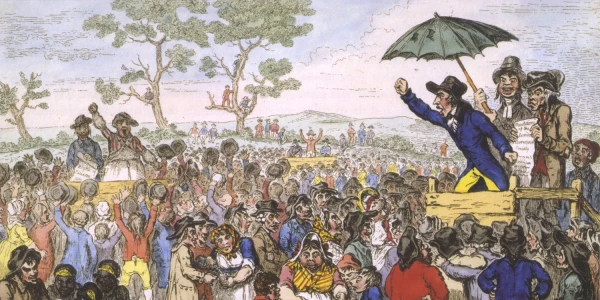
The weekly Chartist newspaper The Northern Star for the 17th and 24th August 1839 reported meetings across the north, often with very large turnouts comprising a majority of the working population of particular areas, which then proceeded to march to surrounding locations to pull others out in support of the Sacred Month.
Perhaps the best way of describing it is a mass flying picket, but before the motor vehicle, the only way to do this was to march on foot.
There is not a uniform picture of how long people stayed out for- some days in a number of areas- but not the whole month. Again the logistics were complicated. With so many out, and long before any kind of welfare system, people had to balance support for the holiday with the need to survive in terms of eating and providing for those unable to work.
Perhaps some had small holdings that allowed them to survive without wage labour, possibly being only recently agricultural workers. This was part of the project that became in the later 1840s the Chartist Land Plan, but for the Sacred Month itself detail on this remains, as yet, scarce.
Even in areas where the strike did not take hold there was at least symbolic support. In London on 12th August there was a mass Chartist meeting on Kennington Common for example.
Why did the strike fail?
Firstly because many leading Chartists were preoccupied with State persecution, arrests and trials, relating to the 1839 Convention.
Secondly because the 1839 Metropolitan Police Act had seen the introduction of new police forces in some areas. For example in Manchester the police, known as the ‘bludgeon men’ attacked and arrested strikers.
Yet this was not the last of the Chartist Challenge. The Sacred Month was just part of a repertoire of strategies that were being tried, mostly for the first time anywhere in the world, to see which might succeed in bringing an end to capitalism.
In November 1839 in Newport South Wales there was an attempt at armed revolution. It almost succeeded.
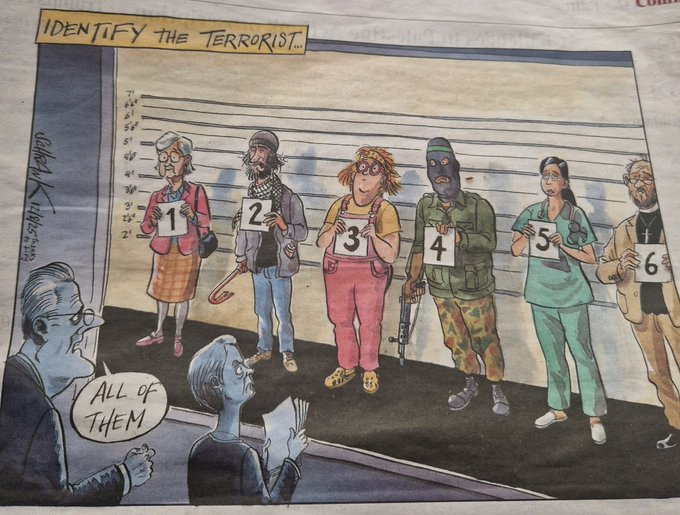
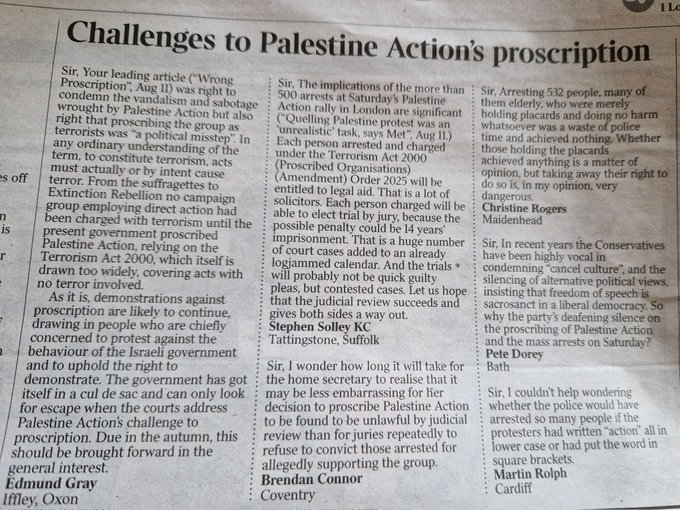
The above is The Times letters page of 12th August 2025. The lead letters are on Yvette Cooper’s decision to proscribe Palestine Action. Not one supports her decision. If Cooper is still digging this might be a sign to stop.
E P Thompson retained an enduring fascination for the Times letters page as representative of a swathe of Middle England thought, often rather reactionary. Not one letter is from London, let alone North London
Its not quite the Daily Telegraph but its a long way from the Guardian and suggests that Yvette Cooper is increasingly isolated on this issue
The usual Reform Monday press conference took place on 11th August. It has been a Monday feature of the Parliamentary recess and has focused on ‘lawless Britain’ essentially an attempt by Nigel Farage to ‘influence’ round two of the Farage Riots. That hasnt quite worked and on Monday Farage was missing from his own presser.
Of course it was focused on the ‘Farage fillies’ (their term) but since when as the CEO failed to turn up at a key event organised by his own business?
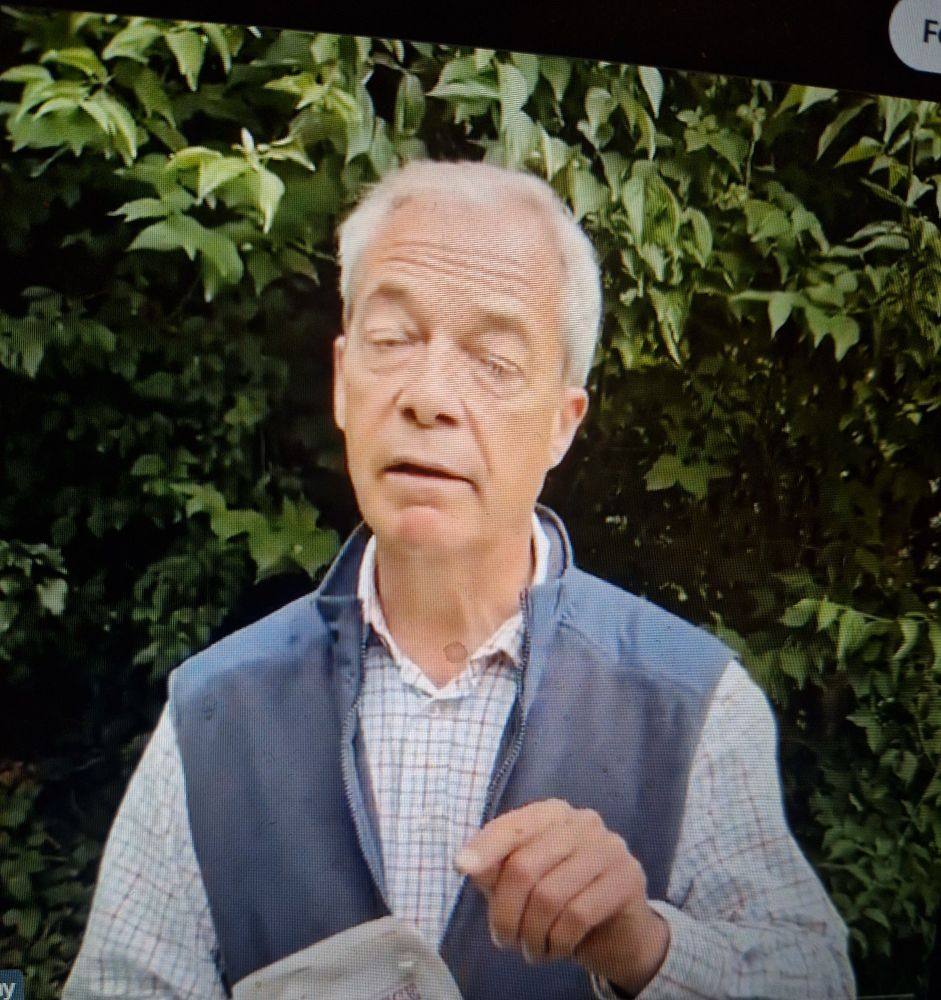
Farage’s Twitter account has continued to post the usual racist blather in recent days- its not hosted by Farage- but the last known appearance of the Reform boss was on 8th August where he looked rather tired….
12th August 1839: Grand National Holiday against the smooth faced men
On 12th August 1839 the Chartists called a Grand National Holiday, a month long general strike to bring down capitalism. It had a good deal of popular support, it did actually happen, but ultimately could not be sustained.
A key populariser of the idea was the veteran radical William Benbow 1787-1864. He had toured industrial districts in 1838 and 1839 speaking at meetings.
The Northern Star for 1st June 1839 captured part of a ‘spirited and excellent speech’ he made at a packed meeting at the Stanley Arms Inn in Stockport.
Benbow directed his speech ‘exclusively to the industrious classes and not to those middle-men, those smooth faced..men who had sold the people to the Aristocracy and would sell God himself if he could be personified on earth’.
Clearly Benbow had in mind not just the exploitation of employers but also their appearance.
Appearance was important to the Chartists. Chartist leader Feargus O’Connor often addressed supporters as those wearing fustian jackets and having unshorn chins. Surviving drawings of Benbow suggest he was clean shaven but evidently not smooth faced.
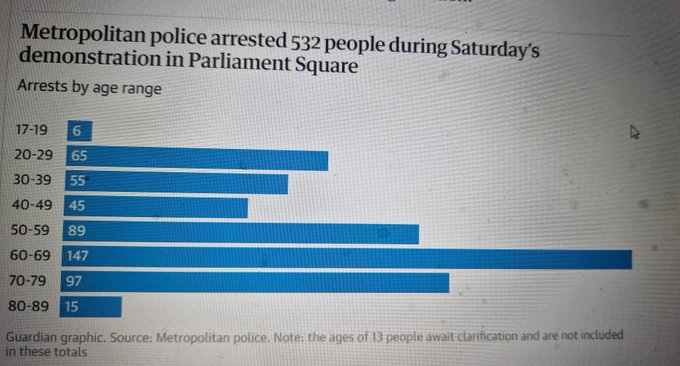
The above figures are very unlikely to be entirely accurate. After all they have been compiled by the Met Police who aren’t very good at reliable evidence. Even so they give an interesting counterweight to the often repeated view that people get more reactionary as they get older. Clearly not universally so…