Articles

50 years on from 5th June 1975 Euro-Referendum. Remembering the role of the left

In Uncategorized on June 6, 2025 by kmflett


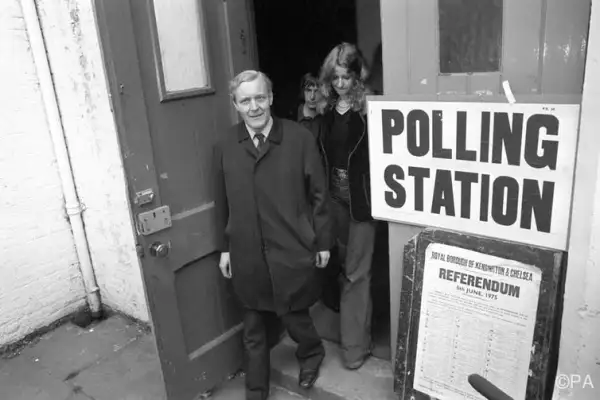
50 years ago on 5th June 1975 a Labour Government held a Referendum on Britain’s membership of what is now the EU

Tony Benn’s Diary for the period provides a detailed account of events. Mrs Thatcher’s archive at the Thatcher Foundation by contrast disappoints. There are no personal papers from 1975.

Of the left campaign the standard reference book by Butler and Kitzinger does reproduce one poignant cartoon from the Morning Star which shows two ‘no’ voters on Referendum day commenting that it was the first time they had had a chance to vote against all three main parties at the same time.

The two main campaigns were less evenly balanced in terms of finance than they appear to be in the more recent 2016 Referendum.

The ‘remain’ campaign was certainly much better resourced in 1975 than the ‘leave’ National Referendum Campaign

A key part of the NRC was the Labour Common Market Safeguards Campaign a long running organisation which had pushed for reform of the EEC. It had the support of a number of major unions.

A number of union officials and researchers were seconded to the campaign, including a young Hilary Benn who worked out of the Spectator’s Offices in Doughty St.

The official labour movement played a considerable role in the 1975 campaign reflecting the political context of the times. Butler and Kitzinger note for example that the Tribune newspaper was an important part of the campaign.

Tony Benn wrote to Thatcher on 20th April 1975 asking her if the Tories would honour a ‘leave’ vote. The answer was that they would not, as ultimately it was a matter for Parliament.

Benn put forward an economic strategy based on leaving Europe and argued his case in Cabinet meetings. His ideas became a central focus of the 1975 campaign.

He had argued that there was ‘more of a danger’ posed by the European Commission than by ‘Mick McGahey’.

On 26th April Labour held a Special Conference on Europe at the Sobell Centre in Islington. Michael Foot made the concluding speech quoting Nye Bevan and Rainsborough and the ‘leave’ position won by 3.9m to 1.7m.

The following day former Tory leader Heath wrote in the Sunday Express ‘are you voting for a Communist takeover?’

In the final weeks of the campaign Benn became an increasing focus.

His diary for May 10th 1975 records him at Barnsley Civic Hall. A meeting of 1,000 NUM delegates chaired by Arthur Scargill heard Benn put the case against the Common Market.

There were 8 press cars outside of his flat. Benn was no happier with the BBC describing it on 14th May as a ‘hot bed of pro-Market people’. He notes receiving death threats and met with Special Branch about these. They felt that murder was unlikely but ‘there may be a risk of you getting biffed’.

In the final days of the 1975 campaign the focus was on whether leaving or staying in Europe would have more impact on jobs. At the beginning of the week of the poll Benn debated with Roy Jenkins on Panorama. The following day he was at a meeting in Cardiff organised by Neil Kinnock to campaign for a ‘no’ vote. Speakers included Michael Foot and Welsh NUM leader Dai Francis. 2000 people attended.

The vote on 5th June 1975 was 17m in favour of remaining in Europe and 8.5m in favour of leaving. This represented a 67.5% ‘in’ vote on a 65% poll. Benn records speaking to Enoch Powell at the party after the polls had closed and finding him arguing that the process of disengaging from Europe had only just begun…

Articles

The reason why Wetherspoons scrapped its steak menu

In Uncategorized on June 5, 2025 by kmflett

The reason why Wetherspoons scrapped its steak menu

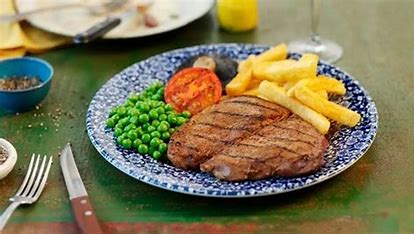
In the middle of May the 800 strong pub chain Wetherspoons scrapped its steak menu (gammon also went) to considerable comment from Spoons regulars. They were replaced on the menu by a new series of gourmet burgers.

Spoons steaks were not particularly cheap- certainly above £10 but they were still more competitively priced than elsewhere. Spoons suggested that there was too much wastage as customers sent back steaks that had not been cooked to their liking.

As any meat eater who has looked at the price of steak in a supermarket recently will know the cost has increased significantly. Of the major supermarkets Aldi probably comes out best where an aged steak costs around £6.79.

Towards the end of May the UK’s largest pub company Mitchells  & Butlers (M&B) published its results showing a 10.4% increase in profits.

However one notable concern was the cost of meat. CEO Phil Urban commented that higher food costs was a significant issue particularly steak. However Urban notes that M&B have a steak brand, Sizzling Pubs ‘so we’re not going to compromise on quality’

Therein lies the Wetherspoons steak conundrum. Either reduce the quality of steaks served or charge a price many won’t pay. Alternatively don’t sell them..

A tale of market capitalism or you could swerve meat or Wetherspoons…

Articles

Early success for Reform’s DOGE as it cuts itself

In Uncategorized on June 5, 2025 by kmflett

Early success for Reform’s DOGE as it cuts itself

Zia Yusuf unelected ‘Chair’ of Reform UK claimed early in June that  a team of ‘software engineers, data analysts & forensic auditors'(mostly blokes Farage met down the pub no doubt)would be a UK DOGE & would investigate the Reform ‘led’ Kent Council.

Vote Leave figurehead Aaron Banks was announced as the totemic person in the Reform DOGE. Readers of this post who are interested will already be aware of Mr Banks track record and reputation.

Actually heading up the team was Nathanial Fried, described as a crypto-populist.

Nathanial Fried and the Crypto Populist Pivot: Reform UK’s New Face of Disruption

What exactly Mr Fried’s reported specialisms could do about the financial and service challenges that local councils including Kent face is something of a mystery. More certain is that based on Elon Musk’s DOGE, Mr Fried may have just comprehensively torched any future business activity he might have been planning.

Now after falling out with Farage, Yusuf has resigned as Reform Chair and Fried has walked out with him, effectively meaning that Reform DOGE has cut itself.

Articles

Shadow Chancellor (Mel Stride) calls for bats to be given beds at Claridges with their own bat butlers

In Uncategorized on June 5, 2025 by kmflett

The Shadow Chancellor Mel Stride made a speech at the RSA in London on 5th June. It was mainly about how dreadful the Tories are and how there must be thoughtfulness on what they should do next. He noted the average age of a Tory voter in 2024 was 63.

Towards the end of his speech he went slightly off message and started talking about bats. This seemed to relate to plans for an HS2 bat tunnel. If Mr Stride had watched Springwatch he might have noticed that many people, probably including Tory voters, are rather keen on bats

Perhaps it would have been better to have booked the bats into Claridges and tucked them up in their little ‘bat beds’ with their ‘bat butlers’ to look after them and to have saved over a hundred million quid in the process? Well you get the idea!

https://www.conservatives.com/news/mel-stride-delivers-speech-on-conservative-economic-vision

Articles

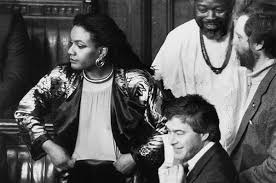
June 1987. Neil Kinnock congratulates Diane Abbott as the first black woman MP

In Uncategorized on June 5, 2025 by kmflett

June 1987. Neil Kinnock congratulates Diane Abbott as the first black woman MP

…for the first time we are a multiracial party, which I hope will affect the self-image of black voters. He congratulated the four black and asian members Diane Abbott, Bernie Grant, Paul Boateng and Keith Vaz.

Tony Benn, Diary 17th June 1987

The occasion was an address to the PLP by Neil Kinnock after the 1987 Election defeat to Thatcher.

Looked at from the perspective of 2025 we might note that progress in history is not a straightforward process.

Diane Abbott remains as a Labour MP and is the Mother of the House. She in the meantime has been the focus of a huge amount of racist prejudice including some from her own Party.

At the same time there is now a considerable cohort of black women MPs and the Tory Party has a black female leader.

The impact of self-image, can’t be doubted. At the same time there is a rising racist right in British politics. A reminder that gains made in one generation can’t be regarded as permanent but a work in progress

Articles

Boris Johnson’s dinner parties

In Uncategorized on June 5, 2025 by kmflett

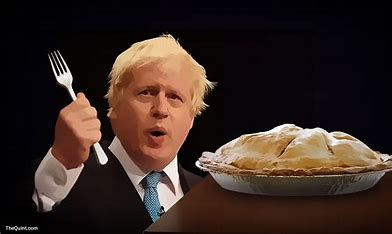
Boris Johnson’s dinner parties

Sarah Vine who spent 20 years married to Michael Gove and writes a column for the Mail is set to publish a memoir on 19th June. As usual extracts have appeared containing some of the more ‘interesting’ tales from the book. I’m not sure there is anything that interesting. Vine seems focused on the point that the Goves were not quite accepted as part of the Tory ruling class. She recounts that a party of the Chipping Norton set Jeremy Clarkson thought she was a wine waitress.

More interesting arguably are a couple of anecdotes about Boris Johnson at dinner parties. She reports a dinner party in Highgate where Johnson is seated with a woman diner on either side. He fails to make conversation and then declares it would be better if he made a speech.

On a second occasion, at Johnson’s then home in Islington a joint dinner party with his then partner Marina Warner, found him on a speaker phone to political allies discussing whether he should back the vote Leave campaign. Lamb was served with Boris telling other guests to keep quiet so he could get on with his conversation. An interesting insight into how the other lives, as well as underlining that old Etonian Johnson was interested almost entirely in himself

Another account of the Islington dinner party:

On Tuesday 16th February 2016 Michael Gove and his then wife Sarah Vine had (according to Tom Bowers biography of Johnson) joined him for a slow roast lamb dinner at his house in Islington. Also present was the owner of the Independent and Evening Standard the future Lord Lebedev. According to Bower there was a Government lawyer on a speakerphone and those present were discussing what attitude to take on the forthcoming Brexit Referendum. Bower suggests that Johnson’s decision to back leave was based not on principle but on perceived personal political advantage.

Articles

Tory leaders & whisky. The case of Liz Truss

In Uncategorized on June 4, 2025 by kmflett

Media interest in Liz Truss’s promotion of a brand of Irish Whiskey produced by an Irish bare knuckle fighter Dougie Joyce has extended to a Times Editorial. The Times thought Ms Truss was bringing the office of Prime Minister into disrepute.

Joyce’s Whiskey is produced in conjunction with Richy Thrower a former British soldier. Mr Thrower is now a CEO, but CEO’s aren’t what they used to be and its likely that he is simply CEO of himself.

The Whiskey carries the strapline ‘death before dishonour’ which is, er, a little unusual for whisky branding.

Its marketed on Insta, Facebook, Youtube and Tik Tok, but while this shows what image is being promoted what the whiskey is actually like doesn’t seem to warrant a mention. Its likely a grain whiskey and probably a little sweeter than many Scottish variants. Who its distilled by and where doesn’t seem to be mentioned.

Still when it comes to whisky drinking (non Irish varieties) Truss is in good Tory company (assuming she does actually drink whisky as opposed to just promote it). Churchill was a great imbiber reputedly of Johnnie Walker Black (a 12 year old grain whisky) or possibly Johnnie Walker Red (a lighter whisky).

Thatcher also was a great whisky imbiber, greater perhaps than may have been picked up by most of the media. What her preferred tipple was I’ve never been able to find out, suggestions welcome

Articles

Reform UK & the working class vote, an historical perspective

In Uncategorized on June 4, 2025 by kmflett

Reform UK & the working class vote in historical perspective

The continued polling success of Nigel Farage’s political business Reform UK has raised the question of whether it is attracting Labour voters and if it has a wider appeal to working class voters.

There is a history to these questions which research on the July 2024 election provides some pointers to. A group of researchers under the label Persuasion found that 75% of Reform voters at the last General Election had never voted Labour, going back to the 2005 Election. Of disillusioned Labour voters most looked not to Reform but to the Greens and Liberal Democrats

Tim Bale’s team of election researchers at Queen Mary College looked who the Reform membership is. They found that most are middle aged, middle class and often small business people. This can in some circumstances be a breeding ground for fascism but in fact it looks a lot more like the traditional base of the Tory Party.

This is a better place to start when considering whether workers are attracted to Reform.

Labour won its first Parliamentary seats in 1906 but it took time to establish itself as an electoral presence across England. This was largely in place by the early 1950s- Labour won 14 million votes at the 1951 Election- but, for example while Tory Councillors in Liverpool are now extinct, the Tories controlled the City for much of the twentieth century until the early 1970s.

This should caution against views that see Labour’s political presence and working class support for it as something that has always existed.

In fact no sooner had Labour consolidated itself as the main working class electoral party in England than the position was challenged. The 1959 Election was lost, although a year earlier it appeared to be going Labour’s way and while Harold Wilson won in 1964 it was by the smallest of margins

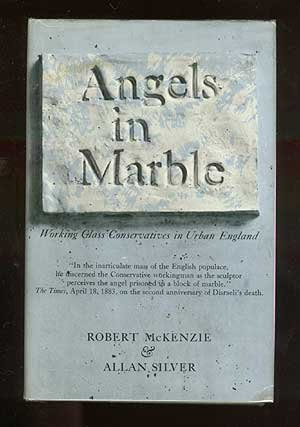
Two strands of understanding the working class vote can be identified from this point. The first was several studies which looked at workers who were anti-socialist and mostly voted Tory. Typically they might argue that taxes were too high and they wanted to be able to spend more of the money they earned. McKenzie and Silver’s book Angels in Marble (1968) looked at working class conservatism in urban England. Lockwood’s Black Coated Worker (1958) conversely examined clerical workers, typically thought to be conservative, and tracked the rise of trade unionism as their economic position changed.

The second strand looked at a drift away from Labour voting, as the nature of work changed and with it the experience of workers.

After the 1959 Election defeat Mark Abrams published Must Labour Lose. It appeared as a Penguin paperback. The argument was that core Labour policies, for example nationalisation, no longer appealed to workers who aspired to develop their status. One notable impact of this was the change in name of the Daily Herald to the Sun

Later came Eric Hobsbawm’s The Forward March of Labour Halted (1981) again after a Labour Election defeat to Thatcher in 1979 it brought up to date the argument that the working class was changing and the traditional Labour vote was declining

What conclusions can be drawn from this?

Firstly that there has been a section of working class voters who support right-wing politics. These are a minority. Secondly that the Labour vote, and indeed votes to the wider left, are not static. A small amount may drift to the right, perhaps even Reform.

The key point however is that class and class votes are not static and fixed for all time. There is a constant flux and interaction of class forces, where socialists have the ability to intervene

This post originally appeared in the Morning Star

Articles

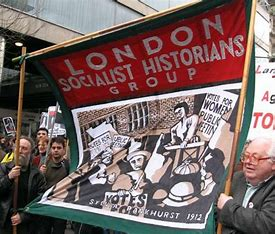
Socialist History Seminars Oct 24-June 25. From Lenin in London & the 84/5 Miners to strike to a social history of beer festivals

In Uncategorized on June 4, 2025 by kmflett

Socialist History Seminars at the Institute of Historical Research. October 2024-June 2025.

Below is a list of seminars for the 2024/5 academic year and recordings where they are available

Monday 7th October 2024 Rosalind Eyben, John Horner & the Communist Party, Uncomfortable Encounter with Truth. Recording https://us02web.zoom.us/rec/share/11a-rXdLrMk4n3kXvQ2xwWWqyi8fJ4qKxDWxwzUIhEuiTX1jDXU_iMd4yi22mJj6.HEFilCUPxIMi0LnS

Monday 21st October Fabrice Bensimon, The Chartist Meeting at Kennington Common, 10th April 1848. The daguerreotypes, the crowd and the coachman. In person, Room 301, Institute of Historical Research. Not recorded

Monday 4th November Gregor Gall, Mick Lynch. The Making & the Unmaking of a Working Class Hero? Recording https://us02web.zoom.us/rec/share/WgVBW_npMr75RoyRFPPtY_66mmRfXXomoZzMjVofQch1IhsnQTTeIL_NjXrSUxMA.VKlYXZZyetLYCdAF

‘Mick Lynch broke through into the public consciousness in the summer of 2022 as a ‘working-class hero’ in the fight against the cost-of-living crisis. He was able to generalise out of his members’ sectional disputes in a way that other union leaders were not. He was in the right place at the right time saying the right things but was he doing the right things? This talk, based upon my book (https://manchesteruniversitypress.co.uk/9781526173096/), will be a celebration and critique of Lynch as a union general secretary and social democrat, where his lack of strategic planning and support for the current Labour Party emerge as his two-sided Achille’s heel’.

Monday 18th November Bob Henderson, Lenin in London. Recording https://us02web.zoom.us/rec/share/D33p6N9Esx17Uo3ad6v2mMzrrnIaxOOTmIswMeGxXa7fEmVCKYfjeZodU7vt1NuH.waeuOJnYjQVPelZD

Monday 2nd December  Aidan Beatty. Gerry Healy & the WRP. Violence, Gender & the Perils of Trotskyism. On Zoom. Not recorded

Monday 20th January 2025

Dr Tony Collins. Raising the Red Flag, Rethinking the roots of British Communism

In Person, Room 301, Institute of Historical Research

Monday 17th February

Danny Bee, Red Vienna, when taxes paid for housing

In Person, Room 301, Institute of Historical Research

Monday 3rd March

Mike Simons, Blood, Sweat & Tears, Forty Years on from the Great Miners Strike, can old images give us new insights. Recording

https://us02web.zoom.us/rec/share/Mq8DWNaGTrQ85QNlFXRhB6J-KvUZ3pIHOyzLkXMeTu32imYa3R6poZ8rP6JI-ODE.sTTq7PpEVd6_wSXJ

Monday 17th March

Toby Manning, The Pop Chart as an Archive. In Person

In Person Room 301 Institute of Historical Research.

Monday May 19th Laura Hadland, Beer Festival Evolution, a history: shaping the British beer landscape. Recording

https://us02web.zoom.us/rec/share/jwHysqSTA8Fn6XDiNWL6-s3KT5eOwkhvtyq7LdgFTgCx5ySEjbt13Z1N3gDjbFVP.u8mzkZt35B4ezAuZ

Monday June 2nd Tony Collins, Rethinking the roots of British Communism

Recording

https://us02web.zoom.us/rec/share/0WNlVZcYAcJBtdqgyl1Q_Q27MNCXW51t8O9ZLKjNX-lJcoIbRDca0ny8NQwDbTGk.kLv28d6vguC-ygo4

Articles

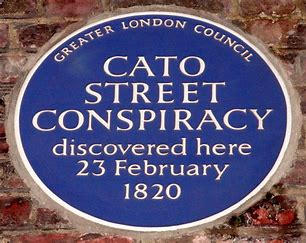
London Porter & the Cato St Conspirators (1820)

In Uncategorized on June 3, 2025 by kmflett

Martyn Cornell died earlier in the year, sadly just before his book on porter was published.

Whenever I wrote about porter- invariably in an historical context-Martyn would pop up and offer invaluable advice and knowledge. One exchange we had is extracted below. It relates to the Cato St Conspiracy in central London, the 205th anniversary of which is marked this year.

Martyn and his vast beer knowledge will be much ,missed

Martyn Cornell

Just put together a map showing the 25 biggest porter brewers in London in 1794. Particularly delighted to include Cratchrode Whiffing (Queen Street, Ratcliffe Cross, Limehouse, since you ask.) He was raided by the excise authorities in 1813, who found 2.5cwt of illegal additives

Keith Flett

did some incidental research recently on what all involved at Cato St(23rd Feb 1820) were drinking on the day. The answer, both conspirators & police appears to have been porter at the Horse & Groom opposite the hayloft

Martyn Cornell 27th April 2020

Three big porter breweries about equidistant from there, Meux in Tottenham Court Road, Combe in Covent Garden and Elliott (later Watney) in Pimlico