Articles

Murdoch Times still opposing Employment Rights Bill

In Uncategorized on March 26, 2025 by kmflett

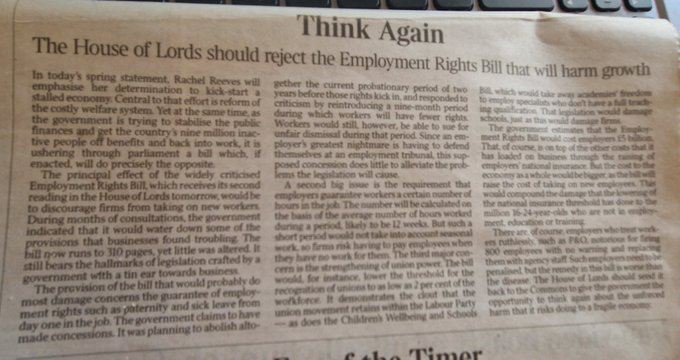
The Times, owned by Rupert Murdoch, who busted unions out of his papers in the Wapping dispute in 1986, has produced another Editorial attacking the Employment Rights Bill.

The Bill passed in the Commons recently with only the Tories and Farage voting against. It’s a subset of the original measure drawn up while Labour was in opposition and could have gone further. As it is important measures such as the right to e-ballot in industrial action votes will apparently not happen until its clear that a framework is in place to make sure it works (not that difficult one might think..). That doesn’t mean that the changes the Bill does include are not an important move away from Tory anti-union laws

The Bill is now in the Lords. According to the Times Editorial the Bill has been ‘widely criticised’. By the Times it certainly has and of course the usual business voices that opposed the introduction of the minimum wage in the Blair era too.

However YouGov polling shows that most of the measure in the Bill have majority public support, mostly at around the two-thirds level and despite Farage’s vote that includes Reform supporters as well.

Nevertheless the pressure for backsliding by the Government is there and needs to be a focus of consistent campaigning at the grassroots

Articles

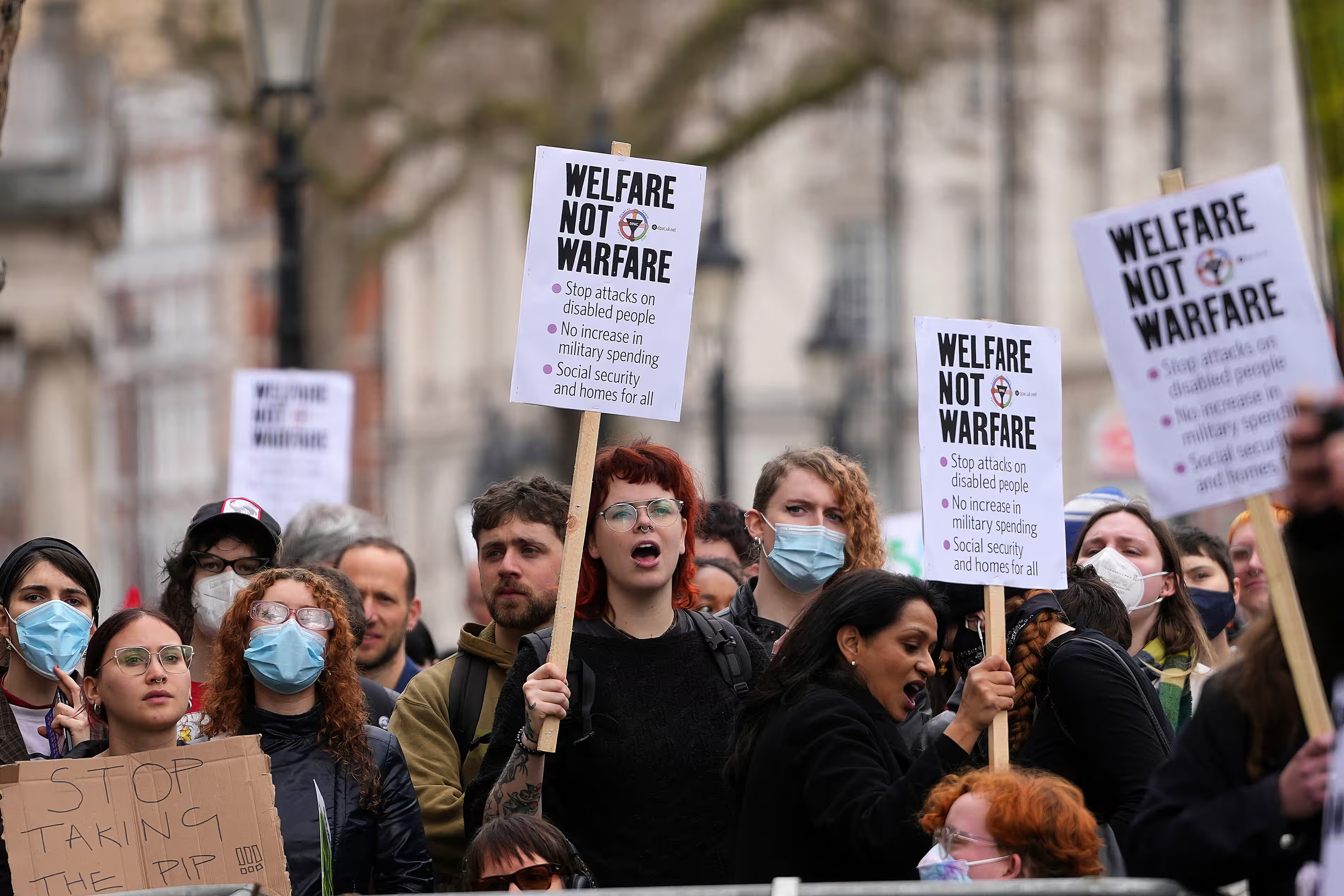
Welfare not Warfare: whatever happened to social democratic politics?

In Uncategorized on March 26, 2025 by kmflett

Protesters outside the Treasury 26th March 2025 (photo Guardian/PA)

I’ve been an activist on the left since the 1970s and the political slogan and demand, welfare not warfare, has always been present. In a sense it is, or until now, was social democratic politics.

Now with spending on defence rocketing while welfare is cut it looks almost like a revolutionary demand.

Of course we need to go beyond the slogan.

The 1945 Attlee Government, even under great financial difficulty, promoted welfare and warfare. That remained broadly the case, even under the Tories, until the oil crisis of 1973/4 and then the financial crash of 2008. Then both welfare and warfare spending were cut.

Of course Labour will say, correctly, that money has been put into the NHS to begin to address the impact of the Tory and Liberal Democrat years from 2010-2024. Its welcome but the direction of travel is clear and its towards warfare. 80 years of social democratic politics have reached a conclusion, and not a good one.

Articles

Farage & the British tradition of heckling

In Uncategorized on March 26, 2025 by kmflett

Heckler at Doncaster Racecourse (PA)

Farage & the British tradition of heckling

Nigel Farage was speaking at a Reform meeting on Doncaster on 26th March when he was interrupted by hecklers from Stand Up To Racism. Farage claims to stand up for British traditions one of which is certainly heckling. However instead of an effective riposte Farage merely mouthed abuse calling one heckler a ‘loser’ which is Trump-speak and called security

It reflects the reality that while there are still very good public speakers out there, very few are to be found in Parliament, where MPs have mostly given up on the idea of engagement with a mixed audience.

Arguably the tradition survives virtually with the social media riposte.

One master of how to deal with the political heckler was Harold Wilson. Addressing a crowd in Birmingham in 1966 Wilson was talking about his public expenditure plans when a heckler cried, “What about Vietnam?” – the burning issue of the day. “The government has no plans to increase public expenditure in Vietnam,” rejoined Wilson. Heckler: “Rubbish!” Wilson: “I’ll come to your special interest in a minute, sir.”

The key to it is both an immediate response, but also a witty one that demeans the heckler and gets the audience on the side of the platform speaker.

I’m no great fan of Wilson, but in a democracy, both heckling and responses to it have a role to play that doesn’t involve calling security.

Articles

The problem with British brewed real lagers & a possible solution

In Uncategorized on March 25, 2025 by kmflett

The problem with British brewed real lagers and a possible solution

Pete Brown’s Sunday Times beer column on 23rd March focused on British brewed real lagers. Not the UK brewed lagers with Spanish or German names that global big beer ensures are on the bar at all pub chains.

Rather properly brewed lagers by independent brewers such as Donzoko, Utopian and Lost and Grounded.

There is however a problem. You can sometimes find some of those lagers in this or that supermarket chain. You are very unlikely to find them on sale in a pub unless it’s an independent one that sells craft beers. You can of course find them in craft bottle shops.

Hopefully the problem can be seen. Lost and Grounded’s Keller Pils is probably the lager you are most likely to come across if you are a lager drinker (& as Pete Brown points out this is by far the biggest slice of the UK market) and not someone who likes or wants to drink craft beer or even real ale or frequent places that sell them. Beyond that you won’t find them or know they exist.

The Beer Orders which allowed for pubs owned by breweries or indeed pubcos to sell a cask beer were repealed in 2003 and there are efforts to get a new version. However pubs owned by say Coors or Heineken (or at least beholden to them financially) may be tied on keg but less so on cask.

So even if a lager drinker wanted to try a good British brewed lager the chances of them finding one in their local are poor.

The solution? Include a right for pubs to sell a local keg beer free of tie as well as a cask one

Articles

Campaigners raise concerns on beard transplants. There is no shame in being clean shaven

In Uncategorized on March 25, 2025 by kmflett

Beard Liberation Front

25th March

Contact BLF Organiser Keith Flett @keithbeard.bsky.social

Campaigners raise concerns on beard transplants. There is no shame in being clean shaven

The Beard Liberation Front, the informal network of beard wearers, has reacted to an article in the Guardian (25th March) about beard transplants by underlining that there is no shame in being clean shaven.

The BLF has always stood for the principle that people should be able to dress and appear as they want. The focus has been on institutions and workplaces that frowned on facial hair and sometimes banned it.

The campaigners say that what appears to be a beard transplant industry is less about beards as such and more about pressures in society about how people should and should not appear.

BLF Organiser Keith Flett said, the beard transplant industry is really about people making profit out of people’s insecurity in respect of their appearance. That really isn’t a place we should be going

Guardian article

https://www.theguardian.com/lifeandstyle/2025/mar/25/the-sudden-surprising-rise-of-beard-transplants-this-industry-is-a-wild-west?CMP=share_btn_url

Articles

Six Years On. Monday March 23rd 2020. Boris Johnson finally announces a lockdown

In Uncategorized on March 24, 2025 by kmflett

Six years ago then PM Boris Johnson announced a full lockdown. On 16th March he had urged people to avoid pubs and restaurants and on 20th March ordered them shut,

Johnson as he made clear with his later ‘let the bodies pile high’ comment was an enthusiast for the then popular (with some) idea of ‘herd immunity’. There was no vaccine until (at the earliest) the end of December 2020. The alternative was a lockdown.

COVID had been spreading rapidly in London for several weeks, and a London lockdown had been mooted but not done.

Then again, as usual Johnson had not been giving the matter his full attention

In the crucial weeks before March (2020) Boris Johnson did not attend any of the five virus meetings held by Cobra, the emergency committee, in January and February and spent 12 days out of the public eye while on a ‘working’ holiday at (Chevening) in Kent.

Sunday Times 19th April

Boris Johnson March 23rd 2020

That is why people will only be allowed to leave their home for the following very limited purposes:

  • shopping for basic necessities, as infrequently as possible
  • one form of exercise a day – for example a run, walk, or cycle – alone or with members of your household;
  • any medical need, to provide care or to help a vulnerable person; and
  • travelling to and from work, but only where this is absolutely necessary and cannot be done from home.

That’s all – these are the only reasons you should leave your home

Prime Minister’s statement on coronavirus (COVID-19): 23 March 2020 – GOV.UK

Articles

Reasons why a cask brewery on the Walthamstow Beer Mile closed in March 2025

In Uncategorized on March 24, 2025 by kmflett

Reasons why a cask brewery on the Walthamstow Beer Mile closed in March

The April/May issue of the London Drinker, the very long running magazine of the London Branches of CAMRA, has an interesting article by Christine Cryne on why Beerblefish brewery which was part of the Walthamstow Beer Mile closed in March 2025.

With the sad closure of Wild Card last Autumn, and Hackney Brewery closing its taproom at the end of March the Beer Mile is currently a bit shorter.

Beerblefish were unusual on the Beer Mile in that they specialised in cask beers often using historic recipes. Some were award winning and the standard was generally good.

The reason for the closure was in short a sign of the times rather than anything dramatic.

Takings at the tap room varied quite widely each week from good to not very good without it seems obvious reasons. Post COVID getting payment for beer sold to pubs took longer and such were cost pressures, that Beerblefish sometimes found itself undercut by competitors offering cheaper, and probably less good quality beer.

They had considered closing at the end of 2023 but gave it another year. When nothing much had improved they took advantage of a lease break. All those concerned seem to have departed for jobs elsewhere, outside brewing, for which they were already well qualified.

As above nothing dramatic but still a sad reflection on the times

London Drinker April/May 2025 for the full story

PDF April/May 2025 – London Drinker

Articles

The politics of eggs & protest

In Uncategorized on March 24, 2025 by kmflett

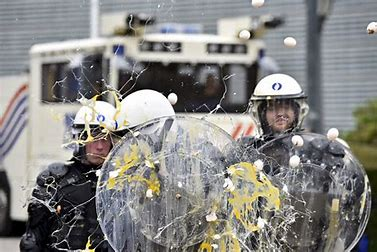
One way or another eggs and protest go together.

In 2025 the protest is more about the price of eggs. Trump claimed that once elected President he would see the price of eggs cut. Like everything else he says this was a lie, not least because egg supplies in the US are hit by bird flu. While that can be addressed up to a point the Ministerial crew of comedians and fascists he has assembled are not up to doing that.

In France also eggs have become a cost of living issue. In a country known for its steak and frites there is a boom in egg sales because they are a much cheaper source of protein and the economic times are, at least for the many, hard.

The Times has reported that average consumption of eggs (per year) has risen from 200 in 2003 to 224 eggs in 2023 (19th March). Britons eat an average of 199 eggs a year.

In the industrial era organised protest has been about banners, placards and chants, but also about eggs.

The organised crowd, boos, hisses and groans at those they dislike, as the Chartist crowd did in London in 1842 at troops leaving the new Euston station to break the General Strike of that year in the north.

Egg throwing is a traditional if individualistic form of protest though. Crowds threw rotten eggs (& worse including dead cats) at people in the pillory(abolished 1816,1837). These were reactionary crowds however. When radicals were put in the pillory the crowd threw nothing but collected money for the victim instead.

Egg throwing at political figures from Cameron to Prescott has continued in the modern age. The worse that results is a mess and the impact of protest is small. Farage of course being a self-important type ignored the reality that the egg thrown at him in Clacton was part of a British traditional form of protest and pursued the matters to the Courts. Even when the egg thrower was found guilty he did not stop droning on about it.

Across Europe the practice of custard pieing figures of public note has a developed, a reminder that politics, eggs and all, is partly theatre.

Articles

Top Beers at the 1990 Battersea Beer Festival. All but one is still brewed

In Uncategorized on March 23, 2025 by kmflett

The Battersea Beer Festival, organised by CAMRA, ran at the Battersea Arts Centre from 1990 to 2015 when a major fire took place at the building. It has been restored now but the Festival did not return. As the former Battersea Town Hall it was the organising centre for the 1926 General Strike.

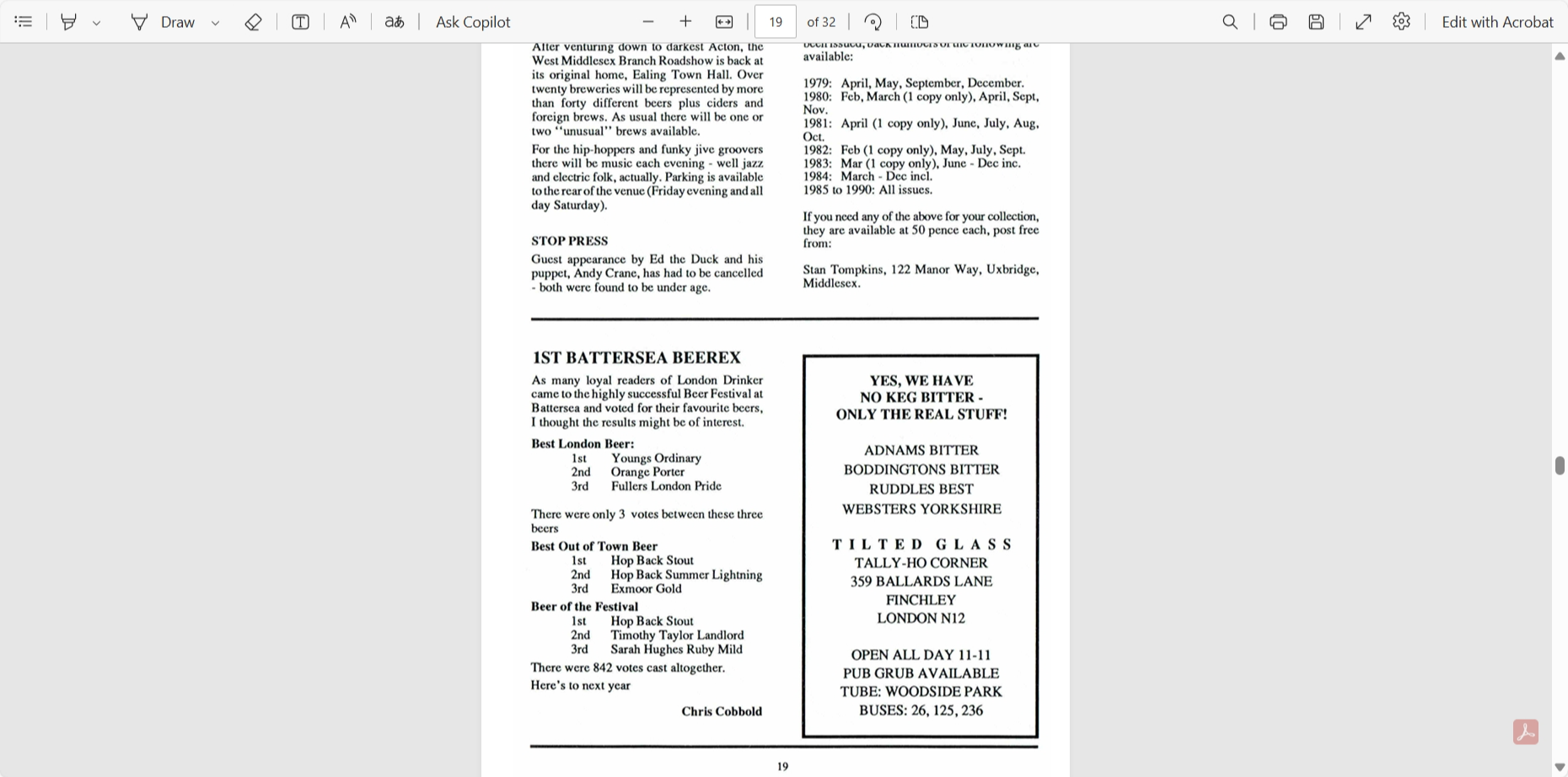
The April 1990 issue of the London Drinker carries the outcome of the votes for the beer of the festival.

Over the last 15 years or so there has been an explosion in the number of breweries in the UK- now around 1,700 and at least some of the classic beers from earlier periods have either changed or disappeared with takeovers and mergers. The perpetual quest to make sure that Bass continues to be brewed and can be found in at least some pubs underlines the point.

Interestingly all but one of the winning beers at that 1990 festival continue to be brewed and be available. The one exception is Orange Porter. Orange was a brewpub in Belgravia. As far I can check the pub continues but brewing ceased a while back

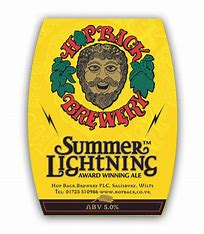
Also of interest is the presence of Hop Back’s Summer Lightning a 5% pale. It remains a decent beer although to modern tastes it may not seem as hoppy as all that! In 1990 it was one of those beers that reminded drinkers that as well as malt beer also contained hops.

Much as it can be argued that in at least some current beers the balance between malt and hops leans towards the latter 35 years ago the reverse was often true.

Its also worth pondering that while it could be found at CAMRA festivals and was a Great British Beer Festival Award winner, before the rise of independent bars (the Beer Orders had only just allowed guest beers at this point) the place you were most likely to find Hop Back on the bar was Wetherspoons

Articles

From Philip Snowden in 1924 to Rachel Reeves in 2025. Labour Chancellors & the Treasury

In Uncategorized on March 23, 2025 by kmflett

From Philip Snowden in 1924 to Rachel Reeves in 2025. Labour Chancellors & the Treasury

Rachel Reeves decision to cut winter fuel benefits for many pensioners reflected a long strand of Labour thinking, tied into Treasury orthodoxy, going back to Labour’s first Chancellor Philip Snowden in 1924.

The more recent decisions to cut disability benefits and cut public spending are arguably not so much in the mould of Snowden, who presented just one Budget in May 1924 before the Government fell in November 1924. Snowden’s view was that the Chancellor should not make decisions on spending at all. Where a Budget surplus was found- and it was in 1924- it was used to pay down the National Debt.

Faced with the issue of alleviating unemployment Snowden rejected public works schemes argued for by a certain Liberal, John Maynard Keynes, unless they could be shown to be a sound investment. He argued that the ‘more positive the remedy the slower the effect’.

Snowden, who was a member of the Independent Labour Party but in reality more of a Gladstonian liberal than a socialist, argued that there wasn’t much a Chancellor could do to address inequality. That would only happen in a socialist society.

No one could accuse Rachel Reeves of promoting a socialist society but historical comparisons need to be done with care. Firstly while her various cuts have made her unpopular, some of it (social media has daily examples) relates to her being the first ever female Chancellor. Even in 2025 the world of finance and finance journalism is still very largely men in suits. Secondly she has in fact increased spending and investment in some areas, the argument being that more needs to be done. Her Spring Statement looks set to match not the Snowden of 1924 but that of the 1930/1 Labour Government where the answer to economic crisis was indeed benefit cuts.

The aforementioned Keynes had an alternative perspective of spending to promote growth. That of course does not sort out the boom/slump syndrome of capital but it can be a little more people friendly-keeping the impact on inflation in mind (which is where Reeves comes from) Fortunately in the several Labour Governments between 1924 and 2024 Treasury inspired thinking was not quite always the preferred policy, although it invariably made appearances in each one of them