Ambridge Cricket Crisis: Tony and Pat Archer told ‘you’re dropped’
The Ambridge Cricket Team which has been promoted for the 2025 season is, under the guidance of Lily and Freddie, being reconfigured. As a result Tony and Pat Archer have been dropped. They both claim its ageism. They are certainly correct. The counter is whether the cricket team will do better without them. An interesting approach to DEI.
Not sure Lily’s plan to win at all costs is either the right one or will work even if she has been reading Mike Brearley
Meanwhile there is a plan to pay Rex to play.
The Bells. Defending the right to protest
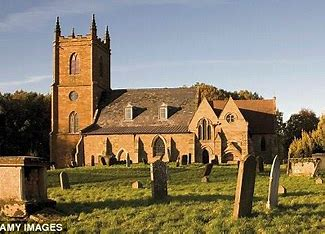
Pat has persuaded Alan that marathon bell ringing session at St Stephens is a way of campaigning against the activities of bell ringing. Borchester Land’s Martin Gibson seems concerned that it would disturb his sleep (aka a meeting). No doubt Gibson is a shareholder in Borsetshire Water…
Chief bell ringer Neil was uncertain but faced with Gibson resolutely defended the right to protest.
George in prison
George remains in prison and has had a visit from Emma and Susan. Happy Days
Beechwood
Kirsty has finally got Natasha and Tom to agree to buy her Beechwood house so she can in turn stay at Willow Farm. Whether this will actually happen we shall see but an Ambridge housing crisis is a thing to behold
Booing as a form of protest: an historic tradition
Booing Republican politicians at meetings in Trump’s America is clearly controversial enough to warrant official intervention on occasion
In fact booing has a long and complicated part in the history of protest.
Historically, certainly dating back to the time the crowd becomes an actor on the stage of history in the mid eighteenth century, booing has been a way of showing collective protest at the rich and powerful.
But it hasn’t been just booing.
What the American historical sociologist Charles Tilly called the ‘repertoire’ of the crowd went far beyond booing. It extended to hissing, groaning, hooting and pelting with missiles, often rotten vegetables or fruit but sometimes stones as well.
The London crowd in particular was well known from the start of the modern era for robust reactions to those it didn’t like. When John Wilkes, who went on to become Mayor of London, announced his intention to stand for Parliament at Middlesex in the late 1760s one of his opponents on appearing at a Brentford hustings found himself ‘jeered and hissed’
At the State opening of Parliament on 29th October 1795, EP Thompson notes in the Making of the English Working Class, the King was ‘hissed, hooted and his carriage pelted.. the King’s carriage window was fractured probably by a pebble’
Parson Woodforde recorded that George 111 was ‘hissed, hooted and groaned at by vast crowds’.
After the formation of the Metropolitan Police the authorities began to attempt to control unregulated street noises and two Acts of 1839 and 1841 aimed to ban all ‘uncommon noises’ from horn blowing to street cries.
The Acts were robustly enforced and their main provisions remain in force little amended today as anyone who has ever tried to organise or do anything on the street without telling the police will testify.
As E P Thompson himself noted there is no guarantee that the crowd will be progressive in intent. The Gordon Riots started with a crowd or mob attacking religious minorities but after a successful attempt to free prisoners at Newgate Prison, ended with an attempt to storm the Bank of England.
The historical point is that crowds can change their minds. Perhaps cheering Marcus Rashford rather than booing taking the knee is what needs to be socialised and encouraged
In August 1842 the 3rd Battalion Grenadier Guards were mobilised from their barracks at Charing Cross to march to Euston Station and then by train to the north-west to be used against strikers involved in the 1842 General Strike, sometimes called the Plug Plot.
Large crowds of protesters gathered as the troops marched through central London and what the historian of London Chartism David Goodway describes as ‘murmurs of groans and hisses’ began. These grew so loud that the troops fixed bayonets in an attempt to silence the crowd. They failed.
In more recent times such crowd reactions have sometimes been stage managed- as at a pantomime and sometimes at sporting events, but the point about their use at a live event or on the street is that they are essentially spontaneous and unpredictable indicators of popular feeling.
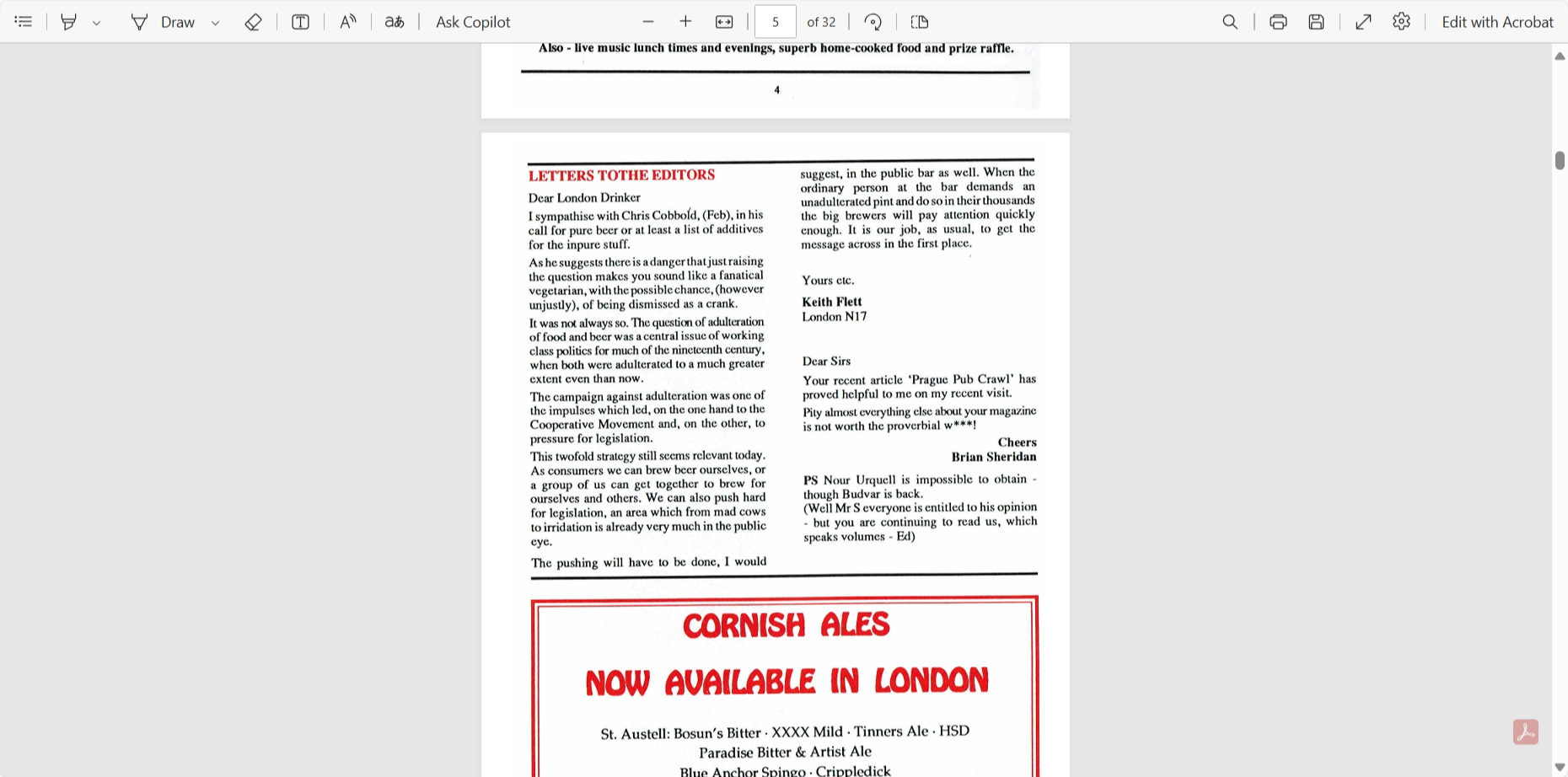
The above Fletter comes from the April 1990 edition of the London Drinker, the magazine of the London Branches of the Campaign For Real Ale. It still publishes, free, six issues a year.
The Fletter underlines my long standing interest (aka obsession) in beer, politics and history even if the writing style is a bit clunky by my standards of 2025.
Where is Keystone Brewing going? Private Equity & Craft beer
Earlier this month Steve Cox was appointed CEO of Keystone Brewing. Keystone is the beer etc bit of Private Equity operator Breal.
The business model of Private Equity is to invest in companies, grow the business and having made a profit sell them. Five years is a frequent timescale.
Not a great deal is really known about Keystone although Cox has now said that the aim is £100m revenue by 2028. Whether that is ambitious or not I’ll leave to financial analysts but all the breweries it currently owns were at best (and to put it politely, more so than their workers might)not making a profit.
Keystone tends to talk of brands which include the original one, Black Sheep, Brew By Numbers, Brick, Purity, Magic Rock, Fourpure, Big Drop and as of February North Brewing. It also own Hofmeister lager.
Finding out about Steve Cox’s business background is equally problematic. He was the CEO of In Good Company which had acquired Magic Rock, Fourpure and Big Drop, and of course were in turn (or at least the brands) acquired by Keystone.
If one were to look at it in Marxist terms (as I would) given the economic travails of hospitality its likely that we are somewhere near the bottom of the craft beer market or heading towards it. The way Capital works (when it does) is to shed excess capacity and in doing so that allows new business to develop in that space. Hence Keystone will as they have reported expect at some point the craft beer business to recover and with it their revenues and profit.
The tradition of protest Grosvenor Sq 17th March 1968,Vietnam; Kensington 22nd March 2025,Gaza
On Saturday 22nd March thousands will gather near the Israeli Embassy in Kensington in central London to protest against continuing genocide and starvation in Gaza.
Such protests have a long tradition now and the actions of America are often a key focus of them
1968 was a year of demonstrations and protests across the world. The May events in France are often taken to be the starting point for this but in reality matters had been stirring well before that.
A key influence was the Vietcong’s Tet Offensive in Vietnam from the end of January 1968. It had underlined that the might of US military power and imperial policy was not invincible and the atrocities committed as the US pushed back the advance of Communist forces gained worldwide media attention.
The well-known demonstration against the Vietnam War in London in 1968 took place on 27th October. There were books written about it and no doubt we will hear something of the 57th anniversary later in the year.
There was however an earlier protest that took place on 17th March 1968 and set much of the tone for what was to follow.
It gathered in Trafalgar Square for a rally and then marched to Grosvenor Square. The official police estimate for attendance was 10,000 which it may be taken was somewhat on the low side. The October demonstration was officially estimated at 25,000 but generally agreed to have been 100,000 strong.
According to the BBC’s report of the day the demonstration ‘turned violent’. It noted that ‘More than 200 people have been arrested after thousands of demonstrators clashed in an anti-Vietnam war protest outside the United States embassy in London’.
One of those arrested was the author Michael Rosen who recounts the episode in his memoir ‘So they call you Pisher!’. Rosen refused to give his name and a police officer simply noted him as being ‘big’. This was not sufficient for the police to proceed with a charge and in the end he was released.
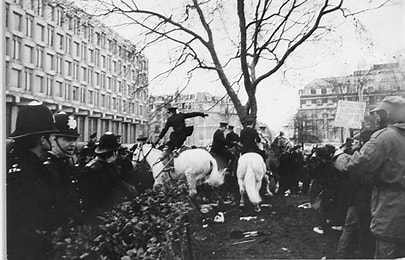
According to the BBC ‘stones, earth, firecrackers and smoke bombs were thrown’ and pictures and footage of the day do bear that out. Much was made of injuries to police officers, with less media interest in injured protesters.
Such was the impact of the day that it led to a debate in the House of Commons. While an uproarious demonstration hardly seems unusual 50 plus years on, it was unusual in 1968 and likewise while the numbers involved appear limited compared to more recent times, again such sizeable protests, those of CND aside, were also not common.
The debate was initiated by the Labour MP Peter Jackson who had been present in Grosvenor Square. He told the pre-Murdoch Times: “I was particularly outraged by the violent use of police horses, who charged into the crowd even after they had cleared the street in front of the embassy.”
Again while police violence was hardly unknown against, for example, anti-fascist protesters the crowd on 17th March had included well known 1960s public figures such as actress Vanessa Redgrave and Rolling Stones singer Mick Jagger. That changed the context. It was one thing giving a working-class protest outside of the public eye a good kicking but this was a high profile media occasion.
57 years on it can be reflected that those who marched on 17th March 1968 played an important role in starting to mobilise wider opposition to imperial wars that led to the 2 million strong anti-Iraq war march in 2003. A tradition of protest against war that continues today.
There was and is certainly work to do. The ‘liberal’ Guardian reported of Grosvenor Square that ‘the demonstrators seemed determined to stay until they provoked a violent response’ while an Editorial argued that far from exerting violent force the police had merely acted in ‘self-defence’.
A reminder that the Guardian’s ‘Love Me I’m a Liberal’ perspective is nothing new
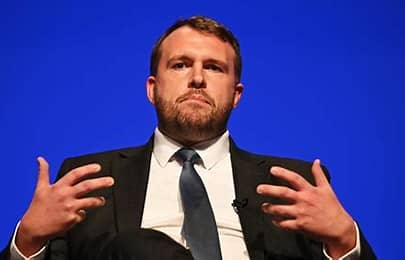
Tory MP Jonathan Gullis lost his seat as an MP for Stoke in July 2024 and he told the Telegraph in January 2025 that he has still to find a new job.
Gullis earlier told LBC that while had got some consultancy work he had been unable to secure a permanent role or even it seems an interview for one
He was previously a teacher and has claimed that his high profile right-wing views are an issue when applying for teaching roles.
There is still no update on whether Gullis has got a job but perhaps Liz Kendall’s measures to get people into work will help here.
Meanwhile at the end of January 2025 Gullis was co-opted (perhaps just as well an Election was not required) on to Kidsgrove Town Council. Essentially a Parish Council it has responsibilities for things like allotments. He also appears occasionally as a commentator on hard right social media site GB News.
In Mid-March Gullis appeared on GB News to back Kemi Badenoch’s U-Turn on Net Zero and went on to comment:
More importantly, if the people around Kemi Badenoch, and those backing her in Parliament, are willing to swallow their pride stop trying to be liked on social media and popular with centrist dads and focus on what is truly important to the people of this country.”
Work, or not, in progress
Extract from the Telegraph But breaking back into the public sector is harder still. Former Stoke-on-Trent North MP Jonathan Gullis was a teacher before he became an MP. He has said he cannot get a job now he’s lost his seat, which has a knock-on effect on his wife and two children, aged four and two.
“I’ve applied for a few jobs and sadly not even had an interview yet,” he said in a radio interview in September. “So actually, I think the days when being an ex-MP was something that was wanted or desired are no longer, as I think we’re now seen as a problem. And so that’s a challenge.” Asked if he thought that was due to his politics, he said: “When I left the profession to enter parliament, I felt being a Conservative was something that was treated with disdain.” Post-parliament, he added, he could not work in education because there are “too many activists in the classroom”. As of January, he is still looking for a full-time role.
“It’s a competitive market where I will be up against many of my former colleagues and former special advisers, some of whom will have expertise in certain fields and some of whom have come from the corporate world,” he says.
The Guardian has reported that as Rachel Reeves pursues public spending cuts because there is apparently no alternative she has raised the spectre of Liz Truss to Labour MPs
The spectre she has in mind is apparently Liz Truss’ 2022 mini-Budget.
Others will wonder what Reeves may have been reading. The Communist Manifesto mentioned the spectre haunting Europe, by which Marx and Engels meant Communism. This is clearly not on Reeves agenda.
However the original English translation which appeared in the Chartist Red Republican paper in 1850 and was by Helen Macfarlane had it as ‘frightful hobgoblin is stalking Europe’ and in a way that seems to fit Truss rather well
The Silences of Starmer & Blair on the 23rd anniversary of the Iraq War
The second Iraq War started on March 20th 2003. A Guardian Fletter in 2022 made the point that when Blair was appointed to the Order of the Garter it was an attempt to erase from the official memory what happened.
Keir Starmer, while approving a knighthood for Tony Blair, notes that Iraq remains an issue for many (UK government urged to rescind Tony Blair’s knighthood, 4 January 2022). The problem is that elevating the former prime minister to the Order of the Garter is an official attempt to say that the Iraq war doesn’t matter any-more. The current Labour leader had it right when, as a QC and human rights lawyer, he wrote in the Guardian on 17 March 2003 that “flawed advice does not make the unlawful use of force lawful”. Many of us remember the point; it’s a pity Sir Keir seems to have forgotten it.
Keith Flett
Tottenham, London Guardian Fletter, January 2022
Keir Starmer’s 2003 Guardian piece where he determined the war was unlawful is here:
His silence on the 23rd anniversary of the Iraq War is not a surprise to those of us who opposed the war but on the 20th anniversary Rupert Murdoch noticed too. Patrick Maguire (Times 20th March 2023) in an article which mainly attacked the Labour left instanced the silences of Starmer on the 20th anniversary
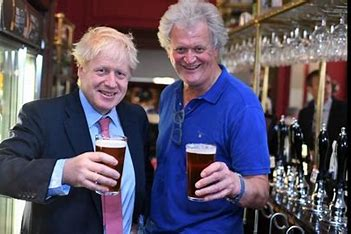
Friday March 20th 2020. Boris Johnson orders pubs to shut. The long hangover
On Monday March 16th 2020 as cases of COVID spiralled, particularly in London, Boris Johnson suggested that people should swerve pubs, restaurants etc.
On Friday March 20th 2020, exactly five years ago, he was back this time with Sunak and Deputy CMO Jenny Harries, and Johnson, or at least Government policy, went further and ordered pubs to shut.
They did not re-open until July 2020. Furlough was available for at least some in hospitality and COVID loans were offered to reflect the financial difficulties the decision clearly caused.
As an inveterate pub goer I was of course not happy but I’d already decided not to go to the pub. My last beer until July in a pub had been in the Cock Tavern Hackney on the 15th March 2020.
I posted at the time that I thought it was probably a sensible decision (one of the few Johnson made or had made for him). It was not really known at this point how COVID was transmitted and no vaccine was available until early 2021.
Of course, and this is a comparatively little explored aspect of the decision, temperance campaigners seized on the matter. Claims that pubs were places where everyone got drunk and indulged in all kinds of excess, thereby spreading COVID, were to be seen quite frequently. They often seemed to be made by people that never went to pubs, regarding them as places proletarians were to be found.
Suffice to say that being primarily airborne COVID could spread wherever people gathered- transport, shops etc and not just pubs.
Five Years On, numbers of pubs and smaller breweries still feel the impact of COVID. In some cases trade never really recovered, and, related to that, paying back COVID loans has become problematic.
It’s a history of the present that is widely ignored, just the rise in those on ill health benefits, which primarily starts from 2020 (though it had risen in 2019) is at least in part likely to be due to the impact of Long COVID, a far from perfectly understood condition or sets of conditions. Did Liz Kendall mention that this week? If she did I missed it.
In short histories of the present are important. We have a 24/7 media focused on NOW, and not too much concerned with history, even recent history.
We are collectively telling, telling cafes, pubs, bars, restaurants to close tonight as soon as they reasonably can, and not to open tomorrow.
Though to be clear, they can continue to provide take-out services.
We’re also telling nightclubs, theatres, cinemas, gyms and leisure centres to close on the same timescale.
Now, these are places where people come together, and indeed the whole purpose of these businesses is to bring people together. But the sad things is that today for now, at least physically, we need to keep people apart.
And I want to stress that we will review the situation each month, to see if we can relax any of these measures.
And listening to what I have just said, some people may of course be tempted to go out tonight. But please don’t.
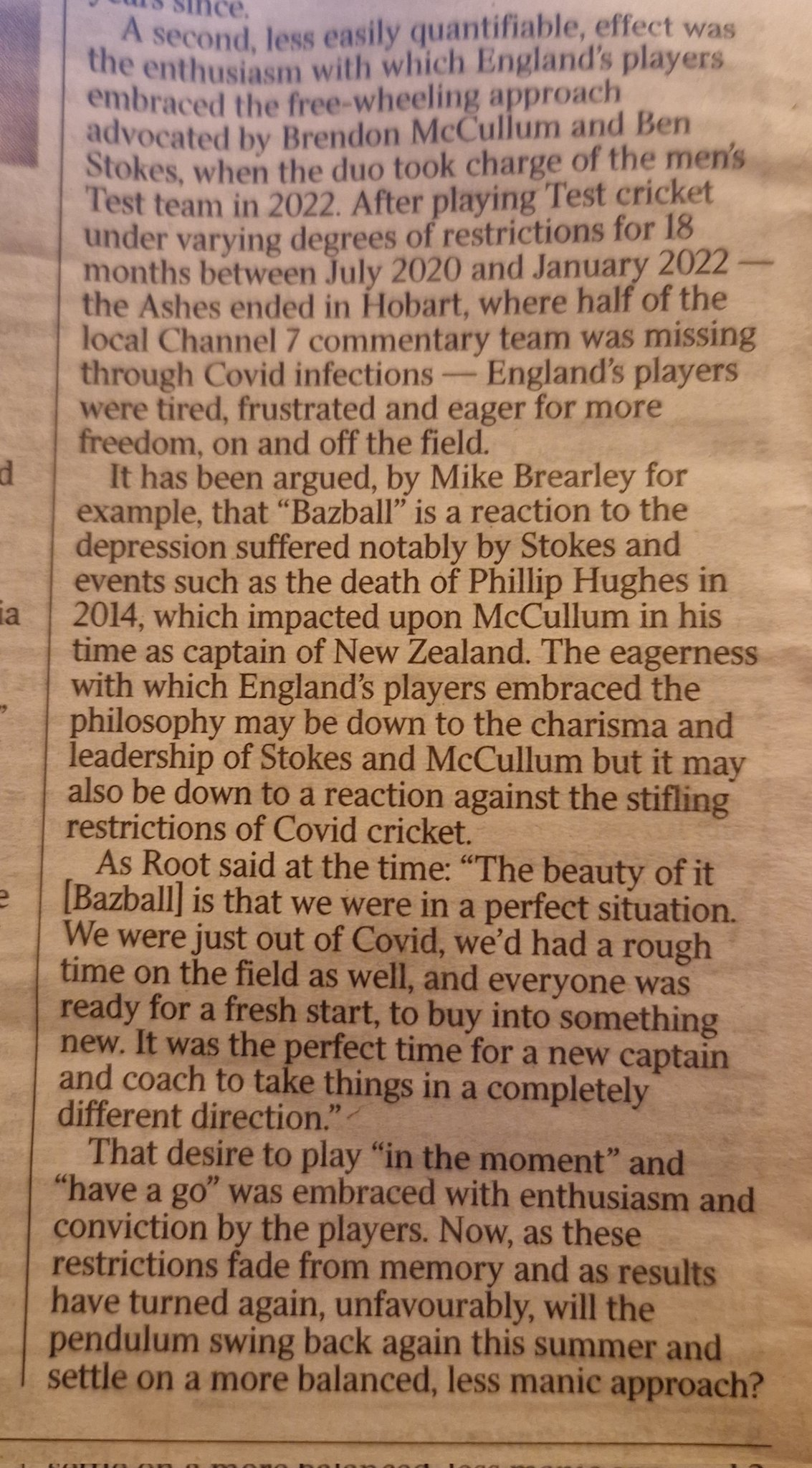
It may be the Murdoch Times but Michael Atherton in my view is the most interesting male writer on cricket in the MSM at the moment.
In his piece on 20th March 2025 he looked back five years on the impact of COVID on cricket. The restrictions ran from March 2020 until January 2022. Cricket was able to resume-minus crowds- in July 2020. I must admit I didn’t return to watch international cricket until 2023 not just because of COVID but also because of an issue Atherton doesn’t mention. That is the impact of Black Lives Matter and the focus it raised on racism in cricket. Whatever the ECB may think that is now widely understood, so widely in fact that it featured in the Archers last month.
Atherton’s point, echoing Mike Brearley, is a good one though. Did the tough times of COVID cricket lead to the embrace of a more care free exciting way of playing that was Bazball? A sense that in a cricketing world we might have lost, enjoyment is as important as winning.
The 2025 cricket season starts shortly. An idea and a matter in progress