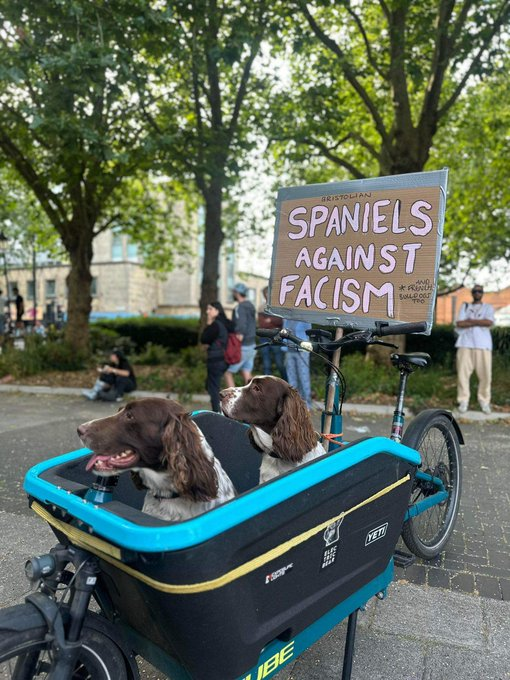
Bristol 3rd August 2024

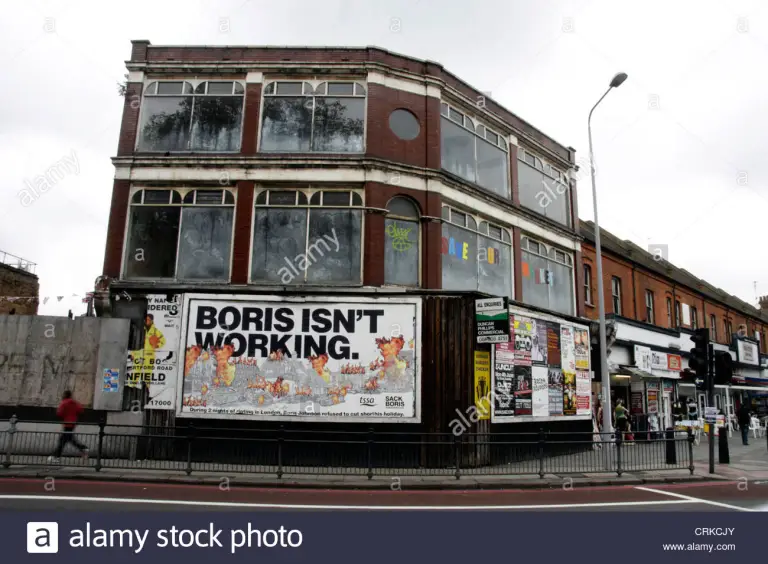
The Tories & riots. The case of Tottenham August 6th 2011 (they were all on holiday & didn’t rush back).
Several contenders for the Tory leadership have commented on the far right mobs causing trouble in some English cities. Given Keir Starmer’s record, which dates from 2011, one might think a pause for thought might occur before demanding that more law and order is called. That was what James Cleverly called for, once again reminding us that the name on the package doesn’t always fit what is inside. If there is one description that fits Starmer its Mr Law and Order. Meanwhile Priti Patel has called for the immediate recall of Parliament (now in recess) simply revealing that whatever holiday plans she has its not this week.
The Tottenham riot of 2011, which sparked others, is a guide to how seriously the Tories took the matter when they were in Government…
On the night of Saturday 6th/Sunday 7th August in Tottenham there was a riot in Tottenham following the shooting dead of Mark Duggan by police several days earlier.
At the time the Mayor of London was Boris Johnson. He was of course on holiday at the time in Canada with his then wife Marina touring the Rockies in a Winnebago. According to his biographer Sonia Purnell Johnson doesn’t like holidays in Britain.
Prime Minister Cameron, Deputy Prime Minister Clegg and Home Secretary May were also on holiday abroad.
City Hall tried to contact Johnson and get him to return. As Purnell notes ‘not for the first time..the cry went up: Where is Boris’.
Johnson was not minded to break off his holiday to deal with unrest that had now hit 29 of London’s 32 Boroughs.
On the Monday May returned to take charge followed by Cameron. Eventually Johnson appeared in London on the Wednesday.
By that time Cameron and Clegg had already visited Tottenham. Johnson made it on the late Wednesday afternoon.
Ignoring a crisis, returning late when he realised how serious it was and making pledges about what might then happen seems to have set a template for Johnson
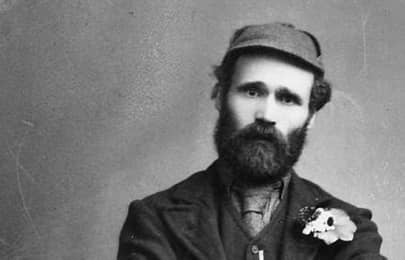
Keir Hardie took his Parliamentary seat for West Ham on August 3rd 1892. He had been elected as a labour candidate where the Liberals did not run but did not back him either.
His dress sense marked him out immediately
Upon taking his seat on 3 August 1892, Hardie refused to wear the “parliamentary uniform” of black frock coat, black silk top hat and starched wing collar that other working-class MPs wore. Instead, Hardie wore a plain tweed suit, a red tie and a deerstalker hat. Although the deerstalker was the correct and matching apparel for his suit, he was nevertheless lambasted in the press, and was accused of wearing a flat cap, headgear associated with the common working man; “cloth cap in Parliament” (Wiki)
While the deerstalker was of course not a proletarian flat cap the point was that it was definitely not a top hat. Hardie had a clear sense of dress by class.
Eric Hobsbawm (Worlds of Labour) argued that the flat cap started to become something that marked someone out as working class (men of course) in the 1880s and Hardie was part of shaping that change. Hobsbawm notes that by 1914 the cap was universally worn and points to the cartoon character of Andy Capp as reflecting this in later decades
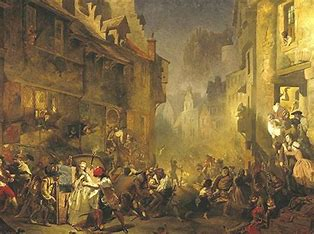
From Church and King mobs, 1780s to ‘we want our country back’ mobs 2020s
Posting on the far right mob thuggery at various English locations I was tweeted by someone who rightly pointed out that while left-wing protest has been chronicled by a lot of historians that of the right has not (leaving aside the often related but specific activities of fascists).
In fact as I noted in response most protest falls into neither category but is often about specific issues- for example climate change.
E P Thompson challenged by a review of the book by Geoffrey Best noted in the 1968 postscript to the Making of the English Working Class that the activities of those opposed to radical and democratic reform and organised labour were too little written about and too little understood.
Thompson perhaps undersold himself since references to Church and King mobs stretch into double figures in the Making. Thompson’s 1968 point was that despite reactionary opposition a class conscious working class still developed.
Church and King was one of the main slogans of gangs of loyalists who opposed supporters of democratic politics- Corresponding Societies- and the French Revolution in the last period of the eighteenth and the first period of the nineteenth century. Other slogans focused on Tom Paine the author of the Rights of Man.
The gangs could range in size from hundreds to on occasion. They were inevitably fuelled by drink and they were violent. Homes of reformers were attacked as were meetings in pubs. In most cases the police and magistrates who supported them did nothing. The aim was to disrupt, terrify and destroy radical organisation.
Where the early labour movement and radicalism were stronger, as Thompson noted of London, Church and King mobs were less effective.
One did operate in the Gordon Riot in 1780 in central London. Encouraged by authority the mob targeted the houses of religious dissenters. However it moved on to free prisoners at Newgate and then marched on the Bank of England. The army were called out.
The motivations of the Church and King mob were mixed. Against reform and the French Revolution some at least saw themselves as upholding the limited liberties of the Freeborn Englishman.
We can trace the reactionary mob through British history from anti-Irish riots in the 1850s to anti-Jewish ones in the early twentieth century. There are many more example almost always focused on violent protests against minorities.
A far right and often violent mob backed by sections of authority has been a persistent feature of modern British history. Mass and organised opposition may not get rid of their sentiments but it can stop their activity.
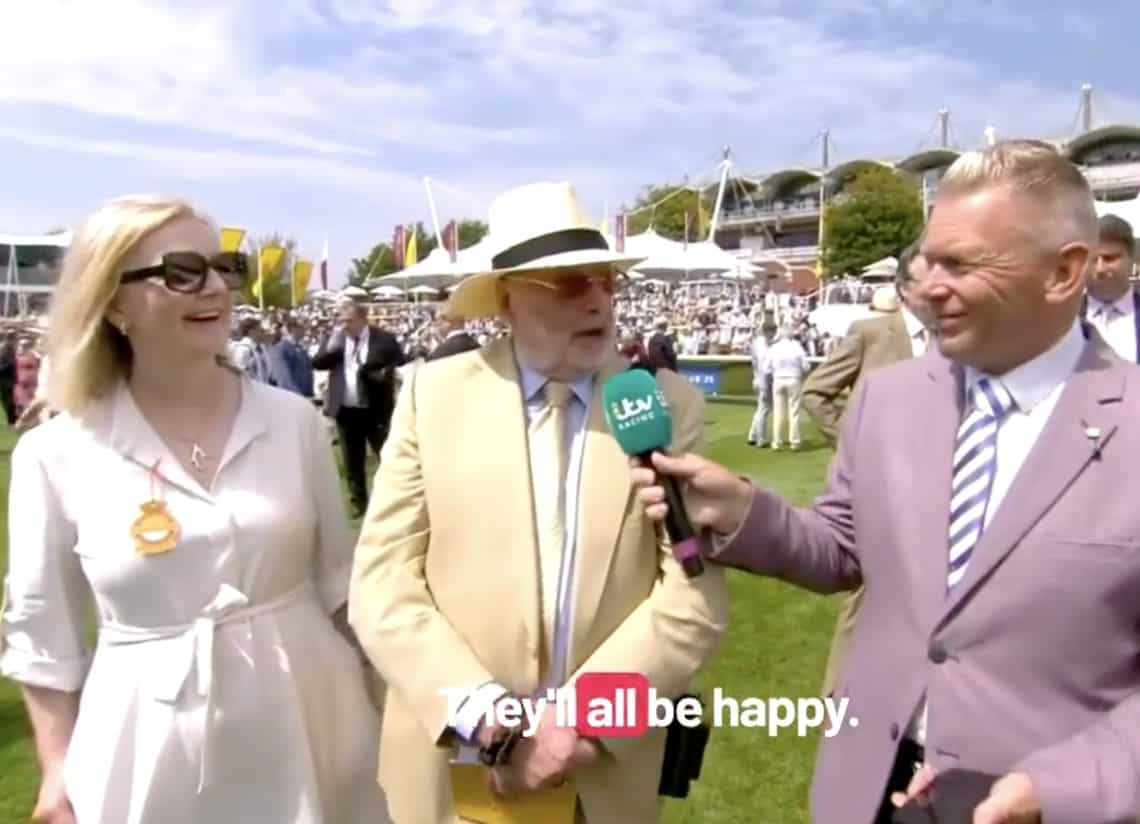
Fresh from her admission to the Telegraph that she was late for her election result on July 5th because she was in Kings Lynn McDonalds, Liz Truss has been at the Goodwood races this week.
ITV racing interviewed race horse owner James Hay. His partner Fritriani Hay was reportedly the largest donor to Truss’s 2022 campaign for the Tory leadership.
Hay was interviewed by ITV’s racing correspondent who either ignored or didn’t recognise a smiling Truss.
ITV later commented after working out it was Truss that the market could collapse at any moment
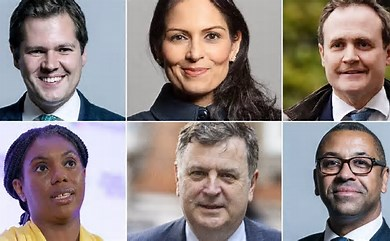
Some have argued that who leads the Tory Party next matters (Martin Kettle, Guardian) because in what remains currently a two-party Parliamentary system having a viable opposition is important.
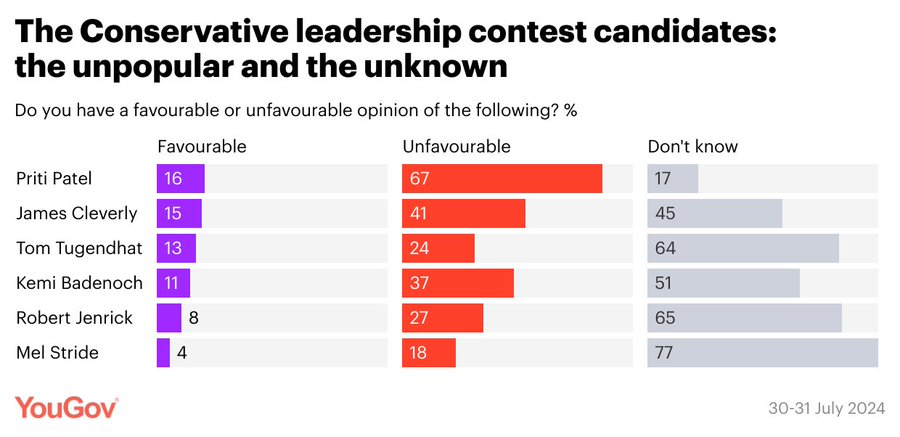
There are two problems with this. Firstly surveying the list of potential leaders from November 2024 below, what chance is there of any of them running a credible opposition to Starmer. Far more likely they will be off on a far right bender with Nigel Farage cheering them on.
Secondly as the July 4th Election underlined the two party system is fracturing. There are LibDems, SNP, Socialist Independents, Plaid all in the Commons and while knitting together a Parliamentary opposition in future from them would be far from easy, will it be any harder than thinking a relatively sane Tory Party will somehow reappear?
The political editor of The Spectator Katy Balls has noted of the leadership contest (Guardian 2nd August)
It says something about the state of the Conservative leadership contest that even Tory MPs are struggling to get excited about the next three months. “I see them as a pack of quite average greyhounds,” says one MP of the six contenders vying to succeed Rishi Sunak. Others are refraining from publicly backing a candidate on the grounds that they fear in a few years’ time it may all blow up – and they may have to do it all again.
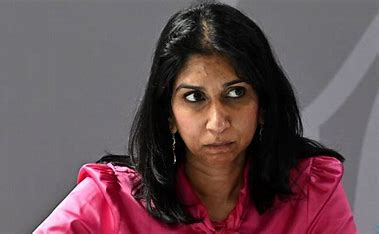
Noting that Suella Braverman will not be a candidate for the Tory leadership (Report, 28 July), I think we can now declare a resounding victory for the “Guardian-reading, tofu-eating wokerati”.
Keith Flett
Tottenham, London
Guardian 1st August 2024
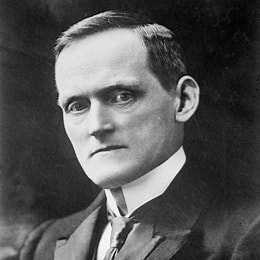
The Treasury mind. From Philip Snowden in 1924 to Rachel Reeves in 2024
Aditya Chakrabortty has rightly criticised Rachel Reeves first statement as Chancellor as sticking very much to the austerity strategies and language of George Osborne.
The cynical spectre of Osbornomics is haunting the Labour party | Aditya Chakrabortty | The Guardian
He is right but the pedigree of Reeves’ statement reaches much further back in Parliamentary history to Labour’s first Chancellor Philip Snowden. He introduced his first and only Budget in May 1924 and later issued it as a pamphlet, the Housewives Budget.
Snowden was an ILPer but with a distinctly Gladstonian Liberal frame of mind when it came to economics. As Churchill noted Snowden shared the Treasury Mind with the Governor of the Bank of England. Rachel Reeves of course is a former Bank economist.
Snowden saw the Chancellor’s job as managing the economy in a prudent way and certainly not increasing public expenditure.
Even so on a class basis his Budget was well crafted in that sense that it made some minor concessions to the have nots, primarily around what is known as the ‘free breakfast table’ while doing nothing to increase taxes for the rich.
Snowden halved sugar duty and tea duty at a total cost of £23m and reduced tax on cocoa, coffee, chicory and prunes. He cut entertainment duty meaning cheaper seats in cinemas and theatres and abolished tax on sweetened table waters altogether. Tax on the middle class drink of soda water remained.
Reeves agreed a range of public sector pay increases sat on by the Tories, and ended discrimination against young people on the minimum wage. She also of course ended the winter fuel payment for some numbers. VAT on private school fees will be payable from 5th August and the Budget itself in October may address some wider issues of wealth and tax.
As with Snowden the issue of class is addressed, this is not what the Tories would have done, while leaving the basic financial structure very much as it was.
Hence while Reeves talked about economic growth she cancelled spending on new hospitals and rail projects. In 1924 a Liberal MP John Maynard Keynes asked Snowden why he had not committed £100m to construction engineering.
As Chakrabortty notes in her economic statement Reeves was clearly aware of Keynesian economics but like Snowden a century before she rejected them in favour of the Treasury mind.
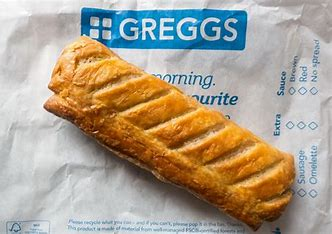
2021 £1
2022(Jan) £1.05
2022 (May) £1.10
2022 (Oct) £1.15
2023 (Jan) £1.20
2024 (Aug) £1.25
Those whose wages have increased by 25% in the last four years will not be concerned
Beard Liberation Front
31st July
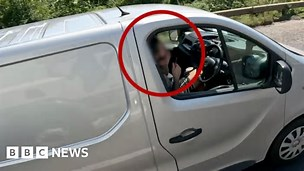
The Beard Liberation Front, the informal network of beard wearers, has warned supporters that manscaping while driving is illegal. The BBC have reported a case in South Yorkshire.
The campaigners say that while trimming and general beard maintenance are perfectly prudent activities this is not the case while driving.
BBC Report
A motorway driver has been caught trimming his beard with no hands on the steering wheel in South Yorkshire.
The “shocking manscaping” was filmed by roads officers in an unmarked HGV, with the man among more than 240 people caught for driving offences over five days in July.
View more by category: Uncategorized (14,145). .


