Articles

Tony Benn b 3rd April 1925. History Man

In Uncategorized on April 3, 2024 by kmflett

Tony Benn b 3rd April 1925. History Man

Tony Benn would have been 101 today. He died twelve years ago in 2014

His published Diaries remain an important historical resource. The eleven
published volumes represent a fraction of his total archive. It is to be hoped
that just as the papers of Mrs Thatcher are being deposited in an academic
archive and made available on-line by the Thatcher Foundation, so Benn’s
equally if not more important- not least for its longevity- documentation can
be made accessible to the public in its entirety.

Tony Benn was a rarity among modern politicians in that he also had a sense
of history and specifically labour and democratic history.

Media commentary after his death suggested that he did not have a grasp of
historical perspective when was a Labour Minister in the 1960s. Rather his
experience of power led him to reflect on lessons that might be learnt from a
study of the past.

Benn however was not an historian, and nor did he claim to be.

He did not spend his time researching matters in archives or wondering if a
study of history might throw up distinctly awkward questions for present
practice.

He did though understand the historical context he which he operated.

I’m grateful to Professor Owen Ashton, the Editor of the invaluable Merlin
Press Chartist Studies series, for reminding me how much Benn focused on the
Chartist movement.

Ashton has argued that Benn was in the tradition of dissenting ‘Gentleman
Leaders; who were radical ‘Friends of the People’. In the nineteenth century
one might look to figures like Henry Hunt who spoke at Peterloo, William
Cobbett and the great Chartist leader Feargus O’Connor who became MP for
Nottingham, as broadly comparable figures.

Benn himself saw the Chartists in the context of a broad democratic heritage
including the Peasants Revolt the English Revolution of the 1640s and the
Suffragettes of the early years of the twentieth century. It was an historical
list he often spoke about and recounted in a 1999 article for History Today

He became he a regular attender at the TUC’s Tolpuddle Festivals in July and
that was very much part of his awareness of labour history. He was also often to be
found at the Durham miner’s gala for the same reason.

He also spoke at a London Socialist Historians conference on the history of
the vote that we organised at the Institute of Historical Research

His Diaries contain several references to the Chartists. He wrote in 1981
about Paul Foot’s book Red Shelley and argued that Shelley’s influence on
Chartism and the working-class movement had been all but hidden.

More poignantly in his General Election defeat in Bristol in 1983, on
changed constituency boundaries, he nevertheless paid tribute in his after-poll
speech to the Chartists and the suffragettes, who had fought for the democracy
that had allowed him to stand.

Historians can argue that Benn’s understanding was too uncritical perhaps
even to a degree hagiographic. Yet that itself misses the times in which Benn
was active as a leader of the labour movement.

Relatively few other Labour MPs or Union leaders knew much if anything about
labour history and even fewer made any reference to it when they spoke in
public.

The importance of Tony Benn as an educator of the labour movement should not
be overlooked. When he spoke at large public meetings and rallies about the
Chartists or the Levellers he inspired numbers to go away and find out more
about who those people were, why and how they fought and what they did and did
not achieve.

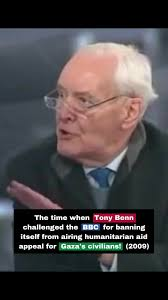
In terms of 2026 Benn who was originally a supporter of the foundation of Israel
came to grasp the impact this had on Palestinians and in later life became an
advocate for Gaza and for aid for those suffering at the hands of Israeli
forces

The inspiration of the life of Tony Benn remains with us in the present
 

Articles

E P Thompson, the Making of the English Working Class & Scotland in April 1820

In Uncategorized on April 3, 2024 by kmflett

E P Thompson, the Making of the English Working Class & Scotland

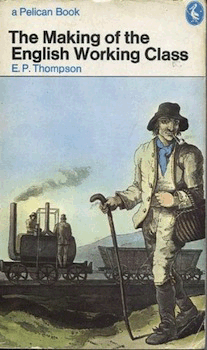
With the 60th anniversary of the publication of the hardback version of the Making of the English Working Class I’ve been looking to finally complete work on a collection of essays on the book that I’m editing.

It has been too long delayed since the work relates to a conference held on the 50th anniversary of the book in 2013.

In order to make sure the book is not marooned in out of date scholarship I’ve been looking at issues that are being discussed around the 60th anniversary, some of which were certainly also there in 2013 but have been amplified since.

One is why Thompson focused on the English working class when 60 years on some might argue that it should have been the British working class. One reason of course is that given the book was not far off a thousand pages long it would have required further volumes. Thompson himself in the 1963 preface had other specific reasons.

He argued that ‘it is possible, at least until the 1820s, to regard the English and Scottish experiences as distinct since trade union and political links were impermanent and immature’

However when it came to Cato St, the unsuccessful London conspiracy to murder the Cabinet as a reaction to Peterloo in February 1820, Thompson actually noted the links between English and Scottish trade unionists. It’s fair to say that these links must have been built over time and deliberately so given this was a time before mass communications.

How far the Cato Street Conspiracy was linked to any genuine national plan is unclear. There were three attempted risings shortly after the arrest of the conspirators-one in Glasgow and two in Yorkshire. In the neighbourhood of Glasgow small parties of weavers rose on 5 and 6 April (with their famous banner, Scotland Free or a Desart), there was a sharp encounter with the military at the ‘Battle of Bonnymuir’… It seems that the insurgents believed they were acting their part in a plan for simultaneous risings in Scotland, Yorkshire, Lancashire and Carlisle- in all the weavers strongholds.

E P Thompson, The Making of the English Working Class

Battle of Bonnymuir

An Account of the Battle which took place at Bonnymuir, on Wednesday the 5th April, 1820, betwixt about 50 of the Radicals and a party of the Military;

Kilsyth, 5th April 1820

This morning a gentleman residing in this parish belonging to the Falkirk troop of Yeomanry Cavalry; left home to join his troop at Falkirk, and had proceeded a short way from his own house, when he came up with between 25 to 30 Radicals, all armed with pikes, muskets, and pistols, who stopped him and requested him to give up his arms, which he refused to do, and showed them a disposition to resist. They told him (at the same time presenting at him several pistols) that resistance would be vain, as they would kill him on the spot. He, however, got off retaining his arms and meeting with an Orderly from Kilsyth going with dispatches to Stirling, informed him it would be improper to proceed. They accordingly both returned to Kilsyth and reported, when the Commanding-Officer there ordered ten men and a serjeant from the 10th Hussars and as many of the Yeomanry Cavalry, to escort the Orderly and the other Gentleman on their several roads, and to endeavour to fall in with these armed Radicals if possible. The Radicals, in the interval, had been joined by a number more, who proceeded along the Canal Bank towards Bonny-muir, having taken several fowling-pieces and a pitch-fork from farmhouses in the neighbourhood of Bonnybridge.

The Cavalry, on their arrival at Loanhead, being informed of their proceedings, immediately went to Bonnymuir in search of the Radicals, and, on coming up with them, they showed a disposition to fight rather than fly; having taken their position behind an old dyke, they allowed the Cavalry to come within thirty yards of them, when they fired a volley; the Cavalry instantly charged, firing a few shots when going over the dyke; the Radicals received the charge with their pikes, and made all the resistance in their power, but they soon found themselves in a bad situation, and throwing away their arms, endeavoured to escape, when the Cavalry secured nineteen prisoners; three of whom are wounded, two remained on the field so badly wounded as not to be able to be carried to Stirling Castle, where the prisoners are lodged. Eight or ten of those who escaped are said to be wounded, and have not been able to go from the place where the affair happened. The whole number of the Radicals did not exceed forty or fifty. None of the Cavalry are severely wounded; two are slightly in the hand; and one horse severely wounded in three different places (since dead) and a number of horses slightly.

It is reported that the whole of the prisoners belong to Glasgow, except one of the name of Baird, said to be their leader, who lately resided at Condorrat. It is said that the whole had been drilling in the Calton Green of Glasgow this morning, that they left that place about four o’clock, and went over the country in a straggling way till they arrived at Bonnymuir, where they expected to be joined by a number from all parts of the country during the evening and tomorrow.

https://digital.nls.uk/scotlandspages/timeline/1820.html

Articles

Labour membership 2004-2024. The great lurching right show again

In Uncategorized on April 2, 2024 by kmflett

Labour membership. The great lurching right show again

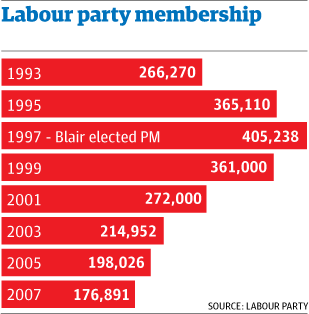
According to a report in the Observer Labour membership is currently at 366,604 down from 390,000 in January. These figures come from Labour HQ passed to a friendly journalist. The spin is that while some have left over Gaza and the scaling back of a green economy policy Labour is well ahead in the polls anyway, so, so what.

Membership stood at 532,000 in 2019 which was comfortably the highest of a social democratic party in Europe. Most have been in significant decline membership wise, even the German SPD which is in Government

The additional spin was those who had left were ‘far left’. The term is used loosely by Starmerites. It does not mean, unfortunately, those who have some familiarity with the ideas of Marx and Lenin. Rather it refers to those who have left-wing views on things like nationalisation and war.

The declining numbers matter though. Firstly members provide income, The cost of Labour membership is not high but when its aggregated into hundreds of thousands of subs its still significant. Hence the ever increasing number of e-mails in my in-box from Labour asking for money. Falling membership also means fewer people to go out on the doorstep. Labour can’t rely on most of the media at an Election even now, so conversations with voters remain important. They can be replaced by, for example, social media content to an extent but that requires money too.

It is a discussion of the moment but as ever there is a history

In 1992 under Kinnock Labour membership stood at 279,000. By the time of Blair’s victory in 1997 it was at a peak of 405,000. It represented at least in part a hope that some change was going to take place (as in fact it did).

One of those changes was the Iraq War in 2003. After this Labour membership went into sharp reverse. In 2004 it stood at 208,000 and by the time of the 2010 Election it was 197,000.

That might suggest that at 366,000 Starmer is not doing so badly. Yet as with Blair in 1997 the direction of travel should be up not down and Starmer isn’t even in No.10 yet

https://www.theguardian.com/politics/2024/mar/30/labour-membership-falls-by-23000-over-gaza-and-green-policies

Articles

Trevor Griffiths 1935-2024. An historian of the present

In Uncategorized on April 2, 2024 by kmflett

Trevor Griffiths the playwright has died. A tribute from Keir Starmer is not expected.

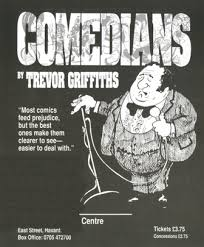
From the 1960s on Griffiths produced a range of political theatre that made an impact on TV, on stage and in the cinema. What today might be called mainstreaming left politics. Griffiths politics were marxist, but firmly of the anti-Stalinist revolutionary left.

His play The Party, where Laurence Olivier played a Glaswegian Trotskyist, looked at the development of and issues with the political far left that remains a part of UK life today. The Comedians, adapted for TV, is set in a working men’s club and makes the very sharp point that the best humour is not funny ha ha, but that which provokes thought. The series Bill Brand which ran on ITV looked at the Parliamentary Road to Socialism.

A serious political theatre that made a wide impact.Trevor Griffiths legacy should be to see whether something like that impact can be achieved again in a world where the on-line plays a significant role

https://en.wikipedia.org/wiki/Trevor_Griffiths

Articles

Storm Kathleen warning: start of 2024 Beard, Shorts & Sandals Pre-Season delayed

In Uncategorized on April 2, 2024 by kmflett

Beard Liberation Front

6th April

Start of 2024 Beard, Shorts & Sandals Pre-Season delayed

The Beard Liberation Front, the informal network of beard wearers, has said that the start of the 2024 Beard, Shorts & Sandals Pre-Season has been delayed due to inclement weather.

An alert has been issued on Storm Kathleen. While the temperature may be warmer than recent weeks, the wet and windy weather will not be suitable for shorts and sandals wearing.

February and March have been amongst the wettest months on record and the April forecast does not suggest a significant improvement.

The campaigners say that wearing shorts and sandals during a heavy rain storm is not to be recommended.

Ten years ago in 2014 the Pre-Season commenced on 10th March but a decision to open the Season is focused entirely on weather forecasts.

BLF Organiser Keith Flett said, we know people are keen for the Pre-Season to open and there is already unofficial beard, shorts and sandals wearing taking place. However as a responsible network of beard wearers who do want to open the season because the sun has come out for a few hours simply to find that participants end up getting drenched,leading to soggy beard syndrome

Articles

Women Turning the World Upside Down after Easter: Hocktide

In Uncategorized on April 2, 2024 by kmflett

Turning the World Upside Down after Easter: Hocktide

British traditions are varied and confusing and those around Easter are no exception.

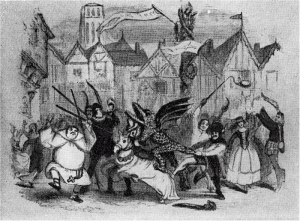
A strand of radicalism is a frequent thread. That is, the existing order of power relations is subverted in some way. The most common form of this is the Lord of Misrule, a character who is the precise reverse of the existing order of monarchs and other leaders. The figure is meant to be one of fun but as often disorder and riot are also present.

Easter has little association with Misrule but there is still a subverting tradition- that of Hocktide. In more recent times (and I’m not sure it existed beyond the early nineteenth century) it took place on Easter Monday or Tuesday. Earlier it was to be found at the end of a much longer Easter festival- two weeks or so after Easter Sunday.

Hocktide involved most commonly groups of women, married or single, kidnapping men and holding them to ransom for money. Originally the money raised went to local Church funds but it appears that later it was used to fund sporting activities.

In a male dominated society it was a rare expression of female power.

Hocktide, like many other religious associated customs was discouraged under the Long Parliament in the 1640s and even more so during the period of Cromwellian Government in the 1650s.

With the Restoration in 1660 it returned and it wouldn’t be surprising to find even today some echoes of the tradition taking place.

Articles

The declining value of Liz Truss

In Uncategorized on April 1, 2024 by kmflett

The declining value of Liz Truss

For someone who crashed the economy in 49 days in the autumn of 2022 Liz Truss remains omnipresent. Her most recent image was posted on Easter Sunday standing outside a derelict rural church clutching a lamb.

Yet the more she appears the less her value is it seems.

In 2023 she made £300,000 from speeches mostly outside of the UK (she is paid £87,000 to do her actual job as an MP)

In February 2023 she spoke in Mumbai and was paid £65,751

In March 2023 she spoke in Tokyo and was paid £6,443

In May 2023 she was in Taiwan for a 4 hour event for which she got £80,000

In June 2023 she pocketed a total of £64,000 for speaking in Switzerland and Dublin

In October 2023 (presumably after a summer holiday) she got £32,000 for speaking in Houston and Washington

In December 2023 she was paid £30,000 for speaking at a conference in London, a very rare  home fixture

Yet in February 2024 according to the Daily Mirror she spent most of the month in the US but accrued ‘only’ £32,000 for appearing at a number of events.

It would appear that the more Truss speaks the less she is worth. For those who had to put up with her in 2022 that does make sense

Articles

It was (just about) an April Fool. NOT calling last orders on Fletters

In Uncategorized on April 1, 2024 by kmflett

NOT  calling last orders on Fletters

The below of course was posted on April 1st so I can confirm that I’m NOT calling time on writing letters, yet. Even so, the points made here remain relevant.

While the Guardian, Times, Telegraph, Morning Star and Mirror do continue to carry on with sometimes lively letters pages, elsewhere the decline is noticeable- where print publications continue. The New Statesman for example, which had a robust letters space, now often carries only a few. People comment on-line or on social media.

My socialist letter writing mission has been taken up by others, notably Sasha Simic who is doing a great job

Nevertheless the reality is that much comment is now on-line and that poses significant issues for future generations who want to discover what people were thinking and saying before them.

Very far from all letters written either personally or for publication survive for posterity, but many do. The collected letters of Marx and Engels (which are far from comprehensive- there are gaps) is a fascinating resource for historians. If they were corresponding in 2024 would the e-mails have been kept?

By contrast while some electronic comment is archived there is no guarantee that it will be available in future decades as technology moves on…

I will be continuing to write Fletters for now but the interest my original post sparked underlines that a move away from the era when more or less the only way a voice from below, as it were, could get a hearing was to write a letter for publication, is with us. If you’re reading this it makes the point!

Articles

Calling time on writing Fletters

In Uncategorized on March 31, 2024 by kmflett

Calling time on writing Fletters

According to my (not particularly accurate) Wiki entry I’m a ‘prolific letter writer to the British press’.

That bit at least is true. I write much less these days but I haven’t stopped, despite occasional suggestions that I have.

I started in the mid-1980s writing to the Guardian (which I still do)with the aim of trying to provide some historical perspectives to a media that seemed even then to be obsessed with out of context for the moment reports.

The letters don’t and never have covered just that though. Beer, beards, cricket, cheese and of course socialist politics all feature.

Now however I’ve decided after 40 plus years to call it a day.

While I still see the value of the edited (in effect moderated) letters page compared to social media and below the line commentary, the sad reality is that the audience for letters to the editor has diminished over the years. So too have the publications that one can write to, as many either go on-line only or close altogether.

What’s Brewing, the monthly paper of the Campaign for Real Ale, has been on-line only for a while now. I used to write letters regularly, but no more. Beer discussion has moved almost entirely on-line some time since.

I comment on Twitter etc and Facebook and run a blog. All excite considerable comment on occasion. I’m afraid published Fletters mostly pass by more or less un-noticed by comparison. Those that ask me, for example, if I’ve stopped writing to the Guardian I suspect mostly don’t read the print edition anymore (nor do I) where the letters are prominent in the comment section. The letters appear in the various Guardian digital versions (which I subscribe to) but you have to search them out.

If you do actually want to read what I’m saying a good point of entry is on twitter. If you don’t you won’t come across me inadvertently as you’re flicking through a paper or magazine anymore

Articles

A history of the present: Assessing protests for Gaza historically & the urgency of solidarity

In Uncategorized on March 31, 2024 by kmflett

A History of the Present: Assessing protests for Gaza historically

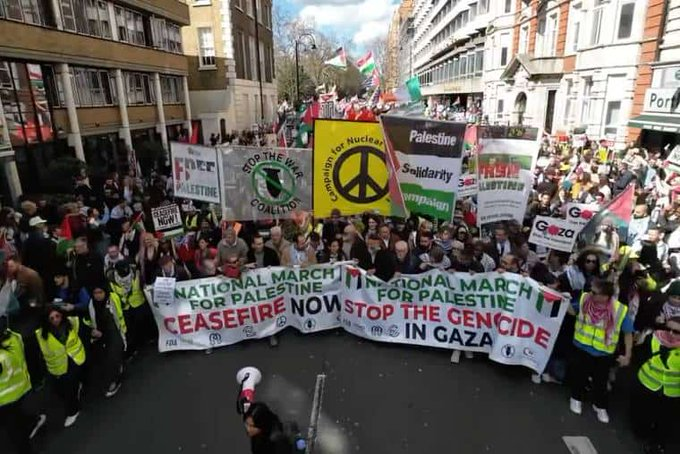
200,000 people marched for Gaza in central London on Easter Saturday. It was the 11th national march since October. Given that numbers are away or at events at Easter and transport is even more unreliable than usual the number was impressive.

It was not course comparable in size to the biggest ever march in British history the 1.5m or so who protested against the Iraq War on 15th February 2003. The march was not a one off, but the sustained level of mass protest is likely to be unique in British history going back to the first ever mass demonstration at Peterloo in Manchester on 16th August 1819.

The importance of marching in London is the impact it makes. Such marches will sometimes get coverage in UK media but they are guaranteed to be noticed around the globe. Britain after all was the former colonial power in Palestine.

That said it’s not just London where protest is happening and this what also makes the Gaza protests unique. On 30th March there was a static protest in Liverpool ,marches in Halifax and Cardiff and a demo at a Manchester venue that had cancelled an evening of Palestinian politics and culture.

It is far too soon to make an historical assessment either of the scale of protests or their impact. But at the same time, as protest needs to continue, there must be some sense of how it fits in historical models and examples of protest.

Perhaps the obvious starting points are the Chartist movement which ran in various formats from 1837 to 1860 or so and the Suffragettes who were active in the first decades of the twentieth century.

An obvious point and one right-wing politicians and media will not want to think about, is that the protests are overwhelmingly peaceful. This was not true of either the Chartists or the Suffragettes. The Chartists had a nearly successful attempt at revolution in Newport in 1839 and a General Strike in 1842. The Suffragettes organised direct action and beyond that various protests which would today be labelled as terrorism.

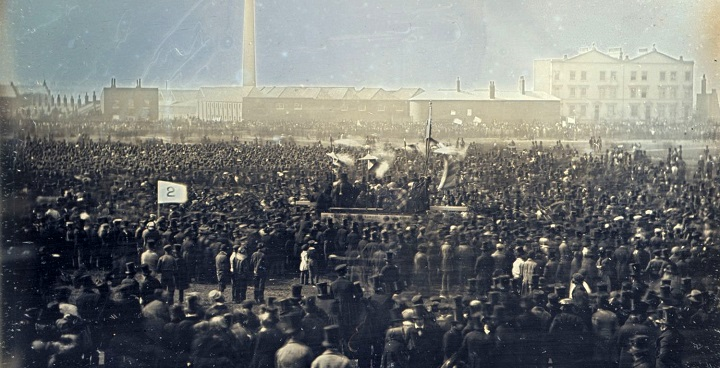
There was a London focus to Chartist protest- for example at Kennington Common on April 10th 1848.Upwards of 100,000 attended before mass train travel was available. In June 1908 300,000 Suffragettes gathered in Hyde Park for what was termed the Big Shout for the vote.

Like the 2003 Iraq War demonstration these were one off events which were also part of wider and long running campaigns.

The 11 national London protests for Gaza in 6 months provisionally suggest an historical specificity and intensity. The Chartists and Suffragettes were both engaged in decade long protests for the vote and more. The Gaza protests have an urgency that suggests a different timescale but the historical link with issues that must be addressed is also there. The need for protest now is urgent but solidarity will go on for years and it has already done well before 2024.

Work in political and historical progress, urgently so.