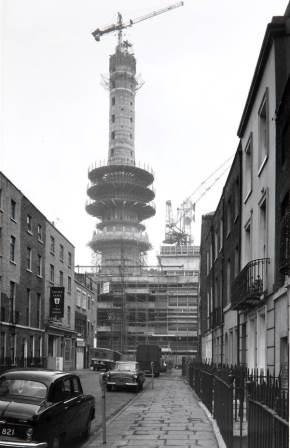
News report indicate that the BT Tower in central London has been sold to a hotel chain, although it will be a while before it opens.
The official opening of what was then the Post Office Tower took place on 8th October 1965 when Tony Benn was Postmaster General. He recorded in his diary
Caroline and I went off by car about 10.15 and got to the Post Office Tower well before eleven for the official opening. Among the guests who came were Clem Attlee, who is our oldest and most senior ex-Postmaster General, Charles Hill, Lord Normanbrook, Sir Billy Butlin who will be running the restaurant and of course the top brass from the Post Office..Harold (Wilson) arrived with Mary Wilson, Sergeant Kelly (their detective), Marcia Williams and Brenda Dew, Peter Shore and Derek Mitchell
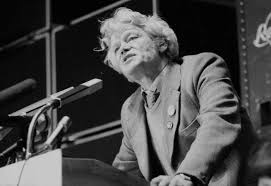
With a number of pieces and a conference to mark the 100th anniversary of the birth of E P Thompson on 3rd February 1924 I’ve been pondering a point made by Julian Harber in an appreciation on the Verso blog. Thompson died in 1993,30 years ago, so how relevant his work and approach to history and politics is now is perhaps questionable.
In an age dominated by performance indicators and statistics its actually quite difficult to find information on the impact of Thompson and the Making.
We might tentatively differentiate between the English speaking world and elsewhere. Certainly Thompson’s work (like Eric Hobsbawm before him) has growing interest in the Spanish speaking Americas. Thompson of course noted in the Making that causes lost in England in the nineteenth century might yet be won elsewhere.
The Making was not translated into German until 1987 (two volumes), while the five part Radio 3 series on the Making broadcast in December 2023 received wide interest, certainly if the number of hits the Society for the Study of Labour History got on a link it posted is a guide.
The Guardian recently published an Editorial pointing to the adult education work Thompson did and the link between the rescuing of the views and thoughts of working in the Making, however inconvenient, and current work by English Heritage to make sure working class voices are not lost.
There was another dimension to Thompson’s work as a peace and anti-nuclear campaigner first with CND and then with END. He noted that he had left his historical work to campaign, grasping no doubt that a continuing supply of history depended on it.
This all seems if not anecdotal not definitive either. A question which remains unanswered as yet is how much interest Thompson finds, for example, amongst current undergraduate students. Reports welcome
Julian Harber on the Verso Blog
But fighting beyond the grave is another matter. In his obituary of Edward, Eric Hobsbawm noted that “In the 1980s Thompson was the most widely cited 20th century historian in the world according to the Arts and Humanities Citations Index and one of the 250 most frequently cited authors of all time.” As I understand it this citation index now takes a different form, but whatever its current manifestation is, I would imagine the situation is now much changed as history has gone in other directions. Some of these directions Edward would I am sure have welcomed, but much else he would have seen as a retreat and in particular a retreat from matters that were his central concern – understanding and reporting the experiences, cultural resources, resistances and struggles of ordinary people against the rich and powerful. His work could only have been written by someone who believed or at least hoped that the world could have a radically more democratic and equal future. The steep decline in such a belief – both in its revolutionary and in its social-democratic versions – is the backdrop to this retreat. The extent to which his work is now neglected, out of favour or dismissed as romanticism is at least partially a reflection of the political ascendancy of those who Edward regarded as the enemy.
Ray Davies, growing in working class in Muswell Hill, New Labour, cricket & Arsenal
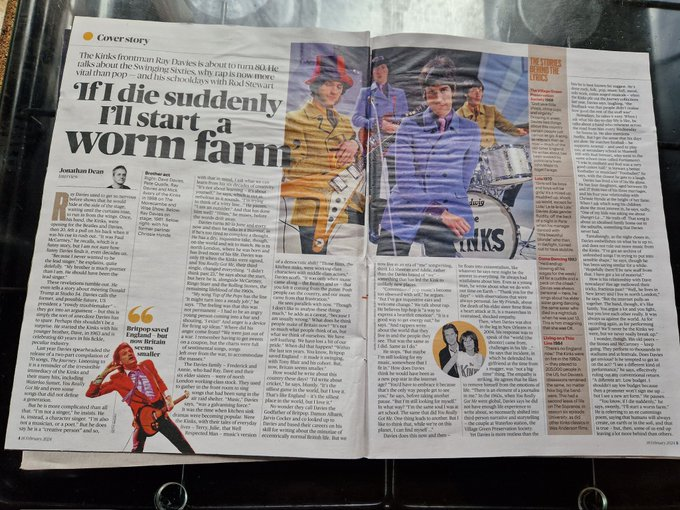
Ray Davies lead singer of the Kinks, and the original Muswell Hillbilly, is 81 on 21st June. He was interviewed in the Sunday Times (18th February 2024) on his life and times.
Muswell Hill is thought of today (not entirely accurately) as a well to do area of North London. Davies was part of a large working class family that grew up in the area after World War Two.
Davies recalls that popular music in the 1950s had a rather middle-class flavour noting that it was only when bands like the Kinks and the Beatles appeared that working class music made an impact. Davies was just 19 when the band signed a record deal. He argues that it was a democratic shift mirrored later by Britpop in the Blair era. Now he argues Britain seems ‘smaller’.
He now thinks that hip hop is expressing the mood and views of the moment, as the Kinks themselves did in the 1960s.
Davies says he is a cricket fan but also recalls playing football at school in Muswell Hill with Rod Stewart. As appropriate for someone on the West side of Haringey he is an Arsenal fan and still living in North London, though not on the Hill
Still looking for a ceasefire: Labour, Elections & Military action. The forgotten lessons of 2005
The House of Commons will vote on an SNP motion calling for an immediate ceasefire in Gaza on Wednesday. Protests are having their impact and that is underlined by Labour’s alternative motion which appears also to call for a ceasefire. The fact that Labour is whipping MPs to oppose the SNP call underlines that its not really doing so.
Of course whatever happens it won’t somehow magically lead to a ceasefire. However as Britain was the imperial power in the area after the First World War, what Parliament says is noticed.
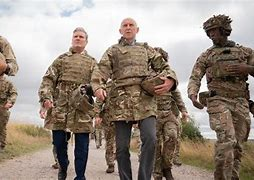
There is a history here and its one Keir Starmer should really recall as he opposed the Iraq War in 2003.
In the 2001 General Election, nearly a repeat of the result of 1997 Labour had a majority of 167. At the next Election in 2005 Labour’s majority dropped to 66. Tony Blair was replaced by Gordon Brown as PM in 2006.
In between the two Elections was the Iraq War. It was opposed by a significant number of Labour MPs (Blair didn’t have quite such an authoritarian focus as Starmer, dissent was freely expressed) and saw the biggest ever protest march in UK history on 15th February 2003. The war has become even more unpopular since and has a limited number of warmongers who still think it was a good idea.
The drop in Labour’s majority was undoubtedly due in large part to opposition to the war. This focused on Muslim voters, and saw George Galloway win Bethnal Green and Bow from Labour on an anti-war platform. The vote was far wider than that however and undoubtedly included those just fed up with the difference between Labour’s plan to create a New Britain and the limited progress that was actually made.
Fast forward to 2024 and we find another Labour leader, Keir Starmer, equivocating at best about a genocide in Gaza. It is increasingly unpopular with the public, polls suggest around three quarters of the public want a ceasefire. Starmer is flat footed as a leader compared to Blair and doesn’t have a large majority to lose since he is in Opposition.
It’s unlikely particularly given the current debacle of an ever more right-wing and incompetent Tory Government that Labour will lose a 2024 Election which is just as well, despite Starmer. The lesson of 2005 and what followed is that in, at best, not calling clearly for an immediate stop to an unpopular and murderous genocide Starmer is doing very significant damage to his chances of hanging around as Labour leader and PM. Blair’s departure underlines the point
The subject of Tory extinction comes up from time to time.
It was discussed after 1997 when the New Labour landslide led to a perspective that if Labour and the LibDems could form a progressive (in 2024 terms centrist) electoral grouping then they could replace the Tories as the ‘natural party of Government’.
It didn’t happen and we’ve now endured 14 years of Tory/LibDem, Tory rule.
It’s being discussed again not because of Labour’s poll lead over the Tories- although the recent By-Election victories for Labour perhaps point to it- but because the Tories have fallen so low in the polls. In a proportional voting system this would not be decisive. However in a first past the post system, as the LibDems have perpetually found out since the 1920s, it can be.
At the moment the Tories need to dip only a percentage point or two further and they could be reduced to a very small rump of MPs. The example used is the Canadian election of 1993.
At one level this appears a possibility. The Tories are meant to be the party of capital. Firstly capital is clearly split about how it wants the economy to proceed. Secondly, and relatedly think Truss. It might be argued that the Tories at the moment are not reliably the party of capital. Rather they are a party of a rag bag of right-wing prejudices and bigotry- hence the culture wars. Electorally however other parties can do this- Reform UK for example.
The media is full of talk of a Tory reconfiguration after the Election and the form this might take is probably going to be determined by how bad the polling numbers are.
Since the formation of the modern Tory Party in the 1830s it has often shape shifted and may well do so again.
Of course the other side of the equation is Labour. The Tories only real hope is that Starmer visits his favourite button- the one marked self-destruct- once too often before polling day. Some might argue that despite its polling numbers Labour as a moderate social-democratic party is also now extinct.
That is an argument for another time. However while the current crop of Labour politicians may not grasp it, the party embodies the idea, deeply rooted in society, that capitalism can be changed to make it a little bit better. Labour may have given up on that, but the idea will remain and find ways to manifest itself
That is discussion to be had in the potential implosion of the Tory Party
The traditional start of Spring is at the beginning of February. The Spring Equinox is on March 20th. Those keenest on upholding traditions invariably ignore that. It will after all be almost Easter by then.
Signs of Spring come before the Equinox. We can leave cuckoos to Times letter writers. In previous years letters in the Guardian have suggested the first lawnmower of Spring, while Waitrose has publicised the first, Forest of Dean, asparagus of the year.
More reliable and absolutely seasonal is wild garlic which appears around the end of February. That pictured comes from Roath Park in Cardiff. Peak season won’t be for another month or so, but early signs suggest a decent wild garlic crop
If you are marking Spring by gathering some wild garlic, forage responsibly.
What the BBC’s 2022 programme added to Private Eye’s analysis of Brewdog’s business model
The BBC Scotland investigation into Brewdog broadcast on 24th January 2022 drew most attention, rightly, to the final segment focusing on the toxic culture at the brewer and bar chain. It takes a lot of courage to speak out against even an ex-employer. Recognising a union still can’t come soon enough for Brewdog.
Brewdog complained to OfCom and after an 18 month investigation an adjudication has found that the entire contents of the BBC programme amounted to fair comment
The programme also covered Brewdog’s marketing strategies and its business model. It’s this last that ultimately is the key to the future of the brewer.
Private Eye covered some details in April 2020 and the BBC added more:
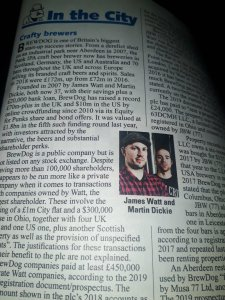
Private Eye (1517) carried a lengthy analysis of the structure and finances of Brewdog. Private Eye generally eschews such new-fangled things as the interwebs but a summary is below
The piece is interesting because Brewdog is far from transparent about how it works despite its Equity for Punks ‘ownership’ scheme.
The nub of the Eye’s analysis is contained in these sentences
‘it is not suggested that any of these transactions are illegal or improper. The question is whether they are appropriate for a company with 100,000 other shareholders’
Of interest it notes that while a profit of £3.8m was made in 2016 this had reduced to £1.4m in 2017 and by 2018 had become a pre-tax loss of £576,000. More recently Brewdog hasn’t made a profit in the last two years and has retreated from paying employees the real living wage.
Private Eye also noted:
When the private equity deal with TSG was announced in April 2017, it was stated to have involved a total of £213m, including £100m for new shares to fund Brewdog. The normal private equity playbook would look for an exit by sale or listing within five years. It’s now two years beyond that but of course the pandemic has intervened.
There was talk of an IPO (a public share flotation) in 2021 and this remains on the agenda. A key issue is what the valuation of Brewdog might be. Getting this right is key as to whether the IPO works. Brewdog has argued the company could be worth £1.8bn, but it could be much lower. The BBC revealed that when TSG brought a stake a new class of share was created which guarantees TSG an 18% return. If the valuation is correctly high this might be OK. If not the return provided to Equity for Punks shareholders will be less.
The BBC also noted that Dickie and Watt had personally made a substantial sum out of the TSG deal but chose not to invest this in Brewdog but rather launched another Crowdfunder.
The Eye analysis focused on a Company named JBW77 that appears to be linked to Brewdog founder James Watt and various holdings, transactions and deals that it has been involved in.
The BBC revealed that Watt has funds in the Cayman Islands, a tax haven. He is hardly alone in that but it’s not very anti-Establishment. It also revealed that Watt has £500,000 worth of shares in Heineken one of the big brewers he reviles. He tweeted that he subsequently sold the shares and explained it dated to when Brewdog were considering partnering with Heineken for distribution. These of course are his personal dealings not Brewdogs but James Watt is the figurehead.
Where the toxic culture and Brewdog’s business intersect is in the area that worries a lot of businesses-reputational damage. That might impact a successful IPO particularly if Watt remains in charge.
It’s a pity it’s no longer just about the beer as it was back in 2007 but the realities of 2024 have to be grappled with. Will they be? A first indication will be the comment, if any, Brewdog makes on the OfCom adjudication
Lukewarm or tepid are words that do seem to fit at least the public character of Keir Starmer well. According to a new biography by Tom Baldwin he is great fun in private. Unlike other recent Labour leaders Ive never met him so I cant judge
Philip Collins column in the Times today raises the possibility of a lukewarm Starmer electoral landslide (19th Feb). Collins is a former Blair speechwriter also associated with Starmer. Politically he’s a centrist but unusually for the genre sometimes has interesting ideas.
His point is that Labour appears on course for a landslide victory at the General Election. That is a majority of around 100 seats or more. Usually this suggests some enthusiasm for the winning parties project if not their leader. However as Collins and many others note if the landslide does happen it will be because people have just had enough of the Tories.
That means that Starmer could come to Office without much electoral goodwill to apply to the awkward issues that inevitably arise for anyone trying to run anything let alone a Government.
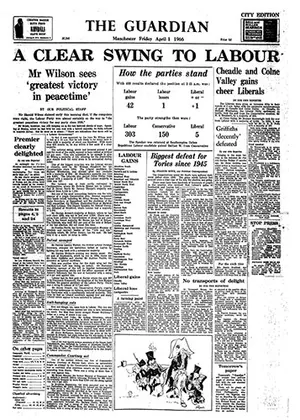
Collins ponders a number of examples but unaccountably misses what is perhaps one of the most relevant, the 1966 General Election.
Labour and Harold Wilson won a 98 seat majority and ran a Government until 1970 that carried through a number of important reforms. It was also quite frequently a very unpopular Government, hence electoral defeat to Heath in June 1970
One clue to that can be found in Tony Benn’s Diary (13th March 1966) ‘I talked to someone yesterday who said he would probably abstain in the Election. Not to put too fine a point on it he finds Harold Wilson phoney and entirely without principle.
Benn attributed this view to those on the left who had campaigned for Wilson to become leader but found him less than radical in Office. Benn noted however that with around 50 new, and youngish Labour MPs the Party was changing, while a core of left-wing Ministers organised at senior levels.
It was however perhaps the lukewarm landslide that was more important. Turn out at the Election was 75.8%. Those were the days..
Picket line & protest drawings of Inga Bystram are the first draft of history
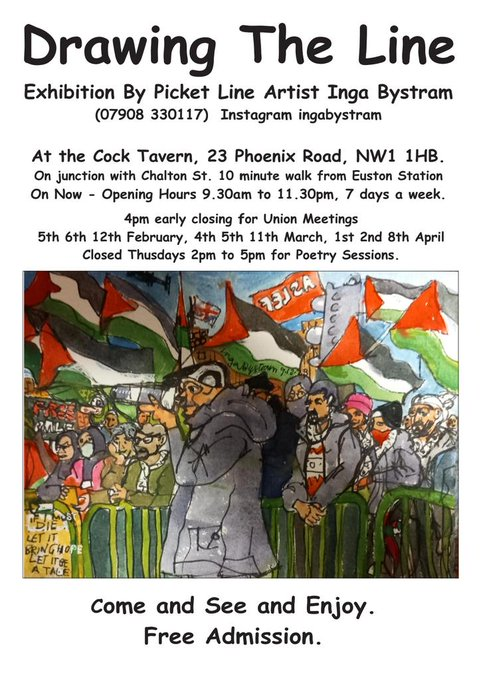
The London Socialist Historians Group, which organises the socialist history seminar at the Institute of Historical Research, University of London, has praised the picket line and protest drawings of Tottenham based artist Inga Bystram as the first draft of history.
Since the upsurge in class struggle from summer 2022 Inga has visited picket lines of strikers ranging from the RMT & ASLEF to the NEU, UCU and RCN and captured the mood and collective strength of unionised workers fighting for better conditions.
She has also drawn extensively on Palestine protests including the huge central London protests
There is now a new exhibition of Inga’s picket line and demonstration drawings at the Cock Tavern, 23 Phoenix Rd NW1 1HB near Euston Station in central London. The drawings can be viewed between 9.30am and 11.30pm seven days a week, with a few exceptions when the space is being used for union meetings.
LSHG Convenor Dr Keith Flett said, of course we are used to seeing photos of picket lines, but Inga Bystram’s drawings capture the mood and feel of a picket line and of demonstrations in different ways. They are the first drawings and drafts of history!
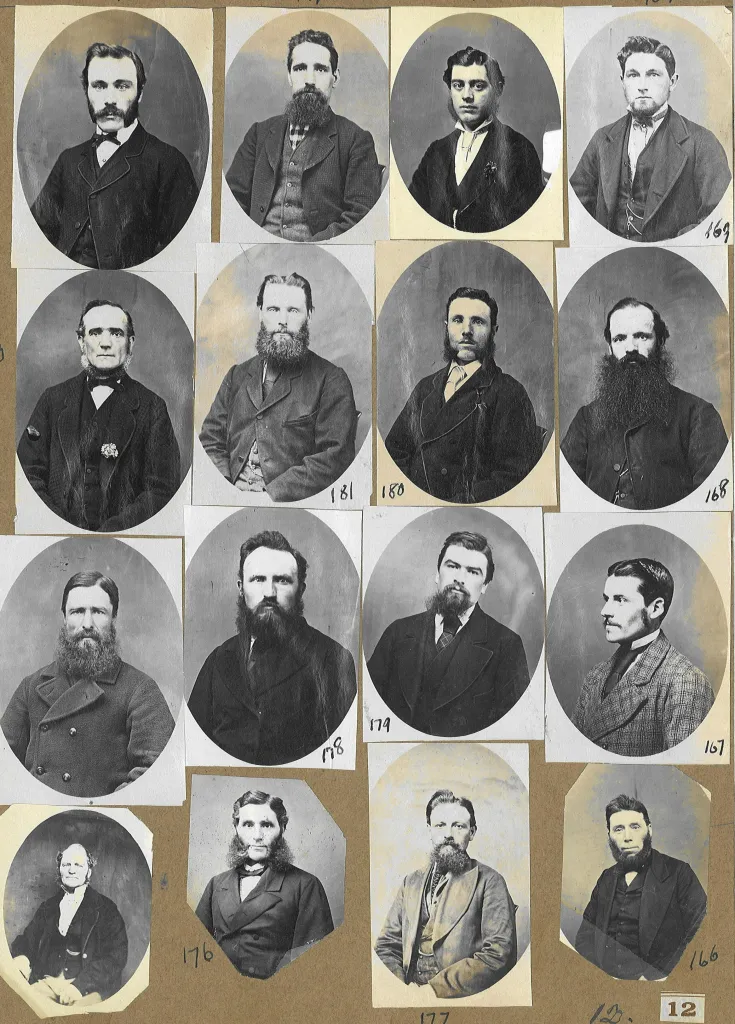
The annual vote which aims to determine the St David’s Day Beard of Wales, the Welsh beard that offers the most positive national image, is coming to a conclusion with the final Beard Off vote now open.
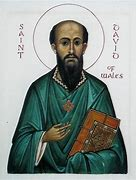
The Beard Liberation Front says that images of St David suggest that the Welsh Saint himself may have had an organic beard
Welsh rugby prop Adam Jones won the Award in 2013, voted for by BLF supporters, just shaving former Archbishop of Canterbury Rowan Williams. Another rugby player Leigh Halfpenny won in 2014. In 2015 the Award went to Thee Faction musician Chris Fox in 2016 footballer Joe Ledley and in 2017 to Charcutier Illtud Llyr Dunsford, with Chris Fox winning again in 2018. In 2019 journalist Grant Tucker shaved the opposition to claim the accolade. Michael Sheen has won the last four votes and the campaigners say that a fifth win would see him gain the honorary title of National Beard of Wales
It is the twelfth time the Award has been given following the traditional UK Beard of the Year at the end December each year and the BLF says it is a mark of Wales as a modern nation on St David’s Day that beards are now playing an increasingly significant role in national life.
BLF Organiser Keith Flett said, beards are blossoming in Wales, and competition is sure to bristle
There are two Close Shave Rounds on 25th and 26th February.
The top two from each round will go the Beard Off vote held on 27th and 28th February
In the first Close Shave round Assembly members Peredur Owen Griffiths and Hefin David shaved the opposition. In the second Close Shave round Michael Sheen and James Dean Bradfield were the follicular favourites. The Beard Off Final with the winners of Rounds One and Two is now open