As my twitter avatar notes I am a ‘marxist trade unionist’. Those however are not my words but those of the Guardian.
Career Marxism is a rather different issue. The term appeared on social media in respect of University Vice Chancellors who are imposing salary reductions on academics during the UCU’s marking and assessment boycott.
While it might be argued that combining Marxism and trade unionism is possible and perhaps on occasion essential, combining it with a senior management role in a University (these days in effect a business) is a contradiction too far.
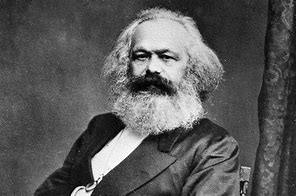
Genuine Career Marxism does not pay and we need look no further than Karl Marx himself to understand this. Marx did earn money from writing articles for papers- his international connections along with Engels meant he was well placed to do this. However he lived generally from month to month and relied on subsidies from Engels and family bequests to keep going.
A career in Marxism is certainly possible, but it doesn’t pay. If it does pay the Marxism has got lost along the way.
Roasting an Ox is a genuine-ish Coronation tradition.
An Ox and four sheep were roast for the 1821 Coronation at Windsor along with 5000 loaves and an Ox was also roast for Victoria’s Jubilee’s in 1887 and 1897.
This year the Whole Roast Ox Company has had no bookings for the Coronation. A roast Ox can feed 1500 people and costs around £5000. One view is that the cost of living crisis has had its impact..
The Met Police: a long history of suppressing protest & supporting the rich
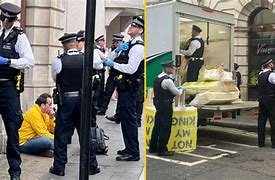
The Metropolitan Police’s arrest of 64 protesters in London at Saturday’s Coronation for no more reason than they were protesting as brought a renewed focus on what the police are for. The late socialist historian E P Thompson looked at why the rich hate protest so much
….The Chartist, Radical Liberal, Irish Nationalist and formative Labour movements were distinguished by their sensitivity to libertarian issues, and their suspicion of the polity of statism. When the police forces were enlarged and rationalized (or, as some would have it today, ’modernized’) in the mid-nineteenth century, this was a victory for bourgeois utilitarian bureaucratic policy in the face of intense resistance extending from old Tory localism through Radical Liberalism to outright Chartist opposition— for Chartists and trade unionists very well understood what kind of imperatives dictated government policies. As a consequence of this opposition, the presence of the police in British public life remained unusually subdued. They must be seen as ‘servants’ of… either the gentry or ’the public’, and they must in no circumstances exhibit a brash public presence. And, as a more concrete evidence of the old libertarian tradition, which endures to this day, the British police (at least in Britain) must go about the streets unarmed.
There were some anticipations of the statism of the twentieth century in the increasingly intrusive and punitive presence of the police in Britain in the 1880s. This was a natural reaction of the propertied classes, who reacted to the rumour that there were now socialist agitators in the streets (making speeches against their property!) with seemly terror. In general the police were impartial, attempting to sweep off the streets with an equable hand street-traders, beggars, prostitutes, street-entertainers, pickets, children playing football and free-thinking and socialist speakers alike. The pretext, very often, was that a complaint of interruption of trade had been received from a shopkeeper. William Morris remarked on the impatience of ’the more luxurious part of society’ to ’clear the streets of costermongers, organs, processions, and lecturers of all kinds, and make them a sort of decent prison corridors, with people just trudging to and from their work’….
E P Thompson, the Secret State
Update
After the arrest of anti-monarchy protesters on Saturday- many associated with Republic- Graham Smith has now tweeted that the police plan no further action. No thanks to the Labour frontbench, but protests from a range of groups and parties has underlined that even with Suella Braverman at the Home Office, authoritarian policing doesn’t always work
In recent decades pop songs from the Mamas and the Papas and the Boomtown Rats have reminded us that Monday is not the most popular day of the week.
Indeed before industrial capitalism got a firm grip in Britain it was common for artisan workers whose weekend consisted only of the Sunday to take Monday off as well, sometimes extending into Tuesday as well. The practice was known as Saint Monday. It may surprise people in 2023 that Peterloo in August 1819 and the Chartist protest for the vote on Kennington Common in April 1848 both took place on Mondays.
The 1871 Bank Holidays Act was an attempt to regularise and control the practice of taking Monday off. A small number of official holidays were permitted such as Boxing Day and Whitsun. Only in 1978 was May Day added by a Labour Government. Officially this was seen as a progressive act to mark international workers day. In practice it was also an attempt to stifle the practice of workers take unofficial strike action on May 1st.
Ever since reactionaries have demanded that the May Day holiday be moved to the autumn and renamed Trafalgar Day or Margaret Thatcher day. Thatcher herself enjoyed the break. Her papers held at the Thatcher Foundation reveal that on Monday 4th May 1981 she took lunch with husband Denis and daughter Carol.
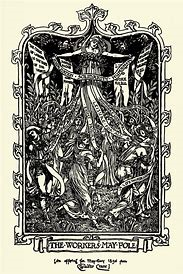
May Day is marked around Britain with a series of marches and festivals, although not always on May 1st itself. Its combined with the traditional welcoming of Spring that May brings, as Walter Crane’s graphics for the day sometimes reflected a new season of labour.
Eric Hobsbawm surveying international May Day celebrations found that in some other countries May Day was marked with more lively and robust protests. British May Days tend to reflect the traditions of labourism dating back to the 1860s. That is marches with banners, brass bands and speakers. In recent times however the diversity of music and flags and banners has broadened considerably reflecting a living tradition.
One week on from the May Day Bank Holiday another will be held on May 8th to mark the Coronation of King Charles 111 on May 6th. Many will be glad of a further paid break, where they get it. While Britain has considerably fewer public holidays than elsewhere in Europe, a point consistently made by the TUC, special holidays can appear at an official whim.
While the May Day holiday costs the public nothing the one to mark the Coronation will cost many millions of public money, despite the enormous wealth both of the Royals and the King personally.
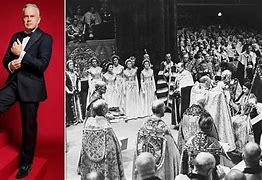
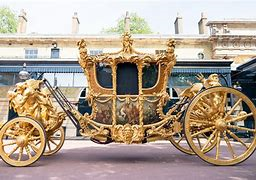
The Coronation too has its traditions, many of them historic but also often invented or reinvented for the occasion.
For example an Australian citizen Simon Abney-Hastings will carry a golden spur at the Coronation. He is the 15th Earl of Loudon whose ancestor reportedly gave the spurs to Richard the Lionheart at his Coronation in 1189. The spur in question dates from 1661 and the Coronation of King Charles 11 as the originals were melted down by Cromwell in 1649.
The tradition is disputed and it is likely that the other golden spur will be carried by 23rd Baron Hastings, Delaval Astley, best known for playing the role of Cameron Fraser in the Archers.
What the purpose of the golden spurs is in 2023 is unclear. It seems unlikely that many will be celebrating this and other Royal traditions, genuine or otherwise, on May 8th. Some may think back to May 1st and ponder if there are not other ways of running society.
1953-2023-How many watched the Coronation on screen?
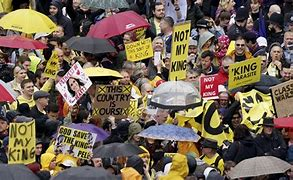
We have some idea of how many anti-Royalist protesters were out on 6th May. There were more than the police had anticipated in central London, and 52 were arrested for being insufficiently Royalist on a wet Saturday in May. In Cardiff republican protesters outnumbered Royalists and there were also protests in Edinburgh and Glasgow.
What however of the far larger numbers who were watching the Coronation either out of general interest or because they are Royalists? Numbers of local authorities had wasted public money erecting outdoor big screens without checking the weather forecast.
There are however TV figures.
At the last Coronation in 1953 there were but 2.5 million TV sets but 20 million watched the Coronation- around 40% of the population. 12 million listened on the radio (Peter Hennessy, Having It So Good).
For the Queen’s funeral in September 2022 29 million watched.
Preliminary figures for viewing on Saturday 6th May suggest 20 million watched the Coronation on TV with the BBC taking the bulk with 15.5million. The BBC Press Office confirmed on Monday that a total of 15.1m watched across BBC1 and BBC2 with an average-those who took more than a glance-of 13.3m. The preliminary figure of 20m across all broadcasters appears an over estimate. ITV claimed 3.5m viewers and Sky 800,000
Numbers who watched it on tablets and smart phones have yet to be factored in.
Linking these figures to the popularity or otherwise of Royalty in 2023 is complex.
The 1953 figures were probably boosted by the novelty of it being the first televised Coronation. On the other hand given Saturday 6th May was wet in many areas it might be expected that more than usual would have stayed in and at least caught a few minutes on TV.
Either way its hard to think that the Coronation was the national event and conversation most of the media have promoted it as. Clearly many were at best indifferent.
Contact: BLF Organiser, Keith Flett on 07803 167266
Beard Liberation Front praises Michael Rosen’s Beard Power on his Birthday
The Beard Liberation Front, the informal network of beard wearers, has said that on his 7th birthday the author, broadcaster and Arsenal fan Michael Rosen remains a commanding example of beard power.
After a period of very serious illness Rosen was voted Beard of Summer 2020 and then went on to be declared joint Beard of the Year 2020. He won the title again in 2021 becoming the first person ever to win the coveted title in consecutive years. In 2022 he was just shaved to the annual accolade by cricketer Moeen Ali.
The campaigners say that Rosen’s beard has been tweaked, redesigned and remodelled over the years but its current status indicates that at 77 his beard remains fully resilient
BLF Organiser Keith Flett said, Michael Rosen’s follicles continue to demonstrate real beard power. We wish him and his beard a very happy birthday.
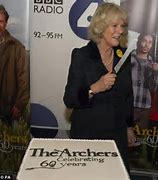
The latest Queen, Camilla, is well known for being a long time Archers listener. Meanwhile the latest King, Charlie, has had a long association with Highgrove in Gloucestershire and the growth and promotion of organic produce.
Borsetshire Venture Capitalist Justin Elliott has, patriotic and self-interested as ever, decided to fund the illumination of an Ambridge landmark to celebrate the Coronation. The Ambridge Socialist backed Grundy’s Cider Barn but Elliott is backing Bridge Farm because of its links to the King’s views on organic produce.
Fully in keeping with King Charlie’s promotion of inclusivity Natasha managed a few lines in Welsh as the Coronation lights were switched on…
We might have thought that veteran CND supporter Pat Archer would object but she has clearly taken the King’s shilling.
At least Jim Lloyd is boycotting the Coronation and he will be a speaker at the Ambridge Socialist Roll on the Red Republic gathering on the village green, Noon on Sunday 7th May.
Rylan is attending Ambridge Eurovision
Aside from the Coronation the BBC is also promoting Eurovision so Rylan will be stopping by The Bull next week. We’re hoping Eddie Grundy will sing his version of Forever Young
Name Dropping
The Rev Richard Coles in his Communards guise was mentioned by Joy this week. Is a takeover at St Stephens planned….
Suppressing protest against the monarchy: a British tradition.
During the modern period of British history, arguably from the late eighteenth century, the monarchy has had long periods of unpopularity. This was particularly true of Queen Victoria, whose various activities or sometimes lack of them in the final quarter of the nineteenth century, helped to promote a vigorous republican movement.
Arguably it was too broadly based for the authorities to be able to do much to frustrate it.
In the latter period of her reign it was not so much Queen Elizabeth II that provoked opposition, with the exception of the 1977 Jubilee, but the wider monarchy starting with Charles marriage to Diana and ending with Andrew.
It isn’t just the personal activities of senior Royals but the enormous wealth, the number of palaces and the unaccountable and undemocratic status that focuses protest.
How worried the State becomes about protest depends on how strong or weak its own legitimacy is thought to be.
In June 1850 the left Chartist George Julian Harney started publication of a weekly paper the Red Republican. Harney worked with Marx and Engels and the paper carried the first English translation of the Communist Manifesto. It lasted only until December 1850 when the name was changed to Friend of the People. Harney was clear on the reason. The paper had been ‘burked’. That is the news trade had refused to carry it, possibly with official if informal support. After all it was only two years after 1848 when Europe had been revolutionary turmoil and Harney was associated with the left of that.
Fast forward to 2023 and we find the Met Police arresting Republic protesters at the Coronation of King Charles 11. They may make an offence up in due course although letting the matter drop would be more sensible. The Met is rarely sensible hence growing calls for it to be disbanded.
The issue of course is that the reality of someone well into their 70s becoming King is not widely popular and the British Government under Sunak has the same issue. Again legitimacy is an issue. When the State feels under threat, protest is suppressed.
Eric Hobsbawm and Terence Ranger argued that all traditions are invented and the British monarchy have been experts at it for centuries.
This seminar will look at what is real and what is invented in the Coronation of a monarch and grapple with what this means for an understanding of British history beyond patriotic posing
Much will be made at the Coronation of King Charles of the historic nature of the crowns, gowns and baubles that are used.
The Coronation Chair which is one of three Charlie will sit in does indeed date back 700 years, although how much of the original remains is another matter.
However nearly all the rest of the items date back to 1660/1 because of an event that perhaps understandably is a little sensitive for the current King.
On 30th January 1649 his predecessor King Charles 1st was executed in Whitehall and a period of Parliamentary rule started.
The keeper of the King’s Jewels was sir Henry Mildmay who had been post since 1620 but astutely changed sides before 1649.
On 9th August 1649 Parliament looking to raise funds and seeing no further use for Royal Regalia ordered the jewels to be sold and gold items melted down and used for coins.
The only item to survive was the Royal spoon because, as now, no one was really sure what it was for
The Regalia was recreated in 1660/1 but the Royal Goldsmith Sir Robin Vyner at a cost of £12, 174 a huge sum today.
Hence the Royal Regalia on display at Westminster Abbey does indeed have a history, just one that its inconvenient to mention