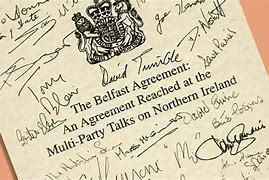
With the marking of the 25th anniversary of the Good Friday agreement (10th April 1998)an historical footnote is that Tony Benn thought it should go further.
When Mo Mowlam made a statement in the Commons on the Agreement on 20th April 1998. Benn asked if there was any reason why post Agreement Gerry Adams and Martin Guinness should not sit in the Commons. Benn notes ‘I got a bit of a brush off’.
Benn had a point about democracy and one the Government did not want to pursue. On the other hand long standing Sinn Fein policy is not to sit in the Commons since their policy is a 32 County United Irish Parliament. The Labour Party doesn’t organise in the 6 Counties of Northern Ireland for broadly related reasons
I’m currently writing a piece (delayed obviously)for Culture Matters on how an understanding of Marx’s analysis of capitalism can also help explain some of the trends seen in craft and Big Beer in 2023.
Sometimes developments appear as a surprise until one remembers that at root market capitalism is based on boom and slump, with fierce competition leading to monopolies.
Hence Black Sheep Brewery in Masham has announced the appointment of financial advisors to look at investment in the business or a possible sale. One hopes that it will be the former and not Big Beer looking to add another brewery to its portfolio.
Underwriting that is the concerning news that Brook House Hops has gone into administration. Award winners in 2022 as Roger Protz has noted their Herefordshire hop-fields supplied a range of British hops, many to be found in craft beers.
Meanwhile in the world of Big Beer Heineken has passed the UK rights for Kronenbourg 1664 to Carlsberg Marstons. Heineken plans to start brewing its Cruzcampo Spanish brand in Manchester. A reminder that Big Beer is firmly global. Along the way Heineken press statement brands Beavertown and Brixton as ‘super premium’ beers. I’m not sure what that means but it’s a reminder of what happens when capitalism gets hold of craft.
Some of this the ordinary drinker can do little about in the immediate moment, but some of it can be impacted by campaigning pressure. Breweries can be saved from closure or takeover and the voracious demands of the market tempered on occasion
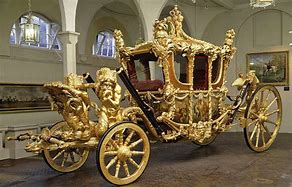
Updating uncomfortable traditions: King Charles Coronation & the Gold State Coach
In the bourgeois media that is concerned about such things- the Telegraph and the Times-there have been reports about which coach the King and Queen will use for the Coronation.
The Gold State Coach was commissioned by George 111 in 1760 and has been used at every Coronation since 1821.
The problem is that it is only sprung on leather and somewhat uncomfortable given the Royal Personages a bumpy ride. Until the Second World War it was used not only for Coronations but also for the State Opening of Parliament. Queen Victoria who complained of its distressing oscilliations is though to have refused to use it on occasion and the late Queen Elizabeth was not a fan.
Even so its tradition. It is reported that the King and Camilla will use another fully modernised coach to travel from Buckingham Palace to Westminster Abbey (there is no shortage of them in the Royal Mews) and use the Gold Coach for the journey back.
Alternatively they could get the bus of course. A reasonably comfortable ride and rather less public expense.
The Beard Liberation Front, the informal network of beard wearers, has said that as rain and high winds are set to sweep across the UK on Tuesday and Wednesday beard wearers are strongly advised to take special care of their beards.
The campaigners say that while danger to life and limb is the central issue when extreme weather hits, a secondary concern for organic beard wearers is that exposing the beard to high and blustery winds may blow the beard out of shape and can cause permanent hair and follicle damage in some cases.
It is less likely that designer and some hipster beards will suffer significant wind damage
The BLF advises the following precautions:
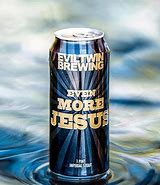
Keep the beard slightly damp at all times by immersing it in a glass of liquid such as a hazy IPA or imperial stout. This will give solidity to the beard hairs and prevent them being blown around.
Use a scarf to protect the beard at all times
Secure the beard with elastic bands, strapping the hairs to the chin
If the beard is blown out of shape use a hair dryer to re-form the hairs in the correct position and then stay indoors for a several hours to allow the hairs and follicles to recover
BLF organiser Keith Flett said, the answer is most definitely not blowin’ in the wind today. We advise the hirsute to take care out there
Turning the World Upside Down after Easter: Hocktide
British traditions are varied and confusing and those around Easter are no exception.
A strand of radicalism is a frequent thread. That is, the existing order of power relations is subverted in some way. The most common form of this is the Lord of Misrule, a character who is the precise reverse of the existing order of monarchs and other leaders. The figure is meant to be one of fun but as often disorder and riot are also present.
Easter has little association with Misrule but there is still a subverting tradition- that of Hocktide. In more recent times (and I’m not sure it existed beyond the early nineteenth century) it took place on Easter Monday or Tuesday. Earlier it was to be found at the end of a much longer Easter festival- two weeks or so after Easter Sunday.
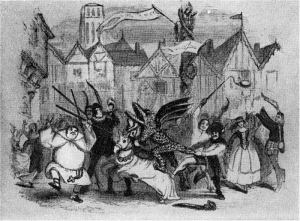
Hocktide involved most commonly groups of women, married or single, kidnapping men and holding them to ransom for money. Originally the money raised went to local Church funds but it appears that later it was used to fund sporting activities.
In a male dominated society it was a rare expression of female power.
Hocktide, like many other religious associated customs was discouraged under the Long Parliament in the 1640s and even more so during the period of Cromwellian Government in the 1650s.
With the Restoration in 1660 it returned and it wouldn’t be surprising to find even today some echoes of the tradition taking place.
The link between the Chartist demonstration, Monday 10th April 1848 & the 1871 Bank Holidays Act
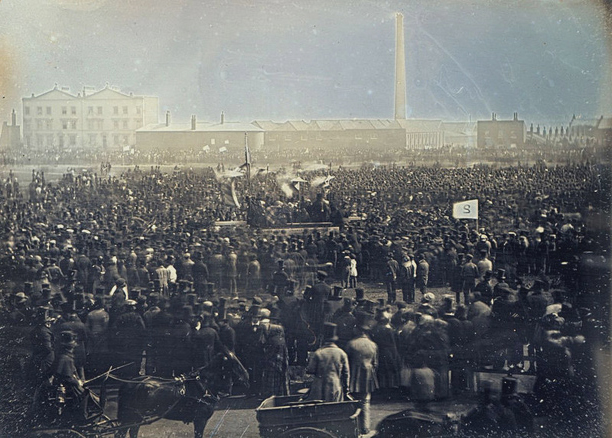
Today is the 175th anniversary of the Chartist demonstration for the vote on Monday 10th April 1848. The 100,000 plus who attended were not on strike. Taking Monday off, Saint Monday, was a widely practiced custom
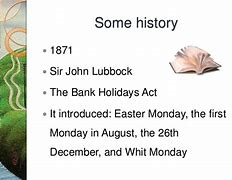
The 1871 Bank Holidays Act was designed to undermine Saint Monday by providing for several statutory Monday holidays during the year including Easter, Whitsun and August.
The daily routines of working life are well-known and they date back to the imposition of industrial disciplines on what had been previously an agricultural workforce during the nineteenth century.
Labour was required to work machines and if it wasn’t available money was being lost.
There was a battle over hours and time (there still is of course) and artisanal and craft working practices were only slowly given up.
EP Thompson in the Making of the English Working Class records employers complaints about the working practices of weavers. They did not work on Sundays, or Mondays (Saint Monday) or often on Tuesdays either. Towards the end of the week and on to Saturday they worked ferociously hard.
Saint Monday was a day of leisure to rest and to drink, or protest.
Thompson speculates in his essay Time Work Discipline that bursts of hard work followed by periods of idleness and drinking, while not what employers want, may well conform to a much more natural working pattern than the daily grind of economic reality most now experience.
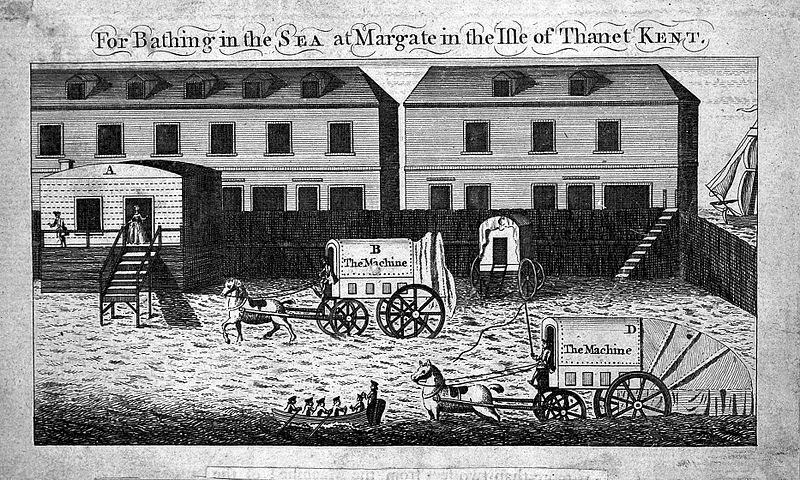
Marx on Easter Monday 1866 in Margate- very bad weather
Marx to Engels April 2nd 1866 5 Lansell’s Place Margate
The weather has been very bad here for several days, as if it had been made especially to order for the COCKNEYS who have invaded this place for the Easter Holidays
Marx had been staying in Margate one of his favourite seaside resorts for several weeks for health reasons. It was quiet and out of season until Easter, hence the remark above…
10th April 1848. Did the Chartists make an historic mistake in meeting in South rather than North London?
Their official aim after a rally was to march to Parliament over Blackfriars Bridge to present a monster petition for the vote. Never mind right-wing historiography that many of the signatures were fake. It had around 2 million genuine ones which even today with a much greater population would be huge.
The Government lived, just about, with the meeting but would not countenance the demonstration. The Chartist leadership went along with this preferring to take the petition by carriage. Numbers of rank and file Chartists did not and on the afternoon of 10th April there was fighting on the south of Blackfriars Bridge, with the army involved.
So why Kennington Common? Surely anyone with sense knows that meeting in Sarf London will end badly? It’s true that the 1990 anti-poll tax demonstration made it across the Thames to Trafalgar Square but unlike in 1848 the Government did not try to stop it. With such things as tubes, bikes and so on trying to keep a very large protest confined in South London is problematic in the modern era.
In any case the reasons why the Chartists met at Kennington Common, although not discussed by historians who don’t have experience of organising demos, are perhaps clear enough.
The number expected at Kennington were very large for 1848. How big the protest was remains the subject of dispute. But the reality was that Kennington Common was perhaps the only sizeable enough space in central-ish London available that was near enough to Parliament to march there. The Royal Parks were of course nearer but these were not available to the Chartists. Rather they were used by the Government to organise its policing operation.
However Copenhagen Fields, which had seen a huge rally in support of the Tolpuddle Martyrs in 1834 and stretched from what is now Caledonian Rd down to Kings Cross was possibly also still available. It became a market in the 1850s
Perhaps the Chartists made an historic mistake by meeting on Kennington Common, when a North London alternative with no bridges to cross might have been available.
Between 1647 and 1660 Parliament banned the celebration of Easter. It was not the observance of Easter Sunday that was the issue but the feasting and drinking- think Easter ales- that went with it. This was regarded as non-religious. Like many bans it was likely not particularly effective.
However a question also raised is whether Parliament also banned beards?
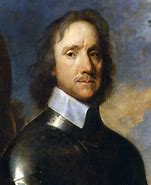
The Puritans in popular historiography are portrayed as short haired and clean shaven. Neither fitted the images we have of Cromwell.
There was however a belief associated with Puritanism that being clean shaven reflected openess,honesty and Enlightenment, whereas, those wearing beards were hiding something.
Royalists from King Charles 1st had long hair and beards. Cultural historian and beard expert Dr Alun Withy argues that in the seventeenth century a beard was thought to be waste from the testicles and so a symbol of manliness.
The battle between the King and Parliament however was not primarily about machismo but religion and politics. Puritans sought to distinguish themselves from their religious opponents not just at the level of ideas but also by appearance.
As ever there are caveats. The English Revolution of the 1640s was not a revolution from below, as, for example, 1917 was. Those in the leadership of the Royalist and Parliamentary forces came from the same social strata. I’m not sure (without further research) if any leading Royalists were clean shaven.
Cromwell in images we have of him has shoulder length hair and, often, a modest beard.
As often historical realities are more complex than stereotypes
Between 1647 and 1660 the celebration of Easter was banned by Parliament
Parliament banned the celebration of Easter and other religious holidays on 8th June 1647. Cromwell had no particular role. However there was an important and not mentioned quid pro quo. Parliament also ordered that the second Tuesday of each month should be a workers holiday. If employers refused then the Courts had the power to intervene. This concession came after a protest march by London Apprentices on 20th April 1647 from Covent Garden to Westminster protesting the ban.
Parliament of course had no issue with Sunday worship, the issue was with the feasting, drinking and celebration that went with it at Easter. Easter ales were common and at 1623 in Storrington, Sussex after the Easter sermon, parishioners enjoyed the ancient custom of a barrel of ale with bread and cheese
Die Martis, Junii 8, 1647.
Festivals called Holy-Days be no longer observed. June 8; Ordinance of Recreation.
Forasmuch as the Feasts of the Nativity of Christ, Easter, and Whitsontide, and other Festivals commonly called Holy Days, have been heretofore superstitiously used and observed, Be it ordained by the Lords and Commons in Parliament assembled, That the said Feasts of the Nativity of Christ Easter, and Whitsontide, and all other Festival-Days, commonly called Holy-Days, be no longer observed as Festivals or Holy-Days within this Kingdom of England, and Dominion of Wales, any Law, Statute, Custom, or Canon to the contrary in any wise notwithstanding: And to the end that there may be a convenient time alotted to Scholars, Apprentices, and other Servants, for their Recreation, Be it ordained by the Authority aforesaid, That all Scholars, Apprentices, and other Servants, shall, with the leave and approbation of their Masters respectively first had and obtained, have such convenient reasonable Recreation and Relaxation from their constant and ordinary Labours, on every second Tuesday in the Month throughout the Year, as formerly they used to have on such aforesaid Festivals commonly called Holy-Days. And that Masters of all Scholars, Apprentices, and Servants, shall grant unto them respectively such time for their Recreations, on the aforesaid second Tuesday in every Month, as they may conveniently spare from their extraordinary and necessary Services and Occasions. And it is further ordained by the said Lords and Commons, that if any Difference shall arise between any Master and Servant concerning the Liberty hereby granted, the next Justice of the Peace shall have Power to order and reconcile the same.