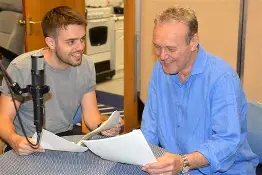
The BBC has reported the untimely death of Robin Fairbrother (Anthony Head) father of Toby and Rex at 72. Whether the Archers will get around to reporting this as well we shall see
Loxley Barratt School: time to abolish OFSTED
Loxley Barratt has received a poor OFSTED report. The Ambridge Socialist supports demands for the abolition of OFSTED. All the local Ambridge children who attend the school appear to have no issues. Perhaps the issue is with the inspectors…
Brian has to reply on a Grundy to run the farm
Having alienated nearly everyone, Brian has been forced to turn to the leading proletarian family in Ambridge. Ed Grundy is considering doing work at Home Farm…Meanwhile Brian has called the police on Adam. They weren’t interested… Meanwhile Martyn Gibson has demanded a special meeting of the BL Board.
Natasha & Tom have plans…as does Helen
Meanwhile at Bridge Farm, both Natasha and Tom have plans, different ones, for expansion. However Helen also has plans and has bought ten cattle to provide for a dairy expansion. There will be trouble and likely bankruptcy ahead.
Martyn Gibson teaches Ian about management. Hmm
Ian is struggling with the role of temporary manager at Grey Gables, and will without question, struggle even more after being given advice by Martyn Gibson
T20 cricket
Cricket continues to feature significantly in BBC reports from Ambridge. Just as long as they don’t start on The Hundred….
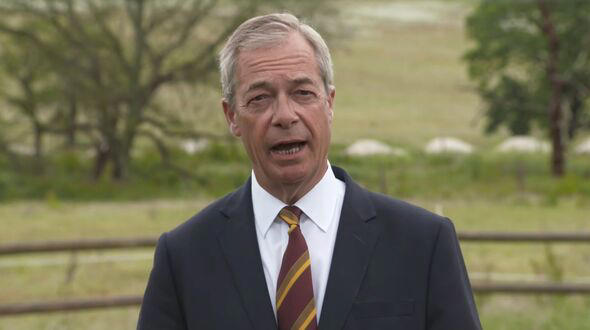
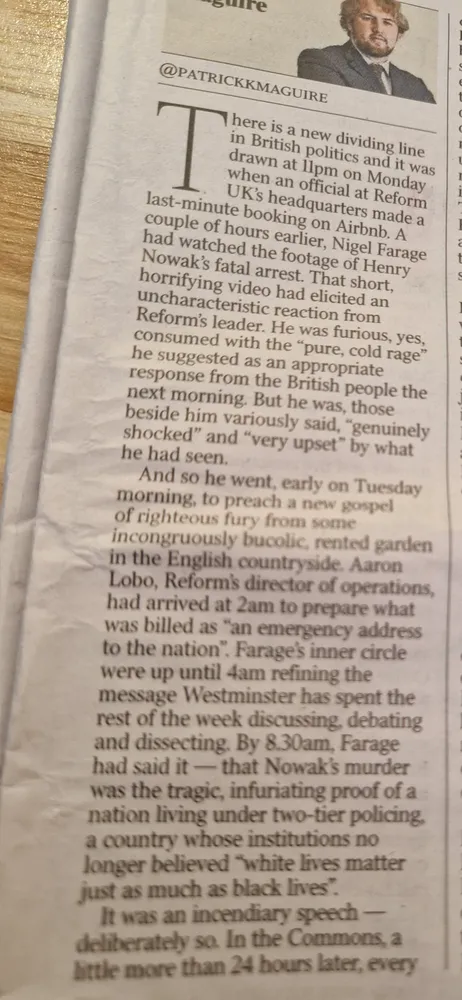
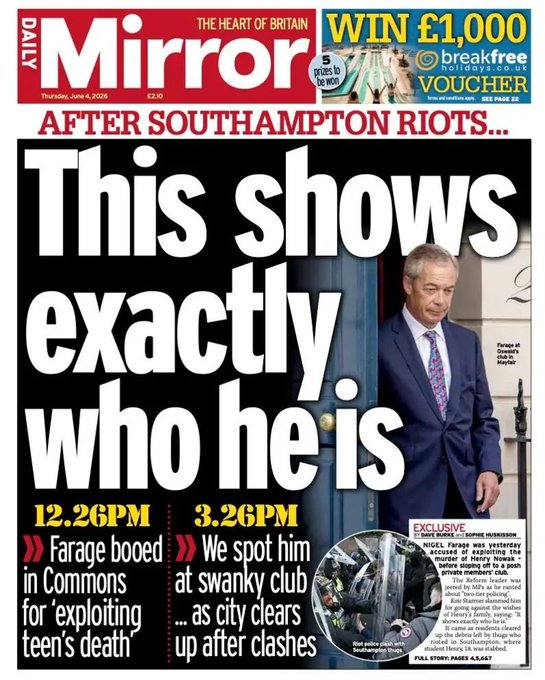
Patrick Maguire (The Times 5th June) has revealed that Farage’s ‘rage’ broadcast was made for an AirBNB somewhere in the countryside. What The Times did not ask is why. Farage until recently did regular press conferences. Reform also has an HQ in Millbank. So why a hired garden?
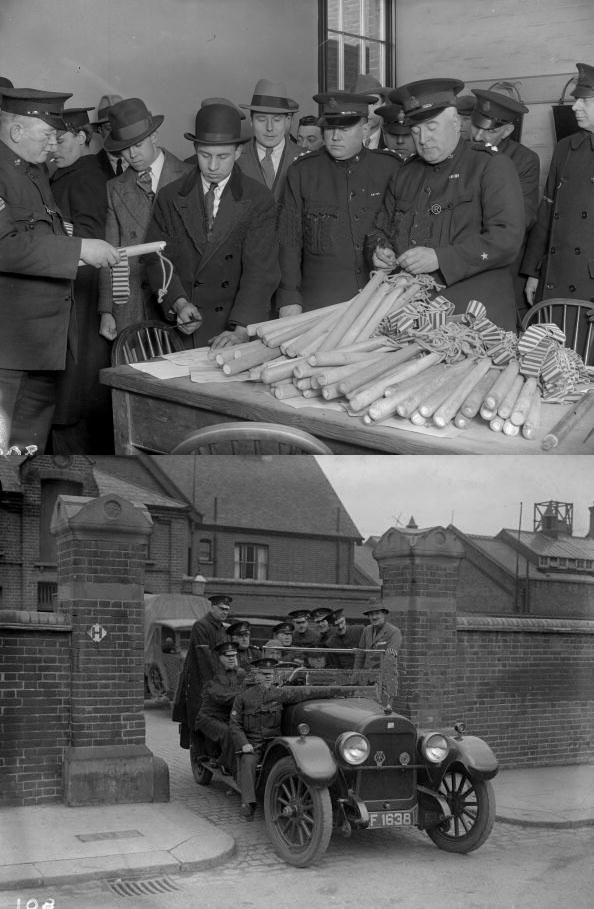
The Hornsey Special Constabulary in the 1926 General Strike
Socialist History Seminar. Adrian Weir, The General Strike & after. Global & local, the Comintern & Hornsey in the 1920s & 1930s. Report
The Hornsey Special Constabulary in the 1926 General Strike
Monday 15th June Adrian Weir, The General Strike and after. Global and local, the Comintern and Hornsey 1920s, 1930s
This was the second seminar in the summer term on the 100th anniversary of the 1926 General Strike. In May Edd Mustill spoke on his new book on 1926, Revolutionary Summer.
Convenor Keith Flett noted that the headline details of the Strike were mostly well known, perhaps with exception of the international solidarity referenced in Charlie Kimber and Judy Cox’s new book on 1926. There is plenty of room for discussion about, for example, the role of the Communist Party in the Strike and this was the subject of an event at the Marx Memorial Library in May where Mary Davis and John Foster spoke.
However there is much scope for further research on the impact of the Strike at local levels
Adrian Weir spoke on some new research on the Communist Party in Hornsey, North London, in the 1920s & 1930s looking particularly at the role of CP militants in the Hornsey and Wood Green branch of the National Union of Railwaymen.
As often his research both provides important new details of the Strike, before and after, but also peculiarities of the local area.
While the Red International of Labour Unions was focused on building new ‘red’ unions, in Britain the CP continued to work within the existing union structures. The National Minority Movement had been formed in 1924 but there was not a rail NMM conference until 1929.
However the local NUR branch produced a regular 4 page bulletin, the Hornsey Star, which emphasised class struggle. It did not call for NMM organisation however.
While the strike concluded after 13 days in May, the miners lock out went on until the end of 1926 and in January 1927 the Hornsey Star was calling for a levy to support the miners.
The NMM gave way to the National Vigilance Movement in the early 1930s its publication the Railway Vigilant achieving a circulation of 12,000.
Adrian Weir highlighted the work of local activist and CPGB member W C Loeber. He was Secretary of the local NUR branch and played a leading role in the Communist Party until he stepped back in 1929, possibly because of disagreement with the new Third Period line.
A carriage cleaner he stood for NUR General Secretary in 1933 but not win and left the CPGB in 1940. He retired from the rails in 1956 and died in 1965.
The long tail of an important figure in the General Strike in North London, over the next thirty years underlines that the Strike itself and its impact was about far more than the thirteen days in May.
These are my notes from the seminar and errors are mine. Hopefully Adrian Weir’s research will get wider circulation and also promote further research into trade union and socialist activity in North London both in 1926 and in the decades after.
Organised by the London Socialist Historians Group
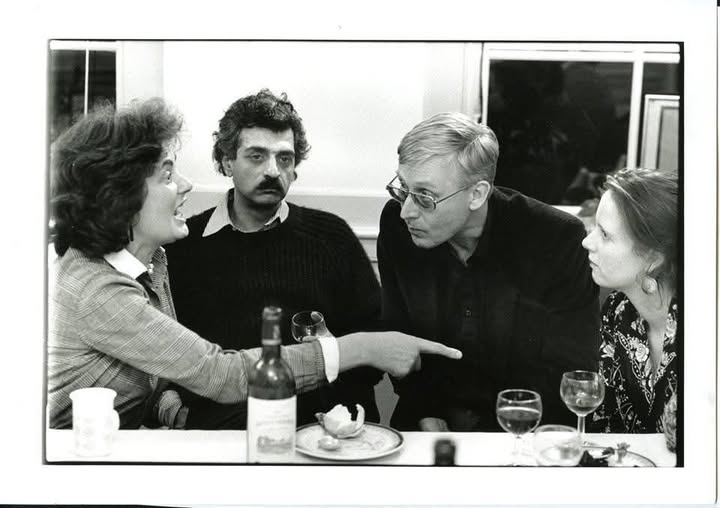
Verso Books gathering to honour Ernest Mandel in 1986. Picture L-R Marion Kozak, Tariq Ali, Perry Anderson, Susan Watkins
Marion Kozak (Miliband) on the launch of the Socialist Register in 1964
The Socialist Register which has been produced annually since 1964 started life as a continuity project for the first New Left after Perry Anderson and others took control of the New Left Review.
The Register was edited by John Saville and Ralph Miliband but also had links to E P Thompson
Marion Kowzak’s account of the formation of the Register can be found in the 1995 edition which is freely available on-line. It underlines her perhaps under played role in the development of new left politics and indeed after..
The first issue of The Register was launched at a dinner at Schmidt’s Restaurant in Charlotte Street on April 29 1964, with Deutscher and Michael Foot present. Schmidt’s, like the Budapest in Greek Street, was one of those cheap but satisfactory restaurants patronised by the left where you could always fill up on goulash or pancakes. I don’t remember whether Lawrence Daly came to the launch dinner which cost 12/6, including the speeches, but certainly Shakespeare was back on the agenda. In January 1964 Ralph had written to John ‘What about a piece on Shakespeare socialist view for 1965, certainly I would like to jazz the thing up somewhat – you know, Culture, Freud and all that jazz’. Victor Kiernan was asked to do something for Shakespeare’s 400th anniversary…
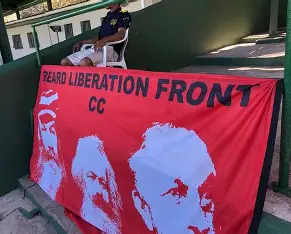
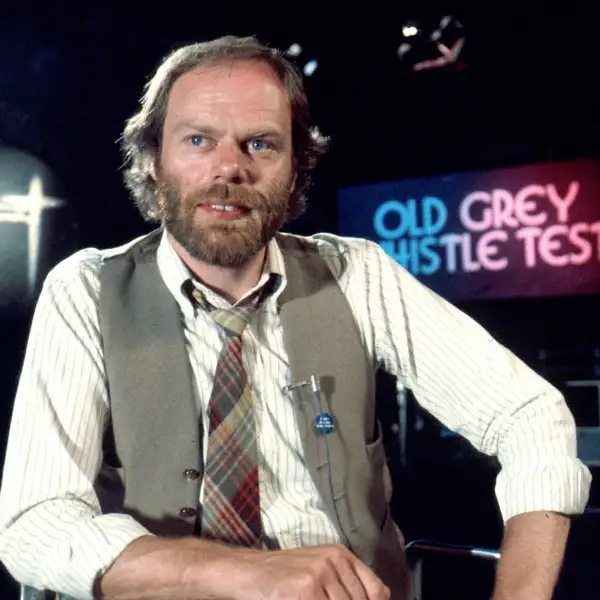
The Beard Liberation Front, the informal network of beard wearers, has praised veteran broadcaster Bob Harris as a ‘hirsute icon’ as he announced his retirement from broadcasting on BBC Radio 2 after 56 years on the radio and TV.
He first appeared on BBC Radio One 56 years ago today hosting Sounds of the Seventies from August 1970. He became well known as a presenter of the Old Grey Whistle Test on BBC2 and continued to present a Country Show on Thursday evenings on Radio Two as well as from 2024 Sounds of the Seventies on Sunday afternoons.
Bob Harris was named Hirsute Broadcaster of the Year in 2011 and 2012.
The campaigners say that while some early photographs show Bob Harris with distinctive sideburns but no beard, he has been a standard bearer for a positive images and impacts of beard wearing in broadcasting over six decades now.
BLF Organiser Keith Flett said, I was a youthful listener to the Sounds of the Seventies programmes in 1970 and fifty six years on Bob Harris has become a hirsute icon in broadcasting and a positive role model for gravitas on air.
The Bob Harris Archive (caution includes beardless picture)
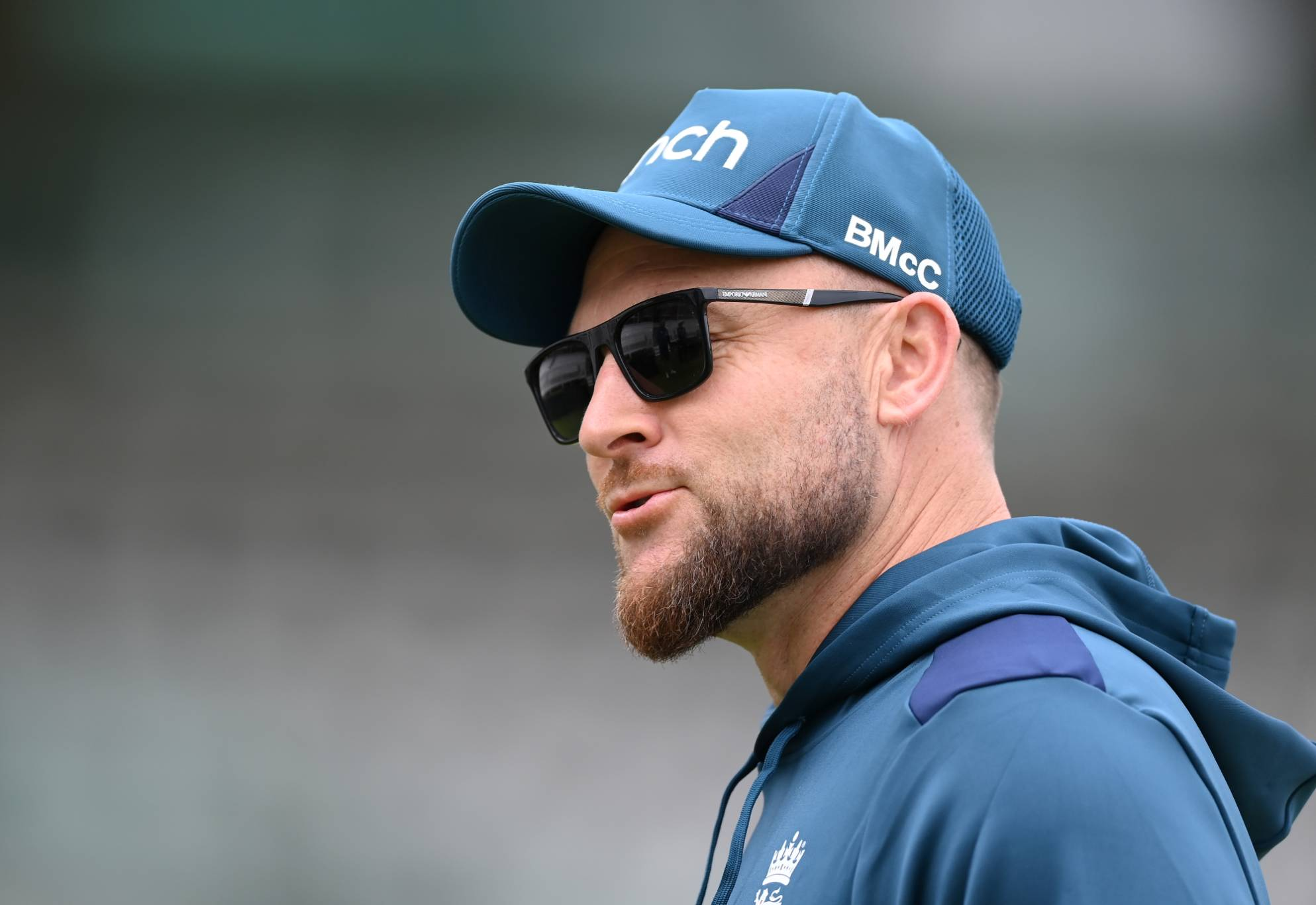
Beard Liberation Front calls on Brendan McCullum to shave his beard off
The Beard Liberation Front, the informal network of beard wearers, has called for England Men’s cricket supremo Brendan McCullum to shave his beard off as the men’s Test Match summer gets underway at Lords on 4th June.
The campaigners say that while McCullum’s beard was a distinctive part of Bazball, in more recent times it has become associated with poor performances by the England side.
BLF Organiser Keith Flett said, as things currently stand Brendan McCullum’s beard is bringing English and Welsh Men’s Cricket into disrepute. A clean shave might help England towards a razor sharp performance.
The former CEO of the SNP and former partner of Nicola Sturgeon Peter Murrell has been sentenced to over 5 years in prison for using over £400,000 of the SNP’s funds to buy an often idiosyncratic list of items over some years.
One item that has attracted ridicule is the purchase of two hair dryers. The assumption seems to be that these were for Ms Sturgeon as Murrell is follicly challenged or in common parlance bald.
However campaigners say that this is another example of peladophobia, the fear of baldness.
In reality as with many follicly challenged men, Murrell is not entirely bald but has hair growth on the back of his head. This will require regular care, washing and trimming, and it follows that a hair dryer is essential as part of the process.
BLF Organiser Keith Flett said, obviously we hold no brief for Murrell but while his hairdryers were illegally acquired the need to have them is a rather different matter