Truss and Kwarteng make Tory economic policy most right-wing out of 275 parties in 61 countries
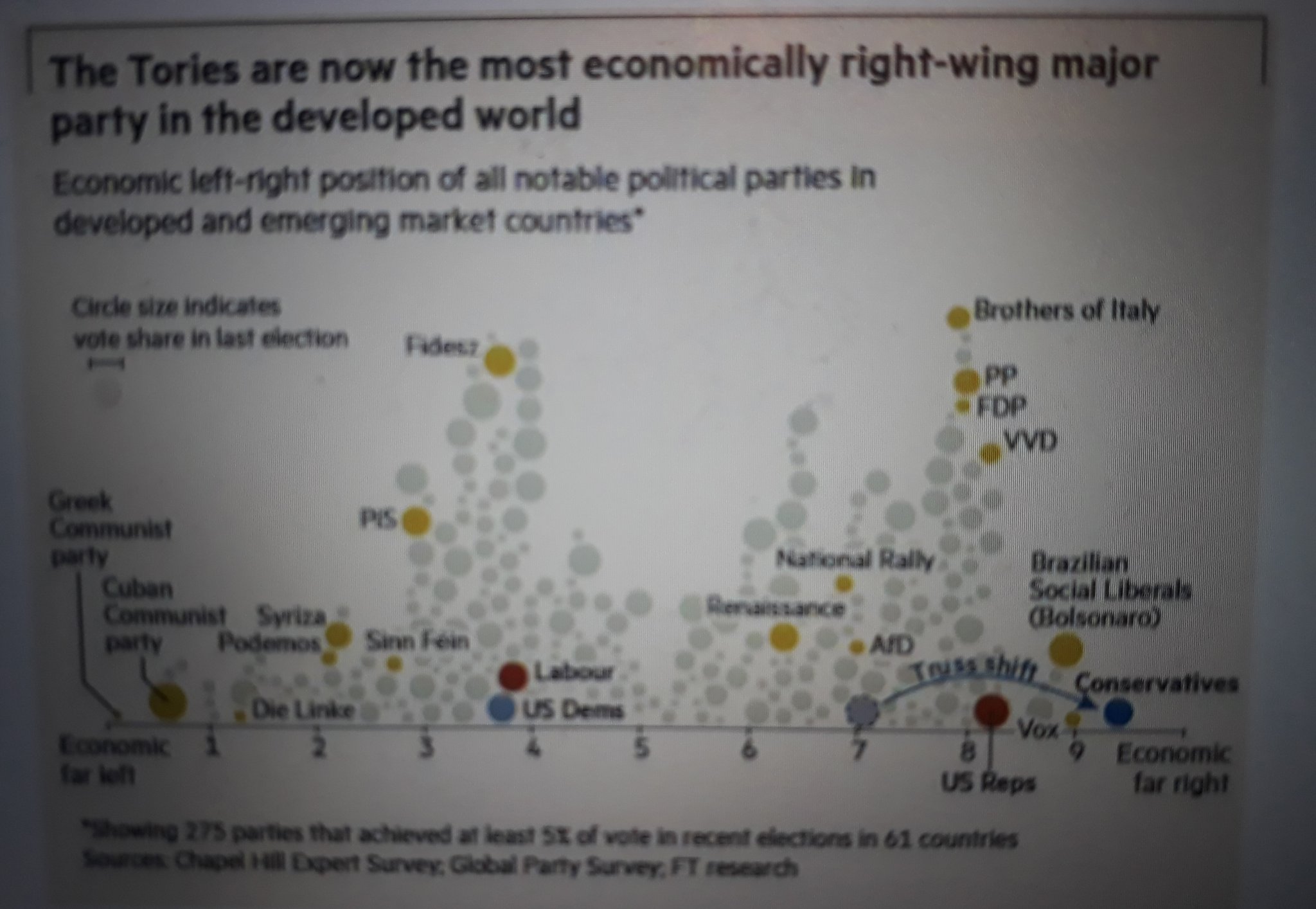
The Financial Times has published a chart (30th September) which demonstrates how Trussonomics has taken Tory economic policy which was mainstream centre right, to the far right of the economic spectrum.
Truss and Kwarteng now stand beyond Donald Trump and Brazil’s Bolsonaro. Its what nineteenth century radicals would have called really useful knowledge. Its not something likely to be analysed in the Tory media but the FT notes that out of 275 parties in 61 countries Trussonomics is the most right-wing of the lot
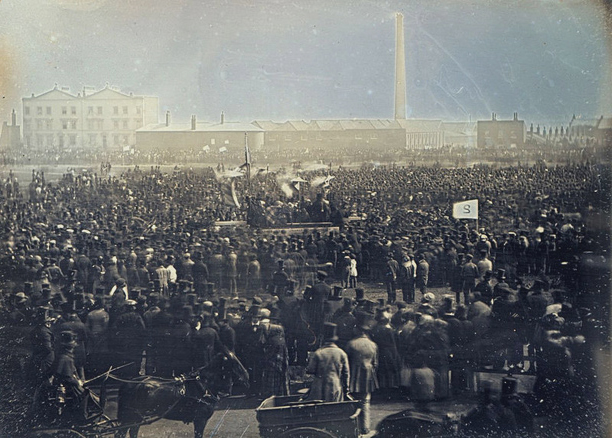
‘Cleaned’ photo of the Chartist rally, Kennington Common 10th April 1848
This photograph is the first of a demonstration taken anywhere in the world and shows that the Chartist demonstration for the vote on Monday April 10th 1848.
The photo is in the possession of the Crown at Windsor Castle but has been ‘cleaned’ by BabelColour @stuarthumphreys
There are some interesting features highlighted. There is for example a distinct difference in headwear between those watching (in the foreground) some of have top hats and the flat caps of the Chartist crowd. The caps were prudent as it rained in the afternoon.
The main platform of speakers can be clearly seen but in the era before amplification not all could hear. In the distance of the photo there is evidence of crowds at parallel platforms rather like the overflow meetings of the current day
Its thought that three photographs were taken of which only two are currently extant
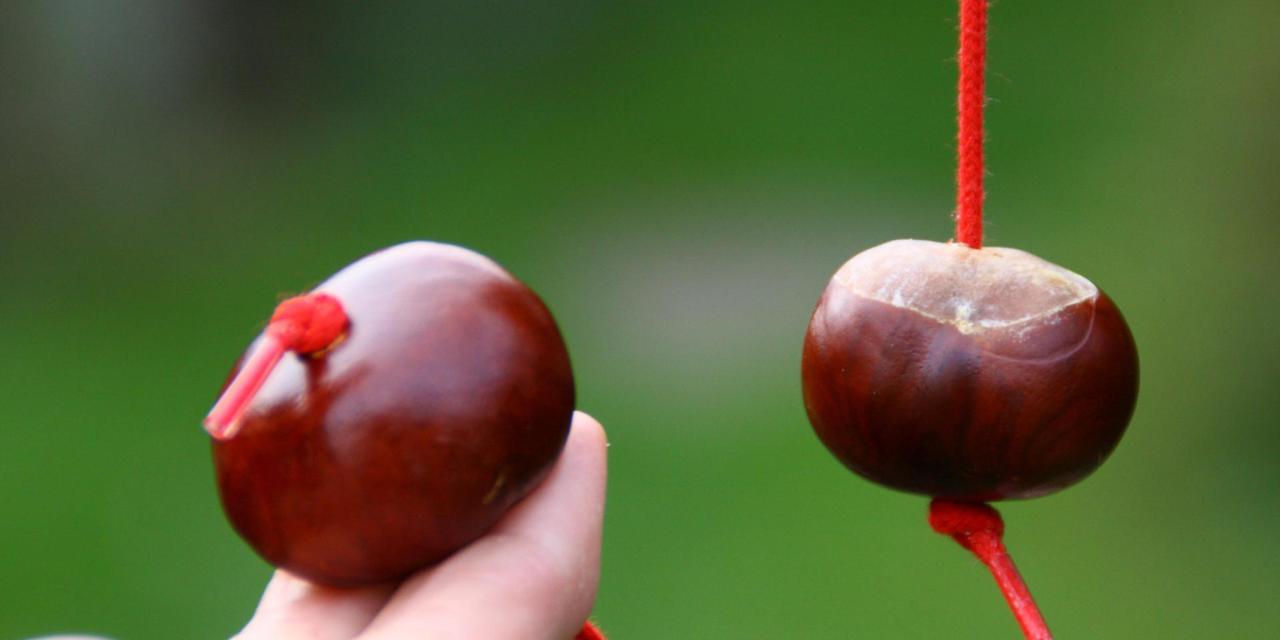
A genuine British tradition: 2022 Conker Season reaches peak
The Campaign for Real Conkers, that opposes bans on conker playing and unnecessary rules and regulations in games has said that that with windy and wet weather during September there has been a significant conker fall and the 2022 season is reaching its peak
The campaigners they are maintaining their usual ‘anything goes’ approach to conker games, to encourage people to play without arbitrary rules.
Campaign Organiser Keith Flett said, it is peak conker season. There are plenty available this year and people can play without the absurd rules of the so called World Conker Championships on October 9th which the campaign traditionally boycotts. Conkers is a genuine British tradition not one we have just invented.
Guide on how to play real conkers safely in 2022
1] Select your conker. Do this yourself. DO NOT use a conker provided by someone else who may give you a poor specimen.
2] There is no specific kind of conker that makes a good game winner. Large conkers may more easily splinter for example. Some prefer conkers with flat and sharp edges
3] You may use the conker ‘as is’ known as ‘organic’. Alternatively you may seek to harden it by baking it, soaking it in vinegar etc. There is no guarantee that an artificially enhanced conker will perform any better than an organic one.
4] Drill a small hole through the conker. A nail will often achieve this. Again you must do this yourself
5] Thread the conker through the hole you have drilled. A strong chord, perhaps a shoelace is best
6] You are now ready to play.
7] Make sure that the chord is long enough to allow you to stand at least 1 metre plus away from your opponent. This would generally be the case as space is required for the conker swing.
8] Players take alternate turns to try and hit and destroy their opponent’s conker
It might be assumed that as usual when Jacob Rees Mogg in 2018 compared Theresa May’s position on Brexit to that of Robert Peel on the Corn Laws after the 1841 Election he didn’t know what he was talking about.
On reflection (see below) that does seem to be likely. However Rees Mogg has a 2:1 degree in History from Trinity College Oxford in 1991. While I’m not sure if the syllabus covered nineteenth century British political history or indeed whether Rees Mogg was paying attention (ability to pass final examinations is a different question, although I can say that I rarely attended lectures during my first degree and still got a 2:1).
Peel was elected in 1841 with the backing of landowners who did not want the Corn Laws (a tax on imported wheat that kept domestic bread prices high, likewise profits for farmers) repealed but did in fact repeal them in 1846 with the backing of the Anti-Corn Law League. The working class, primarily the Chartists, were only marginally concerned pushing instead, in due course successfully, for a Ten Hours Act to reduce the length of the working day. A measure they correctly judged would have more impact on workers lives.
Rees Mogg argues that Peel’s actions split the Tory Party and they were out of Office for several decades as a result.
The Tory Party of the 1840s was hardly the one we know today (ok a few representatives may still be in the Lords). The modern Liberal Party was not formed until 1858 and the present shape of the Tory Party arguably was not fully defined until the early twentieth century. The second half of the nineteenth century saw several significant realignments in ruling class politics between Tories and Liberals.
Where Tories who face losing their seats as a result of the Trussketeers might go we may find out quite shortly
However if you are on the left the definitive view of what the Repeal of the Corn Laws actually meant for workers is below. As several commentators have noted it seems Rees Mogg would have been fully in favour
The English workers have very well understood the significance of the struggle between the landlords and the industrial capitalists. They know very well that the price of bread was to be reduced in order to reduce wages, and that industrial profit would rise by as much as rent fell.
Karl Marx Brussels January 1848
Dr Keith Flett convenes the Socialist History Seminar at the Institute of Historical Research, University of London, School of Advanced Studies
After the Fiscal Statement: 1992-2022: Labour & the opinion polls
Following the debacle of the Chancellor’s Fiscal Statement Labour has a significant poll lead
Poll leads though are not everything. They usually appear because the incumbent Government is messing things up. They are maintained to a successful Election victory if the opposition in this case Labour is able to harness the discontent to a positive mood to support it
We can see this in the period 1992-1997
We can’t obviously be sure what moves the polls but I do think that there is some evidence that there are particular events which change people’s minds on a long-term basis, as Black Wednesday seems to have done in 1992
By 1992 Thatcher had been forced to resign over the Poll Tax debacle and was replaced by John Major. Major, unexpectedly and quite narrowly, beat Labour, led by Neil Kinnock, in a General Election on 9th April 1992. For the few months after wards the Tories led Labour on average by 5 points in the opinion polls.
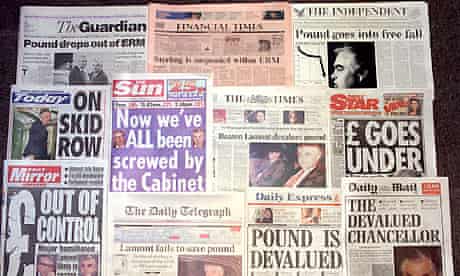
Then came Wednesday 16th September 1992, ‘Black Wednesday’. On that day the Tory Government withdrew the pound from the European Exchange Rate Mechanism (ERM). In order to protect the pound Chancellor Lamont raised interest rates from 10% to 12% in the morning, and then up to 15% in the afternoon.
The following day interest rates returned to 10% but the damage was done in terms of electoral standing. Voters with mortgages, perhaps more inclined to vote Tory, had seen the spectre of the cost rising by 50% in a day. If it had happened once clearly it could happen again.
By November 1992 polls were showing ratings of around 30% for the Tories and 50% for Labour. They changed little until the eventual election in 1997. Labour’s lead was nothing to do with Blair, who wasn’t Labour leader in 1992, rather it was the late John Smith, but with an event so potentially cataclysmic in its impact that it stuck in voter’s minds.
It’s worth pointing out (thanks to Lindsey German for this)dthat the October 1992 pit closure crisis underlined and amplified the Tory crisis. The Tories had spent the mid-1980s demonising and defeating the miners on pit closures. But when Heseltine tried again in 1992 the mood was very different. Public support swung behind Arthur Scargill and the NUM’s efforts to stop further closures.
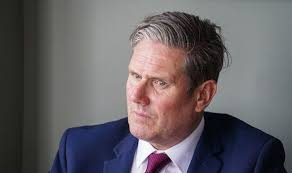
Whether you think Starmer is a decent Labour leader or not, it won’t be that much to do with anything he does or doesnt promote, at least at the moment. What 1992 suggests is that it’s about Tory crisis and whether the left and labour movement can galvanise the mood around that which has the real impact. Work in progress
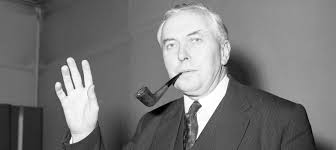
The post below is a research note. It was sparked by the publication of a new biography of Harold Wilson by Nick Thomas-Symonds. The book obviously is not about pipe smoking but there are illuminating passages about Wilson’s use of a pipe.
I’m not sure how widespread pipe smoking was amongst radicals in the nineteenth century, men and women, and more research is needed.
In the twentieth century Raph Samuel notes in the Lost World of British Communism that Stalin who was a pipe smoker, or at least pictured with a pipe, inspired at least some Communists to smoke a pipe. My late father who was a CP member smoked a pipe throughout his life, the Balkan Sobranie tobacco as pungent as cannabis (although it didn’t smell the same). Samuel notes a war time verse written by Hamish Henderson: ‘Hitler’s a non-smoker/Churchill smokes a cigar/but Uncle Joe smokes a workman’s pipe/and he wears a taxi drivers hat.
Thomas-Symonds writes that Wilson switched from cigarettes to a pipe not because of a love of Stalin but because the process of filling and lighting a pipe gave him more time to answer questions and make comments.
In the 1960s Wilson’s pipe smoking, along with his liking for HP Sauce was a symbol that he was a politician in touch with the ‘common man’. Thomas-Symonds recounts how Wilson argued that people who smoked pipes lived longer than those who smoked cigarettes.
However Thomas-Symonds touches on the issue around Wilson and pipe smoking that has caused comment over the years. The statue of Wilson outside Huddersfield station shows him without a pipe. Mary Wilson noted that Wilson’s hand was in his pocket reaching for his pipe. Thomas-Symonds suggests that in private when no journalists were present Wilson might more usually smoke a cigar, his preference. The pipe was important for his public image.
Certainly in the 1960s pipe smoking amongst men on the left was far from unknown, influenced by Stalin, Wilson or simply preference. Eric Hobsbawm is pictured smoking a pipe and Tony Benn was an inveterate pipe smoker
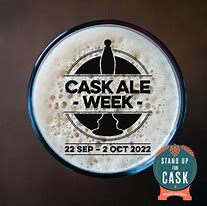
It’s the annual cask ale week designed to promote fresh beer.
It was launched with a seminar the Brewers Hall in the City of London (report via @drinksmarven link below). The keynote was from Tim Martin of Wetherspoons. Not perhaps the most popular figure but cask beer would be in trouble if 800 Spoons pubs didn’t sell it. Martin said that cask represented about 20% of sales and that an effort was made to make sure it was getting drunk rather than sitting in the pipes. The number of beers on tap are reduced if need be to achieve this. Martin also made his traditional plea to redress the balance between supermarket and pub beer prices. The mini budget on 23rd September nodded at this.
Pete Brown, the beer writer, who has researched cask trends in recent years suggested that cask beer was by no means doomed, but much work is still needed to ensure its future. After the lockdown periods when pubs were shut and cask beer unavailable that is clearly a big campaigning issue.
Tim Martin has his views on prices and Wetherspoons is an undercutter here- and a successful one, Timothy Taylor underlined that they wouldn’t sell beer to Spoons at the price they were prepared to pay. This is the countervailing argument that a quality product should attract a premium price.
I’m still a huge fan of cask beer, but finding the top quality cask beer that is produced by UK brewers, on a pub bar-top is often no easy matter. CAMRA and SIBA are right to focus on a renewed right for pubs to sell guest cask beers beyond the tie
In early autumn 2020 Keir Starmer referred to black lives matter protests as a moment when most though they were and are part of a movement.
In his Labour Conference speech on Tuesday Starmer, at the end of his oration, again talked of moments. He said, quite probably correctly, that now is a Labour movement and suggested that others were 1945, 1964 and 1997.
Those were the dates when Labour Governments that one way or another did change things were elected. The problem was that they were moments. In 1997 Labour had the chance, and talked about it, of keeping the Tories in Opposition for the foreseeable future in the same way, as Starmer indicated that Labour only gets into Office occasionally- mainly Britain has had Tory Governments.
It didn’t happen in 1997 because the ambition to really change things rather than just pursue piecemeal reforms (useful enough in themselves) wasn’t there.
Starmer was right however at the start of his speech when he noted that Arsenal are top of the Premiership. That definitely is just a moment.
End of an era: Wetherspoons to shut last remaining original Haringey pub
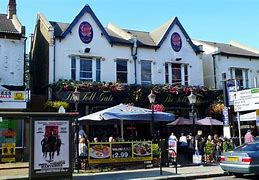
Wetherspoons has announced that the Tollgate pub in Turnpike Lane, London N8 is up for sale. Originally a car showroom it opened in 1989 and is the last remaining original Spoons pub in Haringey.
Wetherspoons started out in 1979 at Marlers Bar, Colney Hatch Lane Muswell Hill. That was then owned by Andrew Marler but Tim Martin soon took over and started to build a Wetherspoons pub empire almost entirely in the London Borough of Haringey. Pubs included, the White Lion of Mortimer in Stroud Green, the Moon Under Water on the Roundway, Tottenham, the Elbow Room, Tottenham, the Goat in West Green Rd and the Old Suffolk Punch in Green Lanes Harringay. Most are no longer pubs and Wetherspoons now has just two outlets in Haringey, in Wood Green and Muswell Hill.
I was a regular in the Tollgate for many years, not least because until the last 10 years or so, there were very few reliable outlets for cask beer in the area.
Of course Spoons and Tim Martin have many detractors, understandably so. However pubs like the Tollgate provided beer and food at prices which the mainly not so well off clientele could afford. Its on the market as a pub but one wonders whether any successor will want to repeat the Spoons model in 2022
Truss & Kwarteng fall out over impact of Fiscal Statement: What the PM’s Oxford tutor had to say
It has been reported that Liz Truss and Kwasi Kwarteng have had a disagreement about how to handle the disastrous impact of last Friday’s Fiscal Statement. If Mr Kwarteng had studied what Ms Truss’s Oxford tutor had to say about her, he would have been better prepared
Marc Stears(now at UCL) wrote about the time he was Liz Truss’s tutor during her time as an undergraduate at Oxford in the Murdoch Sunday Times (31st July)
According to Marc Stears Truss’s time at Oxford was marked by an ability to come up with unusual angles on issues and stick to them even when informed that facts showed she was wrong. Secondly an ability to fiercely argue a position only to drop it and equally fiercely promote something different.