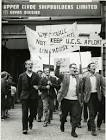
Did Starmer’s Speech pass the 1839 Chartist test: a ‘knife and fork’ test
Keir Starmer’s speech to the Labour Conference in Liverpool seems to have been well received on what might be described as the social democratic left. It offered some useful proposals, for example a State owned green energy company.
The problem is that the crisis is now and needs addressing now. Starmer positioned Labour as on the side of working people but he has still not addressed the seriously practical questions of support for workers taking action to defend living standards.
The journalist Aditya Chakrabortty tweeted that the issue for many is the cost of basic items and for a good number the cost of mortgages.
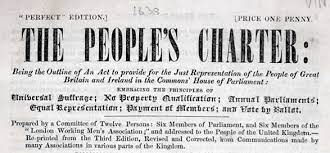
As the Chartist Joseph Rayner Stephens said in 1839 it is a knife and fork question, that is, can food, clothes and housing be afforded. Starmer offered some policies on these areas for the future but concrete action is also needed now.
This question of Universal Suffrage was a knife and fork question after all; this question was a bread and cheese question, notwithstanding all that had been said against it; and if any man ask him what he meant by Universal Suffrage, he would answer, that every working man in the land had a right to have a good coat to his back, a comfortable abode in which to shelter himself and his family, a good dinner upon his table, and no more work than was necessary for keeping him in health, and as much wages for that work as would keep him in plenty, and afford him the enjoyment of all the blessings of life which a reasonable man could desire. [Tremendous cheers.]
Joseph Rayner Stephens Kersal Moor 24th September 1838 (reported Northern Star)
Deepti Sharma, Mankads & imperial preference in cricket
If you are interested in cricket you may well be aware of the controversial ending to the third one day international between England and India at Lords last Saturday.
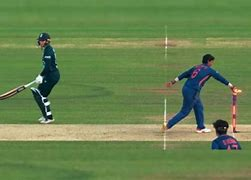
A tight finish was in prospect with England 9 wickets down, but with few balls and few runs left to get. Indian bowler Deepti Sharma ran out England batter Charlie Dean because she was out of her crease as she was in the process of bowling the ball.
This is perfectly legal under the current laws of cricket, although rarely done. There is no requirement to warn a player first, although subsequent screen shots suggest Charlie Dean was sometimes out of her crease when balls were bowled. There is nothing wrong with that except the potential risk of being run out.
Some have suggested that Deepti Sharma was not actually in the process of delivering the ball, hence it was not in play and the Umpires should have called dead ball. That view can be taken but the matter was referred to the third umpire to check the TV replays and the decision was ‘out’. That is definitive.
It has sparked a large amount of on-line and print comment (a whole page in the Telegraph) often from old white blokes (I am one and was watching the game) who are not always that interested in women’s cricket (some are of course).
They didn’t think the dismissal, known as a Mankad after the first player that did it, was fair. It was not in the ‘spirit of cricket’. I suspect that many think the MCC own this concept and get to define it.
They don’t. The days of imperial preference in cricket are over.
26th September 1968: the publication of the 1000th Pelican paperback
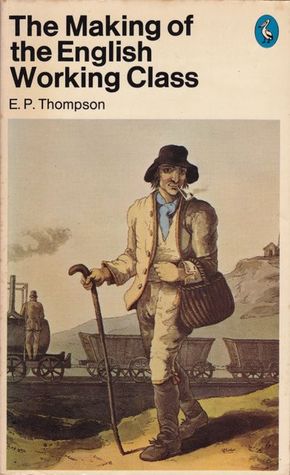
26th September marked 57 years since the publication of the 1000th Pelican paperback.
The book chosen was EP Thompson’s Making of the English Working Class. It retailed for 18 shillings (90p). The hardback had been published in 1963 and Thompson provided a new postscript for the paperback edition, noting some criticisms of the book and adding some further perspectives.
Such was the occasion that The Guardian published a special supplement for which Thompson wrote a piece (on William Blake) headed ‘Beast and Whore’, Blakean terms for Church and State.
In one sense those were indeed the days. The book remains in print and a number of its categories such as the moral economy provoke debate and new research still. It now costs rather more than 90p
All seminars are on Mondays at 5.30pm via Zoom. Please register via the Institute of Historical Research link (these will be posted shortly)
Mon 24th October 5.30pm. Keith McLoughlin. The British Left and the Defence Economy: competing visions of social democracy
Mon 7th November 5.30pm Jane McChrystal and Anne Padfield. The Splendid Mrs McCheyne & the East London Federation of Suffragettes.
Mon 21st November 5.30pm. Catherine Howe, Chartism in London in 1848
Mon 5th December Merilyn Moos, Living With Shadows. A memoir of a daughter of German Anti-Nazi activists This seminar is postponed until a date to be confirmed in 2023
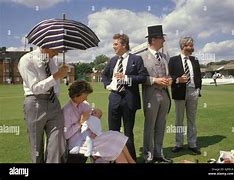
Eton v Harrow cricket match to continue at Lords after ‘wokery’ allegations
The cricket writer George Dobell has reported at The Cricketer that the Eton v Harrow and Oxford v Cambridge cricket matches are to continue at Lords in 2023. The former has been held there since 1805.
Lords had previously said that 2022 would be the last year for the matches as they wanted a more diverse range of games including more women’s cricket.
However some MCC members had called a special meeting for Tuesday demanding that the decision was reversed. These included Henry Blofeld (cricket commentator and Old Etonian) and David Gower (former England cricket captain).The Times published an Editorial in their support although the Sunday Times carried an interview with leading MCCer Stephen Fry who said that while those wanted the games to be scrapped and been accused of ‘wokery’ it was time for Lords to move on.
Lords will now discuss with those that want the matches to continue on how to proceed. These do not seem to include Eton schoolmasters who reportedly see the match as encouraging bad pupil behaviour or Lords stewards who have to deal with the same.
The Times has published several letters from MCC members in support of scrapping the matches, and this may just be the first round in a culture war where Lords is found to be occupied by ‘cultural marxists’
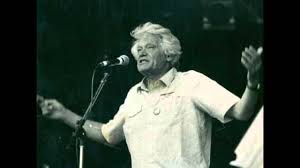
The Beard Liberation Front, the informal network of beard wearers, has paid tribute to James Earl Jones, who at 91 is stepping back from voicing Darth Vader.
The campaigners say that its clear that the tremendous gravitas that Darth Vader’s voice carried was due to Earl Jones Beard Power, his follicles carefully modulating each word spoken
BLF Organiser Keith Flett said, the force was certainly strong when it came to James Earl Jones beard power
After Starmer wraps Labour Conference in the Union Jack E P Thompson on ‘progressive patriotism’
The site of a Labour Conference in Liverpool with a Union Jack stage set up and delegates singing God Save The King reminded that this social chauvinism is not the only version of patriotism available (I’m an internationalist)
Below I touch on how complex the subject is by looking briefly at the attitude the late socialist historian E P Thompson had to it.
Thompson of course was an internationalist, someone who spent years of his life as a leading figure in European Nuclear Disarmament (END) seeking solidarity with people across Europe and someone who as an academic spent a good deal of time discussing with and meeting fellow historians across the globe.
Yet Thompson while he left the Communist Party in 1956 came up in a tradition that was framed by the British Road to Socialism and was someone who described himself as a Great Bustard. The Bustard is extinct in the UK primarily because it could not fly easily and hence was confined to British soil.
In his open letter to Leszek Kolakowski (1973) Thompson compared himself to the great bustard, grounded and unable to fly with wider intellectual developments. Rather he saw himself as part of a distinctively English tradition which as he noted had strengths and weaknesses:
But I cannot fly. When you spread your wings and soar into the firmament where Kierkegaard and Husserl, Heidegger, Jaspers and Sartre and the other great eagles soar, I remain on the ground like one of the last of the great bustards, awaiting the extinction of my species on the diminishing soil of an eroding idiom, craning my neck into the air, flapping my paltry wings. [13] All around me my younger feathered cousins are managing mutations; they are turning into little eagles, and whirrr! with a rush of wind they are off to Paris, to Rome, to California. I had thought of trying to join them (I have been practising the words “essence”, “syntagm”, “conjuncture”, “problematic”, “sign”) but my wings grow no bigger. If I were to try I know very well that with my great bulk of romantic moralisms, my short-sighted empirical vision, and my stumpy idiomatic wings, I would fall – plop ! – into the middle of the Channel.
I belong to an emaciated political tradition, encapsulated within a hostile national culture which is itself both smug and resistant to intellectuality and failing in self-confidence; and yet I share the same idiom as that of the culture which is my reluctant host; and I share it not only through the habits of a writer but out of preference. This, if I am honest, is myself, my sensibility. Take Marx and Vico and a few European novelists away, and my most intimate pantheon would be a provincial tea-party: a gathering of the English and the Anglo-Irish. Talk of free-will and determinism, and I think first of Milton. Talk of man’s inhumanity, I think of Swift. Talk of morality and revolution, and my mind is off with Wordsworth’s Solitary. Talk of the problems of self-activity and creative labour in socialist society, and I am in an instant back with William Morris – a great bustard like myself, who has never been allowed into the company of such antiquated (but “reputable”) eagles as Kautsky or Plekhanov, Bernstein or Labriola – although he could, if given the chance, have given them a peck or two about their gizzards.
Well, that is what I am, and it is a ludicrous predicament. It is an excuse for any amount of silence. Holding for too long, and with too few companions, to an unregarded position breeds – as this letter has already shown – symptoms identical to those of egotism. I have become too much aware, in my silence, of the motions of my own mind; too detached from the thought around me into which my own argument can never be inserted; too stubborn in resistance to assimilation.
Unfortunately E.P. Thompson died aged 69 in 1993 so we cannot know what his thoughts on the 2016 Referendum might have been. His criticism of what is now the EU is clear, but his concern at being isolated from wider European culture suggests that he had in mind the pursuit of a European unity of a rather different kind. That of solidarity and socialism. Progressive patriotism or internationalism….. part of a national culture but in opposition to it. It’s complicated
30 Years On. From September 1992,Tory financial crisis to September 2022 Tory financial crisis
On Friday 23rd September 2022 the current Chancellor made a fiscal statement. It promised tax cuts, primarily for the rich. Widely regarded as a disastrous move the impact was to cause a sharp drop in the value of the pound. It is projected interest rates will rise to 5.5% by Spring 2023 and quite possibly earlier than that.
We have been here before, almost exactly 30 years ago
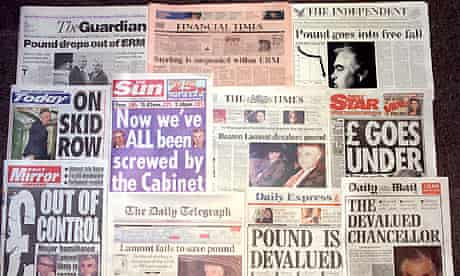
On Wednesday 16th September 1992, ‘Black Wednesday’, the Tory Government withdrew the pound from the European Exchange Rate Mechanism (ERM). In order to protect the pound Chancellor Lamont raised interest rates from 10% to 12% in the morning, and then up to 15% in the afternoon.
The following day interest rates returned to 10% but the damage was done in terms of electoral standing. Voters with mortgages, perhaps more inclined to vote Tory, had seen the spectre of the cost rising by 50% in a day. If it had happened once clearly it could happen again.
By November 1992 polls were showing ratings of around 30% for the Tories and 50% for Labour. They changed little until the eventual election in 1997. Labour’s lead was nothing to do with Blair, who wasn’t Labour leader in 1992, but with an event so potentially cataclysmic in its impact that it stuck in voter’s minds.
It’s worth pointing out (thanks to Lindsey German for this point)that the October 1992 pit closure crisis underlined and amplified the Tory crisis. The Tories had spent the mid-1980s demonising and defeating the miners on pit closures. But when Heseltine tried again in 1992 the mood was very different. Public support swung behing Arthur Scargill and the NUM’s efforts to stop further closures.
The balance of Tory constructed financial crisis and industrial action is something that can move things forward in a positive way not for the few but for the many
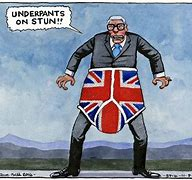
Labour Conference: Starmer fails to wear his Union Jack pants outside his trousers
Steve Bell @bellbelltoons
The Labour Conference has opened in Liverpool. The backdrop of Union Jacks and a large image of the late Queen looks like Labour has saved money by doing a conference set up with the Tories who meet next week in Birmingham.
As dictated by Keir Starmer those in the hall at the start of conference dutifully sang God Save The King (out of tune) although not the verses which attack supporters of the French Revolution and the Scots on this occasion.
Starmer however made a major error by not wearing his Union Jack underpants outside of his trousers as the truly patriotic John Major was reputed to do
William Keegan (Observer 25th Sept) has reminded us that while there were differences, before the economic boom the Chancellor announced on Friday came the Barber boom of the Heath Tory Government (1970-74). It was widely regarded as a disaster and in practice ended by industrial opposition from trade unions.
No wonder Kwarteng is trying to further restrict the right to strike