Articles

After the death of ‘comrade Bala’ a reminder: British Maoism *mostly* harmless

In Uncategorized on April 13, 2022 by kmflett

I wrote the below in 2013 and I’ve left it to stand nearly as is. It relates to the case of Aravindan Balakrishman who has died in Dartmoor prison aged 81 was jailed in 2016 for a number of crimes including rape. He was in effect a cult leader known as Comrade Bala and had described himself in the 1970s as a ‘revolutionary socialist’.

The socialist historian Evan Smith also wrote a piece at the time:

My point below is that while I was never an adherent of Maoism in reality this was not part of what British Maoism was actually like or about

In Defence of British Maoism: mostly harmless

Blimey, British Maoism is getting a bad press, which considering how few adherents it had even at its peak is quite an achievement.

Of course part of that is the media trying to conflate Maoism with anyone much to the left of Blair, which is silly enough to warrant a re-make of the Life of Brian.

It is true that the first issue of the Socialist Register in 1964 [edited by Ralph Miliband and John Saville] carried an article by the orthodox Trotskyist Isaac Deutscher on Maoism. It is very critical and it is available free on-line via Google.

To quote the late Senator I am not now and nor have I ever been, and I am not expert on British Maoism. The detail for those interested can be found here :

http://www.marxists.org/history/erol/erol.htm

Still I think before matters get entirely out of hand we had better rescue the vast majority of British Maoists, those who preferred the pub to keeping slaves, from what EP Thompson called the enormous condescension of posterity.

British Maoists from Reg Birch [who wrote an introduction to a rather good book about incomes policy in the mid-1960s] an Engineering union official who was the leader of the best known early UK Maoist organisation the Communist Party of Britain Marxist Leninist [CPB-ML]* were largely good activists in trade unions and the wider movement and the few who remain active today still have that characteristic.

Whether it was their rather idiosyncratic brand of Marxist politics or other motivations that kept them going most who have been active on the left over the past few decades will testify that most were good fighters for the cause.

Of course, and particularly at the wilder shores, there were issues. Unlike official Communism based in Moscow China was not over bothered [at best] about what its adherents elsewhere thought and did. There were many doctrinal disputes and some British Maoists preferred Hoxha’s Albania to China.

The point was, there was no easy reference point to suggest where someone with Maoist politics should sit on the left. Some, for example the adherents of the Ernest Bevin Society, were arguably more on the right of the left than the left as it were.

Then, and this is perhaps what is seizing the media at the moment, there is the question of the behaviour of sects, small groups cut off from reality who form their own, sometimes other worldly, perspectives on life.

Nick Cohen has blogged on Tim Wholforth’s (died 2019KF) book on the left and sects. I read a draft of this before it was published a while back now [given to me by an ex-member of the WRP]. Its point is that the sect, whether political, religious or other, succeeds by keeping its members engaged in mindless activity and off the realities of reality.

Well, up to a point Lord Copper. As Cohen himself notes the behaviour of obsession is hardly confined to small left wing groups or odd religious sects. Any organisation has to inspire some degree of belief amongst its members or it won’t work. Yes, even Spurs football club. That can go further and when it does as Cohen and myself would no doubt agree it is neither desirable or pretty. If people can’t act and think for themselves then there are problems.

But by that criteria the biggest cult going are the neo-liberals not the Maoists. A sort of Gradgrindism on speed for the twenty-first century, that means, so many tell me that they can’t tweet their actual views in case their employer finds out.

So in summary British Maoists, mostly good comrades and mostly harmless, Comrade Bala very much aside.

*the first British Maoists were Michael McCreery’s Committee to Defeat Revisionism, for Communist Unity founded in 1963 (thanks to John Walker for this)

Articles

Once again on #Partygate & drinking at work(London office culture 1970s-2020s

In Uncategorized on April 12, 2022 by kmflett

Once Again on #Partygate & drinking at work(London office culture 1970s-2020s)

Boris and Carrie Johnson and Rishi Sunak are amongst 50 people to be fined for breaking lockdown rules by attending social events at Downing St. In the case of Johnson the fine was for a party on his birthday(19th June 2020). It may not be the only fine he gets.

Tory MP Michael Fabricant whose relationship to reality and to his wig is at best limited has told the BBC that many have drink in their offices after hard day’s work including nurses and teachers.

As a management veteran of central London office culture I’d say that in 2020 it seems unlikely that alcohol would be consumed at a work meeting. That practice for a variety of reasons has long gone. Firstly because it’s not inclusive. Lots of people don’t drink and don’t want to be in a drinking environment. Offices are no longer the preserve of clean shaven white men in suits (alright I was never clean shaven and never wore a suit myself..) Secondly if you are actually doing serious work drinking does not help.

In short things have changed. I started office work in 1979 (for the same employer I’m still working for). My early managerial years were spent at the old HQ of the (then) London telephone region, 87 Albert Embankment SE1. There was a bar on the 11th floor that opened between 12-2 should one feel like a lunchtime pint or two. In the days before the interwebs and mobiles while you definitely had to attend the office to prove you were working you didn’t have to stay there. Placing the jacket on the back of the chair and leaving some papers on the desk was sufficient. Hence many afternoons were spent in the pub. If anything that serious came up a clerical messenger was despatched from the office to find you.

The senior manager I worked to in those days was a friend of John Young owner of Youngs Brewery and from time to time a cask of Youngs would be tapped in the office to mark some occasion or other.

I can’t place exactly when the tradition of office drinking stopped (for the reasons mentioned above) in London (it was certainly later elsewhere) but I think as the older wartime generation who were the mainstays of it retired. By the later 1990s it had gone.

That doesn’t mean to say that workplace drinking in the environs of the office not in it doesn’t still go on, but its definitively after work and given working hours in central London offices(when people are there) that might mean 6pm or after. Drinking in the office, at least outside of some official function (and even then increasingly rare) might be a disciplinary offence in many large offices.

Of course it might be argued that the Tories and Tory culture is stuck in the 1950s and so work drinking may still survive. If so they are even worse than I thought, if that’s possible….

Articles

Boris Johnson: I Fought The Law(and the Law Won)

In Uncategorized on April 12, 2022 by kmflett

Boris Johnson: I Fought The Law (and the Law Won)

The issuing of fines to Boris Johnson and Rishi Sunak for breaking lockdown laws, they themselves promoted, due to parties at Downing St, reminds of that the Tory Party is the Party of ‘law and order’ that firmly also believes that there should be ‘No, No Go Areas for Law and Order).

Perhaps the Party of Law and Order is now that of former DPP Keir Starmer…

One doubts Johnson will resign. His career history suggests that he doesn’t resign but has to be sacked. The exception was when he resigned as Theresa May’s Foreign Secretary both because it involved actual work, but also because it suited his own political agenda. Sacking him will require action by Tory MPs…

In the meantime there are things that can be done. All those who obeyed lockdown laws and personally suffered as a result (and there were many very difficult stories) will no doubt take note. Practically all fines raised under the legislation should be cancelled and paid back and cases still in progress stopped.

There cant be one law for them and one for us or there is no law and order.

Articles

Haringey Labour Manifesto 2022: Vote Labour but get active yourself

In Uncategorized on April 12, 2022 by kmflett

Haringey Labour Manifesto 2022: Vote Labour but get active yourself

The Labour Manifesto for the 5th May Council Elections was released on Monday (a link is below).

Keir Starmer’s leadership of the Labour Party may not to be to the liking of all, although hopefully the focus remains on ejecting Boris Johnson from Downing St. However this is a local election, with local priorities and interests at its centre.

Of course these are impacted by and the Council is constrained by what are now far too many years of Government led austerity attacks on the funding and public services of areas like Haringey. So the test is whether the elected Councillors are still doing what they can to improve the lives of ordinary people in the Borough in that framework.

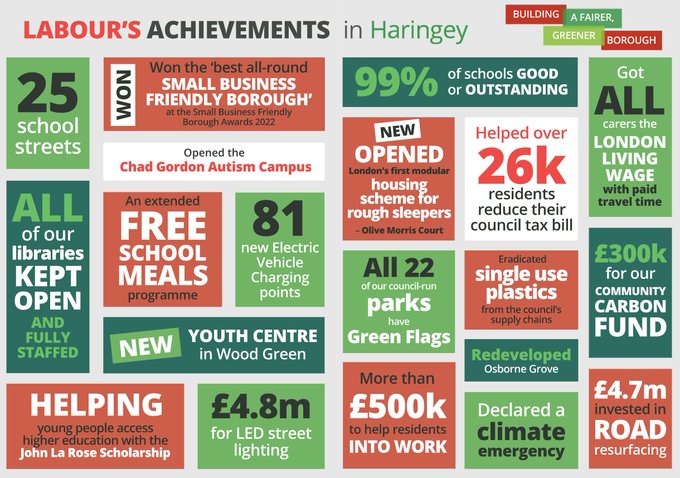
Manifestos are not the most well read of documents so the presentation of the 2022 Haringey Labour document represents a step forward. There are fewer blocks of text and more visual representation of achievements and policies and these also lend themselves to social media where they are more likely to be glanced at.

What is planned on climate, discrimination, inequality and fairness and housing all signals a decent commitment to act on key issues for the period 2022-26. Not changing the world exactly but at least giving it a push in a progressive direction.

Of course most will find issues where they disagree or think more should be done. I’m concerned that there is no focus on trade unions and the workplace. Haringey Labour should flag itself as leading the way on being a living wage and better employer and one that encourages trade unionism not just with its own direct employees but for all employers in the Borough.

The commitment to continuing insourcing services where they are currently done by third parties is welcome as is the focus on what the pandemic and furlough have done to people’s working lives and incomes.

I would also have liked the Council to commit to work with campaigns active locally on key issues such as Haringey Defend Council Housing, Extinction Rebellion and Stand Up To Racism. Hopefully this will happen in practice even if putting it in a Manifesto might raise eyebrows in the wrong places.

Of course too the Manifesto has silences on some of the wider issues that over the years Haringey Labour has become justifiably well known for championing, and which often have a good deal of support locally.

My conclusion on May 5th will be to vote Labour but to continue to urge people to be active and organise with others. Policies good though they may be only go so far without people at the grassroots to make sure things actually happen.

Keith Flett is former Secretary of Haringey TUC and remains an active socialist and trade union representative.

Articles

Beard of Spring 2022 ‘Beard Off’.Can Michael Rosen retain his 2021 title?

In Uncategorized on April 12, 2022 by kmflett

Beard Liberation Front

12th April

Contact Keith Flett 07803 167266

Beard of Spring 2022 Beard Off. Can Michael Rosen retain his 2021 title?

The Beard Liberation Front, the informal network of beard wearers, has said that voting is open for the final round of the coveted Beard of Spring Award, the Beard Off.

Beard of Spring is the second of four seasonal awards that lead to the Beard of the Year in December.

The campaigners say that while the second seasonal award of the year traditionally focuses on new beard growth, the focus in 2022 is as much on those whose beards have appeared in a positive public light during the quarter.

In the first Trim Off Round comedian Alexei Sayle and cricketer Azeem Rafiq shaved opponents. In the second Trim Off Round beer writer Adrian Tierney Jones and current Joint Beard of Spring Michael Rosen bearded the opposition

BLF Organiser Keith Flett said, the Beard of Spring poll sets the beard-benchmark for the period ahead when beards can be flaunted in public as the weather improves.

The vote is open now and will close at midnight on Maundy Thursday, with the winner announced on Easter Saturday

Round One April 6-8

Round Two April 9-11

Final Beard Off April 12-14

Beard of Spring 2022

Michael Rosen, Author

Alexei Sayle, Satirist

Richard Osman, Author

Hugh Laurie, Actor

Tommy Fleetwood, Golfer

Azeem Rafiq, Cricketer

Gareth Southgate, Football Manager

Adrian Tierney Jones, Beer Writer

Articles

How the left did in the French Presidential Election Round One (10th April)

In Uncategorized on April 11, 2022 by kmflett

How the left did in the French Presidential Election Round One (10th April)

The striking thing is the lead candidate of the left Melenchon came within 400,000 votes of making it to the second round. Meanwhile the traditional parties of the left the Socialist and Communist Party (PCF)which have been in Government in recent decades polled poorly (as did the traditional parties of the right).

The far left parties (this may confuse bourgeois commentators who think Melenchon is far left) Lutte Ouvriere (0.6) and the New Anti-Capitalist Party (0.8) got around 450,000 votes between them. They are not in the same electoral game but their continued presence is not insignificant when one looks beyond the purely electoral

Melenchon (LFI) 7,714,529 (21.95%) (Le Pen, Fascist  8,316,369 23.1%)

Yadot (Green) 1,628, 337 (4.6%)

Roussel (PCF) 800,615 (2.28%)

Hildago (SP) 616,651 (1.75%)

Poutou (NPA) 268,894  (0.8%)

Arthaud (LO) 197,184 (0.6%)

Articles

The Ambridge Socialist: Non Doms in Ambridge

In Uncategorized on April 11, 2022 by kmflett

The Ambridge Socialist

11th April

The Editor of the Ambridge Socialist, the weekly bulletin of news from the class struggle in Borsetshire has written to the Guardian exposing The Gills, current likely occupiers of Home Farm as Non Doms. They have not been heard of since a house warming party in 2019. We wonder if other absentee owners are planning to acquire property in the area and if so, for what financial purpose.

Silent characters in The Archers are a tradition (Letters, 6 April). However, there are wider lacunae too. In 2019, the Aldridges had to sell their farmhouse and move to a small place after Brian was fined a substantial sum for polluting the Am. The property was brought by a Birmingham business family who had a noisy house-warming party. Since then we have heard absolutely nothing of them. Presumably non-doms.

Keith Flett

Tottenham, London

https://www.theguardian.com/tv-and-radio/2022/apr/10/where-have-ambridges-non-doms-gone

Articles

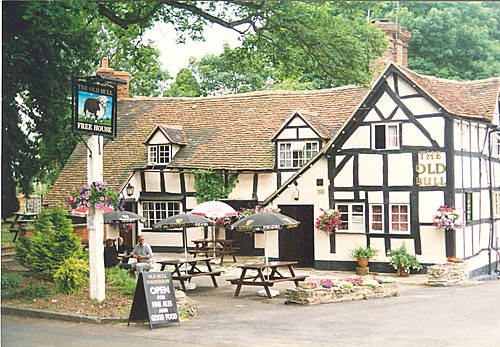
A year ago(11th April 2021)pub gardens re-opened in England: the battle for cask

In Uncategorized on April 11, 2022 by kmflett

A year ago(April 11 2021)pub gardens re-opened in England: the battle for cask

Pubs with gardens or outside spaces re-opened in England on 11th April 2021 (the Sunday after Easter). It was chilly.

CAMRA and SIBA ran publicity campaigns, underliing the key thing that cask was back. That is pub conditioned beer sold via handpump or straight from a cask. Of course was not completely absent during the 3 month plus lockdown. Mini-casks were available at brewery taps and by post but that was really for the dedicated.

When I was a young drinker in North London in the first half of the 1970s the choice of beer was simple. There was no Wetherspoons. There was Watneys, Ind Coope and Whitbread keg. They were widely available and to my mind undrinkable. In North London the nearest Youngs pub, the Spreadeagle, which sold cask was in Camden Town and the nearest Fullers pub was the Anchor and Hope on the Lea. Both are still there, still selling those beers

Otherwise for cask ale you had to hunt out pubs that sold Charrington IPA and/or Bass. There were just a handful of pubs that sold Whitbread (Marlow bitter)- the Victoria in Highgate for example and Courage best (John Baird in Muswell Hill).

Charrington IPA by this time was on its way to blandness but the other beers were decent pints (you drank pints in those days).

If a pub sold only keg I would walk in, check and walk promptly out. I’m sure I wasn’t the only one because by the mid-1970s Ind Coope had restored handpumps in many pubs with Draught Burton Ale (a cask Double Diamond in effect) at the then amazingly strong 1048 OG. The only regularly available beer in London that was stronger was Fullers ESB at 1055.

This is where we were the best part of 50 years ago.

Thanks to the work of CAMRA, then primarily full of young activists like me, cask made a return to many pubs and it stayed. Until recently the number of London breweries did not increase but beers from around the UK, say Regionals like Greene King, Sam Smiths, Shepherd Neame, started to become available here and there in London.

After the law changed, again largely thanks to CAMRA, and many pubs could have guest ales, things moved on further. Wetherspoons was probably the game changer here, surprising as that will seem to many in 2021. A Spoons would often have cask beers on from around the UK that otherwise would not appear in London. Whether they were any good or not is another matter but some, like Hop Back Summer Lightning and Oakham JHB- Spoons regulars- not really seen much elsewhere, certainly were.

Obviously if the cask beer was warm or cloudy (it was not meant to be, and nor was it meant to have twigs in it) or had off notes back it went. Generally though the cask beer was drinkable enough. Did we know, or care much if the beer was a little green, a little tired or not in top condition? Not that much because the alternative was undrinkable keg.

The world has moved on further as it does. Cask is not the only decent beer game in town now. Nor is drinking beer in pints always a great idea given the proliferation of different strengths and styles.

In recent times though cask has started to make an appearance on the bar arguably as a quasi-craft beer. Some might reasonably argue it always was in the hands of some well-known regional brewers a craft product.

They are a reminder of how good well brewed, well-kept cask beer can be which suggests that even in the era of COVID cask has a real future and one well beyond the 1970s when even mediocre cask was hard to find.

The problem a year on is that while pubs are fully open and have been for a good while now, customers have not returned at pre-2020 levels in many places. The reasons for this are no doubt varied, from more home working (although here the ‘local’ might benefit over the city centre bar)to understandable COVID hesitancy. The reality is though that cask is a highly perishable product once tapped with a life of only a few days. It needs to be drunk. Keg beers will last a little longer.

Some surveys of central London pubs in the April/May issue of the London Drinker (CAMRA London, free in good pubs) shows that while good cask is still to be found in pubs, it is often down to one or two pumps to maintain quality against lower custom.

A year on there is still a lot to campaign on around COVID and the future of cask beer is one of many issues.

Articles

Cats, socialism & beyond

In Uncategorized on April 10, 2022 by kmflett

Cats, socialism & beyond

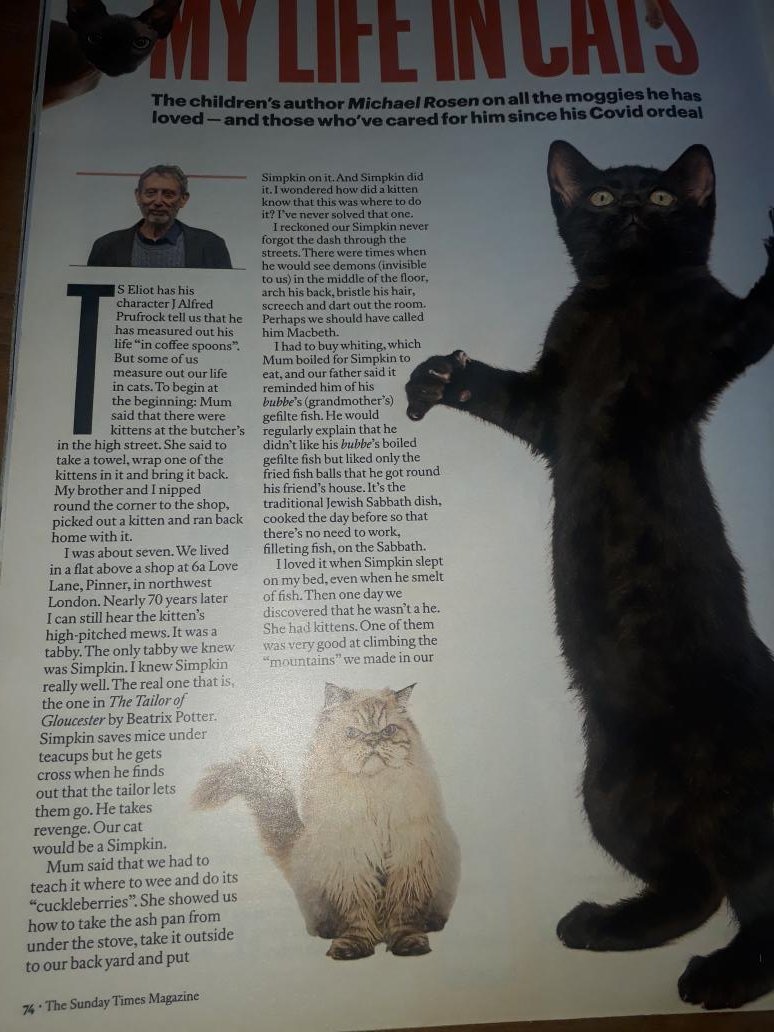
Michael Rosen (10th April) has a lovely piece on the Sunday Times magazine about his lifelong relationship with cats. I have rarely in my 65 years been without a feline companion myself. Rosen swerves the issue of the politics of cats, though most of those I’ve known have been Anarcho-Syndicalists

However cats can sometimes be socialists in the sense that they often plan to share a catch- mice or a bird-with their people. At other times they can be iconoclastic. Even so there have been strong links between the left and cats

Former Labour leader Jeremy Corbyn caused a mild media ripple when he revealed to the Independent that his black and white cat does not have a name but is addressed simply as El Gato. More recently further ripples were caused when the Daily Mail reported that he named a cat he had in the 1970s Harold Wilson

There is a picture of the late British Marxist historian Eric Hobsbawm with his cat. Perhaps there is something about Marxist historians and cats as E P Thompson also had one:

Such pictures appear to suggest a missing link between cats and socialism

If you were looking for a conspiracy, while Lenin was a cat lover there is no record that it had a name either (no, it was not Joe). However that is most probably due to a failure in cat history rather than anything else.

Not all politicians have been cat lovers. There is no record, for example, of a cat in Tony Benn’s Diaries except an entry where he notes he was given a ‘black woolly’ cat to hold for a photo shot.

Harold Wilson by contrast brought his own cat into Downing St when he became Prime Minister, while Churchill patriotically named his Nelson.

The New Labour period, perhaps inevitably, was beset by cat controversy. It was thought Cherie Blair didn’t like cats much and in November 1997 Alistair Campbell announced that the veteran Downing St cat Humphrey had gone to a quiet suburban location. Journalists inquired whether this was code for ‘cemetery’ and photos had to be produced of Humphrey happily in retirement..

We should however be cautious about assuming an automatic link between cats and any particular trend on the left, Rosa Luxemburg described what happened when her cat Mimi met Lenin:

“She also flirted with him, rolled on her back and behaved enticingly toward him,” Luxemburg writes. “But when he tried to approach her she whacked him with a paw and snarled like a tiger.”

Some names of Politician’s cats

Engels- Tidlums

Lenin- cat no known name

Churchill- Nelson

Wilson- nemo (Siamese)

Corbyn Harold Wilson; El Gato

Blair- Humphrey (until Nov 25 1997)

Thatcher Marvin (2007)

Rosa Luxemburg, Mimi

Articles

French Presidential Elections: a history of the recent present

In Uncategorized on April 10, 2022 by kmflett

French Presidential Elections: A history of the recent present

The first round of the French Presidential Elections take place on Sunday with the incumbent Macron looking to head off another significant challenge from the far right to fascist Le Pen. Ideally anyone on the left would want either of them and a left challenger Melenchon again only just failed to get second place. In 2017 he narrowly failed to make the second round in favour of Le Pen.

The traditional parties of the French right, and the left the socialist and communists are not challenging. Macron presents himself as what in the UK would be called a ‘centrist’ or centre politician. His record underlines just what they can mean in practice. Below is a piece I wrote in 2019 about protests of the Gilets Jaunes. Politically a mixed grouping, the motor for the protest was the Macron’s policies were hitting the poor hardest while he did well himself.

The same remains true now. He is proposing a raising the pension age (a long standing issue in France- and here) and demanding that those who seek unemployment benefit must anyway work for some hours  a week

Both Le Pen and Melenchon have campaigned around this successfully although the former has bee helped by a candidate even more unpleasantly right-wing than she is, Zemmour- an apologist for wartime Vichy- who has declined in the polls.

The point being that the policies of Macron have allowed space for Le Pen, while the left isn’t able to capitalise to the same extent.

One can of course argue, prudently, for anyone but Le Pen, but the Macron issue is only underwriting yet more potential for the far right in future. This is not an unfamiliar conundrum broken really only by continued organisation and protests from below

https://morningstaronline.co.uk/article/f/why-macron-cannot-decide-whether-call-gilets-jaunes-crowd-or-mob