Storms Dudley & Eunice: emergency guidelines for beard wearers issued
The Beard Liberation Front, the informal network of beard wearers, has said that as high winds caused by Storms Dudley and Eunice are set to hit the UK over the next few days beard wearers are strongly advised to take special care of their beards.
The campaigners say that while danger to life and limb is the central issue when extreme weather hits, a secondary concern for organic beard wearers is that exposing the beard to high and blustery winds may blow the beard out of shape and can cause permanent hair and follicle damage in some cases.
It is less likely that designer and some hipster beards will suffer significant wind damage
The BLF advises the following precautions:
Keep the beard slightly damp at all times by immersing it in a glass of hazy IPA,imperial stout, or alternative beverage. This will give solidity to the beard hairs and prevent them being blown around.
Use a scarf or snood to protect the beard at all times
Secure the beard with elastic bands, strapping the hairs to the chin
If the beard is blown out of shape use a hair dryer to re-form the hairs in the correct position and then stay indoors for a several hours to allow the hairs and follicles to recover
Update 17th February
With Amber and Red weather warnings for wind issued for Friday the BLF has updated its advice and underlined that beard wearers should only venture out for essential reasons. There is a risk of significant follicle damage
BLF organiser Keith Flett said, the answer is most definitely not blowin’ in the wind today. We advise the hirsute to take care out there and only venture out for essential reasons
Yachts & the Rich in times of Pandemic. A symbol of a world divided by class
The Government has seized a £38m super yacht moored at Canary Wharf owned reportedly by a Russian. The grounds for seizure seem somewhat dubious but that didnt stop Grant Shapps turning up for a photoop. The real issue is that £38m doesnt really get you a superyacht in 2022. At least £100m is required and the new Royal Yacht will cost (at least)£250m
Yachts are one of the symbols of the pandemic. In June 2021 the Financial Times How to Spend It magazine had an entire feature on yachts. I’m not sure whether yacht owners read the FT for guidance or if the paper just likes the advertising.
It reported that the during the Pandemic that the very rich have become even richer and have some spare cash to spend on a new yacht. The FT noted that 494 superyachts (up from 341 in 2020) are currently being built in boatyards.
On 12th February 2022 the FT reported that Credit Suisse has lent more than $1bn to rich investors to buy yachts with. A Dutch boat builder is constructing a $127m yacht for Jeff Bezos which will have 3 masts. There are now 1000 superyachts on order or being built and the FT notes that there are more buyers than yachts.
It appears that slightly smaller but better equipped yachts are what is required. Things like on-board spas, ski rooms, centrifuges and Arctic ice crushers are essential items
As the FT’s yachting correspondent notes they ‘have no real reason’ to exist. They serve no actual purpose. However yacht owners are getting younger, under 40, and as much sailing around in them they want their boat to make a statement when it comes into harbour. Apparently.
Choosing what yacht one wants is reportedly a tricky task. Practical or aspirational. Cost is not an issue either for the super-rich who have created a boom in the market or I suspect for readers of this who may not get much further than the Ally Pally boating lake.
The FT however suggests a dialectic of the superyacht: ‘the less popular the display of wealth, the more desirable the boat
Heart Union Week 2022: learning to love the tradition collective action
14-20th February 2019 is ‘heart’ unions week. Of course 14th February is Valentine’s Day but the week underlines that ‘love’, or perhaps fellowship, is collective as well as individual.
Of course, as they usually do, unions and workplace organising face some challenges
In terms of strikes the figures however cut remain amongst the lowest since the early 1890s when records began and the density of union membership also leaves a lot to be desired. Yet overall trade union membership is steady and rising in some sectors of the workforce
Were it the 1970s I’d say strike statistics don’t reflect unofficial walk-outs and strikes. I’ve participated in and organised a good few of those over the years but they are rare in most, although not quite all sectors, currently. The law around industrial action is restrictive and the emphasis has shifted to getting a high ballot turn-out and using that to get a deal with an employer. The late Bob Crow was a master at this.
Union membership needs to be higher and industrial action in hospitality and by security guards shows that unions are quite capable of organising in less traditional areas of workplace strength. Likewise the low level of strikes reflects a lack of confidence in taking action, the impact of the Government’s continuing austerity agenda in part.
This could change very quickly. You need only look at the 1889 London dock strike- previously unorganised workers with a strike wave across the London and other areas of the UK to underwrite matters- to understand that periods of apparent quiet can suddenly explode.
It’s important though to grasp a wider context.
The reality is that if you are not a trade union member your ability to do much about any issue at work is very limited indeed. And if you are then there is the perpetual work of making sure the union effectively represents people- that only comes from an active membership not a benign General Secretary! It will also help if you are actively politically. A change of Government that is actually on the side of working people remains long overdue.
However self-activity is the start. As the late Marxist historian Eric Hobsbawm noted the world won’t change itself for the better on its own. People are required for that, and people organised in some form of collective activity, which is why being in a union is as important now as it was in the 1890s.
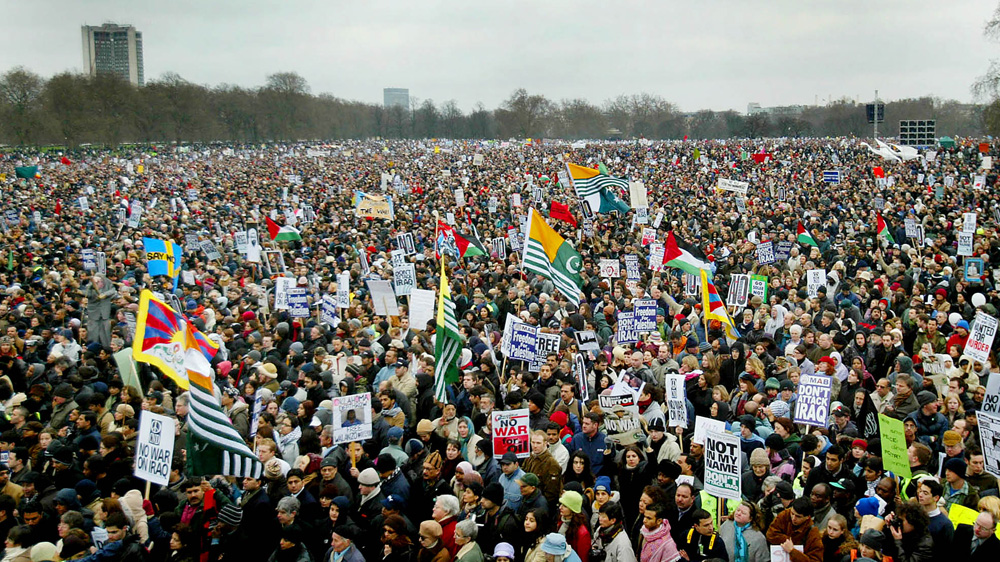
Anti-war protesters are seen massed in Hyde Park during a demonstration
against war with Iraq in London, February 15, 2003. Millions of people
took to the streets of towns and cities across the globe on Saturday to
demonstrate against a looming U.S. led war on Iraq in the biggest
protests since the Vietnam war. REUTERS/Toby Melville
TM/ASA/WS – RTRIDMF
15th February 2003: The biggest protest in UK history 19 years on
It is nineteen years this week since the biggest march in British history, against war in Iraq, on Saturday 15th February 2003.
Below is a slightly edited version of what I wrote on the 10th anniversary.
As Keir Starmer’s attack on Stop the War in the Guardian has underlined the march is not yet history and is some way from being so. The political arguments about war, imperialism, defence and intervention continue and many of the leading players in 2003 remain active today, holding, as they did then, a wide range of views on the world, but still including opposition to illegal wars.
It does however continue to be important to keep remembering that the event took place and left a mark on a generation. Perhaps not surprisingly the blockbuster film has yet to appear and perhaps never will. But what happened and what it achieved should continue to be something that is discussed and debated.
10 Years After: The Historical lesson of 15th February 2003- Keep Marching On
Many readers of this will have been on the central London demonstration called by the Stop the War Coalition on Saturday 15th February 2003 as I was myself.
It was the biggest demonstration in British history and remains so.
The British Government still has imperial ambitions. But whereas before that cold Saturday ten years ago it would have been a minority of left and peace voices that spoke out, today it is legitimate for a broad range of opinion to question why the country is intervening in wars elsewhere and what purpose it serves.
The media are unlikely to be devoting special supplements and programmes to the anniversary although in truth that is what it deserves. The Stop the War Coalition have held a conference to mark the continuing fight against neo-liberalism and war.
Making sure the demonstration is remembered and underlining the historical point that popular mobilisations make a difference is important.
While there were many young people on the march, the fact remains that there are people in their twenties and thirties today who are too young to have either been on the march or to remember it. If in today’s environment it was said,’ we can mobilise well over a million in people in central London for an important issue’, eyebrows might well be raised. Yet just 10 years ago we did exactly that.
So making sure that the event is remembered and remains in the popular memory is an important task not just for historians but for the left generally.
For those who were there, and it was estimated that someone from most households across the UK was, the question ten years on remains one of what impact was made, and whether marching changes anything.
Here history can provide some pointers.
As the historical sociologist Charles Tilly argued in his book Repertoires of Contention- looking at Britain in the late eighteenth and early nineteenth centuries- people fighting injustice can follow a range of strategies. These can vary from petitions through strikes to armed revolts and from riots to large indoor meetings that agree to lobby Parliament.
It depends what is thought to be effective at the time and what mobilises numbers for the maximum impact. In recent times a march with a large and broad turn-out, although far from the only strategy, has often made a significant and sometimes lasting political point.
There is another angle made by the late Peter Sedgwick in his introduction, Farewell, Grosvenor Square to David Widgery’s 1976 volume about the left in the 1960s.
Sedgwick argues that until the rise of CND in the late 1950s the idea of going on a demonstration to make a political point seemed an odd one for many. If you wanted change you wrote to your MP and voted for a Government from time to time.
The minority who did march were watched by many more from the nearest pavement.
From the 1960s all that changed. As Sedgwick noted when delivering leaflets door to door for a protest the reaction was no longer puzzlement from the householder but ‘thanks luv see you at t’demo then’.
Even if a march does not have the precise consequences that were desired it often does beg significant political questions and may do so long after the last marcher has returned home.
That’s why it is important to keep remembering that cold Saturday of 15th February 2003 and to keep in mind that it can happen again.
But while we are remembering 15th February it is important not to forget some other points.
The march did not stop the drive to war with Iraq as the usual suspects have been busy reminding us. But the war itself did not come until a month later on March 19/20th 2003. At that point the aim of anti-war activists was to take protests beyond demonstrations towards walk-outs and industrial action. Numbers did take place, but not sufficient numbers to reinforce the impact of 15th February. It suggests that in the circumstances of the time the mass march was far from being our best strategy to stop the war but in fact the best shot we could muster. Unfortunately it was not enough
Finally a literal footnote. Despite the concern of the Royal Parks and the then Culture Secretary, the late Tessa Jowell, the grass in Hyde Park survived the march and last time I checked was still thriving.
Socialist Historians back renewed UCU strike action. A continuing supply of historical research is at risk
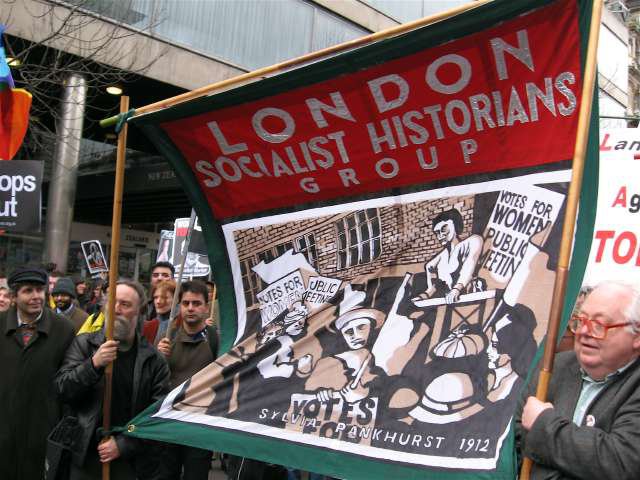
The London Socialist Historians Group, which organises the socialist history seminar at the Institute of Historical Research, University of London, has backed strike action by members of the University and College Union (IUCU) which will take place on 10 days between 14th February and 3rd March.
The academics and professional support staff are taking strike action over further planned cuts to pensions, and continuing attacks on pay and conditions.
The historians say that a continuing supply of historical research is at risk as academics are made redundant or look for jobs elsewhere in the face of a relentless attack by employers on their pay and pensions.
LSHG Convenor Dr Keith Flett, the reality of academic life in 2022 is very different from the liberal University of 50 years ago. It is a neo-liberal workplace where academics face pressure to work harder and harder for poorer terms and conditions. The impact on things like historical research is significant. The UCU are right to strike and they have our full support.
After Munira Mirza the Tories ‘woke psychodrama’ Culture War drones on
Munira Mirza the former ‘Living Marxist’ who was a key advisor to Johnson was largely responsible for the Tories ‘war on woke’. It was designed to distract the focus from Johnson but that doesn’t mean it’s a war the left can entirely ignore.
The Guardian has reported that former Culture Secretary Oliver Dowden has made a speech to a right-wing ‘foundation’ in the US where he criticised the ‘woke psychodrama’ apparently dominant in the West. The speech was clearly designed to appeal to fans of ex-President Trump although why he’d do that at the precise moment that Johnson is trying to convince Biden that what the Tories think about Ukraine is worth paying attention to, is questionable.
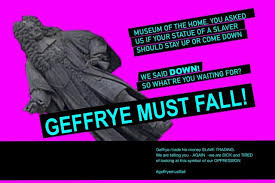
In a war tactics and strategies can vary. The Government’s aim is to invent a layer of people it calls ‘woke’ and in reality promote Tory history over ours. Hence statues of slave traders must stay at all costs.
Oliver Dowden had pursued a slightly different strategy along the lines of ‘retain and explain’. He oversaw a policy that no statue or monument should be moved or taken down. He claimed he preferred new statues to be erected but in fact during his tenure as Culture Minister none were.
It’s something that seeks to establish and dictate exactly what British history is or is not. That is reflected not just in statue wars but in terms of persistent interventions by Tory politicians into what history is taught in schools and Universities.
Labour has had very little to say on this, not least because it’s clear that the current leader Starmer is not a history man. The fact that Dowden claims that like rock if one cuts a section of Labour ‘woke’ runs through it suggests he pays little attention to Starmer who for much of the time appears to be the reverse of the traditional meaning of woke.
Even so its worth taking note. Mirza may have resigned but the Tories Culture War rolls on
Before the current commercialised Valentine’s Day, which dates from the 1950s, there was a peak in the nineteenth century. Ronald Hutton in Stations of the Sun notes that by 1825 the London Post Office handled 200,000 more letters on 14th February than any other day. In the 1840s the decorated Valentine’s card had arrived and by the 1860s could be found across the country. In the 1870s low cost coloured Valentine’s cards were available and in 1880 the Post Office handled one and half million of them, a peak.
Marx and Engels were not perhaps the romantic type though both had affairs as well as long term partners and Marx had children. I haven’t made a comprehensive search of their collected correspondence (which runs to quite a few of the 50 volumes of the Collected Works) but I have checked each year in the 1870s,the Victorian Valentine’s peak. There is no mention of 14th February and cards sent or indeed received. Of course neither Marx or Engels were young in the 1870s but Valentines then as now went wider than just young lovers.
The pair may have thought the matter not worthy of mention, although given what they did write about in the letters (aside from politics obviously) that doesn’t seem that likely. Alternatively it might be suggested that as Germans they weren’t interested in British customs. That however is far from the reality. In fact they were frequent wry observers of them..
Idris Elba and Michael Rosen voted ‘My Hairy Valentines’ 2022
The Beard Liberation Front, the informal network of beard wearers, has announced the results of its annual search for My Hairy Valentine ahead of Valentine’s Day on 14th February.
This year it has been refocused to include two categories:
1 Beards that are sexy, allowing for the reality that this is in the eye of the beholder
2 Beards that are loved because they add a reassuring presence to public life and should be celebrated.
A round of on-line polling covered each category with the winners of both contests sharing the title in 2022.
In the beards that are loved category author Michael Rosen narrowly shaved England cricketer Moeen Ali. In the beards that are sexy round actor Idris Elba won out over ex-footballer and actor Eric Cantona
BLF Organiser Keith Flett said, Valentine’s day is all about love and we think beards are lovely and to be loved. Of course how sexy or loved a beard is remains in the eye of the beholder but we congratulate Idris Elba and Michael Rosen on their 2022 titles
The North London love affair with the Superbowl. Sport as global big business
The owner of one of the teams in the 2022 Superbowl final the LA Rams is Stan Kroenke. He is also the owner of Arsenal.
Kroenke has proved a controversial owner of both. He moved the location of LA Rams games, rarely a popular move with core fans. Meanwhile the amount of funding available to the Rams is considerably more than Kroenke puts into Arsenal.
However that is not where the North London love affair with the Superbowl ends. Spurs White Hart Lane stadium hosted NFL games in 2021. The actual pitch is an NFL one. The football pitch is rolled out on top for games as required. Spurs co-owner Daniel Levy appears to be in the market for hosting the Superbowl 2026 in Tottenham.
In the case of both Kroenke and Levy its about sport as global big business and NFL is bigger business than the Premiership it would seem.