Once again on Brewdog: Inclusivity, Diversity & Equality
Two weeks after the BBC’s disclosure programme about Brewdog the stories and allegations about a toxic workplace culture at the Scottish brewer continue.
Janine Molineux who worked for Brewdog briefly as an accountant in 2017 and 2018 was according to Brewdog sacked for performance reasons. However she has said that James Watt bullied her in a sales meeting and the sacking came a day after she told Watt her father had cancer. She also says that she was warned never to catch the eye of Watt.
Separately Watt himself has commented further on a point in the BBC programme that he stared at employees. He claims that he was not staring but deep in thought.
Punks with Purpose the group of current and former Brewdog workers formed in 2021 to collectivise complaints about workplace treatment have now linked with a third party to launch a portal where Brewdog workers from across its global locations can anonymously share issues
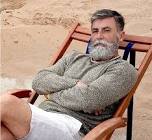
The Beard Liberation Front, the informal network of beard wearers, has launched its annual search for My Hairy Valentine ahead of Valentine’s Day on 14th February.
This year it has been refocused to include two categories:
1 Beards that are sexy, allowing for the reality that this is in the eye of the beholder
2 Beards that are loved because they add a reassuring presence to public life and should be celebrated.
There will be a round covering each category with the winners of both contests sharing the title in 2022
BLF Organiser Keith Flett said, we know that not all beards are sexy and loved, think Ted Cruz, but at Valentine’s each year we celebrate those that are.
The politics of protest: the ‘mob’ versus the ‘crowd’.
The harassment of Keir Starmer and David Lammy in Westminster on 7th February has raised again the question of when a protest is that of crowd engaged in democratic political activity and when it’s a mob with reactionary and anti-democratic intent.
The protesters on Monday appeared to be associated with Resistance GB a right-wing conspiracy focused group and were widely characterised as a mob.
Of course one person’s mob is another person’s crowd
For example protesting outside the house of someone who has transgressed many people’s understanding of what might be termed a ‘moral economy’ is a British tradition stretching back over many centuries. It was not however by any means always politically progressive, so controversy over it is also something not recent.
The use of the term mob to characterise popular protest dates back at least to Edmund Burke’s view of the French Revolution. As the great historian of nineteenth century protest George Rude underlined what reactionaries thought was a mob was in many cases simply a peaceful crowd making reasonable points. If one wants to look for a mob, the activities of the Bullingdon Club are a good place to start.
Events in the US on January 6th 2021 provided a much wider canvass to issues of the politics of protest but a summary of the mob v crowd debate, now history itself, is here:
While George Rude saw in a protest up to a riot the work of the crowd, and broadly progressive intentions and outcomes, E.P. Thompson was less happy with this formulation. He suggested that riots could also contain reactionary elements and the crowd involved in the Gordon Riots would be an obvious example.
I would take Thompson’s side in that debate (if only just) but underline the point above that while we may accept that there may be reactionary elements in crowds which can get involved in riots this doesn’t alter the fact that they happen and need to be understood
E.P. Thompson’s work on food riots points to the reality that the threat of a riot was often more effective than an actual riot. It could cause a reduction in the price of bread or the distribution of hoarded food. When riots did occur very much the same impact was to be found. Hidden food was seized and distributed at low price.
There were other, more obviously political riots, often associated with the Chartists. The Chartists were an organised political force that most certainly did not support riots. It was rather the wider Chartist crowd that participated in such activities, often after provocation from the authorities.
There has been a lot more research and wider perspectives on the crowd since Thompson and Rude looked at the matter in the 1960s and 1970s. Crowds are looked at from the perspective of safety risk management and from psychology as well as history.
Historical research however can provide useful context by looking at who the individuals were involved in mob or crowd protests, what their intention was, how this turned out and what the reaction of authority was. Perhaps needless to say such research is limited because often the only people who can be identified are those who are arrested and any who make public statements about their activities.
Of course the democratic crowd will usually make it clear what its about so a lack of clarity may suggest a mob with less clear intent.
The bad history that claims ‘black boy’ names can’t relate to black people
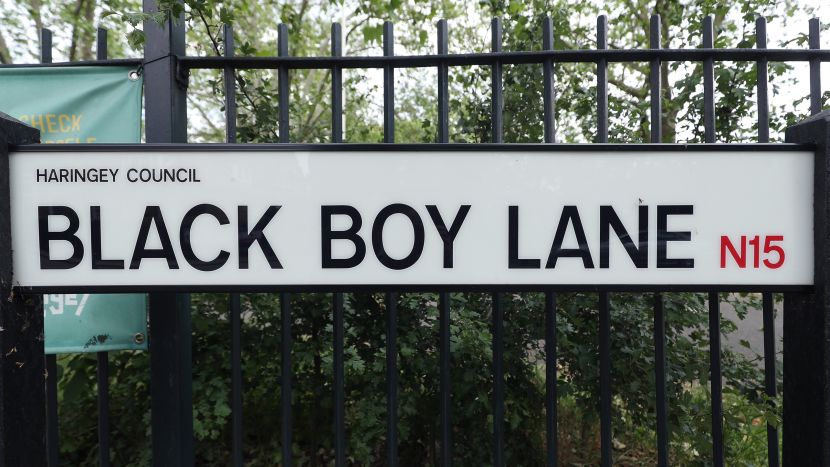
The controversy over attempts to change the names of pubs and roads that have ‘black boy’ in them continues. The latest relates to Black Boy Lane in Tottenham whose name will be changed to John La Rose lane after a public consultation.
In modern day Tottenham the name doesn’t sit well, a vibrant multi-cultural community. Its name probably does not relate to Charles 11 often referred to as the ‘black boy’ itself a rather doubtful usage albeit an historic one. Nor is it likely to related to chimney sweeps but, relatedly, the dust pits that existed in Victorian times at the bottom of the lane and the itinerants who lived amongst their comparative warmth in winter and their rather grimy appearance.
Does that mean then that ‘black boy’ names never refer to black people. Certainly not. The bad history behind this assumes that there has only been a significant black population since after 1945. This is entirely wrong.
London and other ports had a significant black population from the late eighteenth century on. Many were ex-military having fought on the British side in the American War of Independence which Britain lost in 1783.Still others were ex-sailors who found themselves in London and some were ex-slaves who had made their way to Britain.
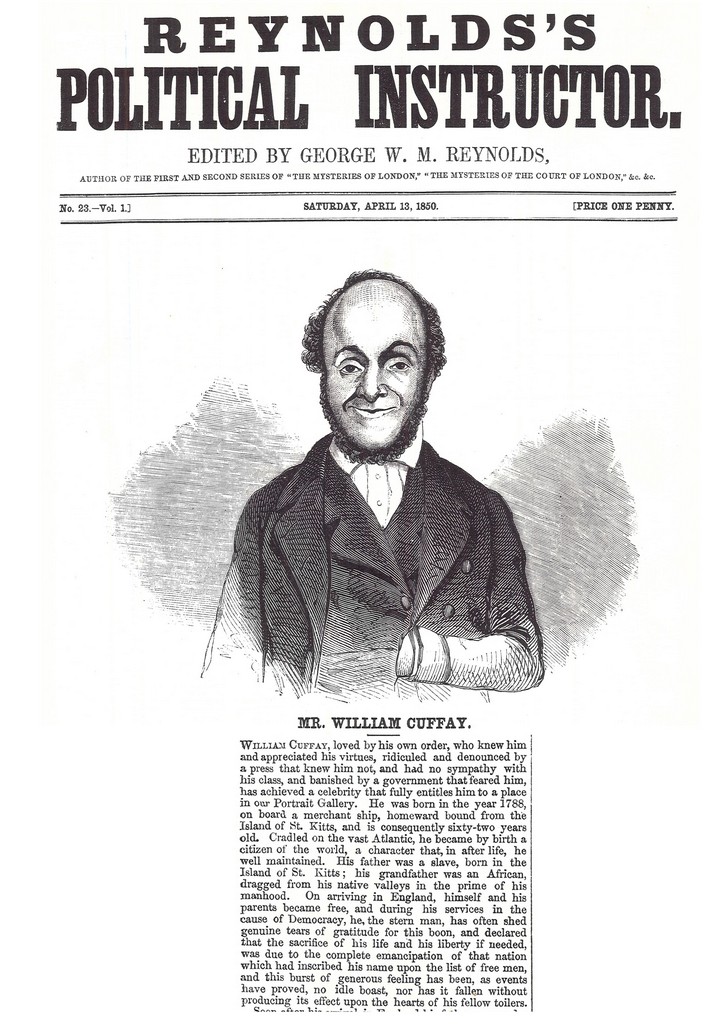
It was a significant enough population for black man William Cuffay to be the leader of London Chartism in 1848. The Times referred to this as ‘the black man and his Party’ and Punch lampooned him in racist tones. We can see here a potential link to ‘black boy’ names.
Not enough is known about black people in the UK in the first half of the nineteenth century but we shouldn’t dismiss ideas that the name ‘black boy’ did not on occasion refer to them, although not certainly from a 2022 perspective in a positive way.
Boris Johnson: the History of a Clown- the serious side
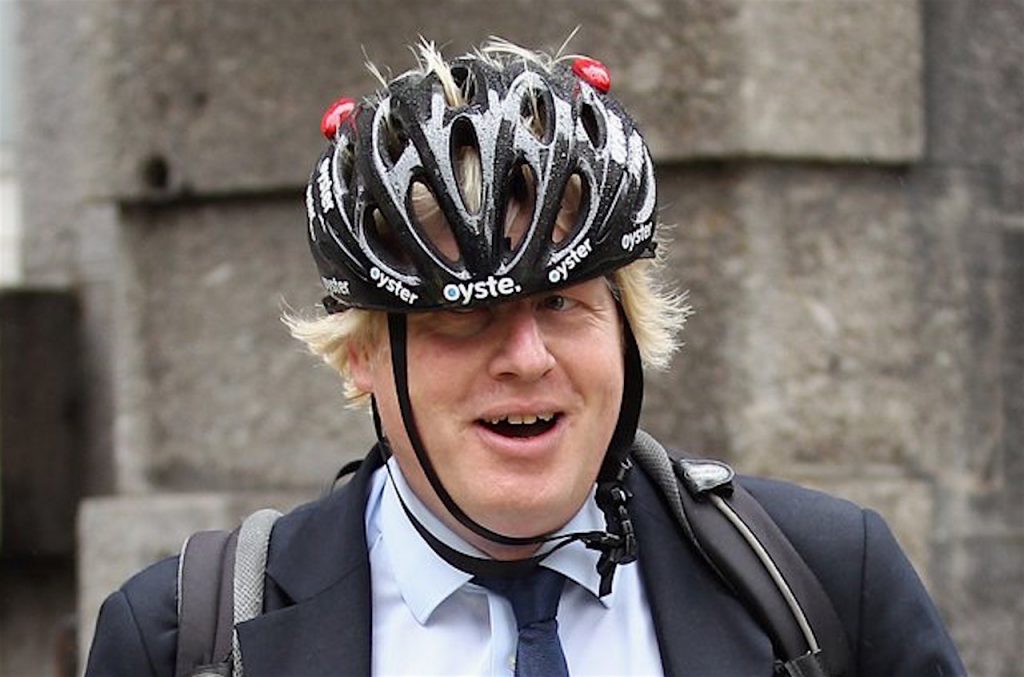
According to his latest (and former)PR man Guto Harri Boris Johnson is not just a clown.
The point being that he is a clown however. Not only that of course. He’s made many racist and sexist remarks and pursued an often ruthless political ambition none of which involved being a clown.
His biographer Sonia Purnell notes that he was seen as a clown as far back as his Balliol student days. Later when a journalist at the Telegraph Max Hastings doubted he could ever be a serious politician (judging by an article he wrote in the Sunday Times on 6th February this is a view he still holds). Douglas Hurd had much the same view. The issue was not perhaps the clowning in itself but the lack of self-discipline its appearance in inappropriate contexts suggested.
Johnson argued 20 years ago that his clowning allowed him to pursue a more serious political agenda with less scrutiny but this sounds with hindsight like a post-hoc rationalisation. Portillo suggested he should choose between comedy and politics.
During his successful run for London Mayor up to 2008 Lynton Crosby the right-wing Australian strategist was a key advisor (as again now) and banned Johnson from ‘smirking’ during media events.
While the clowning could on occasion be controlled leaving a serious right-wing politician the ill discipline and generally shambolic approach continued and continues. For how much longer it remains to be seen
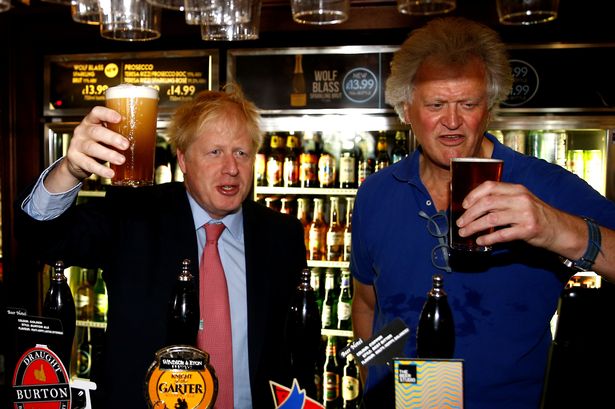
The price of beer is in the news. Thanks to beardless beer writer Matthew Curtis for posting a link to an article in the Manchester Evening News about the impact of the economic times on breweries and the cost of beer. Some well known Manchester breweries are canvassed including Cloudwater, First Chop and Runaway.
The general points are around increases in the cost of raw materials, production (i.e canning) energy and the impact of Brexit. Of course businesses traditionally make such points as much as I as a trade union officer argue for wage increases.
However there is no question that the last two years have led to significant issues. Paul Jones is right to point to the specific Brexit Johnson pushed through as a cause of problems rather than Brexit in general(whether you agreed with it or not- I voted remain). There is a global economic crisis that is not related to Brexit as well.
If the price of beer goes up, does it matter however? After all no one has to drink it, and numbers don’t. The reality is that the price of beer forms part of the Retail Price Index so it is an important economic measure. I suspect though this is notoriously difficult to prove, that the price of beer has outstripped wage increases over a lengthy period. One outcrop of that is the success of Wetherspoons where you can find a pint of cask beer for as little as £1.19 a pint in some places.
Historically beer was considered part of the normal diet for many workers involved in heavy industrial or agricultural labour and was one focus for the ‘standard of living’ debate about whether living standards fell or rose as industrialisation proceeded after 1800.
More specifically thanks to a Malt Tax first introduced to fund the country’s wars in the early eighteenth century, the price of brewer produced beer was considered to be high by the first decades of the nineteenth century. It also made the cost of home brewing a traditional practice, prohibitive.
E P Thompson in the Making of the English Working Class reports a letter from a magistrate in 1816 arguing that the Malt Tax would lead to revolution. In fact numbers of unregulated and unlicensed premises circumvented the law. Reality intervened with the 1830 Beershops Act that made the opening of premises specifically to sell beer much easier and much less costly.
Expect the controversy to continue, though Assizes of Ale, Government assistance to brewers and price regulation would all help.
Black Boy Lane N15 becomes John La Rose Lane N15. A small but important change
I’m a resident of Tottenham and travel up and down Black Boy Lane on the 341 bus regularly. It runs between West Green and St Anns. I also voted in the consultation on whether the name should be changed.
Obviously not everyone was in favour. There were of course those who saw no issue whatsoever with the original name. Some of those who live on the Lane understandably were unhappy at a practical level- it will mean some hassle for them, although most address details will get updated automatically. Others argued that there were more important things for the Council to be doing. They had a point but that doesn’t mean it wasn’t worth doing as well.
A reminder as well that change, even a small one, can be a frustratingly slow process. Black lives matters campaigners put the case to the Council in 2020 that some street names in the area that reflected past imperial ‘glories’ such as Buller Rd and Kitchener Rd should be reviewed. The name change for Black Boy Lane is the only result of that so far, as democratic processes were, rightly, followed.
In that context it can perhaps be understood why protesters decided to topple the Colston statue in Bristol after years of official reviews and tweakings had produced no significant change.
In the world of 2022 Black Boy Lane can be seen to be of racist intent and certainly not the kind of road name that fits well in a place of many ethnicities like Tottenham. The origins of the name remain uncertain though. My view was always that its named after those that scavenged in the massive dust pits at the bottom of the lane (where St Ann’s Hospital now is) and the likely appearance of the homeless who resided there. Its mentioned in Raphael Samuel’s essay about nineteenth century casual labour, Comers and Goers.
The change to John La Rose lane seem particularly timely now, as he, amongst other things, was the founder of New Beacon Books in Finsbury Park. Now under threat of closure as a bookshop(not on-line) it was a pioneer of selling Caribbean and African literature in the UK(and it still is)
As the leader of Haringey Council Peray Ahmet noted it’s a small change as part of a much bigger picture. Credit to those who campaigned for it and to the Councillors that made sure it was ultimately done. It will annoy Tories and hopefully make many local Tottenham residents feel a little bit more at ease (in the words of the late Darcus Howe) It wouldn’t have happened in the Tottenham of the 1960s but thankfully as Dylan sang Things Have Changed.
6th February marked 70 years of Queen Elizabeth being on the throne, an occasion of historical significance, however viewed. She has reigned longer than any other monarch, although Queen Victoria(1837-1902) came close.
Don’t expect criticisms of Royalty to feature in the 2022 occasion although some may appear as Jubilee celebrations roll on through the year.
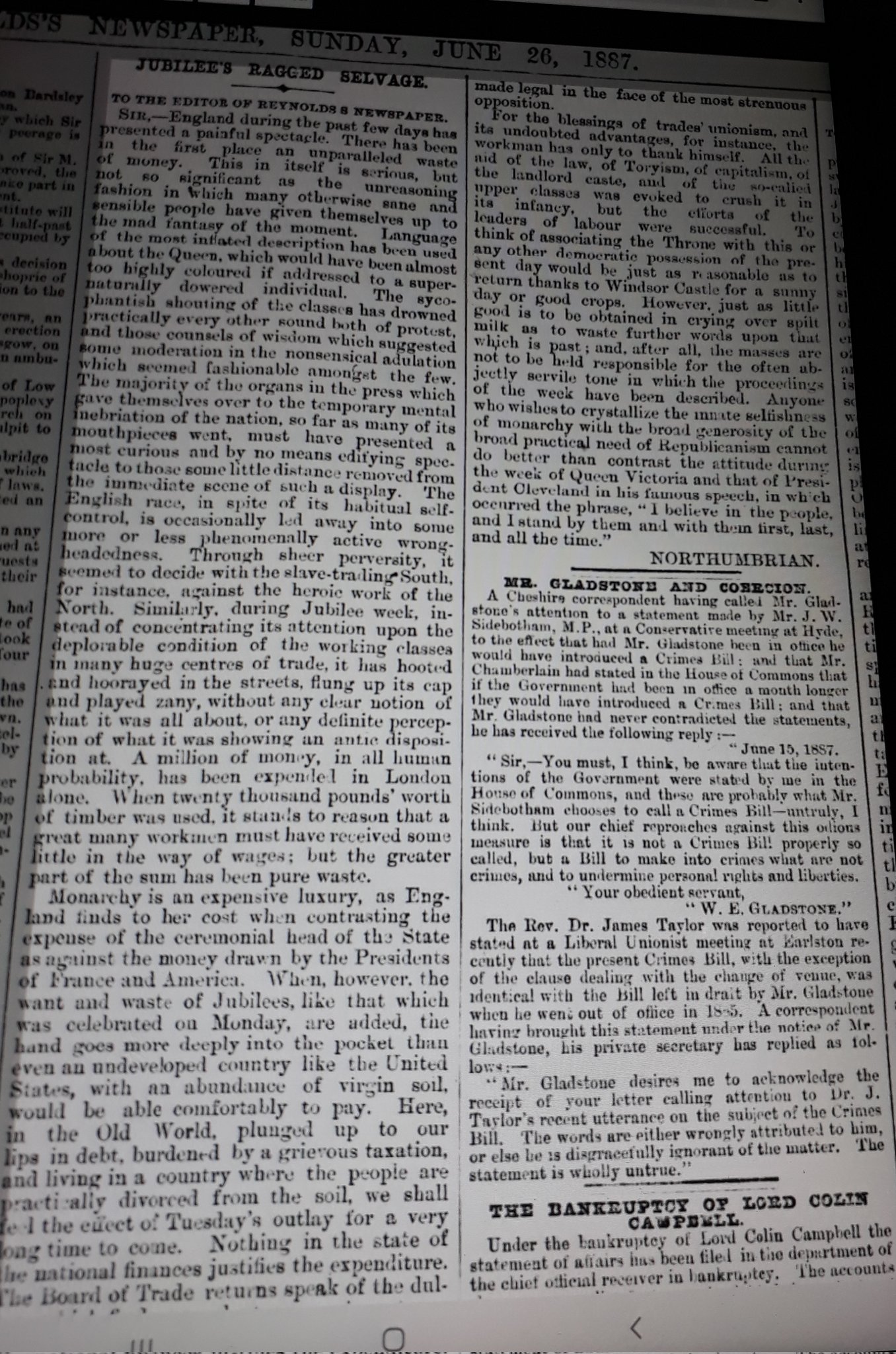
Matters were a little different in the nineteenth century. I’ve delved into the archives and a look at Reynolds’s News for 26th June 1887 Queen Victoria’s 50th Jubilee. It was of course a magnificent occasion with dignitaries from across the Empire as it was then. Reynolds’s reported it straight although noting that a key feature of the day was the enormous amount of dust created by crowds of onlookers to the Jubilee procession.
However Reynolds’s founded by the maverick Chartist and novelist GWM Reynolds in 1850 was fiercely anti-Royalist and pro-Republican in its reporting. It was by far the best selling newspaper of the late Victorian era, coming out every Sunday. Think broadly a rather more radical version of the Mirror.
On the 1887 Jubilee the paper carried a lengthy letter from Northumbrian the opening lines of which were:
England during the past few days has presented a painful spectacle. There has in the first place been an unparalleled waste of money. This in itself is serious but not so significant as the fashion in which many otherwise sane and sensible people have given themselves up to the made fantasy of the moment. Language of the most inflated description has been used about the Queen, which would have been almost too highly coloured if addressed to a super naturally powered individual. The sycophantic shouting of the classes has drowned out practically every other sound of protest
I approach the subject from the angle of the history of sport, arguing that historians too often see practicing sport in this period from the top down, rather state orientated perspective of political ideology. Instead, I show that Swedish cyclists didn’t tend to cycle primarily in order to parade commitment to socialism but to see friends and family, explore the landscape, and explore abroad. I will explore a conclusion- how, although cyclists didn’t cycle simply because of adherence to socialist ideology, the Swedish cycling craze helped create an ethos of informality, inclusivity and egalitarianism among a younger generation of Swedes which could be seen as fundamental for the development of the social-democratic ethos that has characterised Sweden since.
I’m using new research – from newspapers, personal reminiscences and oral interviews – to show how cycling culture in interwar Sweden reveals the new practices of sociability that converged with, and served to support, the socialist ethos.
Concern for Susan as she describes David Archer as ‘masterful’
With Neil otherwise engaged, Susan appeared at Adam & Ian’s for an evening meal and drink. It was one of those Ambridge occasions. Susan and Ian (Adam doesn’t do fun) came up with an idea for the Bull’s Valentine’s Night in the course of which Susan revealed that she had a crush on David Archer who she claimed was ‘masterful’ in the Ambridge Mystery plays. Concerning news indeed. Susan may need help, but not from David.
The Ambridge Socialist poll. How would you describe David Archer?
Brian has been reviewing the latest Berrow Farm financials and has faced questions from Martyn Gibson Borchester Land’s enforcer. It appears pigs are in crisis.
Phoebe: Hello, Goodbye…
Phoebe has reappeared (the lurve child of Kate and Roy for the unfamiliar) fended off an attempt by Kate to get her to speak at a conference on rewilding. She then announced to Roy that aside from a new partner she has a job in the Highlands. So it appears to be hello, goodbye to Phoebe for the time being. That said there are a significant number of people in the village we hear too little from- due to both BBC budgets and time constraints
In Other News
Chris has shingles and Martha has measles
Saint Harrison of the Immaculate Truncheon. Kenton (via Keri Davies)