As far as I know Gramsci, the Italian Marxist jailed by Mussolini had no interest in cricket.
He was however very good at analysing a crisis. He wrote in his Prison Notebooks:
“The crisis consists precisely in the fact that the old is dying and the new cannot be born; in this interregnum a great variety of morbid symptoms appear.”
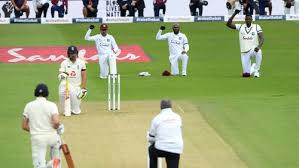
This does rather seem to sum up the state of English cricket at the moment as the issue of racism in the game at very long last at least begin to be grappled with.
The crisis is just beginning and there will be more morbid symptoms before the new can be born and steps towards an anti-racist cricket culture in administration, the dressing room and to some extent in the stands can make progress.
Bells Brewery: Big Beer & capitalism’s tendency to monopoly
The respected beer writer Matthew Curtis has posted various points about the sale of the Michigan craft brewery, Bells to Australia’s Lion. Lion itself is owned by Kirin.
They own several craft brewers in the UK including Magic Rock and Fourpure.
Bells has a long-ish history for a craft brewery and its 7% ipa Two-Hearted, is viewed as one of the best in the world, albeit little seen currently in the UK.
The owner reportedly wanted to retire and having no succession plan a sale was the best way to keep things going
That’s how Ashai came to own Meantime of course as well.
Lion also owns Little Creatures (which has a brewpub in Kings Cross) and Matthew Curtis clearly sees links between them, Bells and Fourpure, in part via New Belgium (another Lion acquisition).
Those who are really only here for the beer (which is after all the point) may wonder by this stage if any of this really matters.
Actually it does. Craft brewing was (and is) about sustainable, locally produced beer for particular tastes. It is meant to be different from and indeed in opposition to global big beer brands, where you get the same beer whichever pub you go in.
What Lion and Kirin are doing here is creating global big beer brands. Capitalism which claims to be all about free market competition in fact leads to monopoly.
There is nothing however in the first part of the free market/monopoly equation to stop new craft beer brewers appearing. The point is enjoy them while you can, before long big beer will come knocking
Owen Paterson, Boris Johnson & William Cobbett’s Old Corruption
There was rightly a furore after Tory MPs (for the most part) voted not to carry through the suspension of Tory MP Owen Paterson from Parliament (Paterson himself voted against his suspension) for share dealings which Keir Starmer correctly labelled ‘corruption.
MPs have standards of behaviour and an independent committee found that Patterson had broken them. Johnson’s response was not to back the committee but to have a look and see if rules could be changed to allow corrupt dealings.
After anger at this attempt to avoid democratic scrutiny and accountability Owen Paterson has resigned as an MP. The media have labelled it a U-Turn by Johnson, but behind that lies a lot of present and past history.
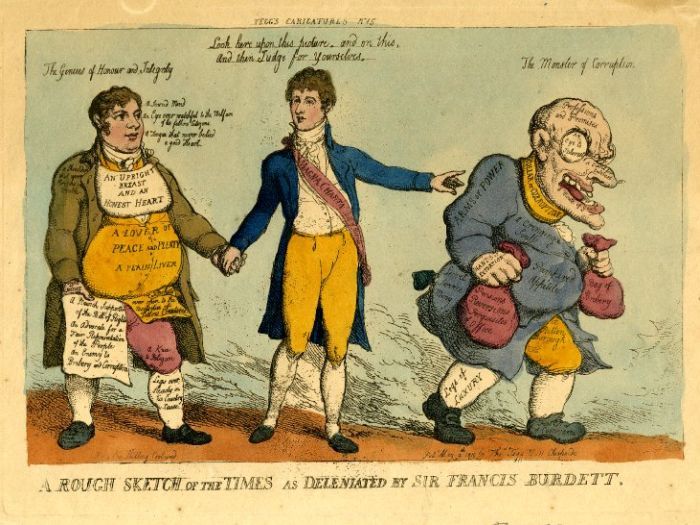
During the 24-hour period when Johnson supported Paterson and then he didn’t there was much media and social media discussion of sleaze and corruption and even an occasional reference to Old Corruption. While recent Parliamentary times have seen a good deal of dodgy practices from MPs expenses to David Cameron’s business interests there was a time when such things were a fully institutionalised part of Westminster politics
The whole Paterson episode has echoes in the views expressed by William Cobbett on politics and Parliament in the pre-reformed Parliament of the 1810s and 1820s where many MPs did much as they liked unencumbered by any democratic accountability.
It was in this period for example that a Tory Government not only evaded any blame for the Peterloo Massacre of 1819 but carried through a series of repressive measures, the Six Acts, to crack down on democratic protest even further. One suspects this is one of the periods of British history that Boris Johnson keeps firmly in mind.
EP Thompson encapsulated the Cobbettian worldview in the Making of the English Working Class. Describing Cobbett’s intervention in the 1806 election for the Westminster seat in the unreformed Parliament, he noted how Cobbett summed up the opponents of the radical candidate:
relations of placemen and pensioners’, ‘tax-gatherers, magistrates, policemen and dependent clergy’, ‘play-actors, scene-shifters, candle-snuffers, and persons following..immoral callings’.
In his Rural Rides, Cobbett criticised ‘pensions, sinecures, tithes and the other ‘glorious institutions’ of this ‘mighty empire’. He referred to this collectively as The Thing.
In the Peculiarities of the English (1965), Thompson explained why the practice of Old Corruption caused such resentment in the late 18th century: “It alienated the sisters and the cousins and the aunts of those who had not obtained preferment, the officers who had not been promoted, the clergy who had not found patrons, the contractors who had not obtained orders, the talented who had been passed over, the wives who had been snubbed.”
It would appear that the Tory MPs who Johnson arm twisted into saving the Parliamentary career of his mate Owen Paterson, only for him to be ditched the next day, have a rather similar view in 2021.
That world eventually began to change in Cobbett’s time as Parliamentary Democracy started itself to be renewed with the 1832 Reform Act. It might be noted however that the passage of the Act was a fine call between reform and a plebeian revolution.
Its good for Parliamentary democracy that Paterson eventually resigned but the wider point is that Johnson’s Government is deeply mired in the practices of Cobbettian Old Corruption. Sinecures and favours for mates are rampant, democratic practice is not.
The 1832 Reform Act averted a revolution in Britain. If action isn’t taken on Old Corruption 2021 there could be real trouble ahead for the ruling order.
Boris Johnson & Rough Music. The booing continues (now in Glasgow)
As I note in an article in the Morning Star when Boris Johnson first became PM in 2019 his first few days as Premier were notable for a chorus of protest where ever he appeared.
Admittedly the report is in the SNP ultra-paper The National and one suspects the booers may have been SNP related but that is all part of the tradition.
One name for this is Rough Music, a community custom, where transgressors against a generally held moral code were singled out for ridicule. It was by no means a universally progressive tradition, as E P Thompson study into it (Customs in Common) made clear.
A tradition of effigies and sometimes the burning of them fed into the wider area of charivari or rough music a wider form of protest, involving discordant music and general uproar.
According to the social historian Robert Storch in reaction to the 1872 Licensing Act it was almost decided in Exeter to burn an effigy of the Home Secretary but instead there was a chorus of groans. From the 1870s Storch notes shopworkers burnt effigies of employers who refused to join in with early closing times
As late as 1887 an inmate of Chelsea Workhouse was charged with making an effigy of the master as a protest about poor food. The judge in the Police Court, aquitting the inmate, told the master ‘public characters like you don’t mind a little ridicule. It’s the penalty of greatness.
Perhaps Boris Johnson, great or not, will grasp the point. But probably not.
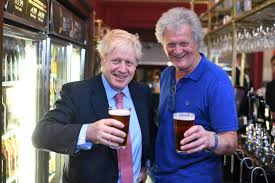
Tim Martin puts this down to the reluctance of older customers to visit the pub in what remain COVID times, because they apparently drink real ale.
I note chat on CAMRA discussion sites (the official ones) about the impact this might have on the production of cask- given the size of the Spoons pub estate and claims that young people prefer craft beer to real ale. I’m afraid that CAMRA’s long overdue discovery that much craft beer (in keykeg) is real ale continues to pass by a certain layer of members (I joined CAMRA in 1975 and remain a member).
I’m 65 (I appreciate some reading this may think Ive been 65 for years- it’s the beard) and I did in fact visit a Wetherspoons pub last week and drank real ale. However that was related to the 2022 Good Beer Guide and is embargoed until later in the weel.
In general though I drank in Spoons pubs regularly 30 years ago. There was often nowhere else to get even vaguely decent beer. Clearly the world has changed since and I hardly ever visit now.
There is the specific issue of the beer. Even pre-pandemic the choice of cask beer and the quality of it when served in Spoons was at best variable. Like CAMRA itself Spoons has been slow to take up craft beer, although you can get a cheap pint of punk IPA which will usually taste better than if you venture into Brewdog. Selling it for £3+ a pint as opposed to £5+ does create a turnover.
However the main reason I swerve Spoons (but certainly not pubs, provided they are safe environments in times likes these- since Xmas is approaching the voices of temperance fans who think pubs are always inherently dangerous places are back btw-) is because it doesn’t recognise trade unions and doesn’t therefore have properly agreed terms and conditions for workers.
Of course that’s true for many pubs. The point is that given the size of Spoons it should be perfectly possible to have a trade union which would of course benefit employees but actually also Mr Martin as it would help to stabilise employment and reduce turnover.
Class & Climate: building a movement on climate change
Dear Editor
Adam Tooze is spot on about the energy transition which is essential to address climate change. It may well mean dearer energy costs but a key issue is who pays for it. If the transition sees existing suppliers maintain profits while people on low wages struggle to afford power to cook and heat, the popular movement needed to do drive serious action on climate change will not be built.
London Socialist Historians Newsletter 74 Autumn 2021 now On-Line
The LSHG Newsletter has been published every academic term since 1997 and all issues are available free on-line. The earlier issues not only deal with historical research but are now also part of the history of the left themselves
The new issue leads with a comment on socialist historians and the culture wars.
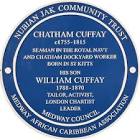
It also looks at a new memorial to Chatham Cuffay in Medway, Engels favourite Manchester pub, Nine Elms station and the Chartists in 1848 and 20 years of the Stop the War Coalition
It’s survival is remarkable in several senses. One because it hardly managed an appearance last year due to lockdowns.
A month long lockdown with pub closures hit London on 5th November 2020. There was a brief period of re-opening in the first part of December (with restrictions) and then the long lockdown which saw pubs shut until after Easter.
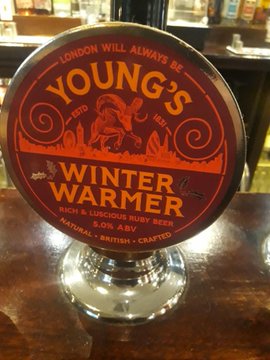
Winter Warmer is a cask only beer so if you found some of the 2020 vintage you did well.
Its also survived successive brewery takeovers. Brewing moved from Wandsworth to Bedford when Youngs moved to pubs only, and Charles Wells was then taken over by Marstons whose brewing business is now in the hands of Carlsberg. The beer is still produced at the Eagle brewery in Bedford though.
A more imponderable issue was raised by comments on the original post. Namely does Winter Warmer still taste as it did in the 1970s and 1980s. I’m not really sure how one judges that (beyond checking if the recipe has changed). In the 1970s I was a fan of Theakston’s Old Peculier. I still drink it occasionally but generally it’s a little too sweet for my taste now. The beer may have changed a bit but my taste in beer certainly has
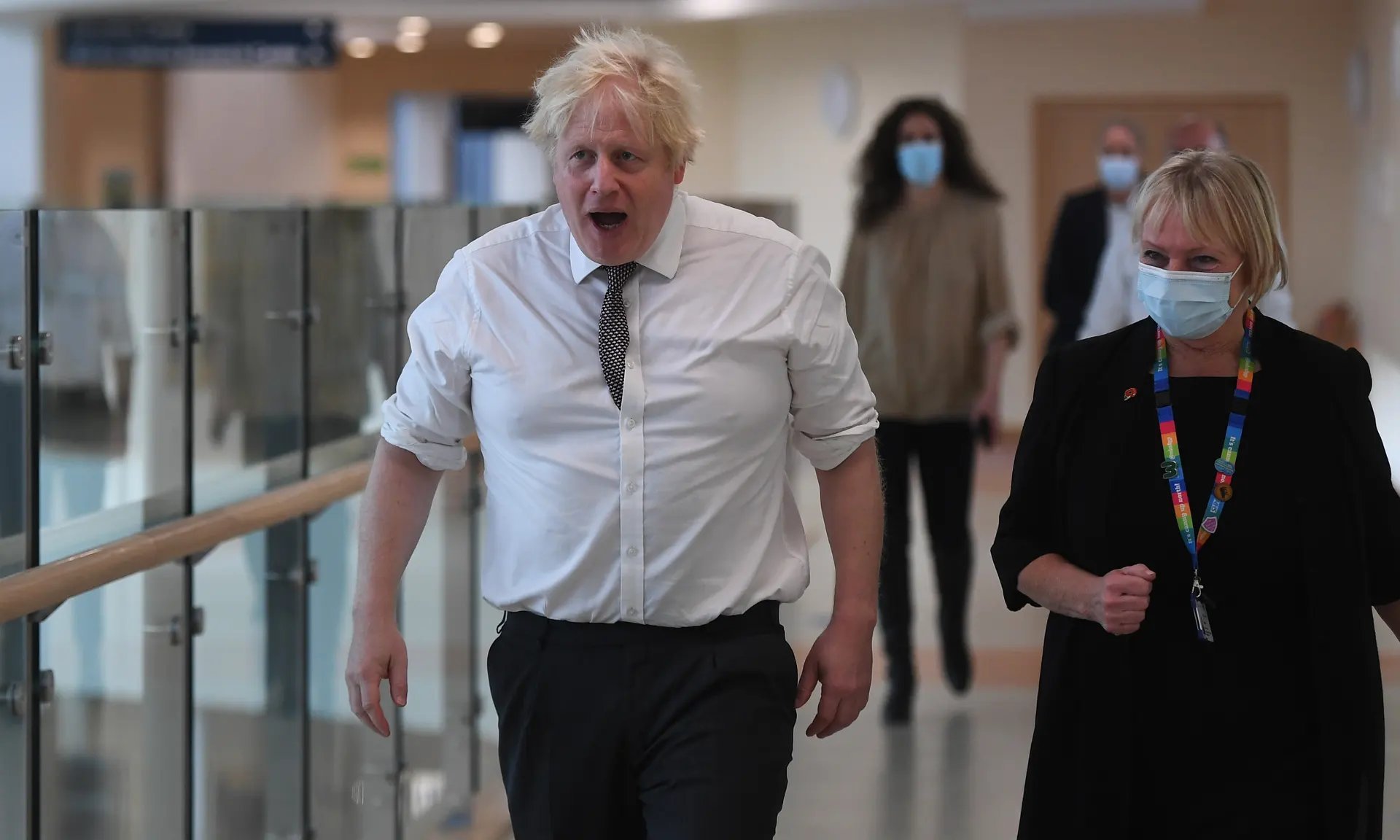
Many might think that Johnson visited a hospital in Hexham on Monday simply to avoid appearing in the Commons for the debate on Owen Paterson and Parliamentary standards. Very probably, but he did also promote getting the vaccine and the booster does which was worthwhile.
Just as he shook hands with patients in February 2020 so on this question Johnson appeared in an NHS hospital unmasked. Of course everyone else was wearing one. It echoes the situation in the Commons where despite guidance from the Parliamentary authorities some Tory MPs, notably leader of the House Rees-Mogg continue to appear mask-less.
The hospital later claimed that Johnson wore a mask in clinical settings, but that doesnt help. In that case the release of pictures Johnson unmasked sends the message that it doesnt matter.
The public health advice on this is clear. Wearing a mask protects the wearer and others from Covid and flu and indeed all airborne viruses. Of course the protection is not that great (vaccines are much better at the job) but it’s a matter of social responsibility. These are two words not in the Johnson dictionary because for him, Rees-Mogg and others it’s about personal responsibility or lack of it.
It is a classic debate between individualism and basic collectivism but in this case a potentially somewhat deadly one
Paterson affair: Boris Johnson tries variant on his sorry/not sorry routine & says he’s taking it ‘very seriously’
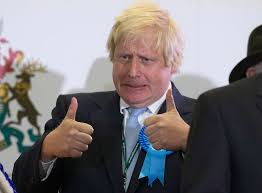
With the Owen Paterson corruption scandal being debated in the Commons, Johnson has of course swerved the House bit told the BBC he is taking matters ‘very seriously’. This appears to be a variant on his usual routine of apologising not for his error and gaffe strewn past but apologising if it has caused offence. Then he goes on saying the same things.
He has not apologised, yet, over Paterson but does anyone think Johnson takes anything seriously aside from how much money he has?
The history of Johnson failing to do anything about issues he is called out for is worth remembering as he certainly won’t.
Sonia Purnell notes in her biography of the PM Just Boris that he has become an almost habitual apologiser for ‘any offence’ that his earlier words, often racist, have caused.
His complete refusal to recognise taking the knee against racism as something legitimate that people concerned about injustice might do was compounded by his disdainful approach to the England football team doing so in the European Championships, until they nearly won it that is.
It is a reminder that Johnson has a long-standing history of racist comments and of dismissing reports that highlight the role racism had and has in British society, to go along with his history of apologising for these when called to account.
One example is the 1999 Macpherson Report into the murder of Stephen Lawrence that found institutionalise racism in the Met Police. Johnson dismissed the findings as ‘Orwellian’ ‘weird’ and ‘crazy’.
Purnell points out that following discussions with his then wife, prominent lawyer Marina Wheeler, by 2001 he was prepared to concede that Macpherson may have had a point. Not of course that when he later became Mayor of London he did anything about this.
More recently on 15th July 2021 Johnson made a speech about ‘levelling up’. Afterwards he was asked by the Independent if he would disown earlier comments about Muslim women and he said:
The best thing I can say is that I’ve obviously apologised in the past for the things that Ive said that have caused offence and continue to apologise for them.
Johnson is not a serious political figure but he does a lot of things that make for serious politics and never says sorry for the issues he creates.