Articles

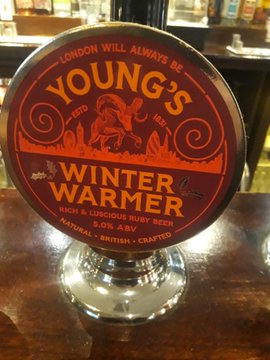
Young’s Winter Warmer: still a survivor from London’s beer drinking past

In Uncategorized on November 8, 2021 by kmflett

Young’s Winter Warmer: still a survivor from London’s beer drinking past

Below was the commercial description for Wells-Youngs Winter Warmer in 2014. The beer appears to still be brewed at the Eagle Brewery in Bedford (ex-Charles Wells) which is owned by Marstons/Carlsberg

COMMERCIAL DESCRIPTION

Cask: Seasonal – October to Jan.

Production moved from Youngs to Wells & Youngs in October 2006. Brand acquired solely by Charles Wells in 2011.

Ingredients: Maris Otter and crystal malt with cane sugar added to the copper with Fuggle and Golding hops.

The definitive winter beer and a long-time Young’s favourite, Winter Warmer is a champion cask ale that is an essential warmer during the winter months.

“Rich ruby coloured beer, almost red in bright light. Complex fruity nose with hints of candy. Luscious and full bodied, with a powerful mouth-coating flavour leading to a bittersweet, vinous finish.”

I tried a half in the Paternoster last week, a Young’s pub by the Stock Exchange. They were charging £2.75 a half pint which for a 5% beer in the centre of the City of London is not outrageous.

The cask Winter Warmer was in decent condition and was indeed very drinkable. The 2014 description above is a bit hyperbolic but it actually tasted much as I remember it.

Of course memory of taste is a very difficult thing indeed to capture. It may well be characterised as much by mood and context as anything.

The fact remains that there was a time in London when the arrival of Young’s Winter Warmer in Young’s pubs was eagerly awaited and celebrated.

That was certainly the case in the 1980s. It was the only winter ale regularly available in London in those pre-historic days and at 5% it was also (after Fullers ESB at 5.5%) the strongest regularly available too.

Winter Warmer was typically sold direct from the cask on the bar-top of Young’s pubs (and nowhere else). Unlike Fullers who had very few pubs outside of West London in those days (for example the Anchor and Hope on the River Lea at Clapton, the Star Tavern, Belgravia) Youngs did have a smattering of central, north and east London pubs. So you could with a bit of effort get to drink the beer.

The world has moved on beer wise a lot since then but if you see Young’s Winter Warmer on the bar this Xmas you might be surprised at how drinkable it is. A survivor from London’s beer drinking past
Articles

Class Politics & the importance of building a popular movement for a just transition to a green economy

In Uncategorized on November 7, 2021 by kmflett

I’ll have more to say on this but below are a couple of paragraphs from Andy Burnham’s Evening Standard column (Nov 5 ’21) which bring a welcome focus on class politics and building a popular movement for a Just Transition.

What was most unnerving in Glasgow was the stark difference in mood between the Blue Zone and the rest of the city. Inside the bubble, the talk was of abstract percentages and far-off dates with remarkably little reference to the struggles of ordinary families recovering from the pandemic.

Outside, in the taxis and pubs, the talk was of the number of private jets at Glasgow Airport and 40+ SUV cavalcades sweeping through the city. To the extent that people have picked up anything from COP26, it’s a sense that the drive to net zero will mean cost and inconvenience for ordinary people and off-setting for the wealthy and entitled. All of a sudden, you can feel how net zero could become the new Brexit — a debate that gets very divided on class grounds. And, right on cue, reports have started appearing this week of calls for a referendum on decarbonisation.

Articles

Michael Rosen’s Sticky McStickstick: a book for children that adults should read

In Uncategorized on November 7, 2021 by kmflett

Michael Rosen’s Sticky McStickstick: a book for children that adults should also read

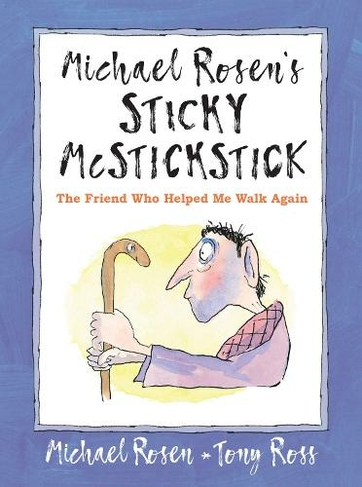
I was in Muswell Hill the other day (flu jab) and took the chance to do some shopping (you know, Muswell cheese shop, M&S etc). I also stopped by the Muswell Hill Children’s Bookshop to get a copy of Michael Rosen latest book (with Tony Ross) Sticky McStickstick.

It’s a book designed for children to help what the left used to call ‘the youth’understand what impact serious illness can have and how you can recover. It’s a slim volume with drawings of Rosen as he recovered from COVID at the Whittington Hospital in North London.

It covers the steps Rosen had to go through to learn to walk again after being immobilised in bed for many weeks. It shows clearly the steps that needed to be taken, including walking unaided, going upstairs and eventually getting about with Sticky McStickstick. If I recall correctly the stick was an Arsenal fan but for some reason this is not mentioned.

It’s a tribute to the NHS and the rehabilitation from illness it, specialist NHS staff that is, can provide.

Its of course easy to read but if you want a guide on rehabilitation after illness I’d warrant it’s a lot clearer than a 50 slide power point presentation. So useful for children and adults.

Is there any way that much of a divide between good writing for children and adults, in the sense that clarity of expression and engagement is key?

I’m afraid that Michael Rosen, as drawn by Tony Ross, only has stubble in the book. The beard had to go for essential medical reasons. Follicles will grow back of course and they did, with Rosen going on to being named joint Beard of the Year 2020

Articles

The Ambridge Socialist.Mystery Plays start Boxing Day. Who will play God?

In Uncategorized on November 7, 2021 by kmflett

The Ambridge Socialist

7th November

Mystery Plays to start on Boxing Day but who will play God?

Lynda Snell has rewritten the Mystery Plays and they will start on Boxing Day the BBC has reported. Kirsty will return reluctantly as usual as chief organiser and press-ganger of participants. However with the departure of Bert Fry there is a vacancy for God. Does it need to be filled, if as many on the Editorial Board of the Ambridge Socialist think, God doesn’t really exist? The answer may still be yes as Mystery Plays are also part of historical folklore when most did believe in God.

Given its Ambridge it should really be an Archer unless of course the world is going to be turned upside down

The Ambridge Socialist poll

Blake, Sgt Knacker Burns, Kirsty & Philip Moss

Are you keeping up here? A good deal of complex human life is playing out after all. The Sherlock Holmes of Ambridge Sgt Knacker Burns is still on the trail of modern slavers and is trying to get Blake to tell him what he knows about the network behind Philip Moss. Blake is rightly suspicious of police officers but wants Knacker Burns to sort a prison visit with Moss. Blake feels Moss had good intentions which might seem odd given that he used him as slave labour. However previous to that Blake was on the streets so it can be understood, but not sustained. One exploiter might be more pleasant than another but exploiters they are

In other news

Lilian is still giving up smoking

Lynda plans to accept her MBE. This is ill advised

Natasha isn’t happy about Summer Orchard becoming part of Archers Dynasty plc at Bridge Farm. Realistically she will have no choice. That’s why it’s called the Archers

Articles

A day of action and protest & climate change but campaigning needs to be stepped up & broadened

In Uncategorized on November 6, 2021 by kmflett

A day of action & protest on climate change but campaigning needs to be stepped up & broadened

Saturday saw a range of actions around COP26. The media has some reports although the idea that ordinary people and extra-Parliamentary activity have a key role to play in politics doesn’t come easily to many media outlets.

The main protest was in (a wet) Glasgow where COP is being held. Organisers reported around 100,000 people which is a very large protest indeed against the size of the population even allowing for some that came from elsewhere.

Three thousand marched in Cardiff (which was less wet) which again for the Welsh capital is a very big march.

I was in London and started by attending a local climate rally in Haringey which heard from local MPs David Lammy and Catherine West as well as a good range of activists. It was also good to see a range of banners from environmental and green groups to Haringey TUC. David Lammy made a very telling point about the impact of colonisation on people movements around the globe and climate change and there was also a clear focus on local campaigns on climate issues.

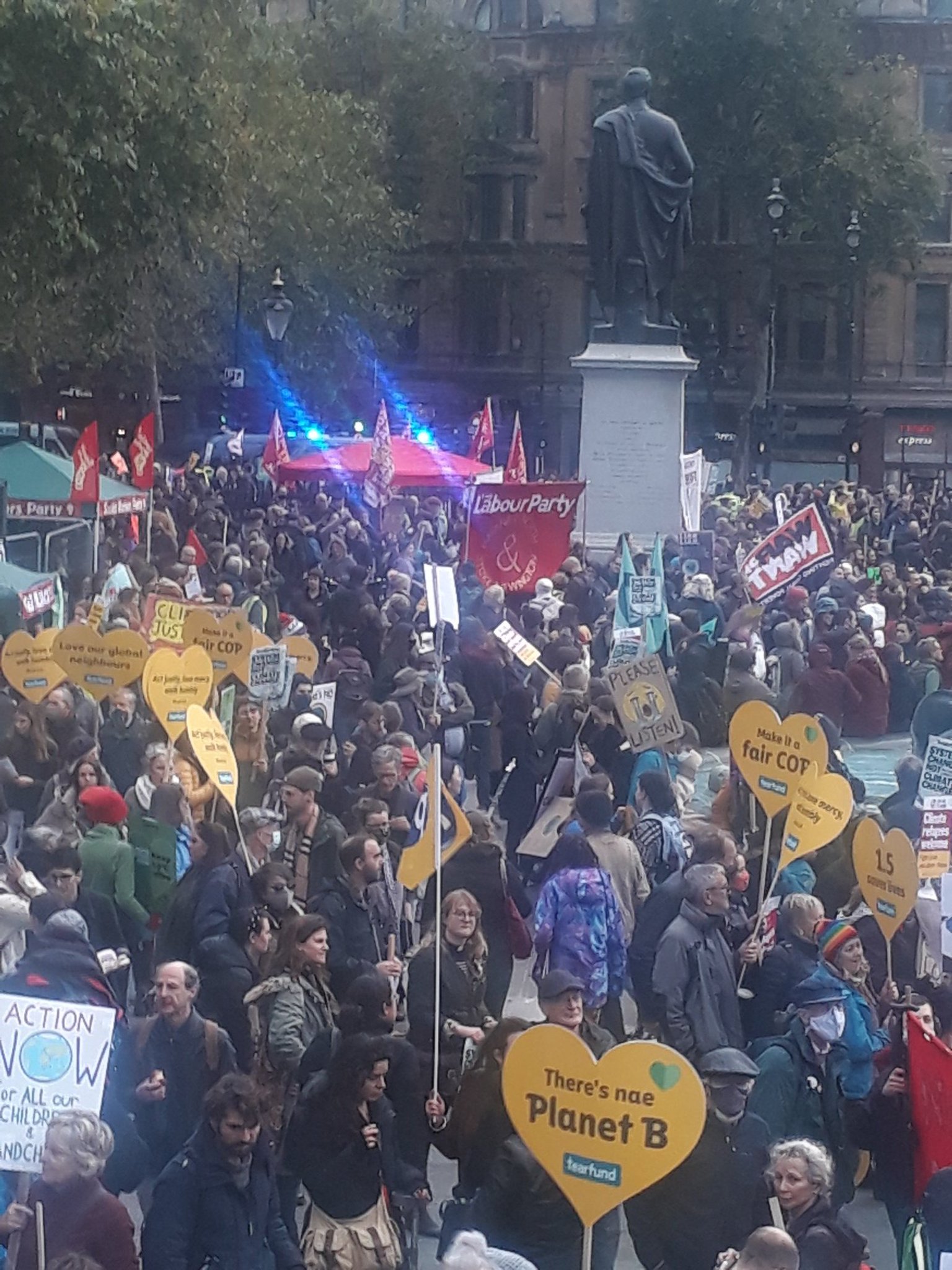
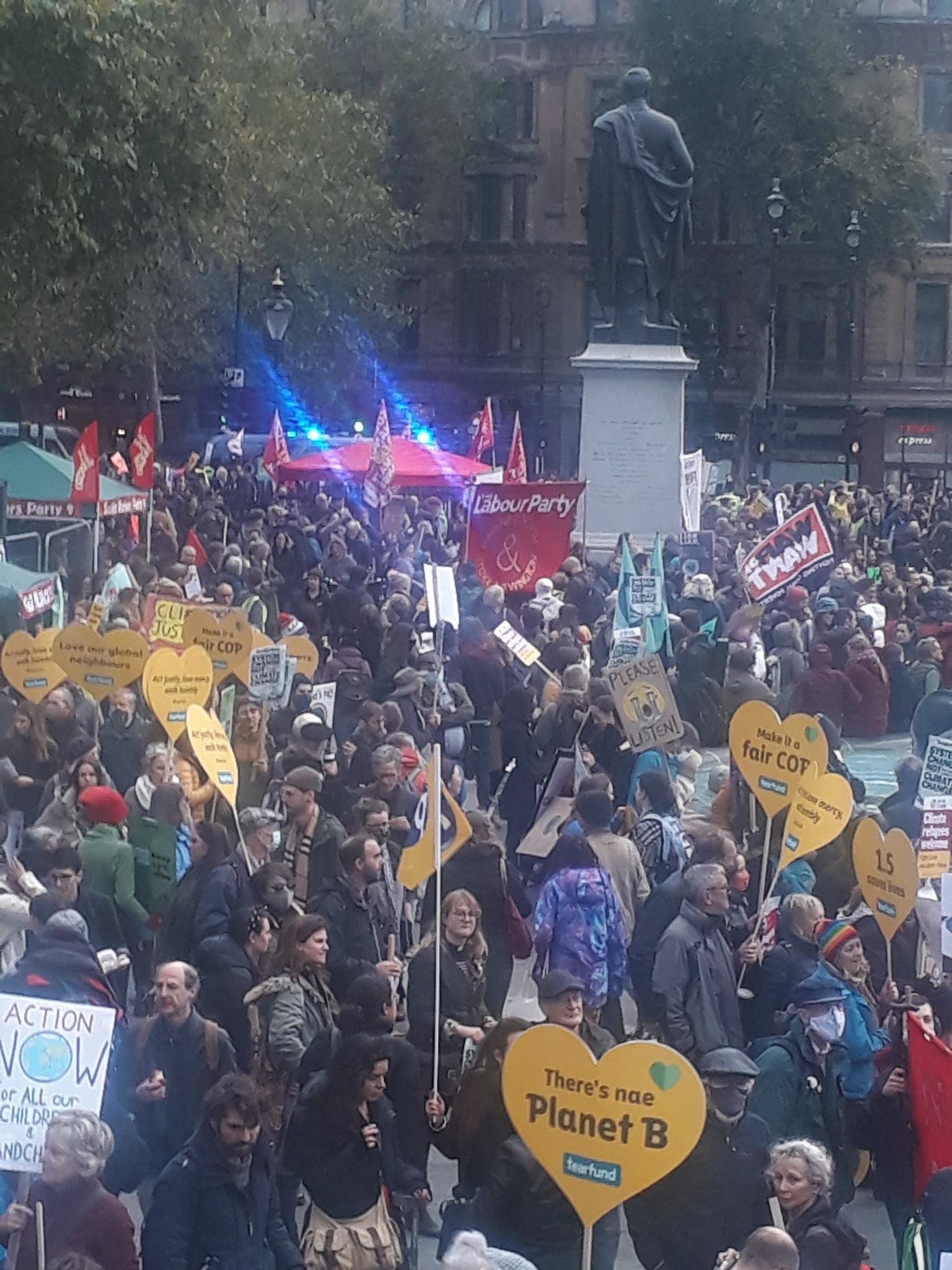
I then headed off to the central London protest which ended in Trafalgar Square. There were screens on the plinth which had the impact of a 2020s campaign rather than just lots of speakers (tho there were those too).

The Square was packed so a protest of twenty thousand plus was there with a good mix of young and old. Some of what I suppose might be called the old left are now very old (that is even older than me) but the welcome impact of Stand Up to Racism and refugee campaigners put things very much in the present day.

As often on these occasions there is work to do in not just broadening but mobilising support. I spotted only one Labour Party banner (Hackney North) and a handful of trade union ones. Of course there is formal support for action on climate change but that needs turning into people coming out to protest.

A Saturday afternoon in a very busy central London may not be for everyone just now (and I think these were across the UK the biggest protests since March 2020) which is why organising locally at the grassroots in workplaces and communities while keeping a national and international perspective in mind.

Whatever does or does not come out of COP26 today’s protests show the potential for protest from below to mobilise on climate change.

Articles

Stop Shaving to reduce carbon impact say campaigners

In Uncategorized on November 6, 2021 by kmflett

Beard Liberation Front

Media Release 6th November

Contact Keith Flett 07803 167266

STOP SHAVING TO REDUCE CARBON IMPACT SAY CAMPAIGNERS

The Beard Liberation Front, the informal network of beard wearers, has said called on clean shaven Tory Chancellor Rishi Sunak to take the chance to be innovative on COP26 and announce a luxury tax on shaving.

The campaigners say that while there has been a significant growth in beards, in reality they still represent a minority in the country compared to the clean shaven.

The BLF says that shaving is environmentally unfriendly and a Shaving Tax would do a good deal to address carbon reduction targets by reducing use of electric shavers and power used to make shaving products.

Those currently employed in the shaving industry can easily be re-deployed into the beard care area of the economy, a growing sector.

A Shaving Tax could be levied at £100 a year for all those who did not have a beard at the beginning of the financial year- April 1st. It would hit popular targets such as clean-shaven bankers in the City who would have to grow a beard or pay up.

BLF Organiser Keith Flett said, Rishi Sunak remains resolutely clean shaven but he can boost his popularity and the Exchequer’s finances considerably by implementing an innovative Shaving Tax.

Articles

Newport 4th November 1839: 22 Chartists demanding the vote shot dead by the army

In Uncategorized on November 6, 2021 by kmflett

Newport 4th November 1839: 22 Chartists demanding the vote shot dead by the army

It was 182 years on 4th November since the Newport Rising in South Wales.

The events of that day may have had a revolutionary character but the specific aim was clear. The Chartists were after the kind of political democracy- adult suffrage and secret ballots- that we take for granted now, up to a point. They had tried petitioning Parliament, they had tried a General Strike in August 1839 (National Holiday]. They had been ignored. The resort to arms was a last attempt.

The traditional histories note that male (and some female] Chartists marched from a number of mining areas outside of Newport such as Merthyr and Pontypool with the aim of rallying in the town itself.

As many as 9,000 Chartists gathered on the Saturday and Sunday 2nd and 3rd November 1839 before marching into Newport early on the Monday morning of 4th November. In the days before the telephone let alone social media, to co-ordinate a series of marches, some miles in distance, to arrive at the same time was problematic. Probably around 5,000 Chartists had rallied near Tredegar House on the outskirts of Newport on the Monday morning ready for the final push on the town centre.

Many were armed, some with guns other with pikes and clubs. Certainly numbers had visited pubs on the march in- hardly surprisingly given the time taken and the weather- and it hardly amounted to a revolutionary army. Even so their thousands far outnumbered anything the authorities could muster.

What exactly the plan was is disputed. It may have been to liberate the occupants of the Workhouse on Stow Hill and some Chartists that were held there and then to move on to Monmouth to free the jailed Chartist leader Henry Vincent.

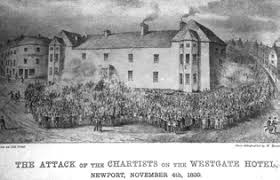
In practice they marched to the bottom of Stow Hill and encountered the British Army at the Westgate Hotel in the centre of Newport. There was a confrontation and numbers of Chartists were left dead, 22 is the most recent estimate, with many more seriously wounded. Numbers were arrested and sentenced to prison. A few leaders such as John Frost, originally sentenced to be hung, drawn and quartered were despatched to Australia. They were later pardoned. A few escaped altogether.

One perspective is that the Chartists were no match for the forces of the British State and that the whole thing was a disaster.

Well, not quite.

In fact the Chartists were much better organised and led than the traditional histories suggest. They were shot down too not by a regular army unit but by a detachment of the crack regiment of the British Army at the time, the 45th, sent to do a particular job. Soldiers from the same regiment had shot down rebels at the Battle of Bossenden Wood in Kent in 1838.

Amongst the Chartist leaders on the day was someone known as Jack the Fifer [John Rees] who had fought at the Alamo with the Free Texan Army in 1835 and so had revolutionary military experience.

Moreover the Newport Chartists did not act alone. Their rising was to be the signal for other Chartists around the UK to do the same.

Clearly tactical mistakes were made. Leaving aside whether many of those who participated in the march in Newport understood exactly what was planned and what opposition they might meet, it must be questioned why it was necessary to confront the 45th Regiment in the Westgate Hotel when they did.

The Chartists easily had the numbers to occupy and control Newport in the face of which a small number of even crack troops could have done little.

It was not to be, but the problem lay with tactics and strategy not support.

The impact of defeat on Welsh Chartism and Chartism more generally is perhaps worthy of further research. The late Malcolm Chase picked up some themes.

Certainly it was to be almost 10 years-in the summer of 1848 and in the Year of Revolutions that further attempts at armed revolt were to take place, for example in Bradford in June and London in August.

Again however the conspiratorial model of organisation was foremost and the results arguably all too predictable.

My wider thoughts on models of revolution and Newport 1839 are here:

Articles

Mon 15th Nov 5.30pm. Merilyn Moos on Anti-Nazi Exiles, German Socialists in Britain 1933-45

In Uncategorized on November 6, 2021 by kmflett

Monday Nov 15th 5.30pm Merilyn Moos ‘German Socialists in Britain and their Shifting Alliances 1933-1945’

organised by the London Socialist Historians Group

Register for the seminar here:

https://www.history.ac.uk/events/anti-nazi-germans-1933-45

Merilyn Moos will introduce her 3 books celebrating the lives and struggles of left-wing Germans who opposed the Nazis from exile. These may be freely downloaded at this link:

http://londonsocialisthistorians.blogspot.com/2021/10/upcoming-lshg-seminars.html

Anti-Nazi Exiles German Socialists in Britain and their Shifting Alliances 1933-1945

by Merilyn Moos  

Hans Jahn  Biography of an Anti-Nazi Trade Unionist

by Merilyn Moos 

German Anti-Nazis and the British Empire The Special Operations Executive, Deserters from the German Army and Partisan Movements in Occupied Europe

by Merilyn Moos  

The refugees Merilyn will be discussing almost all fled Germany as political activists, most from a working class background. They risked their lives again and again in Germany, often escaped arrest and probable death without knowing where they would end up.

Most survived. But, once in Britain, organising an anti-Nazi struggle became very difficult and there was much disagreement as to the best means. Merilyn will examine the details of a few of these refugees. One example is Hans Jahn, President of the German Railway Union. Faced with the Nazis’ attempt to break working class organisations, he tried to organise anti-Nazi resistance amongst railway workers, even when, later, he was exiled here. He  was to say that “one of the greatest tragedies is that German unions did not fight to prevent Hitler taking power in 1933”.

More ferociously anti-Nazi than many at the time in the UK, some anti-Nazi German exiles risked their lives all over again in an often uneasy alliance with sections of the British military. Some worked with SOE. A small group, almost all of whom had fought in Spain, fled to France and then were sent by the French Government to camps in Algeria. They also ‘volunteered’ to fight with the British. Thousands of Germans were conscripted into the 999 ‘Death battalions’, a sub-section of the Wehrmacht, made up largely of political prisoners. Many of them either deserted to the partisans in Greece or clandestinely supported them. Upon the partisans’ defeat, a few of the German deserters escaped to Albania and supported their partisans. The tensions within British policy between being anti-fascist and pro-imperialist, are sharply exposed during the Greek civil war when the German deserters who first were fighting with the partisans  alongside the British against the Nazi forces, then fought with the partisans against the British.

It is a good time for such stories of courage and resistance to be heard.

Articles

Commons motion on racism in cricket, 8th March 2021. Nothing was done

In Uncategorized on November 5, 2021 by kmflett

Commons motion on racism in cricket, 8th March 2021. Nothing was done

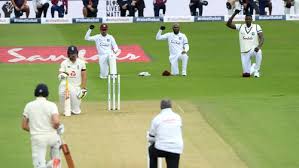
On 8th March 2021 12 MPs tabled an EDM on racism in cricket. Such motions are simply a way of raising an issue.

Even so the issue was very real and nothing was done. Yorkshire cricket club have spent much time and resource trying to cover up the findings of an investigation into racist behaviour at the club. Ultimately they failed and the issue is now headline news.

They could of course have taken robust action to deal with the issue, but they didn’t, and until now neither did the governing body of cricket the ECB. There are a lot of anti-racist cricketers and cricket fans. Its time their voices were not only heard but acted on

That this House expresses its serious concern at the underrepresentation of African, Caribbean and Asian coaches, umpires and match officials at all levels of Cricket in England and Wales; recalls the 1997 report Racial Equality in Cricket by the Cricket Board of England and Wales, which promised to tackle racism in cricket; expresses its alarm at the subsequent failure to address the institutional racism that is present at all levels of the game; condemns the failure of the English Cricket Board to appoint any African, Caribbean and Asian umpires and match officials to such panel positions in the last 29 years; deplores the bullying, racial harassment and victimisation suffered by African, Caribbean and Asian, players, umpires and coaches within first class cricket; welcomes the establishment of the Asian Cricket Association to promote the careers, training, and development of Asian cricketers and professionals in the game; calls upon the English and Wales Cricket Board to support and fully fund African, Caribbean and Asian Cricket Associations to remedy the historical injustice of race discrimination that has excluded ethnic minority cricket players, umpires, coaches, managers, and teams from reaching their true potential and position in the game; and urges the Secretary of State for Digital, Culture, Media and Sport to make anti-racism and equality and diversity targets within cricket a ministerial priority, and to report annually on the progress being made.

https://edm.parliament.uk/early-day-motion/58224

Articles

Warning on Guy Fawkes Night fear of beards

In Uncategorized on November 5, 2021 by kmflett

Beard Liberation Front

PRESS RELEASE   5th November

Contact Keith Flett     07803 167266

GUY FAWKES NIGHT IS ALL ABOUT A FEAR OF BEARDS

The Beard Liberation Front, the informal network of beard wearers, has warned of Guy Fawkes pogonophobia as the 5th November is marked.

Pogonophobia is the ancient Greek for an irrational fear or hatred of facial hair, known as beardism in modern English.

The BLF says that the period around November 5th is the traditional highlight of the pogonophobes year as, in other times, they burn an effigy of what they assume to be a dangerous radical figure with a beard, although few will openly discuss their often deep-rooted concerns about beard wearers

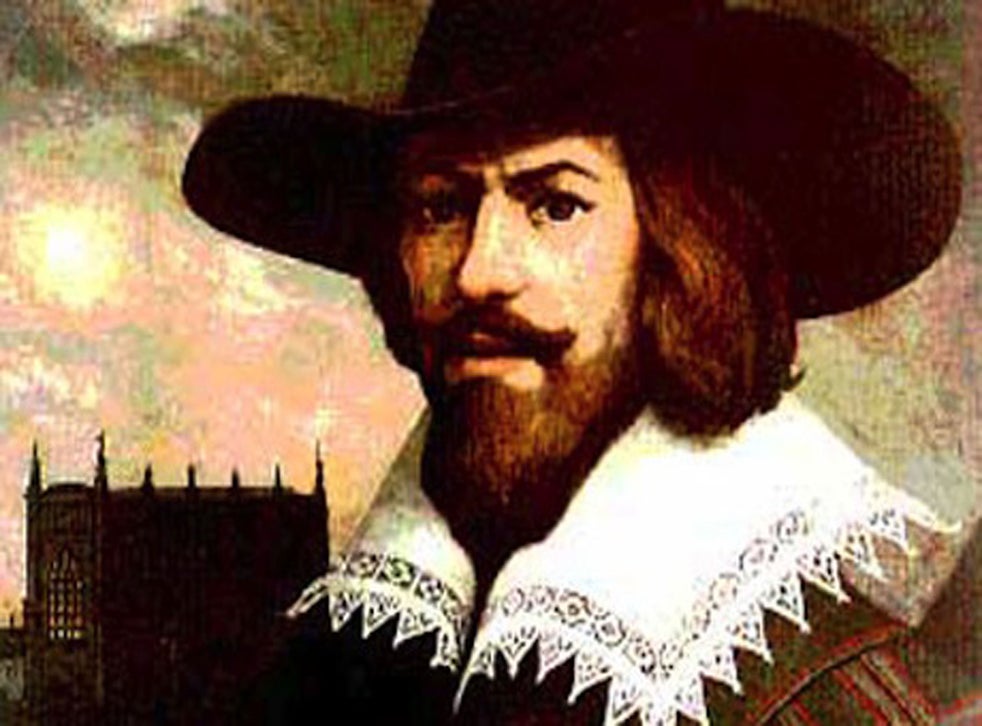
BLF Organiser Keith Flett said the irony is that Guy Fawkes was a deeply reactionary character who, had he lived now, would almost certainly not have had a beard under any circumstances

The BLF is calling on people having Guy Fawkes bonfires not to burn effigies with outlandish beards and to discourage pogonophobic remarks and behaviour. The group says that there is some evidence that beard burning bonfires have been in decline with events to mark 5th November often confined to fireworks only and welcome this positive development.