Cecil Rhodes Must Fall, the Muswell Hill angle
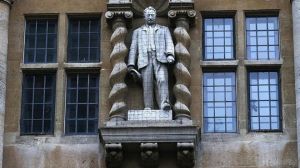
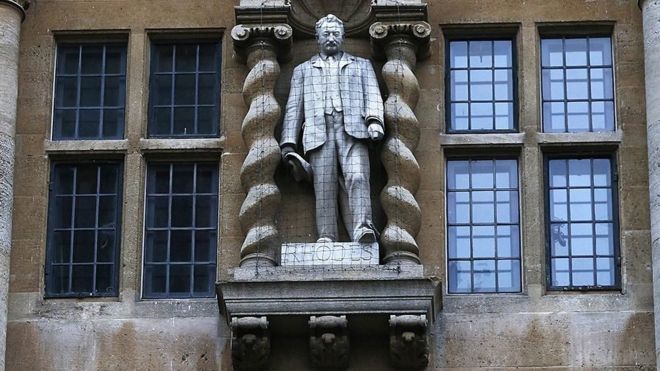
Protests demanding the removal (to a museum) of the statue of Cecil Rhodes at Oriel College Oxford are continuing.
https://www.bbc.co.uk/news/uk-england-oxfordshire-52975687
The post below dates from 2016 but remains relevant. Since then a new statue of Oliver Tambo has been unveiled. It is surely time now for Rhodes Avenue to be renamed Tambo Walk
https://www.haringey.gov.uk/news/statue-anti-apartheid-campaigner-oliver-tambo-unveiled-haringey
Discussion about the statue of British born imperialist Cecil Rhodes at Oxford University and what should be done about it, if anything, continues.
Statues surely exist to be taken down but most often in the context of wider movements for social change. Otherwise one might think that a statue of Rhodes serves to remind us of Britain’s inglorious imperial past. It is undoubtedly something that David Cameron would prefer us to forget, assuming he ever knew much about it in the first place.
Cecil Rhodes was the son of a Bishops Stortford vicar who packed him off to South Africa at the age of 17 as he had been a sickly child. The thought was that the South African climate would be good for the young Rhodes health, and this at least was correct.
The predecessors of Rhodes’ father, Francis William Rhodes had been brick manufacturers. They were in short part of the industrial class that built early British capitalism, if you like, from the bottom up.
They owned substantial areas of land including some in North London such as Tottenham Wood and areas of Muswell Hill.
The Rhodes in Rhodes Avenue N22 refers to Thomas who was Cecil Rhodes great uncle
I went to school in the same area of North London in the 1970s at Alexandra Park Comprehensive School. It was a school with a left-wing reputation, although perhaps not quite as well known as the nearby Creighton School where the head teacher was Molly Hattersley, at that time the distinguished partner of Roy Hattersley.
Alexandra Park School was on the corner of Alexandra Park Road and Rhodes Avenue, London, N10.
Of course this being North London in the 1970s we knew well enough who Cecil Rhodes was and the role he had played in the development of British imperial endeavour in Africa. But we thought little of the matter beyond that.
Rhodes Avenue was however named to mark the land ownership that the Rhodes family had had in Muswell Hill. Cecil Road is nearby.
Street names that recall Britain’s imperial past are hardly unusual though.
Sometimes however truth is stranger than fiction.
The African National Congress had emerged as the leading force opposing the apartheid South Africa that Cecil Rhodes had helped to lay the foundations of.
One of the leaders of the ANC was Oliver Tambo who fled South Africa in the early 1960s partly to evade arrest by the apartheid Government but primarily to make sure that the work of the ANC could continue in exile.
In due course he made his way to London, the centre of the old imperial power.
Money was short but Muswell Hill at that time was not the area of super expensive property it now is.
Tambo and his wife lived in a house in Alexandra Park Road, N10 with other ANC sympathisers living nearby.
His house was just several blocks and less than 5 minutes walk away from Rhodes Avenue.
As the struggle against apartheid intensified and Tambo became an international figure, Nelson Mandela visited Muswell Hill and the local Tottenham MP Bernie Grant was also a visitor.
After Tambo’s death in 1993 the story of his North London years became increasing well known. In 2007 a bust of Tambo was erected on Albert Rd recreation ground N10 again just a few minutes walk from his old home and from Rhodes Avenue.
Imperialism and the man that helped to end its rule in South Africa are marked within a few hundred yards of each other in Muswell Hill.
Whatever the fate of the Oxford Cecil Rhodes statue, the bust of Oliver Tambo continues to stand proud.
This post appears in the Morning Star 1st February 2016
http://www.morningstaronline.co.uk/a-caad-A-tale-of-two-statues