Articles

The Ambridge Socialist: What will the Ambridge Boxing Day Hunt discover?

In Uncategorized on December 26, 2019 by kmflett

The Ambridge Socialist

The real Borsetshire Echo: over 60 years of class struggle in Ambridge

Boxing Day 2019 CONTACT KEITH FLETT 07803 167266

What will the Ambridge Boxing Day Hunt discover?

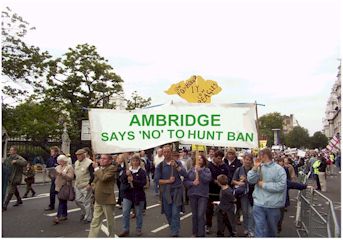
The BBC’s focus is likely to be elsewhere, well away from the seasonal event of real importance in Ambridge- the Boxing Day hunt.

For some years the South Borsetshire Hunt was led by patrician Oliver Sterling but this important job in the ruling class structure of the County is now with horse lover Shula Archer.

The hounds may discover other things of interest beside the *not a fox* they are of course hunting. They may for example find the whereabouts of the bunting that PC ‘Knacker’ Burns has long since given up on locating. They may also find the remains of at least some of the badgers that David Archer has murdered during the year.

Ambridge Socialist Editor Keith Flett said, we expect a report in the Daily Telegraph later in the week about how the Hunt got on. We are less sure the BBC will cover it. We don’t mind hunting providing Tories are the subject of course.

In Other News

The Ambridge Socialist wishes all readers a Happy New Year. Our next issue will feature our socialist analysis of developments in Ambridge in 2020

@kmflett for updates

Thanks to Hazel Potter for material in earlier versions of the Ambridge Socialist Boxing Day issue

Articles

Marx to Engels (in Manchester)25th Dec 1857 ‘I trust you wont go out tippling too much..’

In Uncategorized on December 25, 2019 by kmflett

Marx in London and Engels in Manchester were frequent correspondents.

Marx wrote to Engels on 25th December 1857 (in part)

I trust you won’t go out tippling too much during the holiday and these exciting times in Manchester and that you’ll pay due attention to your health. Warmest regards to Lupus.

The full text of the letter is below. Lupus refers to a co-thinker of Marx and Engels Wilhlem Wolff (1809-1864)

https://marxists.catbull.com/archive/marx/works/1857/letters/57_12_25.htm

Articles

Tony Benn & Christmas postage stamps

In Uncategorized on December 25, 2019 by kmflett

Tony Benn & Christmas postage stamps

I’ve written a handful of Christmas cards this year which I mostly hand delivered in person. I received a handful in the post.

15 years ago before the rise of social media I, and I’m sure others, received quite large numbers of cards.

Christmas has been and no doubt to some extent still is, the busiest time for the Royal Mail dating back to the 1840s.

What is less well known is Tony Benn’s role in making sure that the then Post Office produced special Christmas stamps.

Benn was Postmaster General for a period in the 1964-70 Labour Governments and had to overcome considerable resistance to get the stamps introduced.

He records in his diary for 1st February 1966,

I talked to Downes about the Post Office Christmas card. He had put in an absolute negative in the best Postal Services Department fashion. He came in grim faced and I talked him out of it. We will have a card with a Christmas stamp and simple greetings selling at 6d.

The focus however was on the stamps. On Friday May 13th 1966 Benn wrote

I have decided to go ahead with the children’s competition for the Christmas stamp, even though the local authorities are opposed to it. It will give us an idea of the sort of quality you might expect from children.

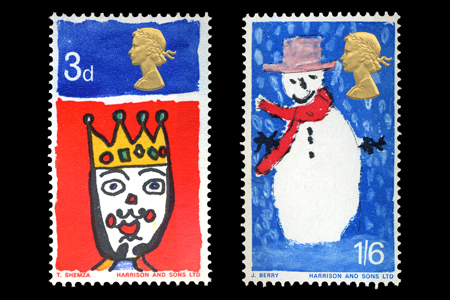
Benn, through the Post Office, organised a competition among schoolchildren aged under 15.  The competition was launched on Blue Peter, which at the time received viewing figures of around 8 million twice a week. Response to the competition was huge.  Over 5,000 designs were submitted which were assessed by a team of eight professional stamp designers.  These first British Christmas stamps featured a design by Tasveer Shemza (of King Wenceslas) and James Berry (Snowman).

https://blog.westminstercollection.com/tag/tony-benn/

Articles

When Christmas was banned (1644-1660)

In Uncategorized on December 25, 2019 by kmflett

From 1644 until 1660 the celebration of Christmas was officially banned in England.

The reasoning of Puritans and Cromwell’s Parliamentarians for this, as well as Catholic opposition to it, is important but for further posts. Below is an edited summary of what the ban meant in practice.

The words are written by Keith Down of the Royal Armouries Museum in Leeds and a link to the full text is here:

https://www.historyanswers.co.uk/medieval-renaissance/how-cromwells-christmas-ban-was-enforced-or-not/

Christmas was banned in Britain by a 1644 Act of Parliament, with the Long Parliament of 1647 passing a law which officially abolished the feast of Christmas making its celebration punishable. The ban remained in place until the restoration of the monarchy in 1660.

Puritans wanted Christmas Day to be a day of fasting and humility, but otherwise a normal working day – not a Feast or Holy day as it had been in the past. Indeed, MPs sat in Parliament on Christmas Day 1643 as though it was any other day of the year. Such measures were not uniformly popular, even in Parliamentarian-dominated London. That same Christmas, for example,  some angry Londoners keen to follow the old traditions of Christmas, attacked shops that opened.

In January 1645 Parliament set up a New Directory of Public Worship which stated that there were to be no Holy Days apart from Sunday. In June 1647 Parliament passed an ordinance which confirmed the abolition of Christmas, Easter and Whitsun and during the 1650s (during the Commonwealth) legislation put in place penalties on those found attending special Christmas church services, or for closing their businesses for the day. In 1657 the Council of State urged the mayor of London to clamp down on celebrations.

Enforcement of the legislation was another matter, whilst some church ministers were arrested in 1647 for preaching Christmas sermons, many people continued to celebrate the season despite Parliament’s official position. The fact that Parliament had to keep issuing proclamations against Christmas throughout the 1650s shows that, until later on in the decade, many people ignored the prohibition.

Royalists saw the victorious Parliamentarians as ‘killing off’ Christmas. One Royalist ballad of 1645 complained that “Christmas was killed at Naseby fight” – a reference to a major Royalist defeat by Parliamentary forces at the battle of Naseby on 14 June 1645. Royalist clergymen also engaged in writing pamphlets defending the celebration of Christmas and the importance of passing on these traditions to the young.

At Christmas in 1647 in Canterbury the town crier had proclaimed the committee’s commitment to the suppression of Christmas. In response a large crowd gathered to demand the usual traditions be observed. Eventually a riot broke out, forcing the mayor and several magistrates and clergymen out of the town. A few months later Kent rose in revolt in the name of King Charles I. Christmas also remained particularly popular among England’s community of Catholics or ‘Recusants’, who regarded the celebration of Christmas and devotion to the Virgin Mary as essential tenets of the faith.

Christmas traditions really stayed the same from the Middle Ages and throughout the Civil Wars. In many ways, we still observe them today. Despite the official ban many still decorated their homes and doorways with holly, bay, ivy and rosemary. People gave gifts especially to the young and the poor, attended church services, feasted and drank copious amounts of alcohol –  including ‘wassailing’ which involved going from door to door singing and drinking from a communal wassail bowl whilst wishing people good health.

Carol singing was an important part of Christmas and some MPs complained that their neighbour’s preparations for Christmas had disturbed their sleep. Mince pies (made with real minced beef) were eaten, as was plum pudding. Morris dancing was another feature of Christmas, as was gambling. As I mentioned previously, Catholics were particularly attached to Christmas and were known for their great Christmas festivities. Some Catholics may have attended illegal Catholic masses in the homes of wealthy Catholic gentry and nobility – one aspect of the Christmas tradition they would have had to have kept secret from the authorities.

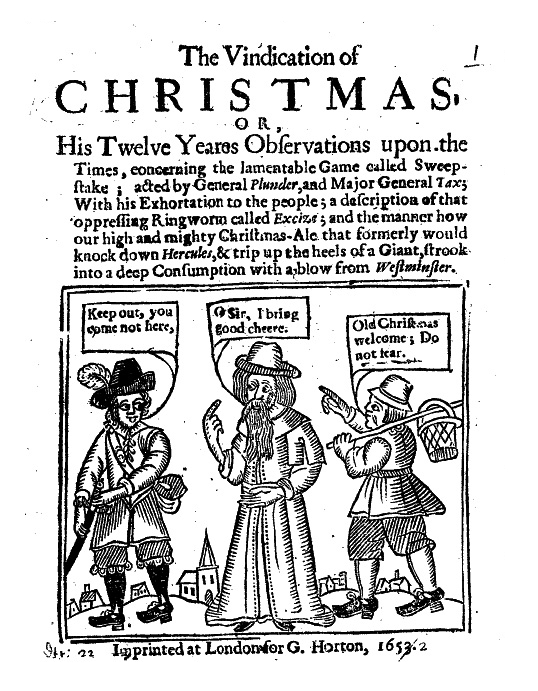
‘Sir Christemas’ had appeared in song in the 15th century, but certainly in the 17th century the personification of Old Father Christmas served as a means of defending the season from Puritans, after all people can generally relate much better to and empathise more towards a person than an idea. In the 1652 ‘Vindication of Christmas’ published by the Royalist John Taylor, a bearded ‘Father Christmas’ defends himself as only bringing “good cheere”

In 1658 Josiah King published ‘The Examination and Tryall of Old Father Christmas’ in which ‘Christmas’ is depicted as a white-haired old man on trial for his life – certainly a deliberately sympathetic image, and naturally ‘the jury’ acquits him. I’m not sure when Christmas is first depicted as an old man, but certainly by the late 16th century.


Articles

Michael Eavis & Michael Rosen feature on Beard of the Decade list

In Uncategorized on December 25, 2019 by kmflett

Beard Liberation Front

Media Release

25th December

Contact: Keith Flett 07803 167266

Michael Eavis & Michael Rosen feature on Beard of the Decade list

The Beard Liberation Front, the informal network of beard wearers, has opened an on-line poll for the Beard of the Decade.

When the poll was last run, ten years ago, Glastonbury founder Michael Eavis beat Fidel Castro. He is the only person to feature on both lists.

The campaigners say that the criteria for the Beard of the Decade list is that the individual has worn a beard consistently over the last 10 years and has had a significant positive impact in the public eye.

BLF Organiser Keith Flett said, of course the list cant be comprehensive but we have tried to have a representative list of the most distinguished beard wearers of the last decade.

The vote is open now and will close at midday on January 1st with the winner declared on 2nd January

The winner of the Beard of the Year 2019 is announced on 28th December

Beard of the Decade

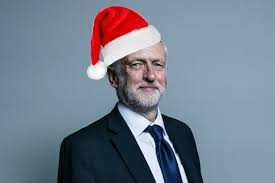
Jeremy Corbyn

Brian Blessed

Michael Rosen

Moeen Ali

Idris Elba

Michael Eavis

Billy Bragg

Robert Plant

Lennie Henry

Mark Gatiss

Roger Protz

Ted Kelsey

Articles

Important Christmas Eve Guidelines on Genuine Santas

In Uncategorized on December 24, 2019 by kmflett

CAMPAIGN FOR REAL SANTAS

Organised by the Beard Liberation Front

24th December

IMPORTANT CHRISTMAS EVE GUIDELINES ON GENUINE SANTAS

The Campaign for Real Santas, which campaigns for Santas to have genuine organic or knitted beards, has said that Christmas Eve is the peak time for Santas who do not have genuine beards and hence fail the real Santa test.

The Campaign has issued special Christmas Eve guidelines so that if Santa is spotted it is easy to tell if they are genuine or an imposter.

HOW TO SPOT A GENUINE SANTA

1 Tug the beard of the Santa. If it comes away, then the Santa is FAKE

2 Tug the beard of the Santa again. If the Santa swears then they are genuine. If they simply repeat a ‘ho ho ho’ mantra they are FAKE

3 The Campaign for Real Santas says that genuine Santas must have just the right mix of bonhomie and gruffness and a real organic beard, particularly when delivering presents on Christmas Eve

CFRS organiser Keith Flett said, we know that most Santas with absurd false beards are genuinely trying to help and only a fairly small minority are drunk. However it is important to maintain a key part of the Christmas story, namely that Santa has a real beard. We would urge people to check tonight if they do spot Santa.

Articles

The Origins of Santa’s beard

In Uncategorized on December 24, 2019 by kmflett

The origins of Santa’s beard

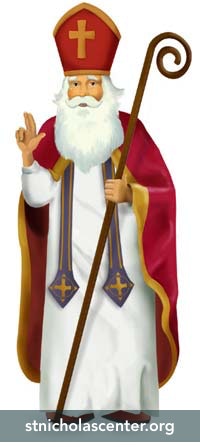
Aside from reindeer, and a red cloak, the one thing usually associated with Santa is a long white beard.

In 2019 the beard is usually fake, but Santa’s beard does have, more or less, factual origins.

The Daily Telegraph noted in 2007:

One can trace the famous growth back to iconic images of Saint Nicholas of Myra (circa 270-343), the primary inspiration for the Christian figure of Father Christmas.

The article goes on to call for Santa to shave his beard off because it is bad for his image underlining that the Telegraph is consistent in its unpleasantly right-wing views.

The commercial image of Santa, promoted by Coca Cola, is based on St Nicholas.

Once delves back into the religious origins of the Santa beard things become distinctly less progressive still.

The Church Mouse has written a useful guide to the theological basis of Santa’s beard:

https://www.premierchristianity.com/Blog/Explained-The-fascinating-theological-reason-why-Santa-has-a-beard

Perhaps in 2019 it is best to stick to a non-religious, non-commercial Santa, who does nevertheless have a genuine beard.


Articles

E P Thompson, radicalism & Christmas: the infant & the emperor

In Uncategorized on December 24, 2019 by kmflett

E P Thompson, radicalism & Christmas: the infant and the emperor

E P Thompson started academic life as someone who wrote about and taught not history but literature.

He published a science fiction novel, the Skyaos Papers and wrote occasional poetry that was eventually collected in one volume by Bloodaxe after his death.

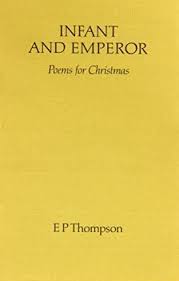
He also produced a slim volume (long out of print) of Christmas related poems, written over the decades, title Infant and Emperor.

I don’t plan to go into a detailed textual deconstruction of the poems but they are interesting both in the sense that they represent something of Thompson’s personal background and how this is reflected in the Making and in the way they also indicate at outline level how Thompson’s political activity fed into his historical concerns.

The title infant and emperor refers to the baby born to Mary and Joseph as a representative of the oppressed masses, while the Emperor is the oppressor Herod. Thompson makes the point in several of the poems that the official church was closer to Herod than the baby and the poems were provoked by various moments of political crisis from Suez in 1956 through to various waves of anti-nuclear campaigning.

While Thompson rejected Methodism (a significant element in The Making) in 1968 he declared himself a Muggletonian Marxist reflecting a millennial world view associated with William Blake about whom Thompson wrote Witness Against the Beast.

The other theme of Infant and Emperor is the prospect of radical change seen in quite dramatic millennial imagery. This was without question part of the world outlook of elements of the early English working class, later pushed to the margins by the more mundane perspectives of labourism and the ability of Methodism to exert control in some working-class communities.

Again Thompson makes the point in the 1963 introduction to the hardback edition of The Making that battles lost in early nineteenth century England might yet be won elsewhere. Or perhaps in late industrial England return and reassert themselves again…

Articles

Scrooge & Boris Johnson: a seasonal historical reflection

In Uncategorized on December 24, 2019 by kmflett

Charles Dickens Christmas Carol & Toryism in 2019
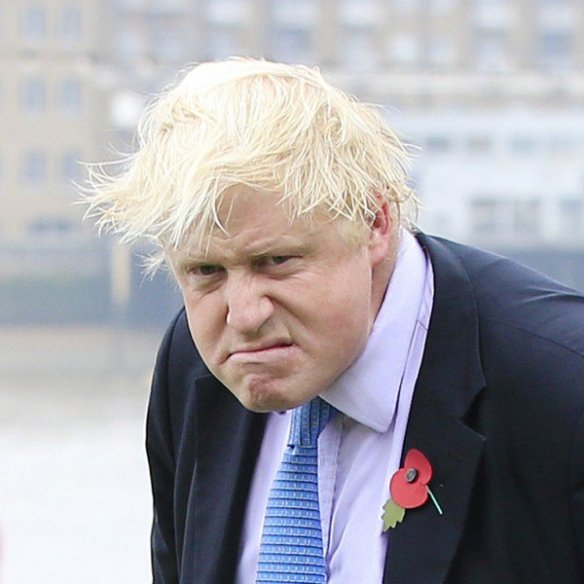
At one of the few TV Election debates Boris Johnson did manage to appear at, Jeremy Corbyn said that he would give Johnson a copy of Charles Dickens Christmas Carol as a Christmas present.

Needless to say this got the Daily Telegraph going. Melanie McDonagh opined that there was nothing socialist about Dickens or about the book in particular. She was certainly right about that but as several comments underlined she had failed to grasp the point Dickens, and indeed Corbyn, was actually making.

It was a point that gained added poignancy in the last days of the Election campaign. A reporter attempted to show Johnson a picture of an unfortunate child who was sleeping on a floor at Leeds General Hospital overnight due to a bed shortage. Instead of looking at the picture and at least empathising, Johnson snatched the reporter’s phone and put it in his pocket.

A Christmas Carol was published as a hardback book shortly before Christmas 1843. The Guardian carried several adverts for it, price £5. While the book was a best seller, it was not aimed at a mass audience. The top weekly wage in 1843, according to Engels in The Condition of the Working Class was £1.30p.

Rather Dickens audience was amongst those he was directly criticising.

His criticism was not of wealth or the making of money as such. Dickens, himself a wealthy man, had no issue with this.

His point was that for those who had wealth, ‘the haves’ there was a certain obligation to the ‘have nots’. He did not advocate expropriation of Scrooge’s money or his business.

Rather a Christmas Carol’s point was that where the well off knew that the less well off were going without they should not ignore it. They should certainly not proclaim as Scrooge does that it is their own fault. Rather they should make sure that where they are directly concerned that provision was made, in this case for a decent Christmas for Scrooge’s clerk and his family.

Before writing the book Dickens had wandered central London and Manchester to see for himself people in dreadful conditions, sleeping rough in makeshift shelters and with not enough to eat. He might, as numbers of well off Victorians did, have shrugged and thought that this was the inevitable reality of a market capitalist society.

He didn’t however

Instead Dickens attacked the Malthusian idea that there is only so much wealth in society and that the poor exist because of that and there is nothing much to be done about it.

We can see the parallels with Johnson’s Leeds hospital incident clearly.

Even if one accepts that Johnson has good intentions towards the NHS, which Star readers myself included would clearly see as far-fetched, the issues of under-funding, under resourcing and under staffing in it can’t be sorted out in a day.

However where there are specific cases of hardship, and where, in this case, they are brought to Johnson’s notice, he has an obligation not to ignore them but to act.

The fact that he didn’t, may mean, if Dickens story is to be followed, that he faces several disturbed nights while three apparitions remind him that there is such a thing as society. If those took the shape of a distinguished chap with a beard, so much the better

Johnson may have won the Election but like Scrooge unless he addresses his own shortcomings, which unlike Scrooge, seems very unlikely, his past actions will continue to haunt him

This post originally appeared in the Morning Star

Articles

Their Christmas & Ours: 24th December, the last day of Advent Austerity

In Uncategorized on December 24, 2019 by kmflett

Their Christmas Eve and Ours: the last day of Advent Austerity

Britain in 2025 may still be a society that is institutionally dominated by the Church of England, the State established Church, but its influence over the daily lives of individuals is much less (at best) than it was in pre-industrial times.

At that time Christmas Eve was the last day of Advent and that had a specific meaning which did not involve opening windows on an Advent calendar.

Advent was a time of dieting prior to the feasting (at least for the rich) that started on Christmas Day and ended on Twelfth Night.

During that time, as Hutton notes in Stations of the Sun, the better off ate ‘soup, stews and fish’ and avoided roast meat and pies.

The poor were invariably less fortunate. Hutton notes a C15th complaint of someone who had to eat during Advent ‘no puddings nor sauce but stinking fish’.

Christmas Eve was meant to be a strict fast when eating meat, cheese and eggs was all banned, prior to the feasting that started on Christmas Day. The poor relied to some extent on the better off to provide a Christmas meal or clubbed together to get one. Records of course invariably record only what the wealthy ate at Christmas not the poor.

Meanwhile at least Christmas Day meant an end to Advent austerity, in the traditional calendar at least.