Articles

Beard Liberation Front wont stand against Beard Friendly Candidates in General Election

In Uncategorized on November 4, 2019 by kmflett

Beard Liberation Front

Press Release

4th November Contact Keith Flett 07803 167266

Beard Liberation Front wont stand against Beard Friendly Candidates in General Election
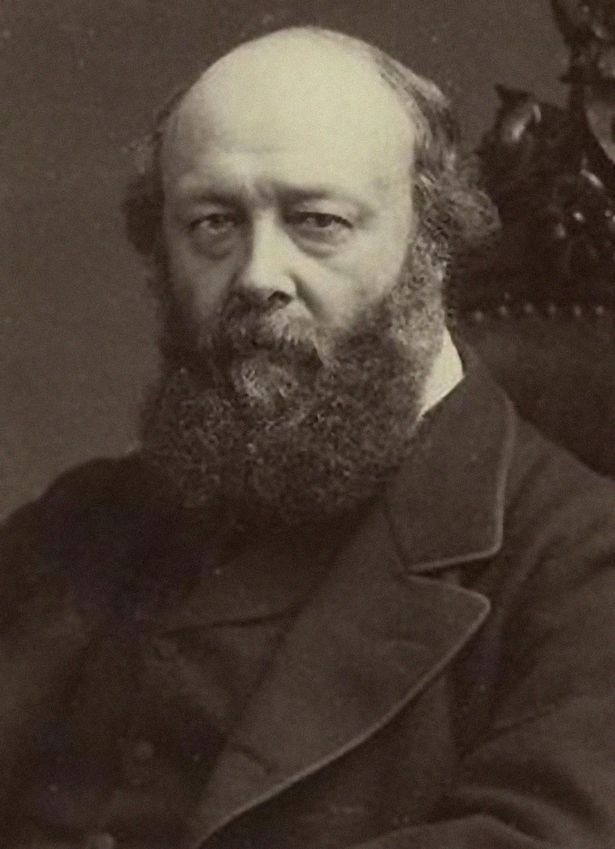
The last Prime Minister with a beard, Lord Salisbury

The Beard Liberation Front, the informal network of beard wearers, has said that while it continues to actively consider whether to stand candidates in the 12th December General Election, at the same time it is consulting on a list of Beard Friendly candidates who it will not stand against and will in all likelihood support.

The campaigners say that they are concerned at the level of pogonophobia in Westminster politics and that far too many MPs are still clean shaven men in suits and that they are determined to make this an Election issue.

BLF Organiser Keith Flett said, by Beard Friendly we mean candidates who have no record of making pogonophobic comments and have a public record of generally be positive about people rather than making unpleasant remarks about any section of society, except the shaving industry,obviously. Wearing a beard is not essential

The Beard Liberation Front is an informal network of beard wearers and welcomes supporters, both women and men, who agree with our core principles.

It is not party political and does not usually stand candidates in Elections. However it is political in a broader sense, as it seeks a less discriminatory and more beard friendly Britain.

Founded in 1995 it campaigns against prejudice and celebrates positive images of the hirsute with an annual Beard of the Year award at the end of December. Beard Week, which focuses on a range of beard related issues, takes place every year in late June.

It has produced an updated version of its Election Manifesto on which it will seek the views of candidates and will publicise those who sign up to its Beard Friendly Charter.

The Beard Friendly Charter (Summary)

No to Beardism and pogonophobic prejudice against the hirsute

More hirsute MPs

More hirsute public employees and monitoring of hirsuteness levels in the senior Civil Service

Promotion of positive public images of the hirsute

No dress codes at work, beyond a requirement for smart appearance for public facing roles

Restrictions on barbers shops
Articles

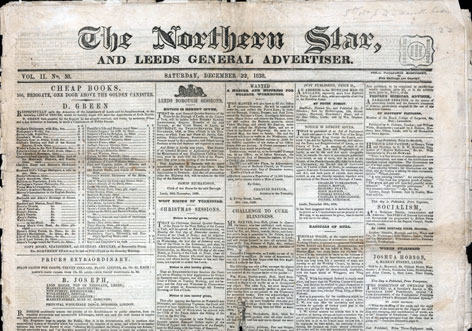
The Welsh Insurrection of 4th November 1839. Northern Star Editorial

In Uncategorized on November 4, 2019 by kmflett

The Welsh Insurrection of 4th November 1839.Northern Star Editorial

The Weekly Chartist paper, the Northern Star reported the Newport Rising in its edition of 9th November and an extract from its Editorial is below.

The Editorial notes that the paper had no direct knowledge of the events which is of interest.

It was based in Leeds in 1839 and certainly did rely on reports from correspondents in the days long before the telephone let alone social media.

Perhaps it didn’t have someone in Newport.

On the other hand since one view of the events of the 4th November 1839 in Newport was that they were meant to spark a national insurrection, perhaps it did, but given the failure decided wisely to claim ignorance.

In this respect the use of the word ‘Insurrection’ is interesting as Newport is commonly referred to as a riot or a rising.


The Northern Star on the Welsh Insurrection of November 1839

Editorial 9th November 1839

…..The time has gone by when any Government can hold possession of the reins of power in this country only by the musket and bayonet. The hearts of the people of this country are full of generosity and kindness. They bear much; bear long and bear patiently; but as the evidence of Newport proves a continued and uninterrupted system of oppression may () them past endurance and, awakening suddenly the recollection of their strength, cause them to exchange the attitude of supplication for that of defiance. It is not a light sense of wrong which has converted the peaceful hills of Cambria into mountain fastnesses of warfare. The grievances that could thus excite the sympathies of a whole population in one movement for redress can have been of no ordinary character…

….to what extent the insurrection has been organised, or how far it may be from being yet subdued, we have no means of knowing; our information having been derived entirely from the London press.. which of course views every object through a jaundiced medium

Articles

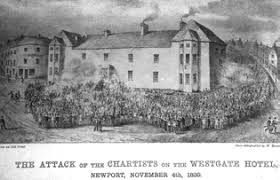
Newport 4th November 1839: 22 Chartists demanding the vote shot dead by the army

In Uncategorized on November 4, 2019 by kmflett

Newport 1839-2019. Results & Prospects

It is 180 years on 4th November since the Newport Rising in South Wales.

The events of that day may have had a revolutionary character but the specific aim was clear. The Chartists were after the kind of political democracy- adult suffrage and secret ballots- that we take for granted now. They had tried petitioning Parliament, they had tried a General Strike in August 1839 (National Holiday]. They had been ignored. The resort to arms was a last attempt.

The traditional histories note that male (and some female] Chartists marched from a number of mining areas outside of Newport such as Merthyr and Pontypool with the aim of rallying in the town itself.

As many as 9,000 Chartists gathered on the Saturday and Sunday 2nd and 3rd November 1839 before marching into Newport early on the Monday morning of 4th November. In the days before the telephone let alone social media, to co-ordinate a series of marches, some miles in distance, to arrive at the same time was problematic. Probably around 5,000 Chartists had rallied near Tredegar House on the outskirts of Newport on the Monday morning ready for the final push on the town centre.

Many were armed, some with guns other with pikes and clubs. Certainly numbers had visited pubs on the march in- hardly surprisingly given the time taken and the weather- and it hardly amounted to a revolutionary army. Even so their thousands far outnumbered anything the authorities could muster.

What exactly the plan was is disputed. It may have been to liberate the occupants of the Workhouse on Stow Hill and some Chartists that were held there and then to move on to Monmouth to free the jailed Chartist leader Henry Vincent.

In practice they marched to the bottom of Stow Hill and encountered the British Army at the Westgate Hotel in the centre of Newport. There was a confrontation and numbers of Chartists were left dead, 22 is the most recent estimate, with many more seriously wounded. Numbers were arrested and sentenced to prison. A few leaders such as John Frost, originally sentenced to be hung, drawn and quartered were despatched to Australia. They were later pardoned. A few escaped altogether.

The perspective is that the Chartists were no match for the forces of the British State and that the whole thing was a disaster.

Well, not quite.

In fact the Chartists were much better organised and led than the traditional histories suggest. They were shot down too not by a regular army unit but by a detachment of the crack regiment of the British Army at the time, the 45th, sent to do a particular job. Soldiers from the same regiment had shot down rebels at the Battle of Bossenden Wood in Kent in 1838.

Amongst the Chartist leaders on the day was someone known as Jack the Fifer [John Rees] who had fought at the Alamo with the Free Texan Army in 1835 and so had revolutionary military experience.

Moreover the Newport Chartists did not act alone. Their rising was to be the signal for other Chartists around the UK to do the same.


Clearly tactical mistakes were made. Leaving aside whether many of those who participated in the march in Newport understood exactly what was planned and what opposition they might meet, it must be questioned why it was necessary to confront the 45th Regiment in the Westgate Hotel when they did.

The Chartists easily had the numbers to occupy and control Newport in the face of which a small number of even crack troops could have done little.

It was not to be, but the problem lay with tactics and strategy not support.

The impact of defeat on Welsh Chartism and Chartism more generally is perhaps worthy of further research. Malcolm Chase has picked up some themes.

Certainly it was to be almost 10 years-in the summer of 1848 and in the Year of Revolutions that further attempts at armed revolt were to take place, for example in Bradford in June and London in August.

Again however the conspiratorial model of organisation was foremost and the results arguably all too predictable.

My wider thoughts on models of revolution and Newport 1839 are here:

Newport 4th November 1839: could revolution have worked?


Articles

Protest & the Weather: From Newport 1839 to Trump 2019: you do need a weatherman

In Uncategorized on November 3, 2019 by kmflett

Protest & the Weather. From Newport 1839 to Trump 2019: you do need a weatherman

According to Bllly Bragg (Saturday Boy):

And it’s surprising how quick
A little rain can clear the streets

I don’t want or plan to generalise and I’m well aware that the 1917 Russian Revolution took place late in that year when the weather was not at its kindest.

Even so the weather does have an impact on protest in the UK and there is no more relevant time to review the point than the, very wet, Chartist march on Newport in South Wales which ended on 4th November 1839. 180 years ago.

Since protest and the numbers it attracts can be unpredictable so the impact of the weather is to.

The ‘common sense’ on weather on demonstrations in 2019 is that if it is wet (people stay at home) or warm and sunny (people have other things to do on such day) turnout is hit. Hence a dry but overcast day is best.

It would take some considerable research effort to bottom that point out.

We do of course know of occasions when the rain hit protest quite significantly.

It’s worth keeping in mind that while in 2019 we have access to reasonably accurate weather forecasts that was not the case in Victorian Britain.

The Chartist Northern Star newspaper did not have a weather page.

When the Chartists rallied at Kennington Common for the vote on Monday April 10th 1848, they were prevented from crossing the river to demonstrate outside Parliament. On the afternoon of that day there was fighting between Chartists and the police on the south side of Blackfriars Bridge. Or there was until heavy rain caused the Chartists to disperse.

In early November 1839 the Chartists gathered in the South Wales Valleys with the aim of marching to Newport in what history calls the ‘Newport Rising’, in actuality a just about failed attempt at armed revolt. One reason for the failure is thought to have been that several days of heavy rain had rather dampened the spirits and organising ability of those involved.

There was heavy rain as the Chartists marched from Merthyr and Pontypool to rally at Rogerstone outside of Newport on the evening of Sunday 3rd November 1839. It also rained heavily in South Wales on the same evening 180 years on but at least this time we knew it would.

Of course in 2019 clothing that can protect against wet weather is much improved. It was impressive that an estimated 30,000 marched through central London on a mid-October Saturday in an Extinction Rebellion Climate Emergency protest. That said the numbers would surely have been larger without the rain. And the reality is unfortunately that wet weather protests make less impact as they look as much like a lot of people who have become wet and bedraggled rather than the militant protest they actually are.

If we can grapple with climate change extreme weather events will decline so protesting to secure the future of protest makes particular sense. Unlike the Chartists we can also at least be glad we have, in the meantime, weather forecasts.

Articles

Farage sends message to Brexit Party Election candidates: I’ll be supporting you(from the saloon bar)

In Uncategorized on November 3, 2019 by kmflett

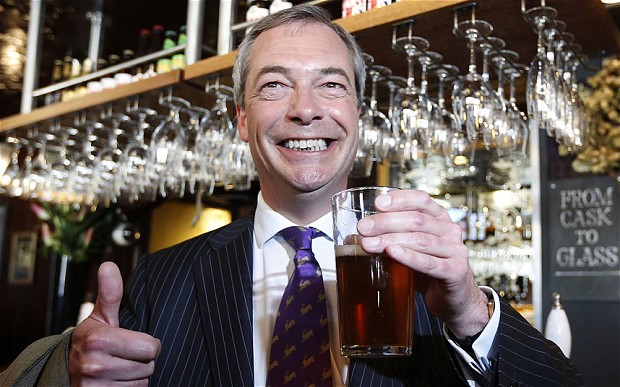
Nigel Farage, who has an unparalleled record of  UK domestic electoral failure has told the BBC he will not stand in the 12th December General Election:

https://www.bbc.co.uk/news/election-2019-50280848

There is indeed as Dylan noted,no success like failure.

The media dutifully note down and report straight whatever Farage says, so the line is he’ll be supporting Brexit Party candidates around the UK (if they stand).

We might consider an alternative reality (Wetherspoons Xmas offering start from 13th November).

Farage is known to enjoy a good lunch and the run up to Christmas is a peak time for such things.

Perhaps he will support Brexit Party candidates out in the cold and wet from the Saloon Bar?


Articles

Politicians & England World Cup Finals. From Harold Wilson to Boris Johnson

In Uncategorized on November 3, 2019 by kmflett

Politicians & England World Cup Finals. From Harold Wilson to Boris Johnson

The only time England have won the Football World Cup was in 1966 just months after Harold Wilson had led Labour to a 97 seat majority in the March Election of that year, Wilson noted:

“Have you noticed how we only win the World Cup under a Labour government”

Wilson was also privately, and perhaps correctly, concerned about the impact England’s failure in the 1970 World Cup would have on Labour’s chances in the June General Election of that year. Labour lost.

Fast forward to 2019 and Theresa May was present at Lords to see the England men’s team win the Cricket World Cup on the Sunday and welcomed them to Downing St on the Monday. May wasnt up to the level of political repartee required to refer back to Wilson’s quote but it did make it 1-1 all when it comes to Labour/Tory World Cups.

Now England have lost to South Africa in the Rugby World Cup during a General Election period.

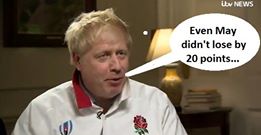
Boris Johnson posted a pre-match message of support with him wearing an England Rugby Shirt which led to former England rugby player Brian Moore suggesting that he should f*ck off.

Moore had a point.

Wilson had already won the Election in 1966 and his comment was light hearted. The failure to win in 1970 probably wasn’t helped by England’s exit from the World Cup but it probably wasn’t decisive.

In the age of social media and 24 hour news who knows what Johnson’s efforts will achieve. The criticism is understandable though. Wilson was aware sport could have an electoral impact but didn’t go upfront about it.

May, who genuinely is a cricket fan, held an official event after the victory and certainly wasn’t able to make political capital out of it.

The point about Johnson’s rugby post was that it was so crude in Electioneering terms, but many might say that sums the man up

Articles

The Ambridge Socialist: Exclusive. We reveal Joe Grundy’s real hangover cure

In Uncategorized on November 3, 2019 by kmflett

The Ambridge Socialist

November 3rd

Reporting on the Class Struggle in Borsetshire

Exclusive: We reveal Joe and Carmen’s Hangover Cure

Eddie and Alf have been to see Carmen to discover the ‘pot of gold’ mentioned in Joe Grundy’s will. It was of course a hangover ‘cure’. The BBC has broadcast fake news that suggests it includes cough mixture, cod liver oil etc. In reality the Ambridge Socialist can exclusively reveal, the cure is much more simple. Just keep drinking Tumble Tussocks cider.

As an interesting aside, the story line also outed on social media a group of Ambridge centrists, appalled that the Grundy’s should be involved in such an affair

Who will be on top of the Village Green Bonfire

Its that time of year again and the Village Green bonfire (plus limited fireworks) will be alight once again. Whose effigy will burnt on it however.

Vince Casey

Alf Grundy

Kenton Archer

Justin Elliott

Joy Horville

Boris Johnson

The Grundy Will

Eddie and Alf have been in search of the ‘Carmen’ mentioned in Joe’s Will. They discover a drag act in a pub in Hollerton but find that the person’s name is Gaz. However his mother is called Carmen…. One of the better Archers storylines of recent times. See our lead story

In Other News

Freddie has read Volume 1 (of 94) of Shula’s Autobiography and mentioned some incidents to Kenton…

Kate & Jakob are back together…

The Village Hall will be closed on 12th December

Articles

The Red Cap of Liberty: a symbol of 1819 & 2026?

In Uncategorized on November 2, 2019 by kmflett

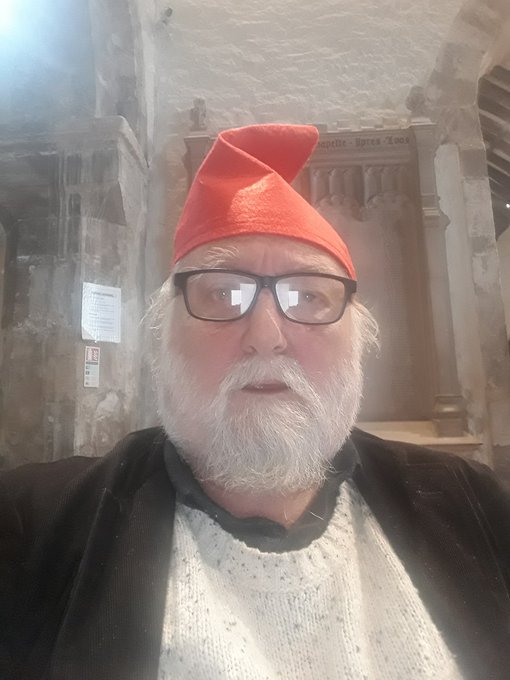
I was at a Chartist Convention on 2nd November 2019 to mark the 180th anniversary of the Chartist Rising in Newport.

I was pleased to be able acquire a bonnet rouge,the cap of liberty.

As James Epstein noted in his article Understanding the Cap of Liberty (Past and Present 122,1989) it was the great symbol of 1819 and was particularly the source of a struggle between protesters wearing it and the Yeomanry at Peterloo on 16th August 1819.

He notes ‘the ability to display the cap of liberty or to prevent its display became the measure of the shifting balance of power between the forces of authority and those of working class radicalism’.

The Cap of Liberty or Bonnet Rouge had its origins in the French Revolution and as Epstein notes after an absence it had first appeared again in Manchester in January 1819 when Henry Hunt marked his arrival on the scene of Manchester radical politics by addressing a smallish reform meeting at St Petersfield.

The Government financed paper New Times reported that Hunt was surrounded by an immense mob and preceded by the Jacobin red cap.

The paper went on to demand that Parliament pass a law to proscribe for ever.. those ensigns of massacre and rebellion the Bonnet Rouge..’

The Cap of Liberty was a symbol of freedom, democracy and change to a better society in 1819, why not 207 years on as well?

Articles

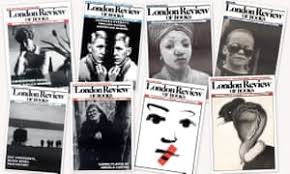
Marking 40 years of the London Review of Books: the first Fletter

In Uncategorized on November 2, 2019 by kmflett

Michael Mason’s review of new books on Francis Place and London’s radical underworld in the first half of the 19th century raises a number of interesting points, not all of which are satisfactorily answered. First, on the role of Francis Place. He was someone who sought to influence behind the scenes, and was therefore rarely to the fore in the public prints: but he was equally someone who left a very large archive, and whose role, for this reason, may be overestimated. Certainly Mason seems to feel that Place’s view on respectability should be taken, almost, as a benchmark against which to measure more wayward elements. Secondly, on the question of respectability itself. Here Mason does see the difficulty in imputing the artisanal view of respectability propounded by Place, which may, or may not, have been held by the developing working class. The point that should be made is that while Place may have hoped that his view of respectability might win out in radical working-class circles, as perhaps it did, to a degree, after 1848, in such circles the concept had quite a different context and rather different ends. For example, radicals fought a long battle to have their own halls and meeting-rooms separate from the public house. Why? Because they thought temperance the solution to their ills? In a few cases, maybe, but more frequently for the very basic reason that drunks could not effect political organisation.


Finally, on the question of the relationship beteen pornography and radicalism. There seem to be two traditions, one leading from Place, to birth control and feminism, which lasted into this century. The other tied in with the fact that being unrespectable radicals might handle all kinds of disreputable material, political or otherwise. But what, may one ask, did the female radicals of the period, covered so well in Barbara Taylor’s Eve and the New Jerusalem, think of all this? If McCalman tells us, Mason makes no mention of it. Either way, it seems rather important that someone should tell us.


Keith Flett

London N17

London Review of Books 29th September 1988

Original Review:

https://www.lrb.co.uk/v10/n15/michael-mason/rogue-socialists


Articles

Beard Liberation Front may stand candidates in General Election

In Uncategorized on November 2, 2019 by kmflett

Beard Liberation Front

Press Release

2nd November Contact Keith Flett 07803 167266

Beard Liberation Front may stand candidates in General Election

The Beard Liberation Front, the informal network of beard wearers, has said that it is actively considering standing candidates in the 12th December General Election.

The campaigners say that they are concerned at the level of pogonophobia in Westminster politics and that far too many MPs are still clean shaven men in suits.

BLF Organiser Keith Flett said, we are considering standing in a handful of Constituencies to make sure that prejudice against the hirsute becomes an Election issue

The Beard Liberation Front is an informal network of beard wearers and welcomes supporters, both women and men, who agree with our core principles.

It is not party political and does not usually stand candidates in Elections. However it is political in a broader sense, as it seeks a less discriminatory and more beard friendly Britain.

Founded in 1995 it campaigns against prejudice and celebrates positive images of the hirsute with an annual Beard of the Year award at the end of December. Beard Week, which focuses on a range of beard related issues, takes place every year in late June.

It has produced an updated version of its Election Manifesto on which it will seek the views of candidates and will publicise those who sign up to its Beard Friendly Charter.

The Beard Friendly Charter (Summary)

No to Beardism and pogonophobic prejudice against the hirsute

More hirsute MPs

More hirsute public employees and monitoring of hirsuteness levels in the senior Civil Service

Promotion of positive public images of the hirsute

No dress codes at work, beyond a requirement for smart appearance for public facing roles

Restrictions on barbers shops