Articles

Brewers & Publicans at Peterloo, Manchester August 1819. Which side were they on?

In Uncategorized on August 22, 2019 by kmflett

Beer & Peterloo

Update 2021. The excellent Peterloo Memorial Campaign updated the list of those known to have been present at Peterloo and made it searchable. Accordingly I’ve updated the list of publicans who rode with the Yeomanry or acted as Special Constables. Butchers and Tobacconists were on the wrong side of history too it seems..

http://www.peterloomassacre.org/names.html

Beer played an interesting part in Peterloo 200 years ago on Monday 16th August 1819.

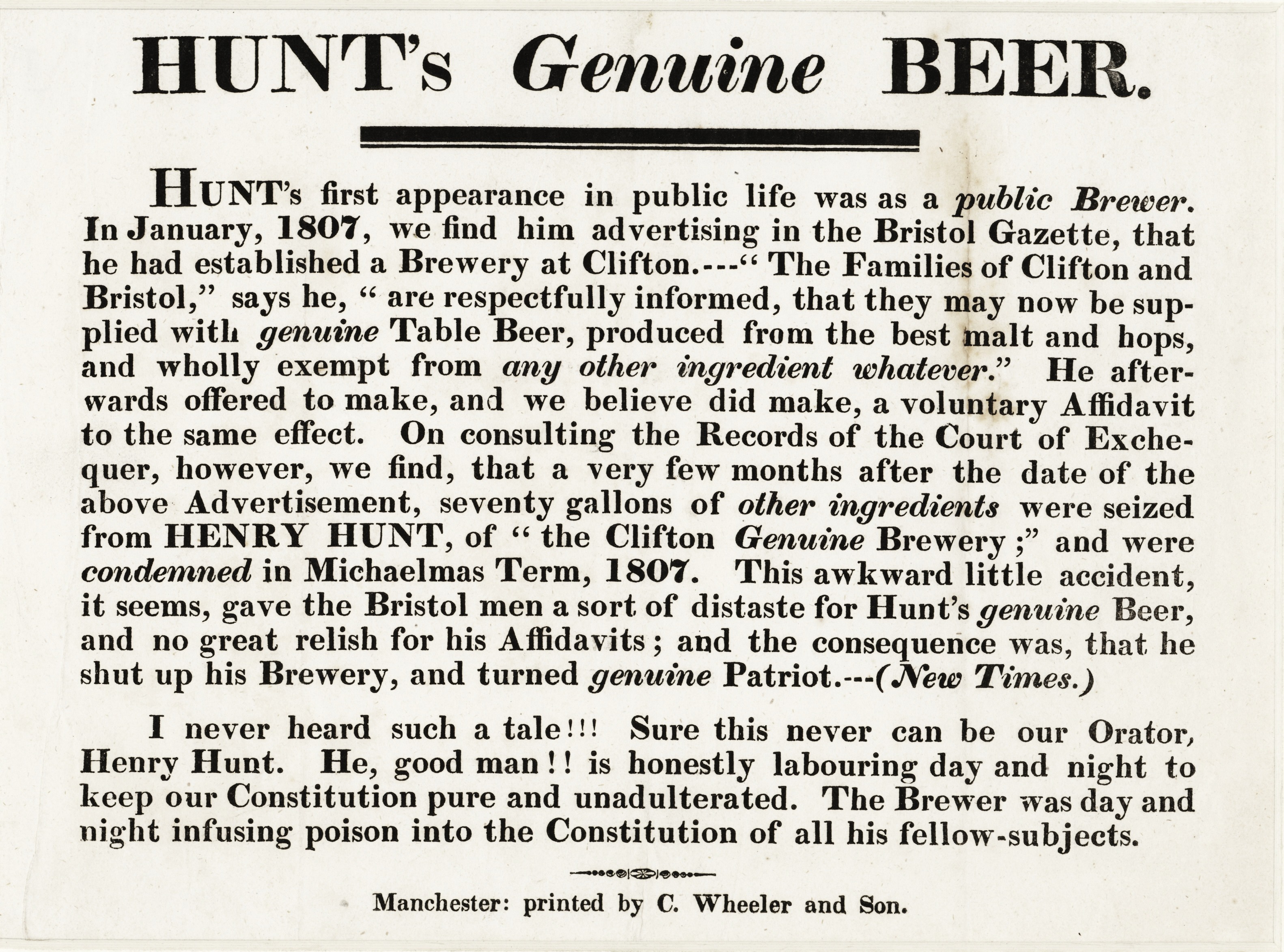
The keynote speaker Henry Hunt had, ten years earlier, been the owner of a Bristol brewery. Flyers hostile to Hunt which circulated in Manchester in the days before Peterloo suggested that the beer was bad or adulterated. This was untrue. Below is an extract from Hunt’s memoirs on the brewery

The brewery was built upon the site of an old distillery, at the rising of a spring called Jacob’s Well, at the foot of Brandon Hill, and immediately below Belleview, at Clifton. The whole was soon completed under my own eye, and finished entirely on my own plan. I took advantage of the declivity of the hill, on the side of which the premises were situated, to have it so constructed that the whole process of brewing was conducted, from the grinding of the malt, which fell from the mill into the mash-tun, without any lifting or pumping; with the exception of pumping the water, called _liquor_ by brewers, first into the reservoir, which composed the roof of the building. By turning a cock, this liquor filled the steam boiler, from thence it flowed into the mash-tun; the wort had only once to be pumped, once from the under back into the boiler, from thence it emptied itself, by turning the cock, into the coolers; it then flowed into the working vats and riving casks, and from the stillions, which were immediately above the store casks into which it flowed, only by turning a cock. These store casks were mounted on stands or horses, high enough to set a butt upright, and fill it out of the lower cock; and then the butts and barrels were rolled to the door, and upon the drays, without one ounce of lifting from the commencement of the process to the end. This was a great saving of labour. I left the concern in the hands of my young friend, with every prospect of success, and I then returned to my farm at Chisenbury; having, as I was taught to believe, laid the foundation of a lucrative concern, from which I expected to derive a liberal interest for the money I had advanced, which was about eight thousand pounds, and at the same time afford a handsome income for my young friend. But such is the uncertainty and precarious state of all speculative concerns of this nature, and such the inconstancy of friendship, that, instead of ever receiving one shilling from this concern, I found it still continue to be a drain upon my purse. Bills were coming due, I was told, and they must be provided for, or the credit of the firm would be blasted. Duty, to a large amount, was to be paid every six weeks, and as often I was called upon to assist in making up the sum.

Henry Hunt’s Memoirs Volume 2

On the day itself many who attended Peterloo had considerable distances to march to get there in the days before coach and rail travel. Below is a brief passage from the Guardian (16th August) which notes how the contingent that Samuel Bamford led from Middleton stopped to refresh themselves at a taproom

When the Peterloo marchers reached Harpurhey, the halfway point to Manchester, they needed a rest. In his memoirs, Bamford recalled how “those who thought proper refreshed with a cup of prime ale from Sam Ogden’s tap”. Fighting for democracy was thirsty work.

But beer and brewing were on the other side too at Peterloo and below is a list of publicans who are known to have ridden with the Yeomanry or acted as Special Constables at Peterloo. Whether, as Mike Leigh’s film Peterloo suggests, they had been drinking before the massacre seems difficult to discover (there may be something in the trials of protesters that followed) but it would perhaps not be entirely surprising.

Publicans at Peterloo. Most rode with the Yeomanry. Special Constables & Witnesses noted

John Barlow, Manchester (Witness)

John Beeston, Windsor Castle (George Inn) Deansgate

William Bowker, Kings Head, Old Shambles

George Burgess late of Hen & Chickens, Deansgate

Jacob Chadderton, Wool Pack, Pendleton

Cope (first name missing) Liquor Vaults, Corner of Bridge St

Henry Froggatt, Church St, Manchester(Special Constable)

James Glover, Market St Manchester (Special Constable)

Edward Hulme, Blue Cap, Salford

Lees (first name missing) Crown & Thistle, Half St

Mills Joseph, Manchester (Special Constable)

John Reid, Globe, Gartside St

Joseph Slater, Bay Horse (Witness)

Andrew Tilford, Campsfield, 3 Ashton St(injured)

Samuel Harrison, Brewer’s clerk

Articles

England could shave Australia in key Beard of the Ashes contest

In Uncategorized on August 22, 2019 by kmflett

Beard Liberation Front

22nd August

Contact Keith Flett 07803 167266

England could shave Australia in key Beard of the Ashes contest

The Beard Liberation Front, the informal network of beard wearers, has said that England look well placed to shave Australia in the key Beard of the Ashes vote.

While David Warner is reported to have shaved his beard, England have added two hirsute bowlers, Archer and Leach to their side.

Moeen Ali, often a frontrunner in similar votes has been dropped from the England side for the moment but they are still making easily the most hirsute impact on the pitch whether its Stokes batting, Archer’s bowling or Bairstow behind the stumps.

Australia’s Steve Smith has grown a beard but unfortunately cant play at Leeds. If he returns at Manchester Australia may still be able to mount a challenge

BLF Organiser Keith Flett said, Beard Power could yet win England the Ashes as well as the Beard of the Ashes vote

Articles

Marx & Engels at the Victorian Seaside in August & September 1857

In Uncategorized on August 21, 2019 by kmflett

During the summer of 1857 Engels was unwell and determined that visiting seaside locations would help.

He went first to Waterloo, Liverpool where Marx offered him this advice:

[London,] 15 August 1857

Dear Frederick,

I am delighted to hear that the sea is doing you good, as was to be expected. As soon as you are fit enough to bathe, It will take effect even more quickly.

The sea itself is, of course, the principal remedy. However, some medicaments ought to be taken internally, partly preventive, partly curative, so as to introduce into the blood those substances it lacks. As opposed to your assumptions in your letter to my wife and basing myself on the most recent French, English and German literature, which 1 have been reading on the subject of your illness, I put forward the following, which you may submit to the scrutiny of any college of physicians or pharmacists:

1. Whereas cod-liver oil requires 3 months to take effect, iron does so in 3 weeks.

2. Cod-liver oil and iron are not mutually exclusive but complement each other during treatment.

3. A temporary iron shortage in the blood is the primary characteristic of your disease. Besides bathing in the sea, you must take iron, even should there no longer be any outward sign of the disease.

4. In your case the therapeutic element in cod – liver oil is iodine, since the oil’s fattening properties are of no moment to you. Hence iodide of iron combines both the elements you need, one of which you would obtain from cod-liver oil. At the same time, it would spare your stomach the extra ballast inevitable in the case of cod-liver oil.

Voilà mes theses, and I hope you will give them your serious consideration so that, once cured, you do not suffer subsequent relapses which are said to be exceedingly disagreeable.

However as the following extract from a history of Jersey indicates Engels did not recover and headed south:

Engels obediently took iron iodide (and cod liver oil) but only felt worse, though he did find that taking baths reduced the inflammation. He thought of going to a ‘vigorous’ bathing station like the Isle of Man and then moving on to the Isle of Wight. Marx replied that the Isle of Man was distinguished only by its smell and that Engels should go to the best place in England for his complaint, Hastings.

The Isle of Wight almost cured Engels, but he wrote to Marx from Ryde to invite him to join him in Brighton to cross to Jersey. Why did Engels choose Jersey? No doubt because an ailing acquaintance, Conrad Schramm, who had gone there on 20 September, recommended the climate. Marx said he might come to Brighton, and Engels replied that he would go to Brighton on 28 September at the latest and to Jersey on the 29th. In fact, as the passenger lists show, “Engels and friend” arrived in Jersey on 1 October on the Brighton from Kingston. The friend must surely have been Marx.

Engels and, presumably, Marx found lodgings in Saint Helier at 3 Edward Place in The Parade. Marx saw Schramm but must have left Jersey by about 5 October when Engels went alone to Schramm’s and renewed acquaintance with George Julian Harney. Marx and Engels had known Harney as a revolutionary in London, “one of the best of the English popular speakers”. as Marx put it. After the failure of Chartism and his newspapers, Harney had come to Jersey and, in July 1856, had accepted editorship of the Jersey Independent.

How much Engels would have fancied bathing in the sea around the coast of Britain 165 years on and whether it would have  helped his health must be highly questionable

Articles

After Fullers & Greene King: what is to be done?

In Uncategorized on August 21, 2019 by kmflett

After Fullers & Greene King: what is to be done?

Following Fullers sale of its brewing operations (not pubs) to Asahi, another large ex-regional brewer, Greene King has announced its sale to a Hong Kong based property company. Its fair to say they are not here for the beer.

A good analysis, as would be expected, is here from Roger Protz

https://protzonbeer.co.uk/comments/2019/08/20/greene-king-another-one-bites-the-dust

Protz has suggested on social media a summit of CAMRA, SIBA and others to determine proposals to put to Government once there is one that is actually concerned with day to day Government.

But what should be proposed? As ever it is much easier to oppose than argue for a positive way forward.

One idea might be to return to the model of the State-owned brewery in Carlisle that was started during World War One and lasted until the 1970s. Its aim was to set a benchmark for good beer and pubs and of course initially to stop munitions workers from drinking too much.

I have no issue with reasserting that idea but in a world where global beer and capital operate it cant be the entire answer.

Another is to strengthen legislation (which currently operates in England) to allow community bids a first crack at buying a pub under threat of closure. That would make bids like that for Greene King less attractive.

More is still required. Perhaps its time to designate a range of regional brewers as producing something unique to the UK and put strict regulations around anyone trying to interfere with it. Much for example as the EU has done (remember them) with Stilton cheese.

Finally, not State ownership but an alternative, perhaps the Government could take a golden share in some leading breweries meaning they could not be sold without a process where the sense of doing so was reviewed.

Of course that depends on the Government….


Articles

Aussies David Warner Ashes facial hair crisis worsens as he shaves his beard

In Uncategorized on August 20, 2019 by kmflett

Beard Liberation Front

20th August

Contact Keith Flett 07803 167266

Aussies David Warner Ashes facial hair crisis worsens as he shaves his beard

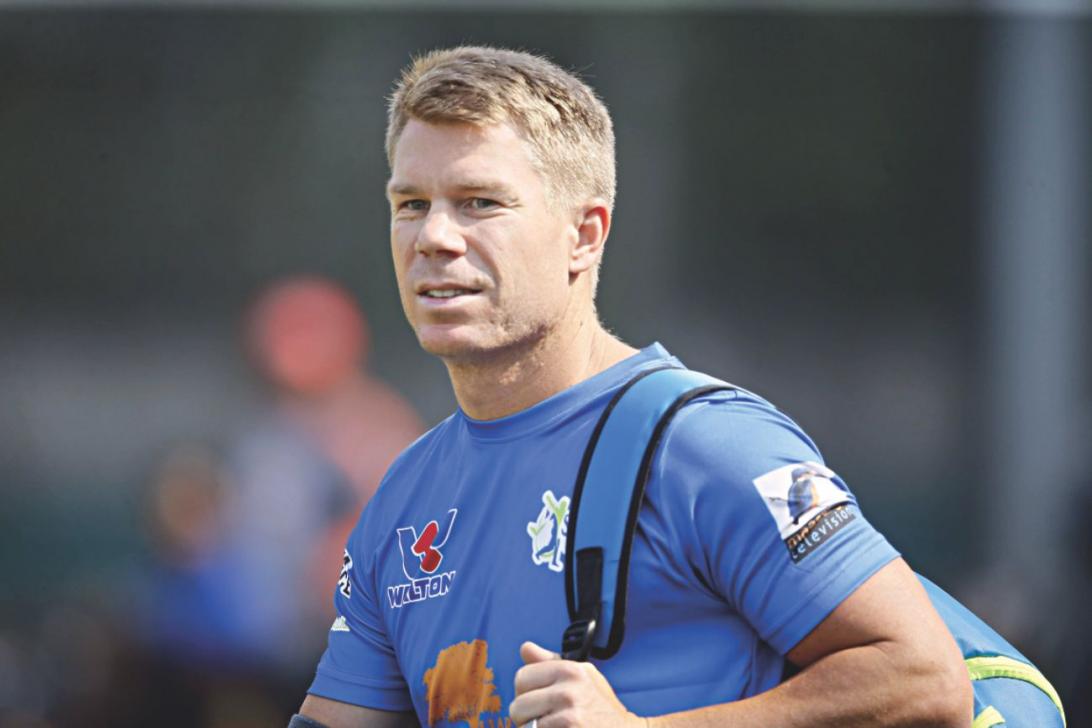
The Beard Liberation Front, the informal network of beard wearers, has said that Australian opening batsman David Warner’s Ashes facial hair crisis has worsened after he was reported to be clean shaven as the Australian team trained at Leeds today ahead of the Third Test on Thursday

Warner was dismissed by Stuart Broad at Edgbaston for 2 and 8 in the First Test and at Lords he made just 3 and 5

The BLF says that after an incident that saw Warner suspended from Test cricket for a period, he grew a gravitas adding beard. It had been thought this would make Warner a key contender for the coveted Beard of the Ashes 2019 accolade.

However it became clear at both Edgbaston and Lords that Warner had been trimming his beard and the campaigners say that the Aussie opener clearly did not have the right balance between beard and ball interaction at the moment.

BLF Organiser Keith Flett said, by shaving his beard Warner has made precisely the wrong tactical decision. He should have been growing it Mike Brearley style not getting rid of it.

Articles

Greene King sells to CKA: the Beerage in crisis?

In Uncategorized on August 19, 2019 by kmflett

Greene King has sold its brewing operations and pubs to Hong Kong based CKA for a large sum of money.

The immediate thought is that this might place the brewing of Greene King beers and thousands of jobs at risk and I havent seen anything in news coverage so far to suggest that this might not be a possibility.

The wider point however is that it underlines the crisis that the Beerage and the political party they support are in.

Greene King is the second large brewer to sell this year, the first being Fullers to Asahi. Both brewers are long term supporters of the Tory Party, which is essentially what the Beerage has represented since the nineteenth century.

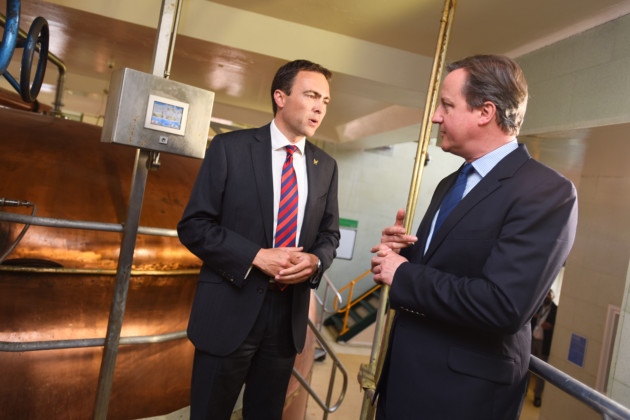
One might say that the appearance of David Cameron at Greene King’s Bury St Edmunds brewery during the 2015 Election campaign was a sign that it wouldnt end well but there are more serious points.

Brewing is dominated by global brewing concerns- ABI, Heineken, Coors, Kirin and so on. Do they have much interest in which political party is in Government in a particular country? Its marginal. Obviously they want the best competitive market but if its not available there are other countries and markets.

The fact that such stalwarts of the Beerage as Fullers and Greene King have both chosen to bail out this year however may also reflect their perspective on the future of British capitalism and its historic political representative the Tory Party.

All that aside the battle is on to defend the brewery, the beers, the pubs and all the jobs that go with. I wonder if the current Prime Minister has any comment?

Update

Lex in the Financial Times (20th August) makes a key point echoed by Roger Protz and others on social media, namely that what CKA are interested in is the property holding of Greene King- the pubs- more than the beer.

Lex comments ‘This a real estate deal, not about beer’ Whether CKA intend simply to keep that as a book value (in the near future to offset substantial losses from the Hong Kong crisis) or actually sell off pubs is unclear

Articles

171 years since the last armed rising on English soil: 16th August 1848

In Uncategorized on August 19, 2019 by kmflett

171 years ago- August 1848- the last armed rising on English soil

1848 was a year of revolutions across Europe, except in Britain.

Here the Chartist demonstration for the vote on Monday 10th April 1848 did not lead, as the authorities feared, to an attempt to take power. The gathering on Kennington Common was the biggest demonstration in British history to that date, but rain intervened as well as a very serious mobilisation of police, army and special constables on the side of the authorities.

Yet that was not the end of the British 1848, even if Victorian chroniclers spent some effort in trying to suggest that it was.

Ireland faced a revolutionary threat and that found its echo on the mainland, particularly after 10th April when Irish nationalists [confederates] joined with the Chartists in many areas.

The Chartist protest of 10th April was repeated on 12th June with meetings this time around the UK.

The Liberal Home Secretary Russell banned these meetings and again mobilised the police and troops to stop them.

The Chartists gathered at Bishop Bonners Fields [now part of Victoria Park in the East End] in large numbers but did not attempt to have a meeting.

It was this sequence of events that led first the national Chartist leadership, and then as they were arrested, the London leadership to start planning an insurrection.

Planning or plotting meetings took place in pubs and coffee houses from June to August 1848. We know this because the meetings were infiltrated by several police spies.

The frustrations of the Chartists can be understood. They had seen revolutions sweep away autocratic regimes across Europe and in Britain they had faced bans and arrests if they protested peacefully.

In addition as the historian of London Chartism David Goodway points out, London had a conspiratorial political tradition to which some of those involved in 1848 were heirs.

William Cuffay the black leader of London Chartism became the effective leader of the attempt at revolution in the days up to the 16th August, although whether his aim was to control it or prosecute it has never been clear.

Even so there was a clear plan and this was to barricade an area of central London and take effective control of the Capital. There was also less clear plans to put effect to this by firing gas mains thereby causing fires and explosions.

The plan for a revolutionary rising was clear enough then. Victorian historians argued that very few supported it at the time and like 10th April 1848 it was a damp squib. As Goodway again points out this was not the case. He estimates that around 5000 Chartists and confederates were mobilised in London on 16th August. That number would certainly have been a good match for the authorities’ forces.

In reality neither side seemed prepared to actually do the deed. While the authorities had intelligence of what was planned the police who were mobilised at Seven Dials on 16th August neither went into action or, on the day itself, made arrests.

The Chartists who gathered at Seven Dials on the evening of 16th August around 9pm did not attempt to occupy it either. On word that the police knew of the plan they dispersed.

Arrests, including that of Cuffay and some others did take place in the days that followed.

Aside from being something that has been hidden from history and is worth recalling the events at Seven Dials 170 years ago this month have another resonance.

While the area is very different in some ways to how it was then- a very poor area with a pub on each of its seven corners- the actual physical layout of the space remains very much as it was. One of the pubs that was there in August 1848, the Crown, remains in place with essentially the same structure that it had then.

This weekend why not re-live a moment of London’s revolutionary past and stop off for a pint at the Crown as some of the Chartist insurrectionaries of that summer certainly did themselves.

Articles

Why dont the Tories want to remember Peterloo?

In Uncategorized on August 19, 2019 by kmflett

Why don’t the Tories want to remember Peterloo?

On 3rd August 2019 the Murdoch owned Times newspaper published an Editorial on Peterloo.

It was complained about how much coverage the BBC was giving to the 200th anniversary of the event on 16th August. According to the Times Peterloo was indeed a dreadful event but that was that and it has no wider significance.

Attempts to remember it on the 200th anniversary were just part of left-wing mythologizing in which it seems the late socialist historian E P Thompson, Tony Benn and Jeremy Corbyn were all implicated.

It was a quite extraordinary Editorial. If it is the case that Peterloo is not worth recalling then why spend an entire Editorial doing just that?

The reality is of course that the Tories have a strong sense of guilt still about Peterloo and with good reason.

The 200th anniversary saw a memorial to the Massacre of 16th August designed by Jeremy Dellar unveiled on the site of what was once St Petersfield. However it is the first such memorial. The only commemoration that currently exists is a small red plaque high up on the wall of what was once the Free Trade Hall (now a Radisson hotel).

The Free Trade Hall was constructed by Liberals in the 1850s in an attempt to claim the heritage of Peterloo for themselves- at least they did not attempt to deny it, although one couldn’t be sure about the current leadership of the Liberal Democrats.

On the 150th anniversary of Peterloo in 1969 Manchester Council was, unusually, run by the Tories. The unpopularity of Harold Wilson’s Labour Government had led to a Tory landslide in 1968 local elections.

The Secretary of Manchester Labour Party had inquired, according to a Guardian report of March 28th 1969, of the Town Clerk whether anything was planned for the anniversary.

The report notes that Alderman Mrs Nellie Beer, the Tory chairwoman of the Town Hall Committee had opined ‘I don’t think a lot will be done. I have no very strong feelings about it. There is always somebody who wants to commemorate something’.

Ms Beer apparently wanted to celebrate something constructive, in particular the 50th anniversary In 1969 of the first Atlantic air crossing which she described as ‘a fine achievement of two very young people’.

By contrast Deputy Leader of Manchester Labour Group Norman Morris countered that Peterloo underlined that ‘the working-class would have to fight for any amelioration of their conditions’.

The Guardian report noted that ‘any celebrations are likely to be a minor key’. This included the Central Library compiling a bibliography on the subject and mounting an exhibition’.

In the event a commemoration was held in the Free Trade Hall in August 1969 with folk singers including Leon Rosselson and speakers such as Michael Foot.

There was a reason of course why Manchester Tories preferred to forget about Peterloo.

The magistrate who gave to order to send in the Yeomanry at Peterloo on 16th August two hundred years ago, William Hulton, was a Tory. His mother owned a race horse named Church and King.

Hulton’s political affiliation was not just a notional one either as E P Thompson noted in reviewing a book by Robert Walmsley on Peterloo published to coincide with the 150th anniversary. Walmsley’s purpose was to rescue and promote the honourable purposes, as he saw it, of Hulton.

Thompson noted that after the ‘blue’ party lost South Lancashire in the 1832 Reform Election, Hulton was a key figure in forming the local Conservative Association which proclaimed itself a friend to the monarchy and to the church.

One wonders if, 205 years on, the Tories are yet ready to apologise for Peterloo?

Articles

Watching the Ashes on TV: who actually got a chance to see Jofra Archer bowl?

In Uncategorized on August 18, 2019 by kmflett

Watching the Ashes on TV: who actually got a chance to see Jofra Archer bowl?

I’ve attended days of Ashes cricket at Edgbaston and Lords (it rained) so far this summer and I have tickets for the Oval in September.

It is not a cheap sporting option in terms of cost of tickets but there is little to beat the atmosphere of a day of Ashes cricket live.

Of course as I’m still working I don’t have time to get to that much more cricket in person and I rely on broadcast media.

The BBC’s Test Match Special remains a superb source of broadcast coverage and it is improving and adapting to new audiences as much as Geoffrey Boycott also still chunters on. Its much less stuffy than it was in my day (I started listening in the 1960s) and it talks more about cricket and less about other things now (I have mixed feelings on that…)

Watching on TV remains problematic and I think that is a significant issue for cricket. We know that the England and Wales Cricket Board don’t think so but there is clearly a mood that when the national team are playing at home matches should be shown free to air by law (as they are in Australia).

As it is coverage remains with Sky. In the days when Murdoch owned Sky there would have been no chance of me paying them a penny any more than I’d buy a copy of The Sun. Those days are gone and Comcast now owns Sky.

However the Murdoch era practices remain. Sky has a main sports channel on which it shows what it thinks is they key sporting event of the moment (I suspect this is based on a ratio of audience numbers and how much they’ve paid for the rights).

The Ashes is sometimes on this channel. I don’t have Sky at my London residence (Im not in enough to make it worthwhile). However my partner does have limited Sky channels at our Cardiff address via BT.

Sometimes the cricket is on the Sky main event channel as it was until 1pm on the last day of the Lords Test on Sunday. Then it was shovelled off to the cricket channel to make way for football. A subscription to that costs rather more and also implies I think that you will spend a lot of time watching TV either at home or on a mobile or tablet. Perhaps but there are also other things to do…

We went out for Sunday lunch and then checked pubs for one showing the cricket (all within 10 minutes walk of the home of Welsh cricket Sophia Gardens). All were showing only the football on multiple screens- hardly anyone was watching.

We returned home to listen to the exciting climax to the Lords Test on TMS and watch the Channel 5 highlights.

We of course are dedicated cricket fans but many who would have been drawn in by the excitement that England’s new fast bowler Jofra Archer brought to the game will simply have missed it as it was not showing on a TV screen they could access and see for nothing and moved on.

Yet another chance to widen the interest in cricket lost.

Still there is the 100. Or is there getting rid of a Government that has close links with the existing Sky set up and moving to that Australian model of TV cricket broadcasting…

Articles

E P Thompson on Hulton who sent the Yeomanry in at Peterloo ‘some sort of stiffening about him’

In Uncategorized on August 18, 2019 by kmflett

Below is an extract from a review by E P Thompson in the Times Literary Supplement of a book published to mark the 150th anniversary of Peterloo in 1969. Peterloo: the case reopened by Robert Walmsley sort to rehabilitate the reputation of William Hulton the Magistrate who gave the order to send the Yeomanry in at Peterloo. Thompson as can be seen below did not agree with Walmsley

Tribune Magazine has reprinted the entire review  to mark the 200th anniversary of Peterloo

______________________________________________________________________________________________________________________________

William Hulton had some sort of stiffening about him which some of his fellow magistrates lacked – an absence of humanitarian cant and a contempt for general opinion. He offered no maudlin apologies for Peterloo; indeed, he later recalled it as the “proudest day” of his life, and many years afterwards he kept a Cap of Liberty, captured upon the field, in his study. A gentleman of Hulton’s breed and station does not lie; he merely has so great a hauteur, so great a distance between himself and the seditious plebs, that it is a matter of utter indifference to him whether this or that is true of them or not.

Twelve years after Peterloo, and after fact upon fact had been disputed for as long, Hulton could throw off a public letter containing a manifest farrago of mis-statements about the day – “two people were killed in St Peter’s Field – one, a woman, who having personated the Goddess of Reason, was trampled to death in the crowd … On the succeeding day, an old pensioner was beaten to death with portions of his own loom, because he had expressed a loyal attachment to the King.” He was as inflexibly convinced, in 1831 as he had been in 1817, that the defence of “this vast aegis” of our liberties required the hunting of Jacobins and the sharpening of swords.

The defeat of the Tories in South Lancashire in the Reform election of 1832 led only to an adjustment of tactics. “A few despondent individuals”, Hulton of Hulton later recalled, then met in a common pot-house in Newton-le-Willows: “It occurred to them that it was their duty to call up every friend to the monarchy and the Church to counteract the machinations of the enemies to both.”

As a result of that meeting, “the foundations of the South Lancashire Conservative Association were laid … and from that stem at Newton, Conservative associations had branched out all over Her Majesty’s dominions.” It is well to remember that British Conservatism has not only been made by the great, the well-endowed, the fluent. It has also had its stubborn, provincial grassroots.