The size of the crowd
The size of crowds continues to be the subject of much discussion both in the media and in academia.
Indeed I came across an academic who is probably best described as a risk management professional who aims to look at the size of projected crowds to make sure there are no safety issues. A sensible idea no doubt but not something you can project back into history when ideas of how many people could fit into a particular space were often quite different.
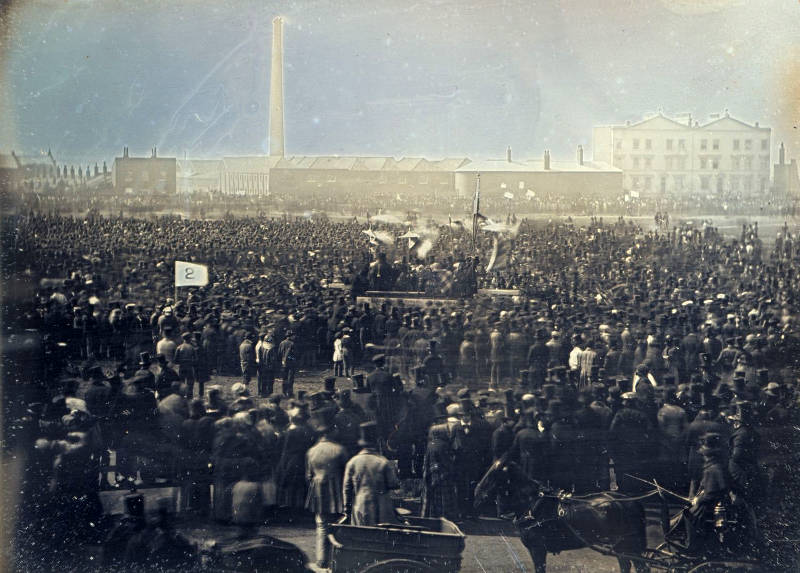
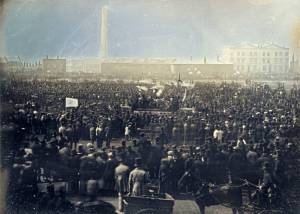
Even after the Chartist demonstration on Monday 10th April 1848* there was argument about how big the numbers might have been based on an assessment of how large a space at that time Kennington Common was. And that argument is still going on 170 years later.
This brings us to the numbers who were protesting about Donald Trump or supporting him on his State visit.
Whatever Mr Trump may have been told the numbers who turned up to view the procession of his car (note not ceremonial coach) to Buckingham Palace on the Monday were, well, close to no one. There were certainly more police officers and pigeons.
When Trump was last here in July 2018 there was a very large, perhaps 250,000 strong, central London demonstration on a rather warm Friday afternoon against him and his politics. The leader of the opposition Jeremy Corbyn spoke, although the entire media and some Labour MPs managed to forget that in the 11 months since. Even short-term historical memory is becoming an issue now it seems.
That made it possibly the largest week day protest in UK history. Another contender was the demonstration when George W Bush came to London in November 2003 not long after the Iraq War:
http://news.bbc.co.uk/1/hi/uk_politics/3223780.stm
The demonstration on Tuesday 4th June against Trump which moved from Trafalgar Square to a rally in Whitehall was not as large although there were certainly very decent numbers present particularly for a late morning mid-week protest, around 75,000.
Could it have been even larger given how much Trump is hated? If there was a precise answer I wouldn’t be writing historically focused pieces about crowds and their history but instead have made my millions in the predictions business and retired.
Some possibilities are that it was an 11am start on a Tuesday meaning it was probably a bit more difficult for those in work to get there than say a late Friday afternoon. Many jobs involve working 5 or more days over variable patterns but in the world of professionals where I’m a union officer the working week in an actual office tends to be Tuesday to Thursday and that is a big factor in terms of London employment, which will always supply the majority of protesters on any demonstration. They can just turn up, mostly, few special arrangements to travel etc are required. However Tuesday might be more difficult than a Monday or a Friday.
The weather probably didn’t help either. The forecast was for sun and showers but in fact changed to some rather heavy downpours. One reason why the Chartist demonstration on 10th April 1848, however big it was dispersed so quickly was that it rained in the early afternoon.
Finally it may be that some have just go ‘demo fatigue’ when it comes to Trump. Pretty much every one but him knows he is hated and some may think the point has been made.
In my view you can never make it too often but I’m trying to understand protest crowds here not argue about why people should protest.
The wider picture
The most common method of assessing demonstration numbers remains to work out how many can fit into a square yard or square metre. The two are of course not the same measurement but this is rarely taken account of in terms of the numbers that can fit into a space.
We may take it that at least in the UK the numbers which can fit comfortably into a specific space, allowing for a variety of regulations, is less than it might have been in Victorian times. Yet anyone who has attended a large demonstration (which does not seem to include academics who write about them unfortunately) will grasp the, perhaps obvious point to this audience, that they are not static things. People come and go all the time.
On the Trump demonstration referenced above, perhaps because it was held in the middle of the working day, perhaps because there was intermittent rain, I find as many people coming as going. The space taken by the protest stretched from Trafalgar Square two thirds of the way down Whitehall to a police barrier with varying clusters of protesters across this space. Working out the size by the numbers occupying a square metre would not have helped.
This means that the numbers attending protests both historically and now continue to be disputed.
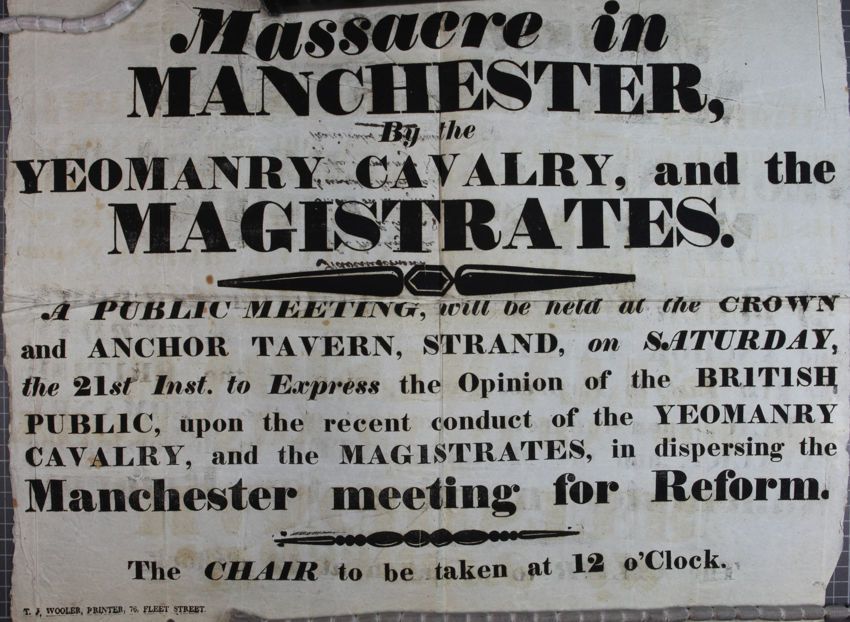
The size of the crowd at Peterloo is generally taken to be around 60,000. This may not seem particularly large by modern standards until we review the context. We know from the lists of dead and injured that numbers did come from Manchester itself. However most came from outlying towns. How did they get then to Peterloo? By train, or bus or coach? Certainly not. None of these existed. The demonstrators had to walk, often for many miles. In this sense the numbers were huge.
It remains the case however that with the possible exception of the Chartists at Kennington Common on 10th April 1848,n(which was entirely a London demonstration for the reasons indicated above) all or nearly all the largest demonstrations in British history have taken place since the October1968 Grosvenor Square protest against the Vietnam War put up to 100,000 people on the streets.
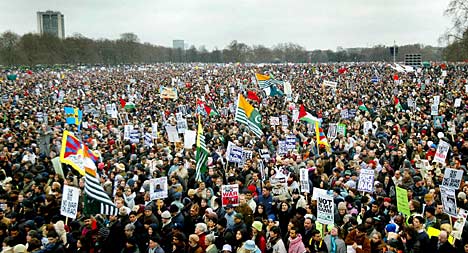
The largest since include the anti-Iraq War demonstration in London on 15th February 2003. There is no accurate number for the protest but its thought to have been between one and two million people.
The police attempted to counter numbers by checking how many people passed a certain point over a specified period of time but again anyone who has attended a demonstration will see that this is flawed. How tightly packed or otherwise a demonstration is at any point can vary considerably. We do know that the march had two separate departure points as organisers realised that with one some would never get to the rally in Hyde Park before it was finished (which was the case anyway). Making the end point Hyde Park (despite concerns of the New Labour Government about damage to the grass) does mean we have some pictures of the size (although no real idea pace the photograph of the Chartists at Kennington Common) whether this was the peak.
More recently there have been several very large demonstrations in central London for a People’s Vote. The interest here is in the demonstration itself rather than whether or not one has sympathy for the objective.
The most recent may have had up to 750,000 on it, although as it started and concluded in a relatively limited space judging numbers is even more difficult than for 15th February 2003.
Street demonstrations are generally the province of the political left and labour movement whereas the People’s Vote protests mobilised numbers from outside of these areas.
Again without judging it underlines the point that post-1968 people making a political point themselves in person rather than relying on a representative such as an MP to do so has become increasingly important.
The London factor remains important and little discussed. The UK politically remains a very London-centric place and major demonstrations to make an impact tend to take place in the Capital. It is certainly the case that in any large demonstration those attending from the wider London area will be in the majority because it is much easier to travel.
Of course trains, coaches and cars can bring significant numbers, should people feel so motivated from across the UK. That is certainly what happened on 15th February 2003. It does mean however that for a demonstration to be significant it does need to strike a chord in terms of support in London. Here too timing is important which explains why Saturday or Sunday remain the favourite days for large protests, when fewer people may be working and can travel more easily.
Conclusions & Ommissions.
I have not tried here to present a comprehensive historical analysis of the crowd in history. George Rude’s work remains the classic text(s) but here I’ve focused much more than numbers in the crowd rather than its composition.
A review of EP Thompson’s numerous references to the crowd in the Making of the English Working Class is instructive.
A fair number of the references relate to a discussion with the historian of crowds George Rude about the nature of crowds in England from the late eighteenth century to the first decades of the nineteenth century.
Thompson agrees with Rude that it is appropriate to use the term ‘crowd’ rather than ‘mob’. He also agrees that there are examples of the revolutionary crowd. However he is more cautious than Rude in arguing that the political composition of crowds was not always progressive and neither at times was their leadership.
Thompson does describe on occasion the nature or size of a crowd but never in terms of numbers. He uses terms such as ‘immense’ or ‘menacing’ underlining that the 10th April 1848 notwithstanding the current interest in the size of a crowd was not such a concern 50 years ago.
In his book on the crowd in early Modern England, Crowds and Popular Politics (MUP 2006) John Walter, while not looking at numbers does underline that the interest in the crowd as opposed to the mob comes in the main from a turn to social history in the 1950s. He refers to ‘an exciting explosion of work that regarded the crowd in history as a serious subject for historical analysis’.
The wider question here perhaps is why the numbers or size of the crowd matters, if it does. As Walter notes on occasion ‘crowds were in danger of being found wanting’. Any activist or organiser reading this will understand the point.
Is a crowd more legitimate if it is larger however or does a large number underline a seriousness of mood or intent? Work in progress….
*Northern Star 28th April 1848
To the Editor of Douglas Jerrold’s Newspaper
A Hundred Thousand at Kennington Common
Sir
The misrepresentations made by a member of the ‘Lower House’ who stated that Kennington Common could not hold more than ninety thousand persons and that he was convinced that the highest number assembled thereon at the late meeting did not exceed 15,000, coupled with other statements, have induced me to examine and measure the ground contained within the fences, and I find it contains 156,000 square yards. Now, as I know that in densely packed meeting you may safely calculate that each square yard will, or can, contain nine persons, and that fact may be easily proved by numbers of men, women and children of various sizes, placed in a room of three or four square yards, it will be speedily seen that Kennington Common within the fences can hold a densely packed mob of 1,400, 000 persons…. I therefore have no hesitation in saying that, from the representations made to me, there were considerably more than 100,000 of all descriptions of persons assembled on the late occasion.
I am no Chartist, nor am I aware that I have ever spoken to one