Articles

Marx, Engels & the Campaign for Real Ale: where would they have stood?

In Uncategorized on April 26, 2018 by kmflett

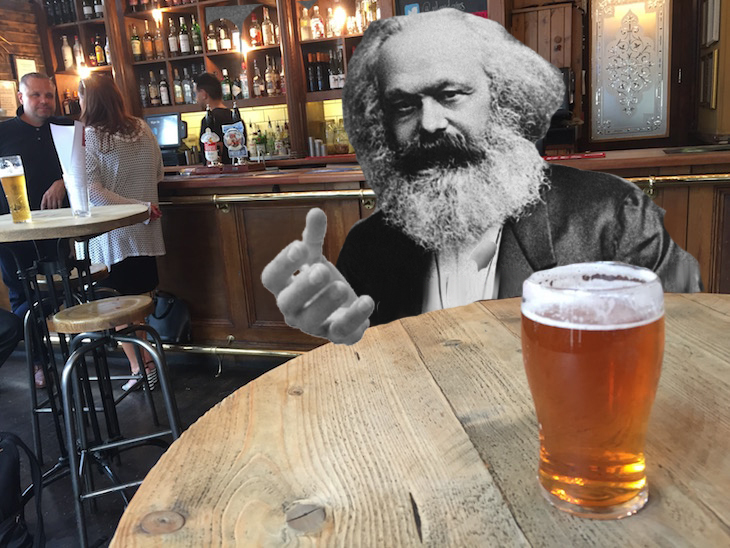
Marx & Engels & beer
Londonist

There have been many and varied attempts over the years to paint Karl Marx in particular as a disreputable character whose ideas on capitalism should therefore not be taken seriously.

In that context the story that he was more or less permanently drunk has a fairly minor place. One would not need a great deal of knowledge of Marx’s life to grasp that, certainly once he came to London, he rarely had sufficient money to fund a lifestyle of drinking.

Jenny Marx noted of Engels when he retired to London in the 1870s that he was keen on beer, particularly the Viennese variety. How easy it was to obtain such a style in London at the time is less clear but the authoritative beer writers Boak and Bailey suggest that Vienna lager was available in the Capital in the 1860s and 1870s and indeed was regarded as a premium ‘craft’ drink.

The episode which feeds the Marx as a drunk caricature is the well-known pub crawl up Tottenham Court Rd in central London that ended with them being pursued by police. There are not that many pubs on the road today but there were considerably more 150 years ago.

It is to be found in a memoir of Marx written by the German socialist Liebknecht in 1896 around 40 years after the event itself.

His account begins

One evening, Edgar Bauer, acquainted with Marx from their Berlin time and then not yet his personal enemy […], had come to town from his hermitage in Highgate for the purpose of “making a beer trip.” The problem was to “take something” in every saloon between Oxford Street and Hampstead Road – making the something a very difficult task, even by confining yourself to a minimum, considering the enormous number of saloons in that part of the city. But we went to work undaunted and managed to reach the end of Tottenham Court Road without accident.

In due course the drinking party Marx included got involved in a political discussion in the back room of a pub. Liebknecht recalls

The brows of our hosts began to cloud […]; and when Edgar Bauer brought up still heavier guns and began to allude to the English cant, then a low “damned foreigners!” issued from the company, soon followed by louder repetitions. Threatening words were spoken, the brains began to be heated, fists were brandished in the air and – we were sensible enough to choose the better part of valor and managed to effect, not wholly without difficulty, a passably dignified retreat.

Now we had enough of our “beer trip” for the time being, and in order to cool our heated blood, we started on a double quick march, until Edgar Bauer stumbled over some paving stones. “Hurrah, an idea!” And in memory of mad student pranks he picked up a stone, and Clash! Clatter! a gas lantern went flying into splinters. Nonsense is contagious – Marx and I did not stay behind, and we broke four or five street lamps – it was, perhaps, 2 o’clock in the morning and the streets were deserted in consequence. But the noise nevertheless attracted the attention of a policeman who with quick resolution gave the signal to his colleagues on the same beat. And immediately countersignals were given. The position became critical.

Happily we took in the situation at a glance; and happily we knew the locality. We raced ahead, three or four policemen some distance behind us. Marx showed an activity that I should not have attributed to him. And after the wild chase had lasted some minutes, we succeeded in turning into a side street and there running through an alley – a back yard between two streets – whence we came behind the policemen who lost the trail. Now we were safe. They did not have our description and we arrived at our homes without further adventures.

It is an entertaining story but not one can find repeated, meaning it was almost certainly an exceptional occasion.

Engels in his younger days was hardly exempt either from occasional beer influenced activities. He wrote on 1st September 1838:

Excuse me for writing so badly, I have three bottles of beer under my belt, hurrah, and I cannot write much more because this must go to the post at once. It is already striking half-past three and letters must be there by four o’clock. Good gracious, thunder and lightning’ you can see that I’ve got some beer inside me. [… ]

However there is a more serious and political side to Marx’s views on beer both in terms of practical political campaigning and in respect of theory.

Marx wrote in support of an 1855 demonstration organised by the Chartists in Hyde Park in what had become known as the ‘Beer Bill’:

The first measure of Religious coercion was the Beer Bill, which shut down all places of public entertainment on Sundays, except between 6 and 10 p. m. This bill was smuggled through the House at the end of a sparsely attended sitting, after the pietists had bought the support of the big public-house owners of London by guaranteeing them that the license system would continue, that is, that big capital would retain its monopoly.

Marx was here defending the right of working people to enjoy a beer on the one official day of the week they didn’t work, against what he terms ‘religious coercion’. Marx associated a Chartist leaflet for the protest which made the point that the aristocracy who of course enjoyed their drinks elsewhere than pubs could continue as normal.

Marx also defended the right of working people to enjoy beer in a more theoretical context, In Capital Volume One, chapter 24 he noted the tendency of capitalists to force down the wages of workers. He quotes an eighteenth-century author who complained that workers indulged in such things as drink:

“But if our poor” (technical term for labourers) “will live luxuriously … then labour must, of course, be dear … When it is considered what luxuries the manufacturing populace consume, such as brandy, gin, tea, sugar, foreign fruit, strong beer, printed linens, snuff, tobacco, &C.”

In terms of 2018 it is perhaps interesting to speculate whether Marx would have been a member of the Campaign for Real Ale. He was clearly interested in defending the right of ordinary people to drink beer and was keen on drinking beer himself, at least on occasion. He would certainly have been much less keen, and more critical than CAMRA sometimes is, of the activities of brewers and he would have the theory to back the point up.

One can see Marx, a lifelong activist, being in CAMRA, enjoying his beer, but organising to keep its focus firmly on pubs and beer while maintaining criticism of what is known as ‘big beer’, the worldwide beer companies such as ABInBev.

Engels with his love for specialist European lager would clearly have been a craft beer man

A version of this post appears on the Culture Matters site: http://www.culturematters.org.uk/index.php/marx200/item/2798-marx-engels-and-beer


Articles

After Fawcett statue in Parliament Square historians renew call for statue of Sylvia Pankhurst

In Uncategorized on April 24, 2018 by kmflett

London Socialist Historians Group

Media Release 24th April

Contact: Dr Keith Flett 07803 167266

After Fawcett statue in Parliament Square, historians renew call for statue of Sylvia Pankhurst

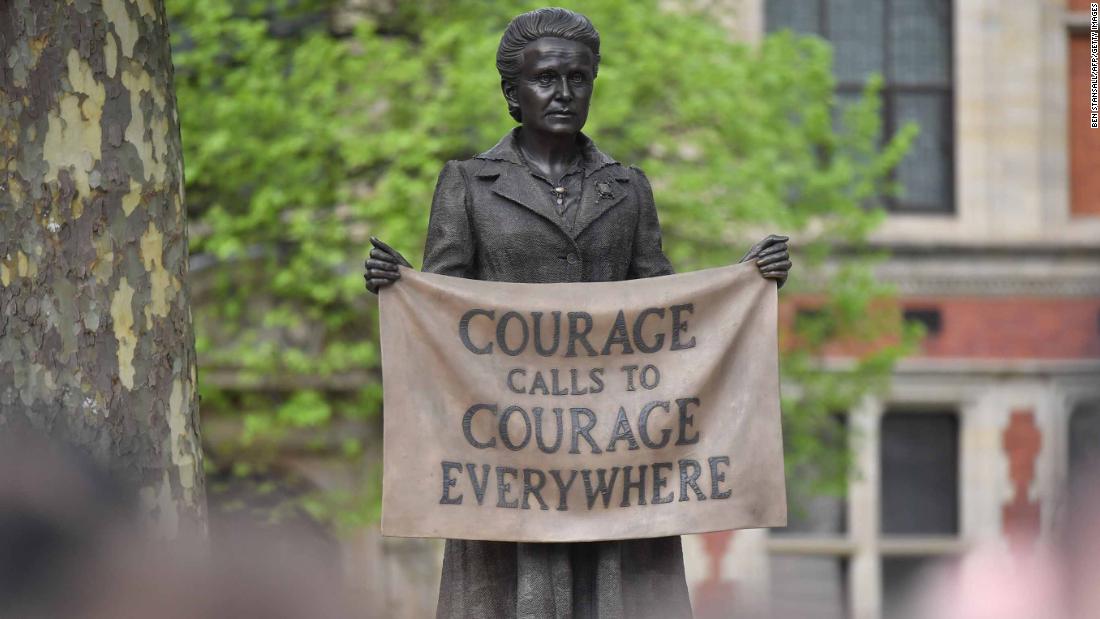
photo: Ben Stansall

The London Socialist Historians Group, which convenes the socialist history seminar at the Institute of Historical Research, University of London, has welcomed the unveiling of a statue of suffragist Millicent Fawcett in Parliament Square on 24th April.

Fawcett unlike the Suffragettes, pushed for votes for woman through traditional means and did not back direct action.

The historians say that there are very few statues of significant women in the UK and more are welcome, although the debate about whether Mrs Thatcher should be amongst them is unresolved.

However what statues get taken up or taken down are a sign of the times. The Guardian (25th April) makes the point well:

But as Mr Khan argued, statues do provide a barometer of the values of a time and a place. Putting them up – and taking them down – can become acts freighted with significance, arousing fierce passions. In the American south, the erection of confederate statues during the era of the civil rights movement reflected a desire to uphold notions of white supremacy. Footage of the toppling of the statue of Saddam Hussein in Baghdad in April 2003 flashed around the world – at the time, it was invoked as symbol of the swift victory of the US and its allies, but later came to signify the bathetic overreach of their ambition. Recent arguments over the commemoration of Cecil Rhodes have been bitter. Whether to commemorate Sylvia Pankhurst – suffragette, anti-colonialist, radical – in a sculpture in London is the subject of a current debate.

The London Historians Group is renewing its call for statue of Sylvia Pankhurst who campaigned for the vote for working women in the East End of London and was briefly associated with the early Communist Party before moving further left.

The historians point out that in the year of the 100th anniversary of some women getting the vote all those who campaigned for the suffrage should be remembered, from Fawcett who was a reformer to the Pankhursts who backed direct action and Sylvia Pankhurst who organised working women.

LSHG Convenor Keith Flett said, generally we are more likely to back the pulling down of statues than their erection but 100 years on from 1918 there is clearly space for many more statues of significant women and Sylvia Pankhurst must be amongst them.


Articles

What is the future of the Campaign for Real Ale as a Campaign?

In Uncategorized on April 23, 2018 by kmflett

What is the future of the Campaign for Real Ale as a Campaign?

The decisions made at the CAMRA members weekend at Warwick University have caused quite a bit of comment. There is dismay, which I share, at the failure to embrace craft together with some widespread misunderstanding of why that might be an issue.

My view is here:

https://kmflett.wordpress.com/2018/04/21/camra-revitalisation-those-who-make-only-half-a-revolution-dig-their-own-graves/

Pete Brown’s take highlighting the crisis in cask ale and CAMRA’s apparent failure to grapple with it is here:

https://www.petebrown.net/2018/04/23/what-should-camra-do-now-to-save-cask-ale-and-itself/

I’m just a beer drinker but I am, and have been for many years a professional organiser and campaigner. It is the potential impact on CAMRA as a campaign that I want to highlight here.

CAMRA is what sociologists call a ‘social movement’ it campaigns for good beer, pubs, responsible drinking etc. It aims to change society a little bit for the better, at least as far as drinkers go.

Social movement theory which fills many volumes works on a basic model of campaigns. They develop around an issue or issues that attract in large numbers of volunteers who are activists and have the time and energy (and usually the youth) to build the movement. Think CAMRA in the 1970s.

As the social movement develops, at least if it is any good, it starts to have influence, maybe some activists become figures in official roles related (but not connected) to the movement. That broadly is CAMRA in the 1990s and early 2000s. It has an influential voice. Its views are quoted in the media and listed to by Government (whether acted on or not).

The third phase of the social movement is one of decline. Some believe that key aims have been achieved, others, getting older and finding other priorities, drop out.

Very few campaigns manage to avoid this model. CND is one that has. Founded 60 years ago it is still going. How has it done that? It has retained its core message (it wants to get rid of nukes) but it doesn’t keep saying that the Cuban missile crisis could lead to the end of the world. Rather it focuses on current threats- Trump- and recruits new younger activists who in turn shape it to some extent in their own image.

Now turn to CAMRA. There is a small hardcore of members whose view of good beer is the same as it was in the 1970s. All keg beer is Grotnys, cask is always best. This does not correspond to reality for many younger people who enjoy good beer and they I suspect see little relevance in CAMRA.

Why in this respect is the refusal to embrace craft beer such an issue?  Craft beer, as Pete Brown notes, does not need a campaign. It is doing quite nicely without one. Indeed I frequently wish there had been a bit less publicity for craft beer events I attend given how rammed they are.

What CAMRA needs are the younger people who like craft beer. Why? Because they are the activists for the future. Just like people such as myself in the 1970s they seek good beer. Not good beer as it was in 1975 but good beer as it is now. Without those people CAMRA as a campaign risks joining the fate of most other social movements and declining to an irrelevant rump.

That is a big problem because just now we do need a campaign for decent beer. I’ll post further on that.


Articles

41 years ago today anti-fascists opposed a National Front march in North London: statement of the protest organiser

In Uncategorized on April 22, 2018 by kmflett

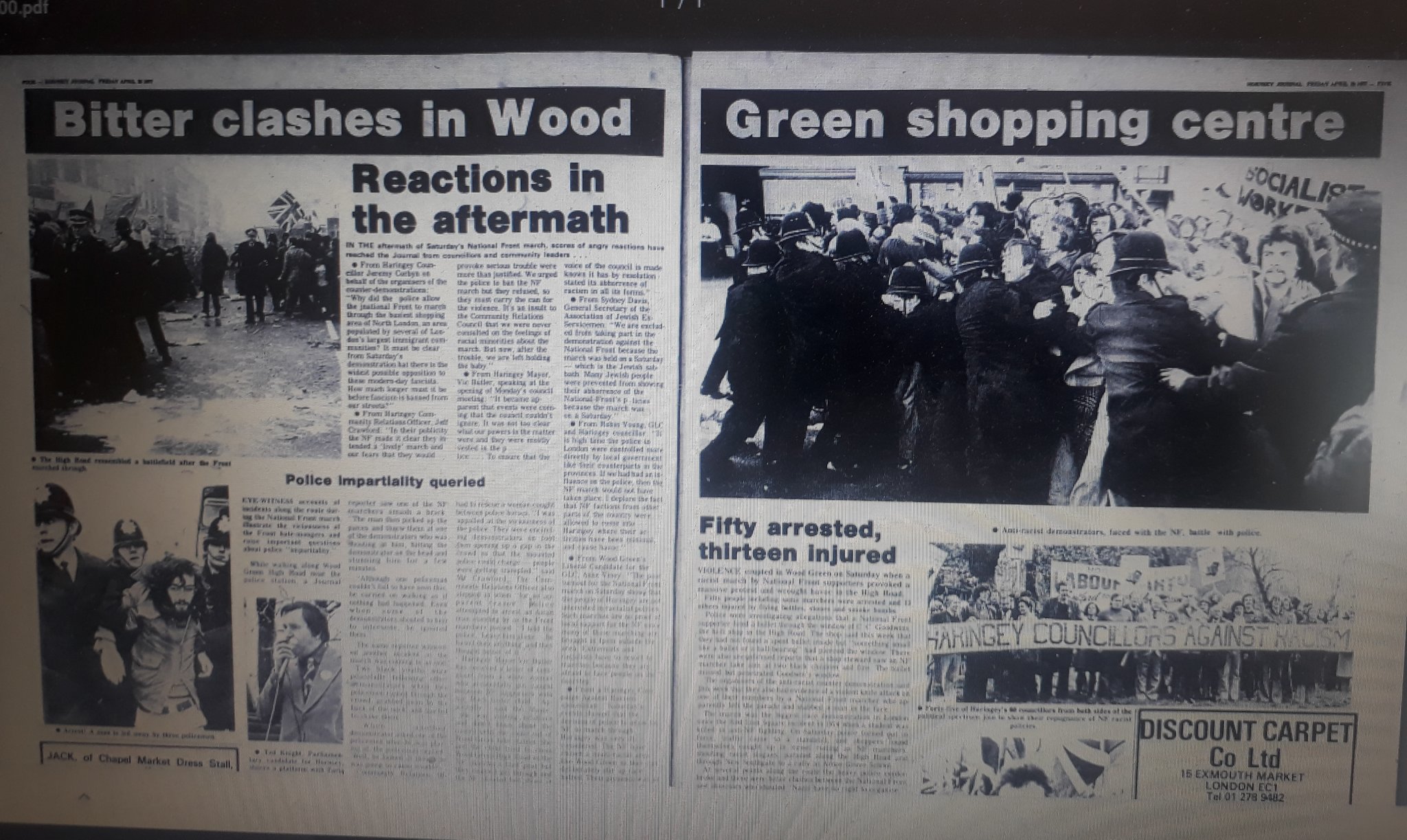
On 23rd April 1977 several thousand fascists from the National Front tried to stage a provocative march on a Saturday afternoon down Wood Green High Rd in North London. They were met by a united protest of local people, including local Councillors, socialist and trade unionists.

Below is what march organiser and local Haringey Councillor Jeremy Corbyn had to say:

From Haringey Councillor Jeremy Corbyn on behalf of the organisers of the counter-demonstrations ‘Why did the police allow the National Front to march through the busiest shopping area of North London, an area populated by several of London’s largest immigrant communities? It must be clear from Saturday’s demonstration that there is the widest possible opposition to these modern day fascists. How much longer must it be before fascism is banned from our streets?’

Articles

The Ambridge Socialist: should Home Farm go vegan?

In Uncategorized on April 22, 2018 by kmflett

The Ambridge Socialist

65 Years of the class struggle in Borsetshire

April 22nd

Should Home Farm go Vegan?

Now that Brian has been purged as MC at Home Farm and Adam has replaced him Kate has put the very reasonable point to him that the farm should go vegan and get out of livestock. Adam isn’t prepared to go that far yet. We shall see how matters develop. A vegan farm in Ambridge would be a worthwhile venture in our view

Pig News

Justin & Neil have been interviewing for operatives for the new pig unit. Jazzer got an interview but was reported to have an unusual interview technique. He didn’t get the job. However he used the interview to extract a pay increase out of Tom which he appears to regard as a result. Ambridge Socialist Editor Keith Flett said, there could be trouble ahead. Jazzer would be well advised to join Unite the Union now.

In Defence of Olwen

Olwen is rightly fed up with the smug bourgeois lifestyle of Pat and Helen so its back to sleeping in the car. We hope however that BBC reporting from Borchester doesn’t attempt to turn her into a caricature Deirdre Spart

In other news

Brian has revealed his secret strategy to Justin. The Ambridge Socialist is investigating. If Donald Trump tweets it there could be consequences.


Articles

The resolution on craft beer & beyond that CAMRA narrowly rejected

In Uncategorized on April 22, 2018 by kmflett

The actual motion at the CAMRA members weekend at Warwick yesterday rejected as the 72.6% in favour didnt reach the 75% threshold is easy to find on-line. The reasoning behind it less so, which is why Ive pasted it below. As a CAMRA member since 1975 I voted for it on the basis that the world of beer is changing and the campaign needs to change too while of course retaining its core principles.

Media reporting has caricatured it as a discussion about whether CAMRA should back lager (I’d have no problem with that,obviously we are not referring to Carling or Fosters, they dont need any support from CAMRA,even if it were warranted which it isnt, they have huge marketing departments)

Anyway judge for yourself. And if you are not a member of CAMRA these are interesting times. Issues that go to the centre of what beer, brewing and pubs are about in the UK are being debated. Why not join and be part of that discussion in a democratic framework?

————————————————————————————————————————————–

SR6. To approve the insertion of the following Article 2(e) in CAMRA’s Articles of Association: “2(e) to act as the voice and represent the interests of all pub-goers and beer, cider and perry drinkers;”

Why?

  • The brewing landscape in the UK could not be further removed from the picture in the 1970s when CAMRA was founded – in 1973 there were fewer than 200 breweries, by contrast the 2017 Good Beer Guide lists more than 1,700
  • Draught beer in the 1970s was available in two broad categories: cask-conditioned ale and keg beer, the latter often made with inferior ingredients, lacking in flavour and devoid of character
  • Members’ testimonies and evidence from the sector show this is no longer the case, with British brewing characterised by innovation and dynamism, manifested not only in the variety of beer styles, but the types of ingredients used and the methods of dispense
  • Boundaries have been blurred and there now exist some keg and other non-cask beers that are high-quality products– brewed with first-class ingredients, matured over a long period, unfiltered and unpasteurised
  • The highest quality keg beers of today contain live yeast, are subject to secondary fermentation and are, to all intents and purposes, real ale up to the point when CO2 pressure is applied in the cellar
  • The consultation revealed many members find some of these products superior to lower-quality, mass-produced cask beer common in pubs – and members questioned why CAMRA champions the latter over the former based simply on dispense method and with no regard to the quality of ingredients, production or taste ● Producers have adopted the term “craft” as a marketing device which, while
  • CAMRA’s failure to acknowledge these developments risks failing beer consumers, but also at best ignores, at worst alienates, one of the most obvious, accessible and youthful potential audiences for real ale
  • With 80% of brewers and almost 70% of licensees saying they sold a greater proportion of “craft” keg beer than five years ago, the majority of members (including active members) polled said it was time for CAMRA to expand the scope of beers it recognises

How?

  • Position CAMRA as the representative and spokesperson for all UK beer, cider and perry drinkers and pub goers
  • Increase the knowledge and appreciation of the quality all types of beer, cider and perry
  • Lobby for a tax regime that favours drinking of beer, cider and perry on licensed premises
  • Forge strong links with other stakeholders, including brewers, licensees, pub owners, national and local government, professional bodies and amenity groups

Activity

  • Provision of beer-related information, educational activities and training opportunities to members, the public and those in the beer and pub sector
  • Campaigning to secure a long-term freeze or reduction in beer duty
  • Secure reform to small breweries relief to maintain growth and support investment

Articles

CAMRA revitalisation: those who make only half a revolution dig their own graves

In Uncategorized on April 21, 2018 by kmflett

CAMRA revitalisation: those who make only half a revolution dig their own graves

It’s the CAMRA members weekend at Warwick University-read national conference-and members have been considering proposals for change.

The results indicate, in my view, progress but not enough progress.

Why does this matter? For many who I met today at Five Points 5th birthday party in Hackney and at the Beavertown and Pressure Drop taprooms in Tottenham it does not. They were not aware the event was happening and very few are members. Yet everyone was at these three venues because they like good beer- cask, keykeg and indeed in some cases keg.

I’ve been a member of CAMRA since 1975 (my thoughts on this are linked below) and I won’t be leaving. I was among the 18,000+ people who voted on the resolutions based on the revitalisation project. That is a several years long review of how CAMRA is relating to the modern world of pubs, beer and brewing. I was also one of the 16,000+ people who voted for 4 places on the CAMRA Executive. CAMRA has over 190,000 members. Food for serious thought there.

I care because I think that an independent voice for consumers is vital in the modern world of beer. Of course CAMRA is a Company (hence the 75% threshold for changes to be passed, absurd in my view) and there are always comprises in life. However CAMRA owns no pubs or breweries and can speak out independently. That is important when even the most on trend craft brewery could be tempted by a buy-out from a global mega-drinks outfit. It happens frequently across the globe.

The results today saw CAMRA members back change up to a point.

Unfortunately Special Resolution 6 fell just short of the 75% threshold at 72.6%. So what you may say? Here is a paragraph of that Resolution:

‘CAMRA’s failure to acknowledge these developments (craft beer KF) risks failing beer consumers but also best ignores, at worse alienates one of the most obvious accessible and youthful audiences for real ale’

Well indeed yes. Of course as Roger Protz tweeted it was only just short of 75% and if CAMRA was organised sensibly 50% or 66.6% should have seen it passed.

Unfortunately the Executive results didn’t help much. I wont name names except to say that I was very disappointed that Tiny Rebel’s Bradley Cummings fell just short of being elected. Perhaps he should be co-opted. Of the 4 candidates who were elected one is in favour of craft, one is a craft-phobic and the other two candidates were silent on the matter. I’ve no doubt all work hard and are great campaigners. But it’s a direction of travel we’re looking at here.

So to echo the words of Saint Just, those who make only half a revolution dig their own graves. Let’s hope not though I’m sure there will be numbers saying so in rather less temperate tones.

I, as above, will be staying. Here is why:

https://kmflett.wordpress.com/2018/04/21/why-im-not-leaving-camra/


Articles

1848: the Communist Manifesto 170 years on & Yanis Varoufakis in the Guardian

In Uncategorized on April 21, 2018 by kmflett

1848: the Communist Manifesto 170 years on & Yanis Varoufakis in the Guardian

The Communist Manifesto was first published, in London, but in German only, 170 years ago, on 21st February 1848. The preamble went as follows:

A spectre is haunting Europe — the spectre of communism. All the powers of old Europe have entered into a holy alliance to exorcise this spectre: Pope and Tsar, Metternich and Guizot, French Radicals and German police-spies.

Where is the party in opposition that has not been decried as communistic by its opponents in power? Where is the opposition that has not hurled back the branding reproach of communism, against the more advanced opposition parties, as well as against its reactionary adversaries?

Two things result from this fact:

Communism is already acknowledged by all European powers to be itself a power.

It is high time that Communists should openly, in the face of the whole world, publish their views, their aims, their tendencies, and meet this nursery tale of the Spectre of Communism with a manifesto of the party itself.

To this end, Communists of various nationalities have assembled in London and sketched the following manifesto, to be published in the English, French, German, Italian, Flemish and Danish languages.

The Manifesto was published just 4 days before revolutionary events toppled the King in France and started the revolutionary year of 1848. However it had no impact on those events, as it was not available either in France or in French.

An English translation by the female Chartist Helen Macfarlane, appeared in the Red Republican in 1850, after the revolutionary wave had subsided.

The point is not that Marx and Engels had a better crystal ball than anyone else but they had correctly analysed the old order in Europe by 1848 was creaking and ready in places to change. They could do little more at the time to influence the course of events than analyse them, though Engels in particular was involved in revolutionary events in what is now Germany in 1848/9. Marx was deported and found his way to London by 1849 as a political refugee. The predecessors of Theresa May as Home Secretary were a little more relaxed about such things.

The Manifesto itself however provided the beginnings of a theoretical basis, overtime, for the development of a serious left based on the revolutions of 1848 and indeed their defeat.

The Guardian has (20th April) published an interesting extract from an introduction to a new 170th anniversary edition of the Manifesto by Yanis Varoufakis where he argues that the ideas expressed in it are if anything more relevant now than in 1848.

https://www.theguardian.com/news/2018/apr/20/yanis-varoufakis-marx-crisis-communist-manifesto

It’s difficult to know how interested the current generation of Guardian readers are in such things, although a passing reference to the extract in a letter from Colin Hines where he describes Varoufakis as ‘gung ho’ (21st April) in defence of Marx at least clarifies that correspondents place on the political spectrum.

Varoufakis in my view rather avoids making the link between theory and practice that Marx and Engels very clear did make in that year of revolutions, 1848. One hopes 2018 will provoke further discussion, and activity

Articles

Why Im not leaving CAMRA

In Uncategorized on April 21, 2018 by kmflett

Why I’m not leaving CAMRA

I joined CAMRA in 1975 I remain a member and I’m not leaving.

This weekend sees an important CAMRA members weekend at Warwick University that will see some sort of conclusion to a ‘revitalisation’ process that has seen the organisation try to grapple with the rise of craft beer, even if it comes in keykegs and is not dispensed by handpumps.

I’m often asked how I voted on the revitalisation plans and for Executive members (there was an on-line and postal ballot). The answer is I voted for change and for candidates who want change. I’ll be 62 later this year and I have a beard.

I’m not sure that the revitalisation proposals will go through as they require a 75% yes vote (I think) a rather high hurdle and one I wouldnt have gone near as a trade union officer. I hope at least pro-change candidates win Executive places.

The reality is that CAMRA is, or certainly appears to be, an ageing organisation with a substantial numbers of members who were active, like myself, in the 1970s and haven’t yet left that decade. In their view CAMRA is about hand pumped cask ale full stop.

I recall the 1970s. They were not great days for those who liked good beer, hence the vital campaigning role of CAMRA. In London many pubs sold only old-style keg. Cold, fizzy and tasteless. Youngs stuck by cask but had few pubs in North London where I still live. Fullers had switched to top pressure leaving just a handful of places, like the Anchor and Hope on the Lea at Clapton that were so out of the way they couldn’t be bothered to take the handpumps out.

Elsewhere you had to rely on Charrington IPA and Bass and occasionally hand pumped Courage Best or Wethereds from Marlowe (Twitbread). The beer was often not great and didn’t taste of much but at least it tasted of something vaguely related to malt and hops.

The situation could not be more different now. CAMRA won a battle for cask beer (not the battle) so handpumped beer continues to be much easier to find now than it was in the 1970s and in much greater variety.

The rise of craft keg in the last 10 years has proved a challenge. Is it real ale? I live in Tottenham and I’d suggest that the hundreds of young people that throng the Beavertown and Pressure Drop taprooms every Saturday actually don’t care. They just like good beer and they are mainly not CAMRA members. They should be.

Of course social movements like CAMRA have their own dynamic an issue I’m suspect CAMRA is not all that keen to reflect on. Most grow, achieve some of their aims and decline. Only a few, CND being the key UK example, continue because they recruit new people and new activists in each generation with a new message but still framed by their core principle (in this case getting rid of nukes).

On Saturday I wont be at Warwick but at the 5th birthday celebration for Five Points Brewery in Hackney (it does cask) and then at a Verdant tap takeover at Pressure Drop in Tottenham (if I last that is). Good beer and hopefully after the weekend CAMRA will be on board with that. If not I’ll still be a member because in the world of breweries, pubs and business an independent consumers campaign is important even if doesn’t always get the campaigning focus right.

Articles

British Justice before Theresa May: transported to Australia for stealing cheese

In Uncategorized on April 20, 2018 by kmflett

As an historian I was of course well aware that British justice has hardly always lived up to the concept and where it has its often been due to ordinary people, what EP Thompson termed the ‘Freeborn Englishman’, fighting for it. Thompson notes of the period 1790-1840 in the Making of the English Working Class (Standards and Experiences) ‘the southern rural labourer refused to abandon his diet of bread and cheese even when near the point of starvation; and for nearly fifty years a regular dietary class-war took place..’

I didnt however know until a discussion at the excellent Wine and Rind cheese stall in Tottenham (@winenrind) today that people were actually transported to Australia for stealing cheese in the first half of the nineteenth century.

A list of those so convicted is here:

https://convictrecords.com.au/crimes/stealing-cheese

London based Australian cheese makers Blackwoods have been naming cheeses after some of the unfortunates who were transported:

http://boroughmarket.org.uk/articles/blessed-are-the-cheesemakers-edmund-tew

His transportation record is here:

https://convictrecords.com.au/convicts/tew/edmund/73407