Articles

Campaigners pay tribute to actor Alex Beckett who played Perfect Curve’s Barney Lumsden in W1A

In Uncategorized on April 12, 2018 by kmflett

Beard Liberation Front

PRESS RELEASE 12th April

Contact Keith Flett     07803 167266

Campaigners pay tribute to actor Alex Beckett who played Perfect Curve’s Barney Lumsden in W1A

The Beard Liberation Front, the informal network of beard wearers, has paid tribute to actor Alex Beckett who has sadly died at the too young age of 35

http://www.bbc.co.uk/news/entertainment-arts-43737714

Amongst many other roles Beckett played the magnificently hirsute Barney Lumsden in the BBC comedy series Twenty12 and W1A about the image and brand of the BBC itself.

As a key figure in the consultancy firm Perfect Curve Lumsden was responsible for promoting absurd rebranding ideas which were invariably taken seriously by his BBC equivalents.

The campaigners say that Beckett brilliantly portrayed a certain kind of middle-class hirsute hipster who baffled people by talking nonsense.

Lumsden’s twitter avatar gives his location as Shoreditch and describes himself as ‘Information Architect at Perfect Curve PR. The town planner of your mind.’

BLF Organiser Keith Flett said, we don’t normally enjoy hirsute stereotypes but Beckett’s portrayal of Lumsden nailed perfectly a certain kind of bearded poseur. How sad that he has died so young.

Articles

Haringey Labour Manifesto 2018: back to what might work

In Uncategorized on April 12, 2018 by kmflett

Haringey Labour Manifesto 2018: back to what might work

Not many people read manifestoes. Political journalists might do, political activists should do, historians will do later and voters will rarely bother.

After all what is said in a manifesto and what actually happens rarely corresponds that much. Reality intervenes.

That said the Haringey Labour Manifesto for the 2018 Council Elections will in due course be read and analysed in the media because the right-wing media and the right-wing of the labour movement have decided that should Labour win (that is up to voters) then in May the Borough will have the first ‘Corbyn’ Council. I struggle to grasp what that means and the media wont bother going beyond using it as a ‘boo’ phrase.

That said it will clearly be different to the Labour Council of the past 4 years which for those with long memories on the left has had the feel of a touch of a certain kind of Maoist politics (which given how far right in the Labour Party it was is an odd but explicable development). Essentially that means it favoured putting politics in command. Its plans to change things came above reality, which was a distant vista, and certainly above the impact they would have had.

By contrast the 2018 Manifesto focuses on what might work.

It correctly notes that after years of Tory and LibDem backed austerity cuts to Council budgets what can be done is limited. The previous Council shared that point. However instead of developing grand plans it focuses on practical matters.

The HDV will not go ahead. Instead a modest number of Council houses built in-house are proposed. Where it can be done some of the most essential services that have been cut may be restored and so on.

It is trying to do what a Labour Council should do which is to be on the side of ordinary working women and men and try to make their lives just a little bit better. Its not revolutionary but it means a lot to those concerned.

I should mention for completeness and because this is bound to become an issue that the world ‘socialism’ does not feature. A pity in my view. Nor more seriously is there anything about working with local trade unions. There should be and that needs to be addressed. When I was young back before Keir Hardie was leader of Labour the Labour Party and Haringey TUC wrote local election manifestoes jointly.

Finally there is no mention of any plan to erect a statue (even funded by public subscription) of former Haringey Councillor Jeremy Corbyn at Spouters Corner. Why not? One gesture would do no harm.

Any way make sure you vote on May 3rd and make sure you Vote Labour.

https://d3n8a8pro7vhmx.cloudfront.net/labourclp402/pages/1224/attachments/original/1523186587/Haringey_Labour_Party_LE_Manifesto_2018.pdf?1523186587


Articles

Beavertown cans in Waitrose: a welcome advance for good modern beer

In Uncategorized on April 11, 2018 by kmflett

Beavertown cans in Waitrose: a welcome advance for good modern beer

The other day I stopped by one of the best known and longest established ‘craft’ beer bars in central London. It had been quite a long day and I was after a quiet pint. Given it was early in the week that should have been possible. Unfortunately it wasn’t. The beer was on top form, both cask and keg (I had two pints) but also in the bar were two groups of middle aged men in suits who may have had a beer or two. They were not particularly quiet. While that rather undercut my purpose I fell to reflecting that not so long ago such people would not have been seen in such a bar and if they had stumbled in would not have known what to drink and probably wouldn’t have liked it anyway.

Tastes are changing and the market for good modern beer is expanding.

It is in that context that I think that Beavertown’s announcement today that half their core range of beer (Neck Oil, Gamma Ray and Lupuloid IPA) will be available in can in Waitrose from 30th April is entirely welcome.

Of course just now its not certain that the world will make it to 30th April but if it does it will mean that good beer is making progress. I shop in Waitrose fairly often (given the fact that Waitrose stores are not all that widespread, even in North London, their market share is the same as Lidl who likewise don’t have that many shops). They do have a wide range of beer and a fair bit of craft but ultimately Thornbridge aside, the best choice should one be looking for some cans is usually Punk IPA. There is nothing at all wrong with that beer but I don’t think its exactly the pinnacle of the brewers art.

No doubt some will say Beavertown have ‘sold out’ and that it causes problems for independent bottle shops who sell the core range. It’s a fair point but the shops seem to have survived by selling the vast choice of great beer that is not in Waitrose or any other supermarket and is unlikely to be so. Plus I doubt all that many are situated within easy reach of a Waitrose.

So for those of us that want to see good beer winning out and want it to be easily accessible to ourselves and others this I think is good news. I’ll be celebrating with a Bloody ‘Ell on Saturday (not available in Waitrose)

Articles

Rainy Mondays: did the weather play a part in the Chartist rally on 10th April 1848?

In Uncategorized on April 11, 2018 by kmflett

Did the weather play a part in the Chartist rally on Kennington Common 10th April 1848?

Monday 10th April 1848: dry but damp underfoot?

Most historians (there are obviously notable exceptions) have no experience of organising a demonstration and that is true of many of those who have opined about the Chartist rally for the vote on Kennington Common 170 years ago on Monday 10th April 1848.

The event was marked by a gathering organised by the Kennington Chartist Project in what is now Kennington Park a rather smaller space than the Common was. There was one distinct similarity between 1848 and 2018. There had been heavy overnight rain and the grass was waterlogged (much to the enjoyment of numbers of dogs who were present due to some kind of dog walkers convention)

If you ever organised a protest you’ll know that if the sun is out and the temperature is OK (for Britain) it promotes a higher turn-out whereas if it’s cold and wet fewer people will show up. Who can blame them?

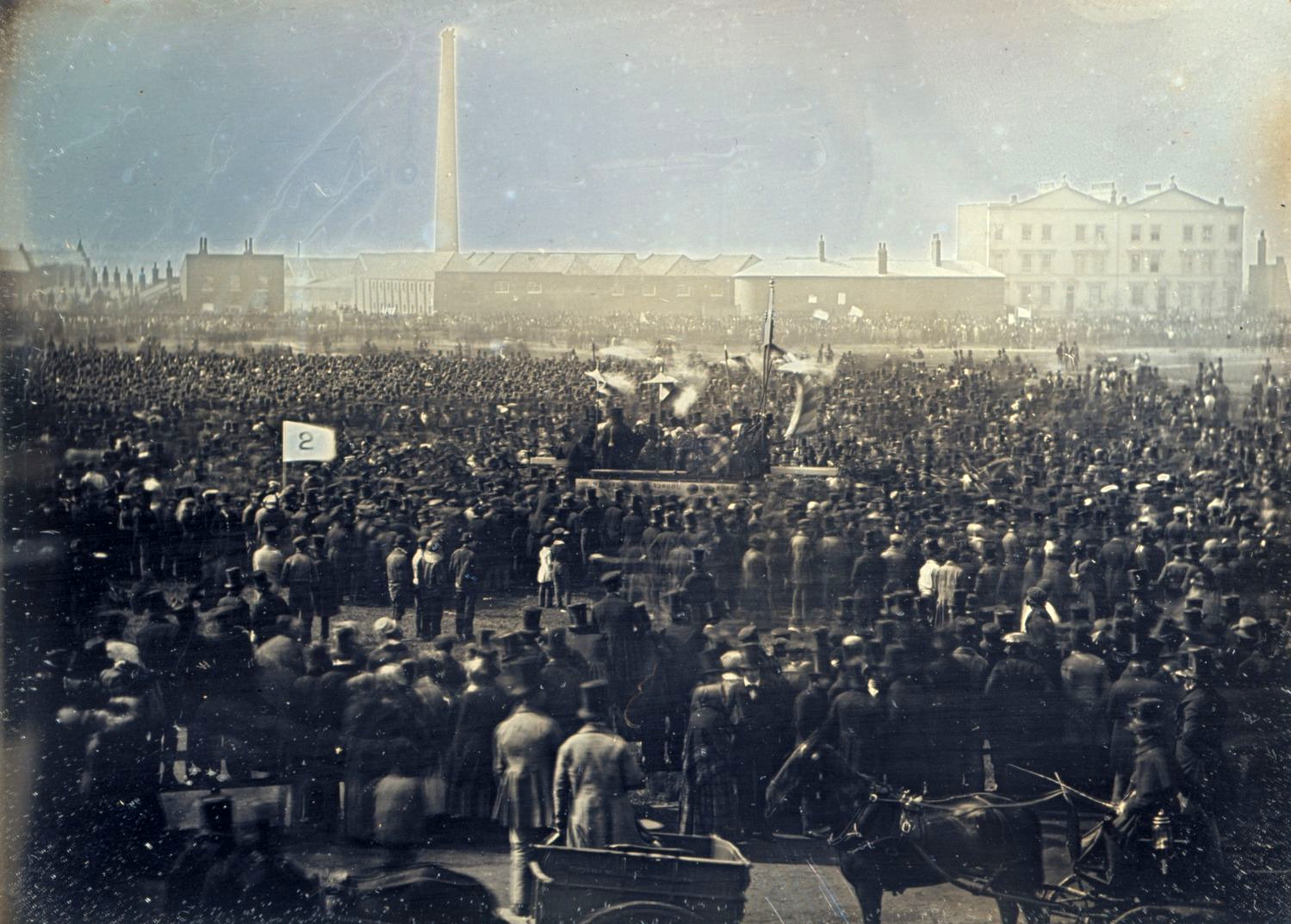
In his book on London Chartism 1838-1848 David Goodway suggests that one reason for the famous photograph of the rally looking the way it does (with an empty space near the main Chartist platform) is that people stayed at the edge of the Common where it was drier. There was a bit of that in 2018 too. The Times report on 11th April 1848 however notes that the ground while wet was firm.

After the rally finished many of those present sought to return to the more pleasant vistas of North and East London by going over Blackfriars Bridge where they were met, for a time, by police and soldiers who refused to let them cross. Some traditional histories have it that the crowd dispersed due to heavy April showers. Yet neither the reports of the Times or the Illustrated London News (let alone the Northern Star) mentions rain. Dispersal of demonstrators in so far as that happened related to the deployment of police truncheons and other weaponry.

So clearly, you don’t need a weatherman..

Articles

How big was the Chartist demonstration on 10th April 1848?

In Uncategorized on April 10, 2018 by kmflett

How big was the Chartist demonstration on 10th April 1848?

Estimates for the numbers attending demonstrations tend to vary a lot from, low side (the authorities) to high side (organisers) and getting a sense of the reality is invariably awkward. Splitting the difference is not the answer.

In terms of 10th April 1848 there is of course a very well-known photograph of the Chartist rally but it is widely accepted that this was taken before the attendance peaked.

David Goodway’s in his book on London Chartism 1838-48 notes that there was a sort of official campaign by those in authority to claim that the rally was only 20,000 strong and numbers of papers the following day repeated that. The Times reported the most liberal estimate as 50,000 people

The organisers on the other hand, including O’Connor, claimed 400,000 or 500,000 which was as absurd as the 20,000 figure. The population of London in 1848 was around 2.2 million so that would have meant around 25% of the entire Capital showing up. The National Chartist Convention estimate was 250,000 while Goodway mentions an estimate of a freelance reporter working for The Times TE Fowler of 200,000.

A number of leading Chartists on the day thought the figure was 150,000 and Goodway on balance supports that.

It was clearly a sizeable demonstration, but it was not the size that allowed the authorities and subsequent historians to paint it as a failure. Rather it was the alleged failure of the Chartists to storm Parliament or seize power that, in the context of the European 1848, suggested this reaction. Plus of course the frenzy of concern the authorities had got themselves into about the possibility.

That however was not what the Chartists had planned for 10th April. Their aim was to deliver a mass petition for the vote to Parliament. That was done, but not quite in the way they intended.

Articles

10th April 1848: the importance of Blackfriars Bridge for the Chartists & the Government

In Uncategorized on April 10, 2018 by kmflett

The importance of Blackfriars Bridge for the Chartists and the Government on Monday 10th April 1848
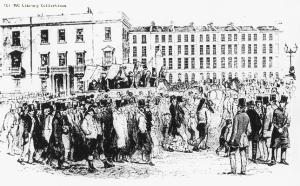
Blackfriars Bridge 10th April 1848

Why was Blackfriars Bridge such a focus before and after the Chartist rally at Kennington Common on 10th April 1848?

Firstly of the four main meeting places for the rally only one, Peckham, was south the river. The others, Stepney, Clerkenwell Green and Russell Square were north. That meant that a bridge had to be crossed, but which one?

Waterloo and Hungerford bridges were at that time subject to a toll and therefore out of bounds. Westminster was not but it was not only the most heavily guarded but also the bridge more likely to have been used after the rally if the plan to march with the petition to Parliament had been carried through.

After the rally, as indicated in the report below, there were considerable struggles at Blackfriars Bridge. Some may have been planning to march on Parliament, most however were probably simply planning to return home.

The story associated with press coverage on or just after the day that heavy rain showers in the afternoon dispersed people is not mentioned here. I will post further on the weather on 10th April 1848.

The decision to meet south of the river was discussed in the days immediately after 10th April at the Chartist National Assembly in London (a gathering of 49 delegates the maximum allowed by law). Ernest Jones who was to become the post-1848 leader of left-Chartism argued that the decision to meet in South London had been a mistake because of the issue of crossing the bridges. Yet it remains unclear where else the Chartists could have met, given the size of the rally, within reasonable marching distance of Parliament given that the Royal Parks were all out of bounds to them.

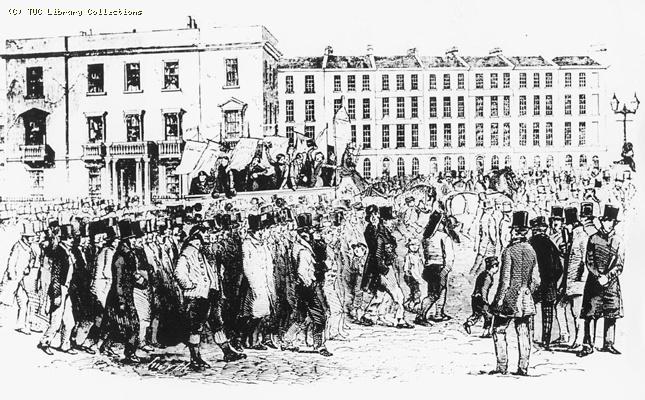
BLACKFRIARS. (report from the Illustrated London News)

“Part of the procession sketched at Blackfriars Bridge”, from the Illustrated London News of 15 April 1848.

The bridges were the chief points of defence, of which Blackfriars-bridge appeared to be a sort of centre, as it had the strongest force. The proceedings in its neighbourhood were nearly as follows:- By ten o’clock a considerable crowd had collected in Farringdon-street and New Bridge-street, and at the point where Fleet-street and Ludgate-hill join this line of street. The stable-yard of the Rose Inn, in Farringdon-street, had previously been occupied by a body of cavalry. Special constables were also mustered in great force by the authorities of the ward, but kept out of sight. Soon after ten the crowd assumed a “processional” shape, and by half-past ten began to pass over the bridge. Men who had been talking together in groups joined arm-in-arm, and the march commenced. From half-past ten till half-past eleven one continuous stream of people crossed the bridge – the pavement on the east side being occupied by the more systematic procession, and the roadway being thronged by a closely-packed body. At the latter hour vans, decorated with flags, and containing some of the leaders of the “demonstration,” made their appearance, and passed on without any appearance of confusion. With the exception of a few closed shops, there were, in this locality, no signs of alarm, and no symptoms of disorder.

After the meeting on Kennington-common had dispersed, an immense crowd on their return straggled irregularly along Blackfriars-road. Upon arriving at Stamford-street, they of course came face to face with the mounted police, who refused them passage, and ranged themselves across the road. Together with these were the police and special constables. Many strenuous attempts were made by the Chartists to get across the bridge. As fresh numbers arrived from Kennington-common, those in advance were pushed forward, but were immediately driven back by the horse-patrol without drawing their sabres. The metropolitan police made use of their staves, and, from time to time, repulsed the crowd, which grew thicker and thicker every minute. In about an hour and a half, however, the mob, which, by this time, reached as far down as Rowland Hill’s Chapel, made many vigorous attempts to force their way through; and, notwithstanding the cool steady courage of the police, the latter were, at intervals, separated. The special constables at these times were very roughly handled, a great many of them having their hats broken and being deprived of their staves. Showers of large stones were every few minutes thrown on the bridge, and the police received many severe blows, but gave more than equivalent in return with their batons. A great number of men who were seized by the police for throwing stones were rescued, and the yells and shouts were deafening. At half-past three o’clock the pressure of the concourse was so great that the line of police was forced, and a great many of them carried with the throng over the bridge, holding their staves up as they were borne along. On the City side of the bridge a great many arrests were made, and the mob, which seemed inclined for a minute to make a stand, were uniformly repulsed by the horse patrol, the sight of whose drawn sabres, wielded over the heads of the mob, soon put the more noisy and impudent to flight. Both on that and the other side of the bridge there were numbers of men with their heads bleeding, who were led away by their friends.


Articles

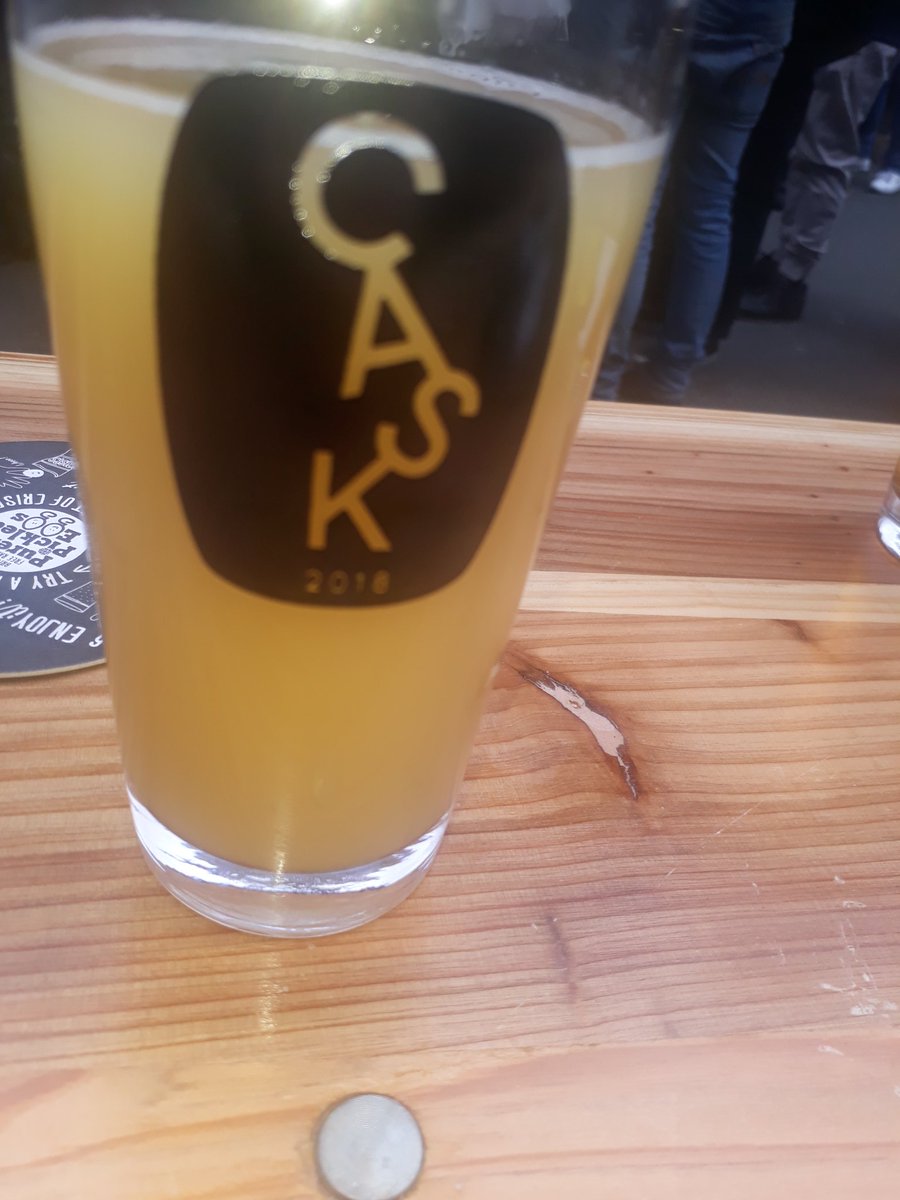
Cask 2018: if it tastes good, drink it

In Uncategorized on April 9, 2018 by kmflett

Cask 2018

I’m in my 43rd year of CAMRA membership (& I won’t be leaving as a result of any decision taken at the forthcoming members meeting at Warwick University) so I may have drunk a glass or two of cask ale over the years. Perhaps to put it another way I have served my time on perfectly ok but often quite dull brown beers, often with the balance of malt and hops tending towards the former. So I’ve welcomed the rise of ‘craft’ beer however defined.

In that spirit I was pleased to be at Saturday’s session of Cask Ale 2018 (with Megan Davies). It was organised by Affinity brewery who started life just a few minutes down the road from where I’m writing this in Tottenham Hale but then defected to Sarf. Apparently the area is known as Bermondsey.

I tend to think that one of the purposes of Cask 2018, held at Affinity and at Partizan just around the corner (another defector from Tottenham) was to persuade those who drink perhaps some of the more esoteric craft beers on keg, as I certainly do, that cask can be just as interesting while also providing some mainstream cask beers from newer breweries.

I tended to avoid beers from those breweries who I know do excellent cask ale such as Tiny Rebel in Newport and Redemption in Tottenham. I was more interested in trying beers from those breweries who don’t produce so much cask. Pressure Drop’s DDH Pale, Parachute was good, and a little murky. Brew By Numbers IPA was full murk while Bristol’s Left Hand Giant pale was only slightly murky by comparison.

I write this because of course one fetish about cask ale has been that it should be absolutely crystal clear. And so it should be if it is designed that way. If it is not fined then it will be less clear and if it has certain ingredients in it, it will be even less clear than that. So the taste counts here rather than the sight.

That is quite an issue for cask ale drinkers I think, although most should be able to recall glasses of absolutely clear cask that were in fact off.

There was a good range of strengths available to from 3% through to 11% and at £2.50 a half that balanced itself out decently, unless of course you drink your cask ale primarily in Wetherspoons.

In short on Saturday it was a very well attended and enjoyable event. I understand the intention is to repeat it in 2019. In the meantime no doubt debates around cask and craft ales and the relation between the two will continue. As above my view continues to be, if it tastes good, drink it. If it doesn’t, don’t.

Articles

Cask Ale: the lacunae of Brewdog

In Uncategorized on April 9, 2018 by kmflett

The annual Brewdog members weekend has produced some interesting updates for beer enthusiasts. James Beeson of the Morning Advertiser has the report here:

https://www.morningadvertiser.co.uk/Article/2018/04/06/BrewDog-bosses-admit-regrets-over-Pink-IPA-stunt?utm_source=copyright&utm_medium=OnSite&utm_campaign=copyright

One particularly interesting point of the Q&A session with James Watt and Martin Dickie was on their plans for the Draft House chain of bars they have just acquired. Their decision to pay the Living Wage in them is very welcome. Interestingly however the existing cask range will be kept because ‘if you think classic British you think cask ale’

I agree. Cask ale is the pinnacle of British brewing, although as we know quality and consistency is not always easy to achieve.

It does however beg an interesting question. If that is what Brewdog’s founders think how come they dont produce any cask ale themselves? After all they certainly did once, and I recall enjoying drinking it..

Articles

In defence of anti-capitalist beetroots

In Uncategorized on April 8, 2018 by kmflett

In defence of anti-capitalist beetroots

A good deal was made this week of a report by the hard-right blog Guido Fawkes, now summarised in the Daily Mail by Andrew Pierce, about Jeremy Corbyn’s attendance at a Seder event in North London.

One part which seems particularly to have seized the interest of social media relates to beetroots. At one point in the evening, it is alleged that a beetroot that Mr Corbyn had brought from his East Finchley allotment (some reports have also mentioned horseradish) was held aloft and the words ‘f*ck capitalism’ were said to some apparent amusement.

The story about the beetroot coming from the Labour leader’s allotment remains unconfirmed, even by those who were present.

However what Mr Corbyn’s detractors clearly don’t know is that it was Karl Marx himself who connected beetroot and capitalism. Writing in the Neue Reinische Zeitung in December 1848 on the state of affairs in Germany in that revolutionary year Marx noted that:

The aristocracy itself was largely bourgeoisified. Instead of dealing in loyalty, love and faith, it now dealt primarily in beetroot, liquor and wool

Elsewhere on social media this week it was suggested that beetroot and marmite sandwiches are worth trying. I’m not sure whether Jeremy Corbyn has any plans in that direction although he is a noted adherent of marmite.

But as the beetroot ‘row’ rolls on Jeremy Clarkson in the Sunday Times has added his, as ever, astute take on the issue:

Instead he rocks up in an anorak, obviously, with a bundle of fresh beetroot, which is the most right-on thing I’ve heard of.

What higher praise could the humble anti-capitalist beetroot receive?

Articles

Campaigners say pogonophobia is a key cause of criticism of Jeremy Corbyn

In Uncategorized on April 8, 2018 by kmflett

Beard Liberation Front

8th April

Media Release contact Keith Flett 07803 167266

Campaigners say pogonophobia is a key cause of criticism of Jeremy Corbyn

Lord Salisbury, the last hirsute Prime Minister

The Beard Liberation Front, the informal network of beard wearers, has said that it believes pogonophobia, irrational dislike of facial hair, is a key cause of criticism of Labour leader Jeremy Corbyn.

They say that the thought that a person with a beard could become the first hirsute Prime Minister since Lord Salisbury in 1902 is deeply unsettling for some.

Mr Corbyn has come under attack for failing to respond vigorously to instances of anti-Semitism, for being too friendly to Russia, for being a Czech spy and for growing anti-capitalist beetroots on his allotment amongst other things.

While political leaders will always attract legitimate criticism the BLF believes that an element of the recent attacks on Corbyn is related to a fear that he is hiding something under his beard.

BLF Organiser Keith Flett said, we are consulting on the launch of a Campaign to Defend Jeremy Corbyn’s beard, which will attempt to expose the pogonophobic aspects of attacks on the Labour leader and promote a positive sense of the hirsute