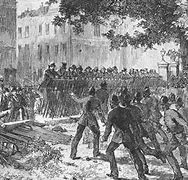
From the Chartists & the Suffragettes to Palestine, Parliamentary Democracy rests on exercising the right to protest. The case of Hyde Park May 6th 1867
Jeremy Corbyn has written a very good piece for Tribune on the Government’s plan to ban Palestine Action and the importance of the right to protest and actual protests to Parliamentary Democracy.
One wonders what Yvette Cooper would have made of the Chartist attempt at insurrection in Newport South Wales in November 1839 which nearly succeeded had she been paying attention in school history lessons.
The point as Jeremy Corbyn underlines is that you have to keep on protesting and if you do, not only is democracy strengthened but on occasion the many can overcome the few.
One example can be found on 6th May 1867. The Government banned a demonstration in Hyde Park. It didn’t work out as they expected
Historically we haven’t heard much about successful demonstrations for example, but they do exist.
When the Chartists gathered on Kennington Common on April 10th 1848 to protest for the vote they failed. They were prevented from even marching. The failure of the Chartists on that Spring Monday in South London is well known.
Rather less well publicised is what happened on a subsequent Monday, not quite 20 years later, on 6th May 1867 when many of the same activists, under the auspices of the Reform League, marched to Hyde Park, and did so again for the vote
It was one of the most immediately successful demonstrations in British history to date.
The Reform League was a combination of middle class radicals, former Chartists and working class trade union activists. The May 1867 demonstration was the latest in a series demanding an extension to the franchise.
Both Liberal and Tory Governments had looked at extending the vote to allow more working class voters, but deliberately not enough ever to have a majority influence. Gladstone boasted that his property qualification for the vote would still leave less workers enfranchised than had been before the 1832 Act.
The Government took the decision to ban the League’s proposed rally in Hyde Park and mobilised large numbers of police, special constables and troops to ensure that it did not go ahead.
The League was far from a revolutionary organisation but it determined that it would continue with its plans.
At 6pm on Monday 6th May 1867 a protest of 150,000 people approached Hyde Park led by the Clerkenwell branch of the League with a red flag topped with a cap of liberty on a pole.
There was no confrontation. Faced with the League’s determination, the Government backed down.
The right-wing press was beside itself. The Home Secretary Walpole had to resign.
Meanwhile the impact of the campaign for an extension of the franchise was felt at once. In the Commons the Liberal leader Gladstone announced his discovery that the people wanted reform of the franchise. The actual measure, known as the Second Reform Act, which was passed in short order was far more radical than anything proposed before May 6 1867, extending the franchise by four times more than previously discussed.
Historian Royden Harrison noted of the working-class impact on the demonstration ‘If it was increasingly respectable it was increasingly well organised. If it had abandoned its revolutionary ambitions it had not wholly lost its revolutionary potentialities’.
The trade union leaders of the Reform League- far from the most radical of men- Applegarth, Odger and Howell- knew why the fight was worthwhile.
In 1863 the Manhood Suffrage and Vote by Ballot Association noted that ‘the evils under which we suffer have a common origin, namely an excess of political power in the hands of those holding a higher social position’.