Marx’s New Resolution for 1863 & why he didn’t keep it
I had even decided to become a ‘practical man’ and enter a railway office at the beginning of next year. Luckily-or perhaps I should say unluckily-I did not get the post because of my bad hand writing’
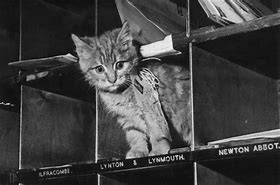
Cats as Royal Mail mice catchers & the permitted payment
The HQ of the Royal Mail was in St Martins Le Grand (near St Pauls) from 1829 to 1912. In the authorised history of the postal service Matters of the Post (Penguin 2012) Duncan Campbell Smith records an issue with mice at the HQ building.
In 1868 Mr Jackson the Controller of the Money Order Department Mr Jackson had written that there was a problem with mice nibbling at paid money orders. Mousetraps had not worked so he asked for permission to acquire cats to do the job.
There was of course an official policy for this. Up to three cats could be acquired. They should be females (more likely to catch things than fight) and they should be on probation for performance purposes. The cats were not to be overfed and a shilling a week was allowed for this purpose. The remainder of their ‘emolument’ was to be mice. If the number of mice had not been reduced in six months then the amount paid for feeding should be reduced. It was also required that statistics were kept on the number of mice caught.
Campbell-Smith records that the instruction (known as a PI- Postal Instruction) remained in force for many years.
Whether or not the cat solution worked is not revealed. However for many years until 2020 (when it moved to another part of the City of London) I worked at the HQ of Post Office Telecommunications (since 1984 BT) which was immediately opposite the old Royal Mail HQ. There were certainly issues with mice from time to time. Cats however were not deployed. People were simply told not to leave edibles lying around…
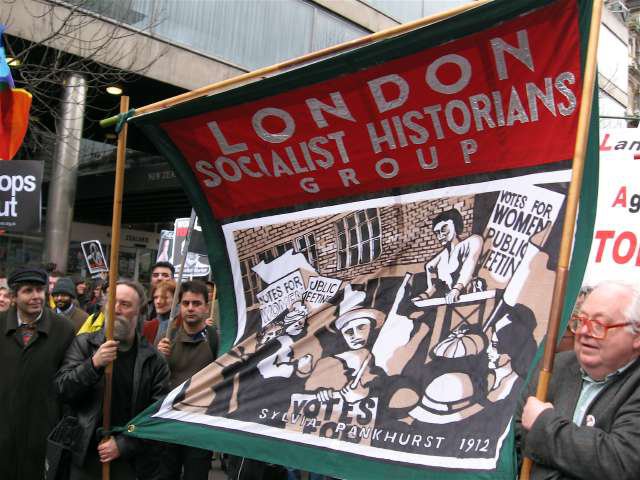
London Socialist Historians Newsletter Winter 2022/23
The London Socialist Newsletter has been delayed in appearance due to a number of issues behind our direct control! (as well as capitalism obviously). The lead article is below. I will post other items (all of which are complete) as time allows
Tories Culture Wars threaten ‘British History’
At the Tory Conference in early October 2022, Andrea Jenkyns, reportedly a Tory Minister who covers higher education, criticised teaching of critical race theory, anti-British history and social Marxism.
Despite intensive social media investigation no one seemed quite sure what ‘social Marxism’ is. As a term it has been used by hard right US politicians to cover what they consider ‘woke’ views, an equally vague category. It is possible that Ms Jenkyns meant, as several media reported, sociological Marxism. Those familiar with the work of Tom Bottomore will know that it is a less than revolutionary subject.
Ms Jenkins did not define what she meant by anti-British history either but this Culture War has been running long enough for a broad meaning to be grasped.
The last but one Prime Minister Boris Johnson criticised some on the left who he claimed wanted to cancel aspects of British history. By contrast he proclaimed that he wanted all of British history to be told. Like so much else that Johnson said it was a lie.
The history in contention is that which focuses on Britain’s imperial past and present and the racism that was at the centre of it. Such history is inconvenient at best to the Tories and their efforts to promote a 2020s version of ‘our island story’.
The matter does not exist just at the level of culture wars rhetoric either. At Goldsmiths College in London, once a beacon of liberal humanities, a sustained effort to turn it into a business University, has seen history and history lecturers significantly downgraded. The UCU has fought the matter all the way and achieved some success.
The battleground has now shifted to Birkbeck College were a similar destruction of liberal arts and humanities is planned
The Tory Culture Wars message is clear: socialist history and socialist historians are not wanted on voyage.
It’s over 50 years since E P Thompson edited Warwick University Ltd about the origins of the business university. In 2022 the concept is a commonplace.
You thought Universities are about a liberal education and learning? They are in fact about profit. The higher education sector as a whole makes many millions of pounds each year. Vice Chancellors are paid salaries of hundreds of thousands of pounds, although what for remains obscure.
In recent years, the pay of academics has seen real cuts against inflation. Many are employed on far less than secure contracts, and the final salary pension scheme has also seen, largely unjustified, cuts.
Faced with this the University and College Union has balloted for action on both pay and pensions. They have managed, despite the restrictions of Tory employment law, to get successful national results in both areas. Union activists are now looking at industrial strategies for early 2023.
It is more than time for University employers to think again on pay and pensions. If not push will come to shove and the UCU and its members as always will have the support and solidarity of the London Socialist Historians Group
_____________________________________________
Teaching Global History & the marketing of history
The historian Simon Sebag Montefiore has called for there to be less teaching of English history and a focus on history from across the world (Times 1st November). He argued at the Petworth Literary Festival that teaching about the history of the British Empire, whether seen as good or bad, is not as important as understanding the histories of people from across the world. He noted for example that the Great African War which took place in the Congo between 1998 and 2003 which involved nine countries and saw five million dead was hardly known about in Britain.
Dominic Sandbrook has put a counter argument that there were few teaching materials available for the kind of history Sebag Montefiore is calling for. Further given that school history lessons were brief the key thing was to attract pupils and ensure they got good results.
Sandbrook emphasises the role that the market plays in history education but one wonders if teaching the real history of the British Empire would not fulfil much of Sebag Montefiore’s call for global history. There are surely texts available to do that, even if they are not on the approved reading list of Tory Central Office.
_____________________________________
Historians say graffiti on Thatcher statue was ‘living history’
The London Socialist Historians Group, which organises the socialist history seminar at the Institute of Historical Research, University of London, has said that ‘Tories Out’ graffiti which was added to a statue of Margaret Thatcher in Grantham towards the end of 2022 represented not vandalism but a living history.
Statues have become part of a Tory Culture War with Ministers determined to defend those of slave traders and colonialists.
The statue of Thatcher in her town of Grantham has been and continues to be controversial. However the ‘Tories Out’ slogan was painted on the plinth and did not impact the figure of the late Tory leader. Rather it gave a sense that while Mrs Thatcher had much support as Prime Minister she also generated a large amount of opposition.
London Socialist Historians Group convenor Dr Keith Flett said, just as Margaret Thatcher was a controversial and contested politician it seems reasonable that a statue of her should also have the same status. She was certainly venerated by some but many others she was hated. That is an historical reality that should be reflected.
Engels on Xmas 1867 ‘a lot of eating & drinking & upset stomach’
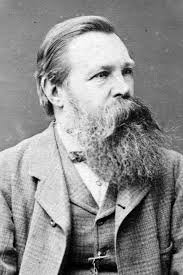
Engels was keen on both eating and drinking but even it could get too much for him at this time of year…
Manchester, 3 January 1868
Dear Mrs Marx,
I must apologise for leaving your letter unanswered for so long. But the Christmas period is the only time in the whole year when, apart from business, I am made to feel that I stand with one foot in the bourgeoisie, and here in Manchester this entails a lot of eating and drinking and upset stomach, and the obligatory ill humour and waste of time. This is now fairly well over, and I am beginning to breathe freely again.
There have been some insights into the mindset of convicted badger killer David Archer this week. He was unable to compute why Ben, who has health issues, is taking a break from his course until September continuing his generally unempathetic attitude. He also talked on the 12th anniversary of the death of Nigel Pargetter about how he may have put Nigel in harm’s way by encouraging him to go on the roof of Lower Loxley on that icy early January night to take Christmas decorations down. Nigel Pargetter’s death remains unexplained.
The Ambridge Socialist poll. Who was responsible for Nigel Pargetter's death as he fell from the roof of Lower Loxley 12 years ago?
It’s the Ambridge proletarian partnership of the decade. Bourgeois marriage should not be central to it.
Snell cancels Jakob’s sprout story
Lynda Snell’s Christmas stories were launched at the Tea Rooms on 29th December. She cancelled Jakob’s fascinating tale about why he doesn’t like sprouts claiming that it was boring. Not so boring apparently that Rylan didn’t get to discuss his dislike of sprouts with Mary Berry on TV before Christmas
George Grundy
George is tedious
Tony plays the guitar
This week is presumably the last we’ll hear about Tony and the guitar he probably didn’t really want in the 1960s and certainly doesn’t want now. We can only hope that in 2023 that the tendency of the Archers to fill up space with issues not even vaguely related to anything Ambridge related will lessen. A bit.
The Beard Liberation Front, the informal network of beard wearers, has said that 2025 is set to start with the highest numbers of beard wearers since 1945.
National No Shaving Day takes place on Thursday 1st January.
The hirsute campaigners say that 1st January is the best day in the year to start a beard. With many celebrating until the early hours the last thing most want to do in the morning is to shave. As it is Bank Holiday with a further day before the official working week resumes for many the beard can be started in the privacy of the wearer’s own home.
The BLF has provided the following guidelines to starting a beard on Wednesday:
Step 1: do not shave
Step 2: by early afternoon, wash the face and comb through the developing stubble
Step 3: during the afternoon rub some craft beer, or alternatively lemon juice, into the developing facial hair to nourish it and promote growth
Step 4: In the evening you can begin to trim and style the proto-beard
BLF organiser Keith Flett said, Beards are set to be big again as 2026 dawns, with not only record numbers of designer beards but also a continued resurgence in the traditional organic full bearded style
CAMPAIGNERS SAY NEW YEAR TRADITION OF FIRST BEARDING IS INCREASINGLY POPULAR
The Beard Liberation Front, the informal network of beard wearers, has said that it is again reviving the ancient New Year tradition of first bearding this year.
At midnight on New Year’s morning the first person with a beard across the doorstep of a house, or on this occasion only a false beard, must be given a glass of imperial stout to marinade their beard in. In return the beard wearer will bring good fortune for the coming year.
First bearding can be when a stranger with a beard comes to the house, as in first footing, or when someone with a beard already inside steps outside to return again.
The campaign group which opposes irrational prejudice against the hirsute says that the tradition of first bearding is thought to have been as popular as first footing but declined with the more clean-shaven culture after 1945
BLF Organiser Keith Flett said, while it seems first footing may be in decline first bearding is growing as an important New Year tradition. We expect many of those who have grown a beard over the Xmas holiday to participate this year for the first time in this ancient and now revived tradition.
GUIDELINES ON FIRST BEARDING
On or immediately after the stroke of midnight on December 31/January 1 await a knock on the door
If the person has a beard welcome them in as a First Bearder. Check first however that it is not Liz Truss wearing a fake beard.
Be sure to answer the door promptly as otherwise the First Bearder may sustain weather damage to the beard.
If they attempt to give you a lump of coal, ignore this. It is not part of the modern tradition of First Bearding
Give them a glass of imperial stout to marinade their beard in & wish them a Happy Hirsute New Year
The Feast of Fools & black puddings. Some historical questions
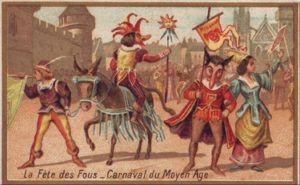
The Feast of Fools was part of the traditional 12 days of Christmas and took place around January 1st.
It was a world turned upside down affair where authority (in Medieval times that meant religious authority) was relentlessly mocked. Needless to say over time authority hit back and there is little evidence of the feast beyond the eighteenth century.
It was more celebrated in France than England and the example below is from the former country. However there is evidence, via complaints, that the Feast of Fools was marked in places such as Exeter, Lincoln and York and eating black pudding at the altar of the Church was cited in the complaints (Reading Museum).
Black puddings, boudin noir, were seen as delicacies in the Middle Ages which may explain their otherwise rather surprising role in the proceedings.
Priests and clerks may be seen wearing masks and monstrous visages at the hours of office. They dance in the choir dressed as women, panders or minstrels. They sing wanton songs. They eat black puddings at the horn of the altar while the celebrant is saying Mass. They play at dice there. They cense with stinking smoke from the soles of old shoes. They run and leap through the church, without a blush at their own shame. Finally they drive about the town and its theatres in shabby traps and carts, and rouse the laughter of their fellows and the bystanders in infamous performances, with indecent gesture and verses scurrilous and unchaste.
Letter from the Faculty of Theology University of Paris 12th March 1445
The most recent research into the Feast of Fools is Max Harris’s Sacred Folly (2011). This is a revisionist account which argues that it suited the Clergy to exaggerate the nature of the event and confuse it with the secular Kalend festival.
Reviewers have both praised Harris’s careful scholarship but raised the issue about whether the ‘confusion’ between religious and secular festivals was not in fact genuine and that the level of complaint about the Feast of Fools over a sustained period does suggest that there were real ‘world turned upside down’ fears.
More research is needed now on instances of subversion at the year-end period and for those interested in the role of black pudding in it, some detail on that too…
‘THE SLIPPERY AND CONVOLUTED VIEWS OF E. P. THOMPSON’
Guardian – 7 December 1981
E.P. Thompson complains (Agenda, November 30) of the possible existence of “an orchestrated campaign, centred on Washington, to confuse and divide the European [unilateralist] movements”. In support of this contention he refers to conflicting reports in the Dutch and British Press, respectively showing him to have “urged acceptance of President Reagan’s ‘Zero Option’ ” and to have rejected it as “an illusory offer and a deliberate deception”.
Yet, is this any wonder when the views of Mr Thompson are so slippery, convoluted and obscure? He says that his response to the American offer is “Yes, but more!” – an intriguing conjunction of contraries if ever there was one, the first word indicating acceptance and the other two (as expanded upon) indicating the opposite.
He snipes at the President for his temerity in offering not to deploy missiles in European countries, arguing that this should be for : the European peoples most concerned” to decide. But it has never been the case that such weapons could be deployed against the will of the host nations anyway – unless, of course, Mr Thompson challenges the right of the European governments to act in the name of their own “peoples”.
If these governments declined to co-operate, Reagan’s nuclear offer would naturally be quite meaningless; but, as long as even one of them is prepared to take cruise or Pershing II, then the Reagan initiative is both morally and politically legitimate.
Mr Thompson’s next step is to advocate pressure on both East and West for “the largest possible measure of reciprocal disarmament”; but he combines this with the warning that “if they try to introduce the new missiles, we will refuse them anyway” – as if the latter sanction could be applied equally on both sides of the iron Curtain, instead of merely undermining prospects for reciprocal disarmament (as it would).
Nor is he consistent in his claim that, if the “peace movements” get “drawn in to the numbers game – so many SS-20s equals so many forward-based NATO systems”, they will bargain away “their unilateralist birthright for a mess of superpower pottage”. For he does precisely that himself, a couple of columns later, when it suits him to observe that a “nil option would take the Soviet Union not back to square one, but a minus figure (in balance), in exchange for the ‘withdrawal’ of what is not now here and is not ever likely to come”.
With unconscious irony, Mr Thompson then goes on to stand the classic multilateralist objection to unilateralism on its head, by declaring that “grossly one-sided proposals” – i.e. Reagan’s – “are a threat also, since they block effective negotiations”.
In this assessment of the Presidential initiative, Mr Thompson appears to have forgotten what he himself wrote in a letter to The Times (March 6): “If European NATO states, under popular pressure, should reject cruise missiles and Pershing IIs – and if the Soviet Union did not, instantly, halt and then reduce its deployment of SS-20s, we can be sure that Western unilateralist movements would at once lose their popular support.”
Now, it appears, Mr Thompson has upped the ante. The Reagan proposals should be accepted certainly, but only if they are accompanied at once by “a general freeze, binding upon all powers, upon the deployment, manufacture, development, and testing of all further nuclear weapons at every level”.
The truth of the matter is that CND and END have been put on the spot by Reagan, do not like it one little bit, and now choose to “accept” his practical proposals – but only if they are liked to hideously impractical ones which have baffled disarmament negotiators for decades.
Strong ale and more recently beer at Christmas has a very long history.
The end of the calendar year is a time of festivity and celebration for many whether religious or otherwise.
Specially brewed ales and beers are part of that. Ive enjoyed a Mince Pie Barley Wine (Elusive) and a Christmas Cake Imperial Stout (Vocation) in recent years.
What however happened to such brews during the period of the Commonwealth from 1649-1660? Anti-Royalist forces had a Parliamentary majority from at least 1647 and after the King was executed on 30th January 1649, the first Parliamentary Democracy was briefly in place.
Christmas festivities and the marking of the day as a holiday was officially banned, although enforcing it was a more a complex matter.
Royalist propaganda of the time was clear on the impact on Christmas Ales
In December 1652 one such propagandist (Taylor) had Father Christmas visit London and complain about the weakness of the beer on offer that ‘warmed a man’s heart like pangs of death in a frosty morning’.
He was told, ‘Alas, Father Christmas, our high and mighty ale that would formerly knock down Hercules and trip up the heels of a giant is lately stuck in a deep consumption, the strength of it being quite gone with a blow from Westminster, and there is a Tetter and Ringworm called Excise doth make it look thinner than it would do’
How true this really was and how much enforced is of course another matter.
It might be reflected however that with new Government Duty bandings introduced in August 2023 most stronger festive beers are now under 8.5% or, where they are stronger, are even more expensive than they previously were.