Socialist Historians back UCU strike action. A continuing supply of historical research is at risk
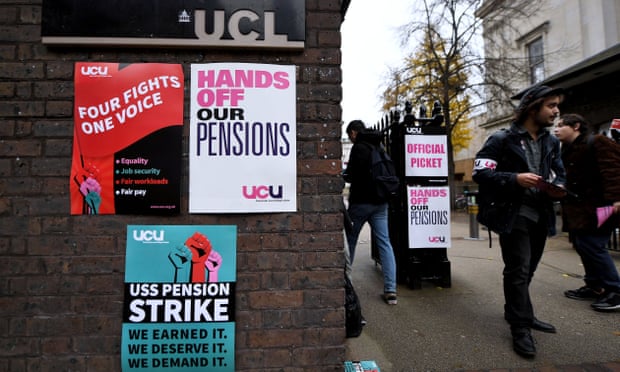
The London Socialist Historians Group, which organises the socialist history seminar at the Institute of Historical Research, University of London, has backed three days of strike action by members of the University and College Union (IUCU).
The academics and professional support staff are taking strike action from 1-3 December over further planned cuts to pensions, and continuing attacks on pay and conditions.
The historians say that a continuing supply of historical research is at risk as academics are made redundant or look for jobs elsewhere in the face of a relentless attack by employers on their pay and pensions.
LSHG Convenor Dr Keith Flett, the reality of academic life in 2021 is very different from the liberal University of 50 years ago. It is a neo-liberal workplace where academics face pressure to work harder and harder for poorer terms and conditions. The impact on things like historical research is significant. The UCU are right to strike and they have our full support.
Mystery of Marx Algiers beard shave photographs remains
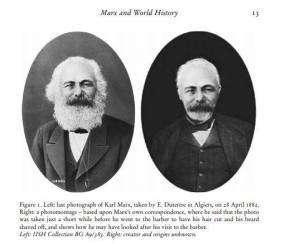
The Beard Liberation Front, the informal network of beard wearers, has said it believes it has resolved the long running mystery about why Karl Marx had his beard shaved off while in Algiers in April 1882 and whether a photograph of him without the beard actually exists.
While there is no doubt that Marx did visit an Algerian barber to have his beard shaved and hair trimmed the reason for this has remained obscure.
While in letters to Engels from Algiers in April 1882 Marx describes the weather as very changeable with rain and high winds he notes in a letter to Engels on Friday 28th April 1882:
‘Apropos; because of the sun I have done away with my prophet’s beard and my crowning glory (but in deference to my daughters) had myself photographed before offering up my hair on the altar of an Algerian barber. I shall receive the photographs next Sunday (30th April). Specimina will be sent to you from Marseilles.
The photograph was taken by E Dutretre on 28th April 1882 and is in the archive of the International Institute of Social History. It is thought to be the last one to be taken of Marx while alive.
Another purporting to show Marx clean shaven is a fake, probably a photomontage of what he might have looked like.
Intriguingly Marx wrote to Laura Lafargue from Monte Carlo on 6th May 1882 stating ‘I enclose one photo for you another for Fred; no art can make the man look worse
This suggests that a photo of the clean shaven Marx may exist but is not extant.
Marcello Musto who is at York University Toronto tweeted on 28th November
He wrote to Engels: “I have done away with my prophet’s beard and my crowning glory but had myself photographed before offering up my hair on the altar of an Algerian barber”.
In 1882, when he visited Algiers, Marx surprisingly shaved his beard.
Musto has written an excellent study of Marx’s last years but the precise reason for his Algiers beard trimming remains an open historical question.
From Cromwell to Jacob Rees Mogg. Parliament on Christmas Day
Promising a vote on new Covid measures in the Commons on 30th November noted that they would be reviewed in 3 weeks when Parliament would be in recess for Christmas. Rees Mogg noted that only during the Commonwealth (1649-1660) had Parliament met on Christmas Day. If he really knew his Parliamentary history Rees Mogg might have noted that such a thing was no more popular with MPs in the 1650s than it is in the 2020s
My right hon. Friend is being a little unfair on the Government. He will recall, as he was part of these discussions, as was I and as was the former Secretary of State for Health and Social Care, that we assured the House that it would get to debate and vote upon important national measures. Bringing forward the debate tomorrow is a statement of how importantly I personally, and others in government, take that commitment that it is only right that this House should approve matters of that kind. There was of course a caveat in that agreement, which is that we needed sometimes to act during recesses. Mostly that has not in fact happened; we have been able to do this when the House has been sitting. However, I cannot give guarantees as to what will happen in three weeks, nor can I give them as to what the desire of the House will be—it was only Oliver Cromwell who made us sit on Christmas Day
Dr Stephen Roberts, editor of the Commons 1640-60 section, discusses the Commons’ debates on Christmas day, 1656: still sitting, of course, and rather disappointed that the rest of the country seemed to have taken the day off…
On Christmas day 1656, the second parliament of Oliver Cromwell’s protectorate met as usual to transact business. Some years earlier, the legislation of the Long Parliament (1640-53) had outlawed the observance of the festival, but it had evidently failed. On 25 December 1656, the MPs began the parliamentary day by giving a second reading to an obscure bill for holding sheriff’s courts in Wiltshire, heard amendments to a bill for altering the forest laws relating to the Forest of Dean in Gloucestershire; during the short debate, Luke Robinson spoke bravely against plans to re-forest the area, fearing for the rights of ordinary people: ‘We promised Englishmen freedom, equal freedom… Did we not make the people believe that we fought for their liberty? Let us not deceive them of their expectation.’ A government spokesman denied that the bill would restrain commoners’ rights, instead asserting that ‘it gives the people more liberty than they have had these hundred years’. The bill was passed, and then in what we might consider the true spirit of Christmas, a member was given leave to visit his sick child.
But the elephant in the chamber could be ignored no longer, and Colonel Joachim Matthews, Member for Maldon in Essex, noted how thin the attendance was, attributing it to Christmas observance, and produced ‘a short bill’ to reinforce the earlier legislation of abolition. Luke Robinson, the republican opponent of re-afforestation, complained that Christmas preparations outside his London lodgings had kept him awake all night, and made the inevitable link between Christmas festivity and Catholicism: ‘We are, I don’t doubt, returning to popery’. The bill produced a range of responses. Some said it was needed, as the people were keener on Christmas than on Sunday observance; others said that important parliamentary business should take priority over this measure, since it was too late to prevent this Christmas taking place, and so there was a year in hand to pass it. Yet others noted with regret the complete closure of businesses: ‘One may pass from the Tower to Westminster, and not a shop open, nor a creature stirring’. Lambarde Godfrey, MP for Kent, said that now the bill was being debated, everyone should support it, in case the public came to the conclusion that Parliament was in favour of superstitious festivals.
Jack Dorsey Twitter epitaph should be a ‘beard friendly’ button for tweets
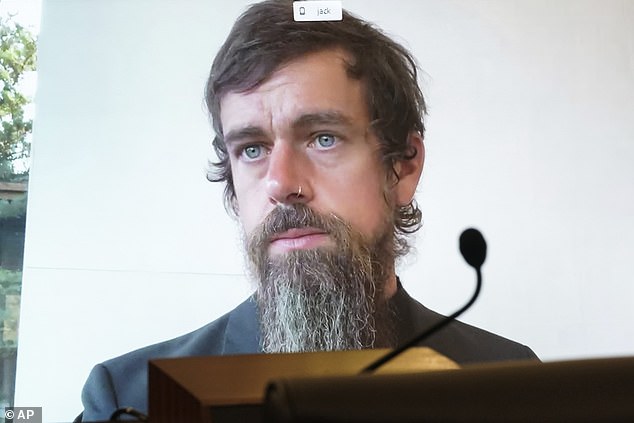
The Beard Liberation Front, the informal network of beard wearers, has said that with Twitter CEO Jack Dorsey standing down on 29th November a fitting epitaph would be for twitter to add a button which allows users to marks tweets as ‘beard friendly’
The campaigners say that there is some evidence that of male users of twitter a significant proportion are beard wearers. A button to allow tweets to be signified as ‘beard friendly’ would be a recognition of this.
BLF Organiser Keith Flett said, twitter is sometimes in the news for less than happy reasons. This is a chance for the social media platform to do something positive and progressive, and what better way for it to mark the departure of Jack Dorsey?
In Medieval Times the marking of Christmas by Class started with Advent Sunday.
The period between the fourth before Christmas and Christmas Day was a period of a limited diet, the more so for the poor than the rich obviously.
Advent Sunday is the fourth before Christmas and this year fell on 28th November.
People were enjoined to limit their diet during Advent. For the wealthy this meant soups, stews and fish instead of roasts or pies. The poorer, however, could find the reduction a misery. In the fifteenth century James Ryman complained of eating ‘no puddings nor sauce, but stinking fish not worth a louse’
Ronald Hutton, Stations of the Sun
If you are following an Advent diet or even if you aren’t putting food aside for your local Foodbank seems like a good tradition
How the signal for revolt was sent before the internet, & the telephone: Newport 1839
In early November 1839 Chartists marched to Newport South Wales in what some have seen as an attempt at a rising. It failed as the crack regiment of the British Army shot dead some of the Chartists. Some of the Chartists were armed but were no match for the elite soldiers.
What happened on 4th November 1839 and what was meant to happen has long been the subject of historical research.
In Archives Week in 2021, the Peoples Collection of Wales placed on-line a very large number of documents relating to what happened on the day and subsequent trials. The original documents have been in the archives for many years but have now been transcribed and versions can be read more easily
One document gives an interesting perspective on what the purpose of the Chartist march on Newport was designed to be, at least by those who led it. It also indicates how the signal for revolt was sent in the pre-electronic age.
John Frost, one of the leaders is quoted (vol 1p22) as arguing:
They should come to Newport and take possession of the Poorhouse and Soldiers and their Arms, That there was a Store house there where there was plenty of powder and then they would blow up the Bridge and stop the Welsh coaches that ran to the North then there would be notice for them in the North, to commence on Monday night…
How Engels celebrated his 70th birthday on 28th November 1890
Engels was born in Bremen on 28th November 1820 but by 1890, when he turned 70, he was living in Regents Park Rd, having retired a while since from his job in the family firm in Manchester.
Writing to Laura Lafargue on 1st December 1890 he noted that he had received numerous birthday messages and in the evening of 28th November had celebrated with a number of comrades mainly from the German socialist movement:
‘we kept it up till half past three in the morning, and drank besides claret, 16 bottles of champaigne- the morning we had 12 dozen oysters…One can celebrate one’s 70th birthday only once.
Beard wearers should wear masks as social solidarity & ignore clean-shaven unmasked Tory MPs
The Beard Liberation Front, the informal network of beard wearers, has renewed a call that it first made on 23rd July 2020 for the hirsute to wear masks as a matter of social solidarity.
The campaigners say they have been unimpressed but not surprised by Tory MPs excusing themselves from a requirement to wear masks in the Houses of Parliament. Its clear that the majority of MPs who won’t wear masks are clean shaven Tories
A specially commissioned poll found that 91% of respondents backed its guidance to the hirsute to continue wearing masks in appropriate contexts and settings.
The campaigners say that mask wearing has seen a rise in follicle health over the past year, as beards have been protected from the elements and accidental exposure to noxious substances.
They also say that mask wearing protects others, hirsute and clean shaven, from anything that the beard wearer themselves may transmit, via the occasional splutter, groan or cheer.
BLF Organiser Keith Flett said, it’s clear that beard wearers put the duty to protect themselves and others first against clean-shaven fools like Jacob Rees-Mogg and Boris Johnson and will continue mask wearing where appropriate
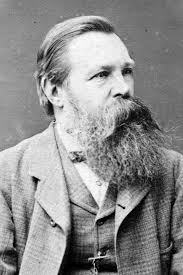
Engels at 201: beard wearer, Pilsner drinker, activist, theoretician, revolutionary
28th November marks the 201st anniversary of the birth of Friedrich Engels.
Engels wrote a landmark volume on the working class in Manchester 1844, much admired by Marx, and was an active participant in revolutionary events in Bavaria and Prussia in 1848/9. He carried the nickname ‘The General’ for his military knowledge and writing. He was of course for some years a Manchester businessman in the family business but throughout an active collaborator with Marx. After Marx’s death in 1883 Engels extended the research and impact of his friends work as well as producing some work of his own.
Some of this has been controversial amongst those who stand in the Marxist tradition but in a short appreciation the key thing to underline is Engels centrality to that tradition.
The fact that he both understood and was partly responsible for Marx’s perspectives is well summed up in the extract below:
Marx and I are ourselves partly to blame for the fact that the younger people sometimes lay more stress on the economic side than is due to it. We had to emphasise the main principle vis-à-vis our adversaries, who denied it, and we had not always the time, the place or the opportunity to give their due to the other elements involved in the interaction. But when it came to presenting a section of history, that is, to making a practical application, it was a different matter and there no error was permissible. Unfortunately, however, it happens only too often that people think they have fully understood a new theory and can apply it without more ado from the moment they have assimilated its main principles, and even those not always correctly. And I cannot exempt many of the more recent “Marxists” from this reproach, for the most amazing rubbish has been produced in this quarter, too. . . .
As perhaps might be expected there are those who seek to draw attention away from the continued importance of such a perspective. The former Labour MP Tristram Hunt has written a partial but entertaining biography of Engels.
Writing in the Observer in November 2020 he did emphasise the political importance of Engels writings but underlined that above all Engels should be seen as a bon viveur. A lover of beer, wine and good food. Indeed Engels was all of that (as was Marx) though sadly his recipe for lobster salad has not survived.
While that was true Engels was also a serious revolutionary. It’s not his taste in drink and food that matters in 2021,interesting though this is, but his ideas and his politics.
Engels was a figure of profound historical and philosophical significance. Yet what I discovered, as his biographer, was that his vision of socialism could also be richly uplifting: the grisly, corrupt, anti-intellectual egalitarian Marxism of the 20th century would have horrified him. “The concept of a socialist society as a realm of equality is a one-sided French concept,” he said. Instead, Engels believed in cascading the pleasures of life – food, sex, drink, culture, travel, even fox-hunting – across all classes. Socialism should not be a never-ending Labour party meeting, but a life of enjoyment. The real challenge of living in Manchester was that he could find no “single opportunity to make use of my acknowledged gift for mixing a lobster salad”.
Its been haircut week in Ambridge thanks to trainee hairdresser Chelsea. Lynda has been re-fashioned as a Pixie although Lilian (Chill Lil..) avoided the scissors. Later in the week discovering Blake sitting in a shelter at Borchester bus station Chelsea whisked him off to Ambridge for a Jack Grealish style cut which seems to have impressed him.
The Vicar has over imbibed on the Tumble Tussocks
Officiating at the renewal of wedding vows between Eddie and Clarrie in the Cider Barn last Sunday Alan the Vicar had a slight over imbibement issue on the Tumble Tussocks. Oliver Sterling had to step in with some appropriate verbiage. It appears the Bishop found out and Alan now has to deliver a rambling speech (sober)between Xmas and New Year to show contrition.
Clarrie and Eddie head to France
Clarrie and Eddie headed to Paris for a honeymoon. There has been no update but Macron is sounding ever more exasperated with the Brits so it seems likely that he has encountered Eddie
In other news
Its muddy at Brookfield
The Professor has reminded Jazzer that he is not forever young
Mia and Chelsea may not the dream team, but they are interesting Ambridge residents, unlike some men we can think of…