Articles

The seasons of labour: Spring & the Victorian ‘gig-economy’
In Uncategorized on April 12, 2019 by kmflett

The seasons of labour: Spring & the Victorian ‘gig-economy’

In the days of 24/7 news coverage and social media storms it can be quite easy to forget the underlying material realities of life.

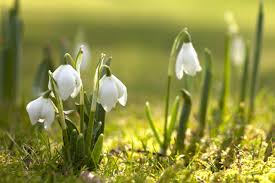
March 1st marked the start of the Spring for weather forecasters who prefer even quarters. The first day of Spring was on March 20th and the clocks changed on the last Sunday in March in the UK

It should mean (slightly) warmer days, more daylight and, before climate change speeded up the process, the arrival of blossom and spring flowers, although austerity weather can persist.

Labour wise it also marked, and still does mark a transition. Despite ever present claims that the world of work has somehow irreversibly changed there are still many seasonal and casual jobs around, just as there were in Victorian times.

Indeed the ‘gig-economy’ of unpredictable employment patterns was a key feature of the Victorian labour market though not under that name obviously.

Raph Samuel (see below) noted that ‘through the spring men were beginning to move from indoor to outdoor jobs, sometimes taking the step of exchanging a permanent occupation for a roving one’.

A  study of seasonal female labour remains to be written…

London was the centre of winter labour, not only because there were more jobs to be had in the Capital but also because there was more shelter from the winter weather.

It remains the case that winter sees a peak in deaths, invariably weather related. Some of the rich don’t winter elsewhere in the world just because they like all year sun but also because it is healthier than the damp and cold of the UK.

The late socialist historian Raphael Samuel described these seasonal patterns in his essay Comers and Goers, about how the workforce and the nature of work changed through the year.

Samuel suggested that, ‘the ebb and flow of wayfaring life in nineteenth century England was strongly influenced by the weather’

From March to October those in search of work were often to be found on the road

Samuel observed that ‘Country labourers who wintered in the Metropolitan Night Refuges were said to fly off about March.. travelling circuses began their tented tours in March.. all through the spring men were beginning to move from indoor jobs to outdoor ones’.

The peak of the labour exodus from city to countryside came rather later in the year- August and September- when places like London themselves were quieter, only to go into sharp reverse as the weather worsened and people sought warm night shelters again.

Some industrial jobs were also resolutely seasonal. Work in maltings (associated with brewing) didn’t tend to end up until May but again Samuel suggests that ‘Gas stokers (regular winter men) were given their notices (sack) as early as February and March’ as the demand for gas fell in the better weather.  The point seems to have been that many voluntarily gave notice and they preferred to go brick making once the weather improved. Only a third of stokers were employed year round

Gas stoking was well-paid but the hours were very long and the work heavy.

The drift of workers out of London was not a sudden migration, as birds might do, but a genuine ebb and flow. People might move from central London to the suburbs and then out to the countryside as the weather improved.

One of the key aims of the 1834 Poor Law which introduced the Workhouse was to make sure that labour was mobile and would travel to where workers were required.

The principle remains central to the ideology of market capitalism. In the Thatcher era Norman Tebbit famously talked about people getting on their bike to look for work.

In the current period hard-line neo-liberal Government policies are determined to make sure that people are looking for work, whether fit for it or not.

Yet the seasonal nature of some work is also a reminder about why the labour movement fought for a welfare state, a social safety net that provided a bottom line for those whose labour power capital picks up and discards as the days lengthen and then shorten
 

Articles

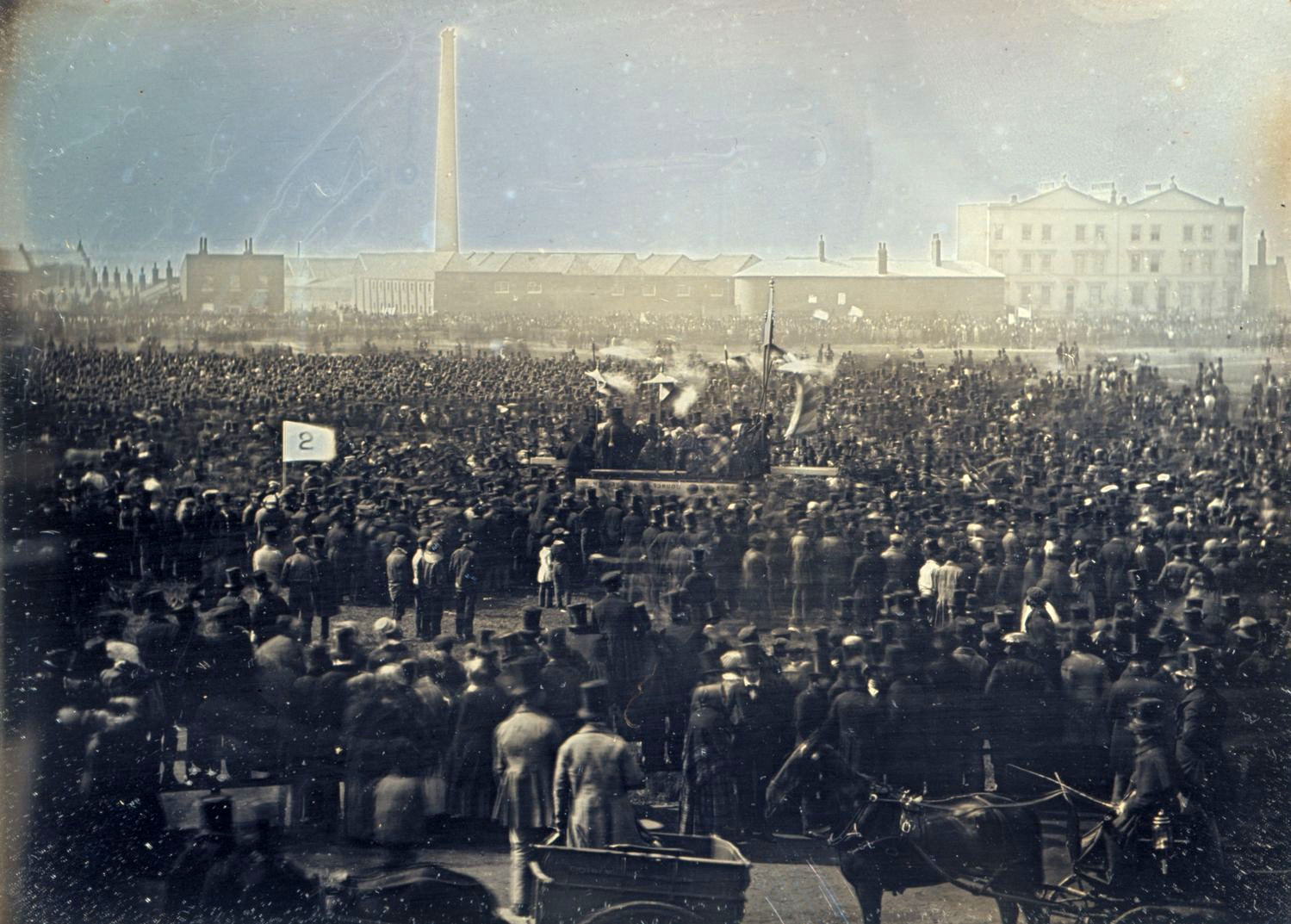
What we looked like in 1848: The Chartist crowd on Kennington Common, 10th April(photo, Royal Collection, Windsor)

In Uncategorized on April 12, 2019 by kmflett

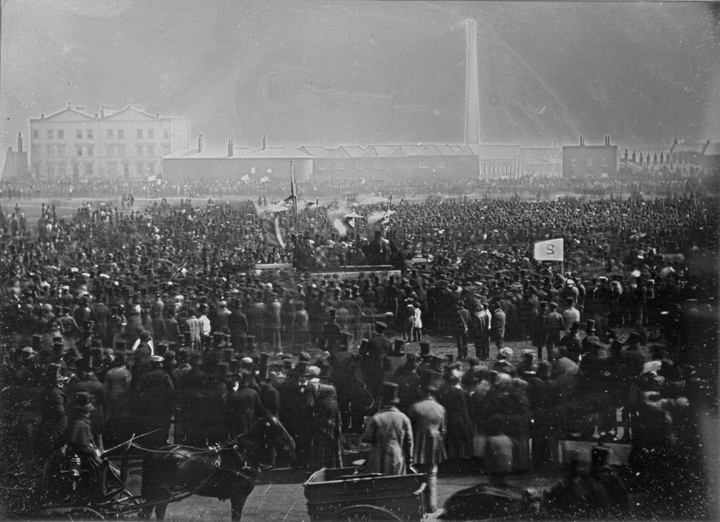
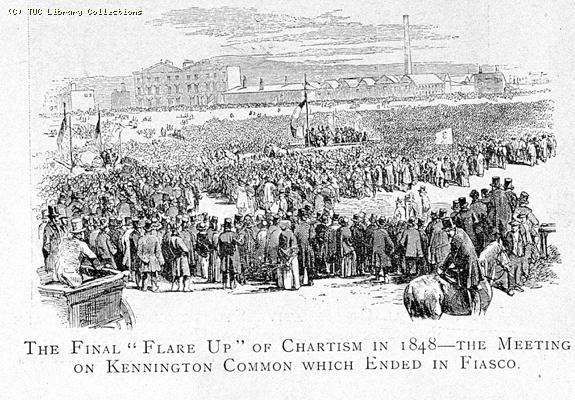
The above is a photograph of the Chartist meeting held on Kennington Common on Monday 10th April 1848.

More detail is here from the important Kennington Chartist Project:

The Chartist Meeting on Kennington Common

Many readers of this will have been on demonstrations and protests in the last few years. Since 1968, when an anti-Vietnam war march mustered the first ever modern protest crowd of 100,000 people, such things and participation in them have become much more common.

Unless its Yaxley Lennon speaking in Whitehall, protest crowds in 2024 are, thankfully, very mixed in terms of age, gender, ethnicity.

Ive been asked if the crowd in 1848 was hirsute. The picture does not indicate some beard wearing, but much more obviously lots of hat wearing (it did rain in the afternoon of 10th April 1848). The ability to mass produce cheap brightly coloured clothing did not then exist, ditto banners (although mass production techniques for banners did develop from the 1850s) so the crowd looks a bit different to 2024.

The picture is thought to have been taken as the demonstration assembled rather than at its peak. At least some of those in the foreground may well be more middle class spectators or journalists. The actual numbers attending were very likely to be larger than the picture shows

The standard ‘uniform’ for many of the working classes in 1848 was fustian (cotton) jackets and trousers or skirts.

This is very largely a London working class crowd. ‘Cheap’ and regular rail travel that facilitate national demonstrations in London in 2024 was only just starting to become available in 1848.

There was of course no public address system so the question arises as to how the crowd could hear the speakers. The photograph shows a number of platforms around Kennington Common, although the Chartist ‘van’ clearly visible was the centre point

There are far more men than women,. Its difficult to tell from the photo but ethnic minorities were involved. The leader of London Chartism in 1848 and the organiser of the 10th April 1848 demonstration, William Cuffay, was a black man.

It is an irony of history that the original of the photograph is in the Royal Collection at Windsor Castle

Articles

From 2014. An exchange on the upsides & downsides of Julian Assange

In Uncategorized on April 11, 2019 by kmflett

Below is an exchange from 5 years ago (March 2014) on the upsides and downsides of Julian Assange, together with a commentary by myself. Wherever you draw the balance extraditing a whistleblower to the US would be regarded historically as an affront to William Cobbett’s Freeborn Englishman (Assange of course is an Australian). More on that elsewhere

Andrew O’Hagan and Colin Robinson on Julian Assange: how lucky did capitalism get?

Whether you like, dislike or couldn’t care either way about Julian Assange Andrew O’Hagan’s piece in the LRB about his experiences when he was contracted to ghost-write Assange’s autobiography make fascinating reading.

http://www.lrb.co.uk/2014/02/21/andrew-ohagan/ghosting

If you’re not familiar with the story, the book didn’t get written and Assange was not happy. Neither I suspect was O’Hagan

There are some wider points to be picked out of O’Hagan’s account.

Firstly that Assange and Wikileaks genuinely did have material that was seriously embarrassing and worse for numbers of Governments. Not just difficult because it revealed awkward things but because it indicated things that really should not have been done at all.

O’Hagan notes an attempt via Tariq Ali and Verso to systematically edit and present the material in a series of books. Unfortunately it didn’t happen and not due to them.

A summary of O’Hagan’s view of Assange’s personal behaviour is that he is self obsessed. The detail is sort of entertaining although anyone who thinks that some things they do might not seem odd when viewed at close quarters by a third party might usefully think again.

Details here include not doing the washing up and not using utensils to eat dinner with. Somewhat unreconstructed one might venture. If one was kind.

The overall impression here though is of one of those 1960s and 1970s radicals who older readers may remember who were in public certainly of radical intent but in private much less so.

Finally there is the point, as O’Hagan notes, that Assange surrounds himself with ‘yes’ people and certainly no one older than himself with more experience who might venture a critical thought or two.

In other words here  Assange’s working practices were in one of the dominant neo-liberal/managerial frameworks of our time.

In short, at least on Andrew O’Hagan’s account, when it comes to Julian Assange, capitalism got lucky.

However in a response in The Guardian Colin Robinson, Assange’s current publisher, has perhaps raised the question of exactly how lucky capitalism got

http://www.theguardian.com/books/2014/mar/06/julian-assange-publisher-defence-wikileaks

Before we judge Assange  Robinson argues we should consider several factors. Firstly he faces the possibility of jail [on several counts one might add]. Secondly it is likely that various agencies of various States have an interest in spreading malicious stories about him [O’Hagan is clearly not part of that]. Robinson suggests that anyone faced with such pressures might well behave a bit oddly. That can clearly be accepted.

Robinson also suggests that far from being someone who never really seemed to complete anything useful, Assange did in fact manage several important matters during the period O’Hagan refers to.

Up to a point fair enough.  I don’t think it takes away from several important points that O’Hagan makes however. Firstly that Assange did not pursue the chance with Verso to systematically organise and publish the information Wikileaks has. Secondly that, particularly given his situation, he did not either work with a team of people who had the ability to overrule his judgement on occasion, or appoint someone to oversee the project to take some pressure off himself.

After all as the Lego Movie tells us, Everything is Awesome, everything is cool when you’re part of a team. While this is a piss-take on managerialism, the left doesn’t have a tradition of genuine collectivity without reason. Relying on heroes doesn’t work. They can do heroic things but they are inevitably, probably as a result, flawed.

Articles

Who is the worst Prime Minister ever? Theresa May continues to gain support

In Uncategorized on April 11, 2019 by kmflett

London Socialist Historians Group

Media Release

4th May

Contact Dr Keith Flett 07803 167266

Who is the worst British Prime Minister ever? Theresa May continues to gain support

The London Socialist Historians Group, which organises the socialist history seminar at the Institute of Historical Research in central London, has said that following a potential delay to Brexit until 31st October, Theresa May’s apparent intention to go on and on & the Tories second worst performance ever in modern times in local elections on 3rd May its poll for the Worst Prime Minister ever remains open.

While Iain Duncan Smith has called for May to go it should be underlined that the poll is for the Worst Prime Minister not the Worst Tory leader, hence he doesnt feature

On two previous occasions David Cameron comfortably won the vote. The current poll first posted on 11th March 2019 has seen Theresa consistently increase her lead until she is now nearing 50%

In November 2018 Mr Cameron got 50% of the poll with Margaret Thatcher 2nd on 29%, Theresa May 3rd on 7% and Lord Liverpool, PM at the time of Peterloo in 1819 4th with 5%

The poll has provoked discussion on social media, particularly in respect of why other PMs were not listed. Every PM since the late eighteenth century could certainly have been listed as by definition being in a position of political power will mean doing things some people don’t like, as well things some do.

Attlee for example would be applauded by most on the left, while some might recall him as the man who secretly gave the nod to UK nuclear weapons. The upsides and downsides of Churchill are too well known to rehearse.

The poll therefore aimed at a balance: the worst Prime Minister in this case would be the one where the negative impact significantly outweighed the positive impact of their tenure at No.10.

London Socialist Historians Convenor Dr Keith Flett said, obviously as historians we tend to prefer long departed Prime Ministers where it is easier to form a judgement on their worth or otherwise. However there may be a case for arguing that there is a longer term trend for the quality of British Prime Ministers to decline. Indeed some might say that Theresa May is determined to prove that point. As historians obviously we think it’s far too early to say

The Worst PM?

Lord Liverpool, a Tory, (1812-27) who presided over the Peterloo Massacre in 1819,introduced the repressive Six Acts that cracked down on democratic political activity and introduced the 1825 anti-union Combination Acts is a serious contender for the title.

Earl Grey who was a Liberal (1830-34) is also up there. He was PM when the Tolpuddle Martyrs stood trial and he introduced the Poor Law and the Workhouse. On the plus side he abolished slavery (as it was then).

Ramsay MacDonald (1924;1929-1935). First Labour Prime Minister; Later First National Government Prime Minister…

Margaret Thatcher, Tory, (1979-1990) Falklands War, miner’s strike, poll tax. An impressive record

Tony Blair, Labour (1997-2007) not perhaps an obvious contender compared to others but features primarily because of the Iraq War.

David Cameron (2010-2016) Lost Referendum on Europe he was supposed to win. Then resigned.

Theresa May (2016-) Called an Election to increase her majority and ended up with a minority Government (at best). Then embarked on a Brexit omnishambles


Articles

Campaigners say Assange’s beard not a contender for Beard of Spring 2019 title

In Uncategorized on April 11, 2019 by kmflett

Beard Liberation Front

Media Release

11th April

Contact Keith Flett 07803 167266

Campaigners say Assange’s beard not a contender for Beard of Spring 2019 title

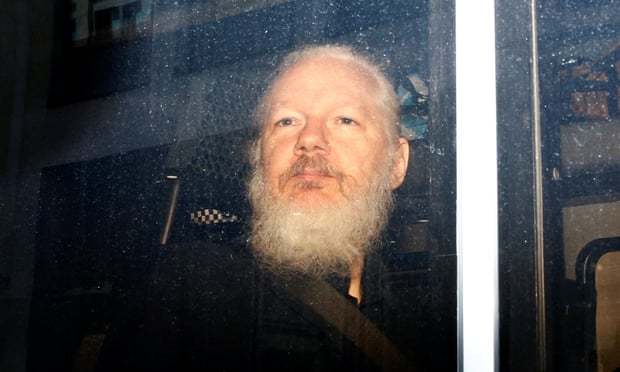
The Beard Liberation Front the informal network of beard wearers has said that Julian Assange’s beard, in the news again after his removal from the Ecuadorean Embassy in London and arrest, remains as problematic and enigmatic as it was when it received its first public airing back in April 2013.

The campaigners say that Assange remains a controversial figure with a range of people for a range of different reasons and it is impossible to unequivocally state that his beard presents a positive public image, a key BLF criteria.

It remains unclear whether Assange saw little point in shaving in captivity, if the beard, which is now organic in style, is a fashion statement, or if he is making a more serious statement of hirsute rebellion

BLF Organiser Keith Flett said, while Assange’s beard is hardly likely to do anything to commend him to pogonphobes like Donald Trump he is not currently on the Beard of Spring shortlist. However write-in votes are available

Beard of Spring poll


Articles

Campaigners say study into beards & testicles is a load of b*ll*cks

In Uncategorized on April 11, 2019 by kmflett

Beard Liberation Front press release

Contact Keith Flett 07803 167266

11th April

Campaigners say study into beards & testicles is a load of b*ll*cks

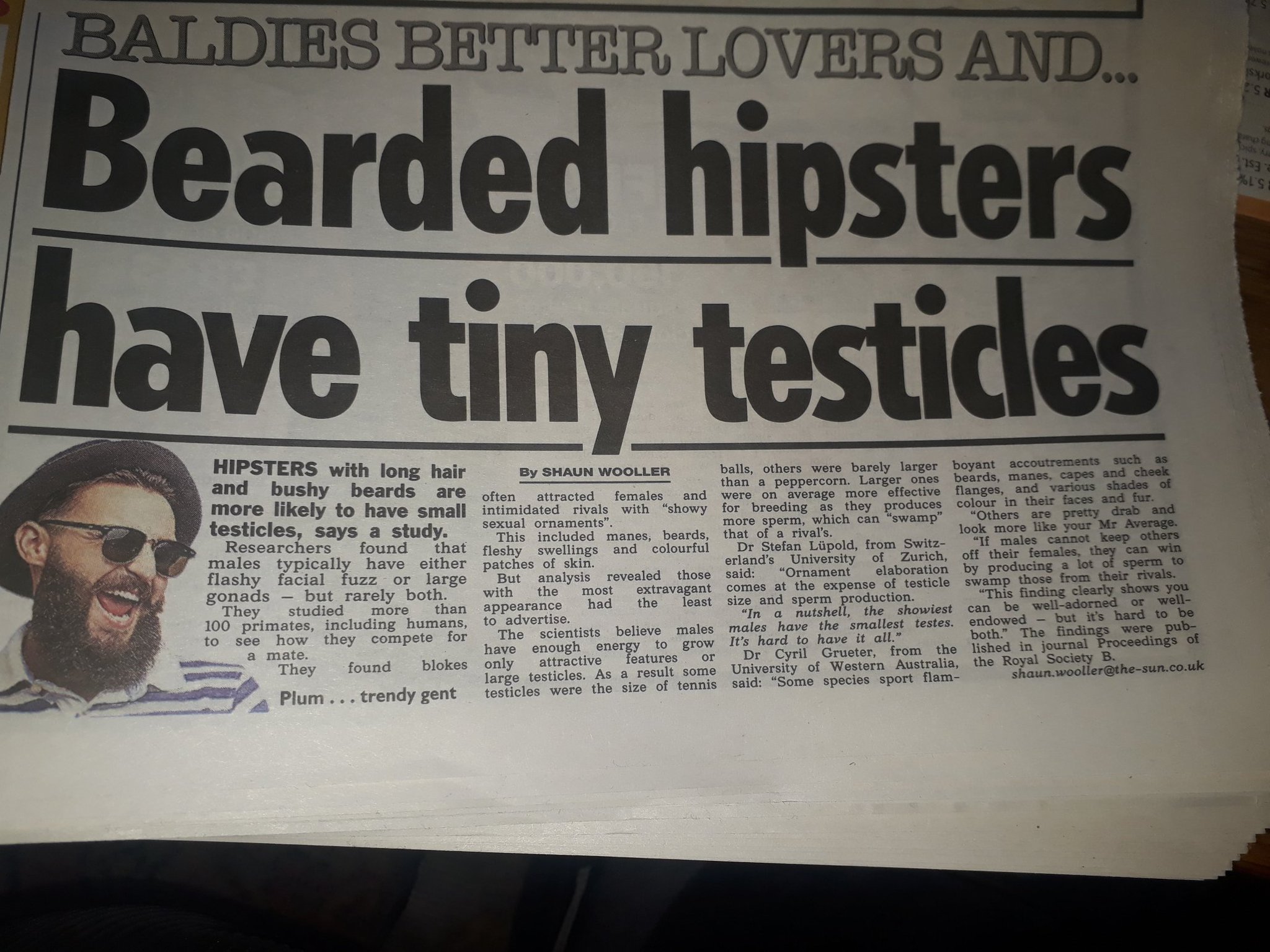
The Beard Liberation Front, the informal network of beard wearers, has said that the latest research by Australian scientists into beards & sexual attractiveness is just as doubtful and unproven as a series of earlier media friendly monographs covering the same areas.

The study (link below) looked at hirsuteness in the animal kingdom (known as ornaments), the size of male testes and how this related to the ability of the male to attract the female. The scientists claim that the energy put into growing hair means less is available to develop the testes. However this may not be an issue if the hairiness succeeds in attracting the female.

The campaigners say that as usual with Australian scientists the research is determinedly heterosexist. Secondly while media stories relate to hipster beards the study provides no evidence that these have been reviewed or measured or indeed what criteria might be used to determine the size of hipsters testicles.

BLF organiser Keith Flett said, as usual with these studies cultural and social influences are rigorously excluded. We might conclude that Australian scientists have small brains although we have no actual evidence for that.

Link to the study

https://royalsocietypublishing.org/doi/pdf/10.1098/rspb.2018.2542

Articles

The first photo of a mass working-class protest in the UK: Chartists on Kennington Common 10 April 1848

In Uncategorized on April 10, 2019 by kmflett

This is the first ever photograph of a working-class protest in the UK. It is the Chartist protest for the vote on Kennington Common on 10th April 1848.

The photo is a form of a long exposure known as duaguerrotype. Part of it is almost certainly missing so we cant see the full extent of the protest and it is generally thought that it was taken fairly on in the protest before numbers peaked.

Those in the foreground of the picture are probably observers, perhaps sympathetic middle-class radicals, but may include some who found the Common itself sodden after rain.

The picture is held in the Royal collection and the copyright lies with the current Queen. Its good to know that the Royals have an abiding interest in preserving labour history. God Bless You Ma’Am….

Articles

The size of the crowd: the Chartists on 10th April 1848

In Uncategorized on April 10, 2019 by kmflett

The size of the crowd : the Chartists on 10th April 1848

Estimates for the numbers attending demonstrations tend to vary a lot from, low side (the authorities) to high side (organisers) and getting a sense of the reality is invariably awkward. Splitting the difference is not the answer.

In terms of 10th April 1848 when the Chartists assembled on Kennington Common for the vote there is a very well-known photograph of the rally but it is widely accepted that this was taken before the attendance peaked.

David Goodway’s in his book on London Chartism 1838-48 notes that there was a sort of official campaign by those in authority to claim that the rally was only 20,000 strong and numbers of papers the following day repeated that. The Times reported the most liberal estimate as 50,000 people

The organisers on the other hand, including O’Connor, claimed 400,000 or 500,000 which was as absurd as the 20,000 figure. The population of London in 1848 was around 2.2 million so that would have meant around 25% of the entire Capital showing up. The National Chartist Convention estimate was 250,000 while Goodway mentions an estimate of a freelance reporter working for The Times TE Fowler of 200,000.

A number of leading Chartists on the day thought the figure was 150,000 and Goodway on balance supports that.

It was clearly a sizeable demonstration, but it was not the size that allowed the authorities and subsequent historians to paint it as a failure. Rather it was the alleged failure of the Chartists to storm Parliament or seize power that, in the context of the European 1848, suggested this reaction. Plus of course the frenzy of concern the authorities had got themselves into about the possibility.

I have found a letter from someone (not apparently a Chartist) who did a calculation based on the then size of Kennington Common to work out likely numbers attending. It appeared in the Northern  Star on 29th April 1848 and I’ll post further on that

The Chartists had not planned revolution for 10th April. Their aim was to deliver a mass petition for the vote to Parliament. That was done, but not quite in the way they intended.

Even so 171 years ago on Monday 10th April 1848 took place the first demonstration in UK history that was large enough to warrant an argument about the numbers attending and in 2019 we are still at it.

Articles

Pochettino shaves Guardiola in Spurs Man City game & joins Beard of Spring 2019 list

In Uncategorized on April 9, 2019 by kmflett

Beard Liberation Front

9th April

Contact Keith Flett 07803 167266

Pochettino shaves Guardiola in Spurs Man City game & joins Beard of Spring 2019 list

The Beard Liberation Front, the informal network of beard wearers, has said that voting is now open for the coveted Beard of Spring Award and competition is bristling.

After an epic Champions League game at White Hart Lane on 9th April saw Spurs beat Manchester City 1-0 Spurs manager Mauricio Pochettiino has joined the Beard of Spring shortlist. He shaved Manchester City manager Pep Guardiola 70-30 in a match time poll on which of the two had the best beard.

Beard of Spring is the second of four seasonal awards that lead to the Beard of the Year in December.

The campaigners say that while the second seasonal award of the year traditionally focuses on new beard growth with Easter so late, the focus is more on those whose beards have appeared in a positive public light during the quarter.

BLF Organiser Keith Flett said, Pochettino has joined the Beard of Spring shortlist but Raheem Sterling is still in the lead.

The vote is open now and will close at midday on Good Friday, with the winner announced on Easter Saturday

Beard of Spring 2019

Gareth Southgate, England football manager

Rick Wakeman, musician

Alexei Sayle, comedian

Logan Plant, brewer

Raheem Sterling, footballer

Scott Wagstaff, footballer

David Warner, cricketer

Dotun Adebayo, broadcaster

Garrett Oliver, brewer

Ian Jack, journalist

Joe Root, cricketer

Mauricio Pochettino, football manager

Articles

Competition bristles for Beard of Spring 2019 Award

In Uncategorized on April 8, 2019 by kmflett

Beard Liberation Front

8th April

Contact Keith Flett 07803 167266

Competition bristles for Beard of Spring 2019 Award

The Beard Liberation Front, the informal network of beard wearers, has said that voting is now open for the coveted Beard of Spring Award and competition is bristling

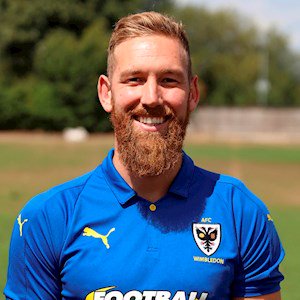
Wimbledon AFC player Scott Wagstaff who dyed his beard in club colours, Aussie cricketer David Warner, broadcaster Dotun Adebayo and master brewer Garrett Oliver are all at the top of the poll with others including England football manager Gareth Southgate trailing.

Beard of Spring is the second of four seasonal awards that lead to the Beard of the Year in December.

The campaigners say that while the second seasonal award of the year traditionally focuses on new beard growth with Easter so late, the focus is more on those whose beards have appeared in a positive public light during the quarter.

BLF Organiser Keith Flett said, beards bloom in Spring but at the moment the Beard of Spring Award is looking like it’ll be a very close shave

The vote is open now and will close at midday on Good Friday, with the winner announced on Easter Saturday

Beard of Spring 2019

Gareth Southgate, England football manager

Rick Wakeman, musician

Alexei Sayle, comedian

Logan Plant, brewer

Raheem Sterling, footballer

Scott Wagstaff, footballer

David Warner, cricketer

Dotun Adebayo, broadcaster

Garrett Oliver, brewer

Ian Jack, journalist

Joe Root, cricketer