Articles

How ownership of a Bristol brewery set Henry Hunt in the road to Peterloo

In Uncategorized on November 3, 2018 by kmflett

How ownership of a Bristol Brewery set Henry Hunt on the road to Peterloo
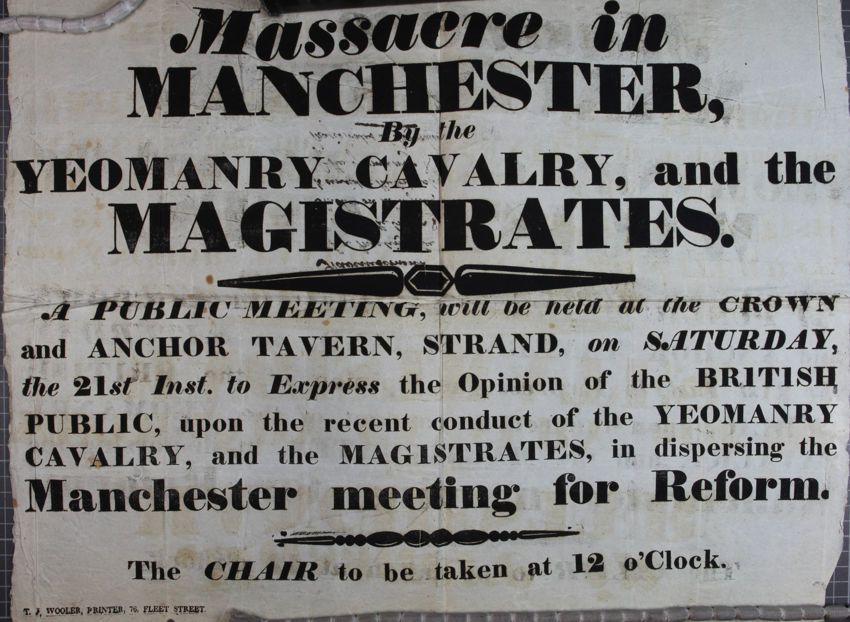
Henry ‘Orator’ Hunt (1773-1835) was one of the best-known English radical leaders of the first half of the nineteenth century, active before the Chartist movement. Hunt was a speaker at Peterloo in Manchester in 1819 and was jailed for the words he spoke there about the vote.

Hunt was a well to do West Country farmer, someone who William Cobbett looked to for agricultural advice, and after his political activities led to the decline of his farming business, he diversified into a range of other business activities including tea and coffee substitutes.

I’ve researched Hunt- the modern biography is by John Belchem-primarily because of an interest in political leadership and Gentleman Leaders, of whom Hunt was certainly one.

In doing so I came across his ownership, in the first years of the nineteenth century, of a brewery in Bristol. The connection between Henry Hunt and brewing is briefly mentioned in Mike Leigh’s film of Peterloo.

Belchem argues that a crisis in stewardship of the Bristol brewery he owned led Hunt to move from his Wiltshire farm to Bristol to assume direct control. It was in Bristol that he found an audience for his radical politics and began on the career that led him to Peterloo on 16th August 1819.

The Jacob’s Well brewery was based on the site of an old distillery at the foot of Brandon Hill on Jacob’s Wells Rd, Hotwells.

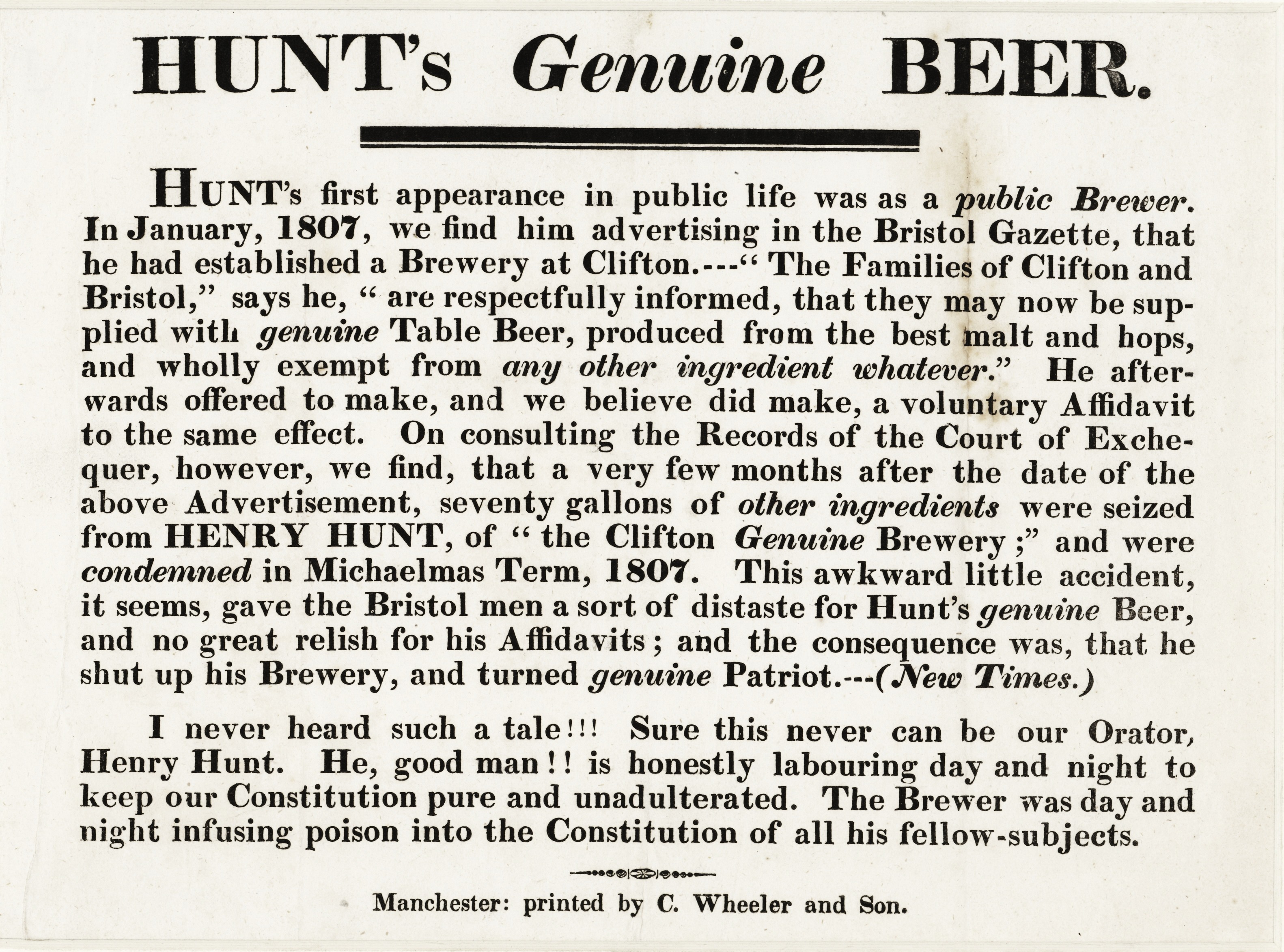
Hunt invested in the brewery at the behest of a relative and a young brewer was hired. Barley from Hunt’s farm was used, apparently of top quality and Hunt was keen that the beer produced was of a similar nature. The British Gazette reported it brewing a ‘genuine table beer produced from the best malt and hops and wholly exempt from any other ingredient whatsoever’.

Hunt was determined to avoid the use of additives in his beer and signed up with the Mayor of Bristol to this effect, but it appears the brewer had other ideas. Hunt had to intervene when losses at the brewery mounted and it became clear that the brewer was not only producing bad, adulterated, beer but also siphoning off cash as well. He fled and Hunt took direct control, moving from his farm to Clifton to do so.

I’ve found one further issue related to the brewery. Hunt began using a natural colouring to produce porter style beer. This drew the attention of the Excise- very probably a political interest- and barrels were confiscated from the brewery. Hunt contended, correctly, that he had done nothing illegal and a Court ordered the return of the beer with an apology.

The brewery, still loss making, appears to have been put for sale in 1809 (see below). The connection between beer and radical politics is well known, as is the Tory politics of most large brewery owners- the Beerage. However it is rare to find such a prominent radical figure as Hunt with a brewing heritage.

From Henry Hunt’s Memoirs Volume 2

The brewery was built upon the site of an old distillery, at the rising of a spring called Jacob’s Well, at the foot of Brandon Hill, and immediately below Belleview, at Clifton. The whole was soon completed under my own eye, and finished entirely on my own plan. I took advantage of the declivity of the hill, on the side of which the premises were situated, to have it so constructed that the whole process of brewing was conducted, from the grinding of the malt, which fell from the mill into the mash-tun, without any lifting or pumping; with the exception of pumping the water, called _liquor_ by brewers, first into the reservoir, which composed the roof of the building. By turning a cock, this liquor filled the steam boiler, from thence it flowed into the mash-tun; the wort had only once to be pumped, once from the under back into the boiler, from thence it emptied itself, by turning the cock, into the coolers; it then flowed into the working vats and riving casks, and from the stillions, which were immediately above the store casks into which it flowed, only by turning a cock. These store casks were mounted on stands or horses, high enough to set a butt upright, and fill it out of the lower cock; and then the butts and barrels were rolled to the door, and upon the drays, without one ounce of lifting from the commencement of the process to the end. This was a great saving of labour. I left the concern in the hands of my young friend, with every prospect of success, and I then returned to my farm at Chisenbury; having, as I was taught to believe, laid the foundation of a lucrative concern, from which I expected to derive a liberal interest for the money I had advanced, which was about eight thousand pounds, and at the same time afford a handsome income for my young friend. But such is the uncertainty and precarious state of all speculative concerns of this nature, and such the inconstancy of friendship, that, instead of ever receiving one shilling from this concern, I found it still continue to be a drain upon my purse. Bills were coming due, I was told, and they must be provided for, or the credit of the firm would be blasted. Duty, to a large amount, was to be paid every six weeks, and as often I was called upon to assist in making up the sum. I now began, although much too late, to curse the hour that I became connected with trade. I, however, did not despair. I met all the demands, till, having called in a considerable..

Hunt on the brewing of porter in Bristol in the early nineteenth century

When the act was passed, making it a penalty of two hundred pounds to use any _drug, ingredient_, or _material_, except malt and hops, in the brewing of beer, Alderman Wood obtained a patent for making of colouring, to heighten the colour of porter. This colouring was made of scorched or burnt malt, and it was mashed the same as common malt, which produced a colouring of the consistency of treacle, and having nearly its appearance. As this patent was very much approved of, almost every porter brewer in England used it in the colouring their porter; and amongst that number I was not only a customer of the worthy alderman for colouring, but I was also a considerable purchaser of hops from the firm of Wood, Wiggan & Co. in Falcon Square. I had just got down a fresh cask of this colouring, and it was standing at the entrance door of the brewery, where it had been rolled off the dray, when news was brought me that the new exciseman had seized the cask of colouring, and had taken it down to the excise office. I immediately wrote to Wood, Wiggan & Co. to inform them of the circumstance; upon which they immediately applied to the board of excise in London, and by the return of post I received a letter from Messrs. Wood, to say, that an order was gone off, by the same post, to direct the officers of excise in Bristol to restore the cask of colouring without delay; and almost as soon as this letter had come to hand, and before I could place it upon the file, one of the exciseman came quite out of breath to say that an order had arrived from the board of excise in London, to restore the cask of colouring, and it was quite at my service, whenever I pleased to send for it. I wrote back a letter by the fellow, to say, that as the exciseman had seized and carried away from my brewery a cask of colouring, which was allowed by the board of excise to be perfectly legal to use, as it was made of malt and hops only, unless, within two hours of that time, they caused it to be restored to the very spot from whence it was illegally removed, I would direct an action to be commenced against them. In less than an hour the cask of colouring was returned, and the same exciseman who had seized it came to make an apology for his error. His pardon was at once granted, and so ended this mighty affair; and I continued to use the said colouring, as well as did all the porter brewers in Bristol, without further molestation, as long as I continued the brewery; never having had any other seizure while I was concerned in the brewery.

Detail on the brewery

Henry Hunt announced he was quitting the business and put it up for sale in January 1809 (Bristol Mirror – Saturday 31 December 1808) but it looks to have been still unsold in 1810 ( Bristol Mirror – Saturday 10 March 1810). The brewery was in the hands of J Highett from Weymouth by 1811 (Bristol Mirror – Saturday 09 March 1811) but was put up for sale again the following year (Bristol Mirror – Saturday 29 February 1812). It was put up for sale again in 1813 by Joseph Pope, together with a ‘new copper furnace, never used’. By 1827 it was being described as a ‘late brewery’ (Bristol Mirror – Saturday 24 February 1827).

Thanks to Terry Collmann
Articles

Beard Campaigners warn on Guy Fawkes bonfire night pogonophobia

In Uncategorized on November 3, 2018 by kmflett

Beard Liberation Front

PRESS RELEASE     3rd November

Contact Keith Flett     07803 167266

BEARD CAMPAIGNERS WARN ON GUY FAWKES BONFIRE NIGHT POGONOPHOBIA

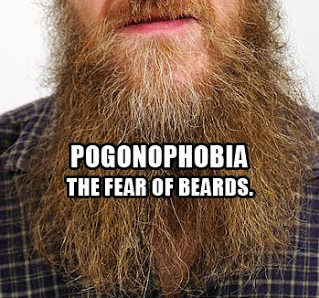
The Beard Liberation Front, the informal network of beard wearers, has warned of Guy Fawkes pogonophobia as bonfires around the country burn effigies of a hirsute man over the next few days.

Pogonophobia is the ancient Greek for an irrational fear or hatred of facial hair, known as beardism in modern English.

The BLF says that the period around November 5th is the traditional highlight of the pogonophobes year as they burn an effigy of what they assume to be a dangerous radical figure with a beard, although few will openly discuss their often deep-seated concerns about beard wearers

BLF Organiser Keith Flett said the irony is that Guy Fawkes was a deeply reactionary character who, had he lived now, would almost certainly not have had a beard under any circumstances

The BLF is calling on the organisers of Guy Fawkes bonfires not to burn effigies with outlandish beards and to discourage pogonophobic remarks and behaviour. The group says that there is some evidence that beard burning bonfires are in decline with events to mark 5th November often confined to fireworks only and welcome this positive development.

Articles

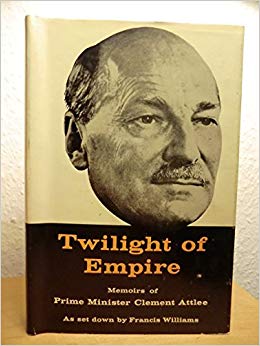
Socialist History seminar 5th Nov: Prof John Newsinger on The Other Spirit of 45, Attlee & Empire

In Uncategorized on November 3, 2018 by kmflett

London Socialist Historians Group

Autumn Term seminars 2018

Contact: Dr Keith Flett 07803 167266


The 1945 Labour Government is rightly remembered as a great progressive and reforming administration in Britain. Its record overseas was rather different and foreign policy is an issue which continues to be a significant issue in Labour politics in 2018.

Professor John Newsinger looks at the record of the Attlee Government and Empire

All seminars are from 5.30pm in Room 304, Institute of Historical Research, Senate House, Malet St WC1.

8th Oct Rupa Huq MP: from lecture room to Parliament: ‘From theory to practice : the difficulties of transitioning from teaching society and politics in the lecture hall/seminar to “doing “ it in Parliament.”

22nd Oct Marika Sherwood the beginning of the Cold War in Ghana (Gold Coast) in 1948

5th Nov John Newsinger The Other Spirit of ’45: War, Empire and the Attlee Governments

19th Nov Daryl Leeworthy Labour Country: Social Democracy’s Roots and Possibilities.

3 Dec Keith Flett. 50 years since the Pelican paperback of The Making of the English Working Class. Still relevant?

Free without ticket

Articles

20 years after Peterloo over 20 protesters for the vote were shot dead by the Army in Newport

In Uncategorized on November 2, 2018 by kmflett

20 years after Peterloo over 20 protesters for the vote were shot dead by the Army in Newport

With the attention being paid to Peterloo as Mike Leigh’s film is released its worth recalling that 20 years later over 20 people were shot dead by the army as they marched for the vote.

It is 179 years on 4th November since the Newport Rising in South Wales.

The event is being marked by a series of lectures, exhibitions and events in the town itself. It deserves to be observed much more widely. Details are here:

https://www.newportrising.co.uk/?fbclid=IwAR2nCF-C0JuSL6GZJ3fwBDwodesbATJNpZIuBDbl-uvhztQ77H-bnhvZfBw

The events of that day may have had a revolutionary character but the specific aim was clear. The Chartists were after the kind of political democracy- adult suffrage and secret ballots- that we take for granted now. They had tried petitioning Parliament, they had tried a General Strike in August 1839 (National Holiday]. They had been ignored. The resort to arms was a last resort.

The traditional histories note that male (and some female] Chartists marched from a number of mining areas outside of Newport such as Merthyr and Pontypool with the aim of rallying in the town itself.

As many as 9,000 Chartists gathered on the Saturday and Sunday 2nd and 3rd November 1839 before marching into Newport early on the Monday morning of 4thNovember. In the days before the telephone let alone social media, to co-ordinate a series of marches, some miles in distance, to arrive at the same time was problematic. Probably around 5,000 Chartists had rallied near Tredegar House on the outskirts of Newport on the Monday morning ready for the final push on the town centre.

Many were armed, some with guns other with pikes and clubs. Certainly numbers had visited pubs on the march in- hardly surprisingly given the time taken and the weather- and it hardly amounted to a revolutionary army. Even so their thousands far outnumbered anything the authorities could muster.

What exactly the plan was is disputed. It may have been to liberate the occupants of the Workhouse on Stow Hill and some Chartists that were held there and then to move on to Monmouth to free the jailed Chartist leader Henry Vincent.

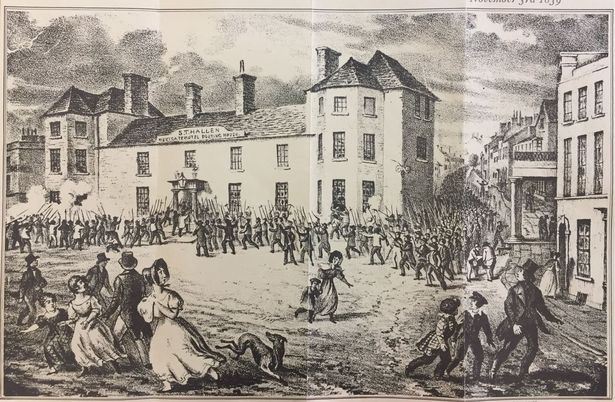
In practice they marched to the bottom of Stow Hill and encountered the British Army at the Westgate Hotel at the bottom the centre of Newport. There was a confrontation and numbers of Chartists were left dead, upwards of 20 in all probability with many more seriously wounded. Many were arrested and sentenced to prison. A few leaders such as John Frost, originally sentenced to be hung, drawn and quartered were despatched to Australia. They were later pardoned. A few escaped altogether.

The perspective is that the Chartists were no match for the forces of the British State and that the whole thing was a disaster.

Well, not quite.

In fact the Chartists were much better organised and led than the traditional histories suggest. They were shot down too not by a regular army unit but by a detachment of the crack regiment of the British Army at the time, the 45th, sent to do a particular job. Soldiers from the same regiment had shot down rebels at the Battle of Bossenden Wood in Kent in 1838.

Amongst the Chartist leaders on the day was someone known as Jack the Fifer [John Rees] who had fought at the Alamo with the Free Texan Army in 1835 and so had revolutionary military experience.

Moreover the Newport Chartists did not act alone. Their rising was to be the signal for other Chartists around the UK to do the same.

Clearly tactical mistakes were made. Leaving aside whether many of those who participated in the march in Newport understood exactly what was planned and what opposition they might meet, it must be questioned why it was necessary to confront the 45th Regiment in the Westgate Hotel when they did.

The Chartists easily had the numbers to occupy and control Newport in the face of which a small number of even crack troops could have done little.

It was not to be, but the problem lay with tactics and strategy not support.

The impact of defeat on Welsh Chartism and Chartism more generally is perhaps worthy of further research. Malcolm Chase has picked up some themes.

Certainly it was to be almost 10 years-in the summer of 1848 and in the Year of Revolutions that further attempts at armed revolt were to take place, for example in Bradford in June and London in August.

Again however the conspiratorial model of organisation was foremost and the results arguably all too predictable.

Articles

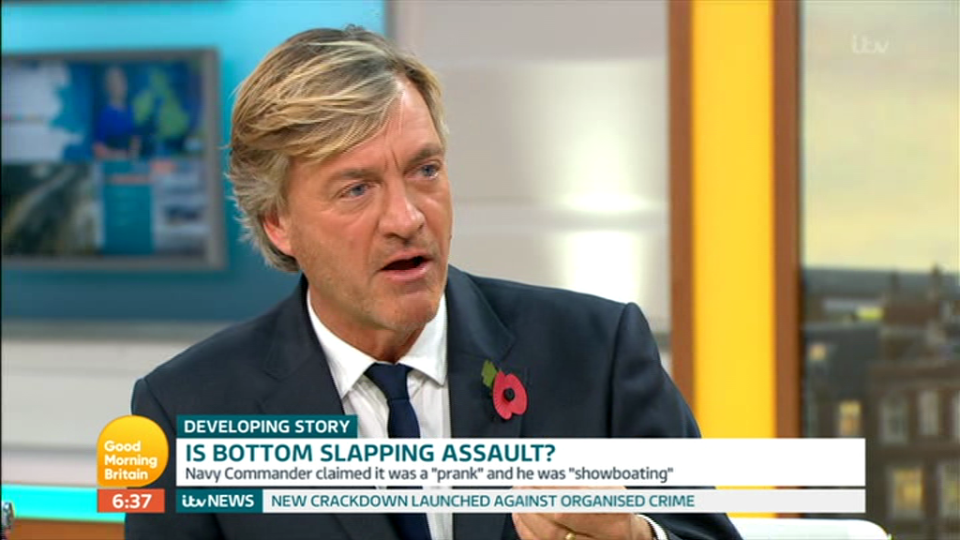
Good Morning Britain accused of pogonophobia as Richard Madeley is forced to shave beard

In Uncategorized on November 2, 2018 by kmflett

Beard Liberation Front

press release 2nd November

Contact keith flett 07803 167266

Good Morning Britain accused of pogonophobia as Richard Madeley is forced to shave beard

The Beard Liberation Front, the informal network of beard wearers, has demanded that Good Morning Britain bosses apologise after a newspaper report suggested that stand-in presenter Richard Madeley was forced to shave off a newly grown beard.

According to the report Madeley received a late night call from a GMB Editor demanding that he shave the beard which he duly did.
There has been a long standing resistance in broadcasting to presenters wearing beards. Jeremy Paxman when he grew a beard while presenting Newsnight complained of BBC pogonophobia but eventually shaved it off.

BLF Organiser Keith Flett said, GMB bosses must issue a full apology. In 2018 it is simply not on to tell a presenter they should shave their beard off

Articles

Are the ruling class characters in Mike Leigh’s Peterloo caricatures?

In Uncategorized on November 2, 2018 by kmflett

Are the ruling class characters in Mike Leigh’s Peterloo caricatures?

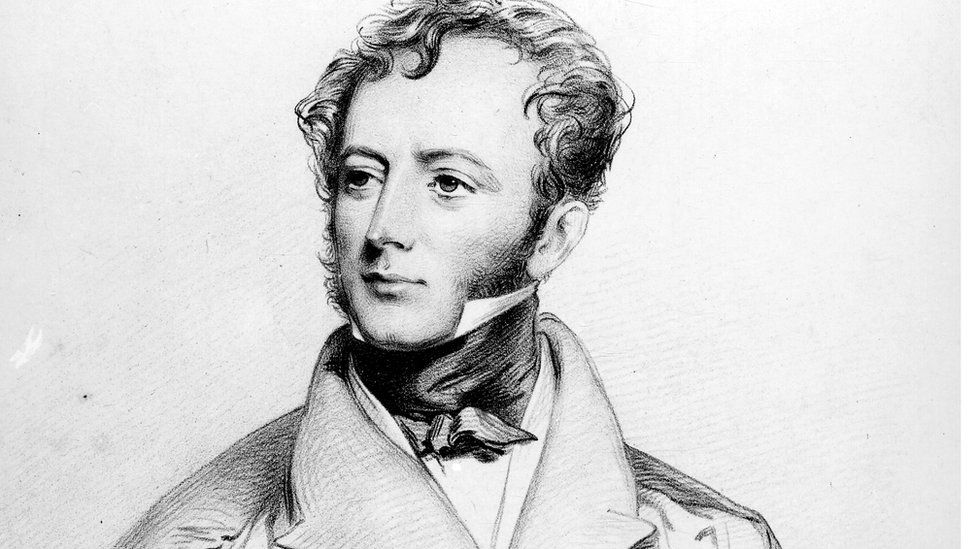
William Hulton

Mike Leigh’s film of Peterloo is on general release from today and well worth 154 minutes of your time.

Some reviews have suggested, in summary, that there is too much history in it (speeches etc) and not enough massacre. I tend to think the reverse but that is for another post.

A related point is that the ruling class characters in the film, the Prince Regent, Lord Sidmouth (Home Secretary) Lord Liverpool (Prime Minister) and the Magistrates at Peterloo are simply caricatures and would not have been like that.

We cant of course be sure since 1819 is many years before any way of independently checking (film, interviews etc) existed. However while bourgeois politicians in 2018 are subject to mass scrutiny and in general have learnt to behave as human beings (Boris Johnson being an obvious exception) there was no such requirement two hundred years ago.

Contemporary accounts suggest that the Prince Regent was much as Tim Mcinnery plays him in the film. The chair of the Magistrates on the day, William Hulton, shown as signing warrants for the arrest of Hunt and orders to send the Yeomanry in was also the man who  The Guardian (formed in 1821 as a result of Peterloo) spent decades describing as a ‘foolish country squire’, although I’m not sure there is anyone currently working on the paper who is aware of that direct connection.

See the film for yourself as above but I think in so far as we have any means of judging Leigh does well with the portrayal of the bourgeois at Peterloo. I would say however that I’m not totally sure there is evidence that ‘Oliver the Spy’ had a beard.

Articles

The facial hair question at Peterloo revisited

In Uncategorized on November 1, 2018 by kmflett

The facial hair question at Peterloo revisted

When Red Saunders organised the Manchester shoot for the latest in his Hidden series of historical tableaux, on Peterloo, I know he paid particular care to the issue of facial hair in terms of the participants.

Mike Leigh, the famously hirsute Director of Peterloo the film, has told The Guardian that shaving is amongst other things a waste of resources.

So is there is a facial hair angle to Peterloo? The question is rather less frivolous than might be thought.

The most well-known leader of Chartism Feargus O’Connor frequently began addresses to Chartist gatherings by noting the ‘fustian (cotton) jackets, unshorn chins and blistered hands’ of those present. Their appearance indicated that they were working men and hence Chartists

The ‘Gentleman Leaders’ (in effect full-time financially independent political organisers) of radicalism and then Chartism were invariably clean shaven. I don’t recall ever seeing an image of Henry Hunt, the main speaker at Peterloo, arrested and jailed afterwards, as anything but clean shaven.

One of the main chroniclers of Peterloo Samuel Bamford, who was there on the day (with partner Jemima) but who only wrote about it several decades later, was certainly hirsute in later life and indeed before Peterloo. Whether he had a beard on 16th August 1819 and how that would have fitted with his perspective of his role on the day isn’t known.

It was a matter of facial hair distinguishing between leaders and led, although by the mid-Victorian period leaders too had started to have beards.

I’ll be caught up with Mike Leigh’s film at a Guardian screening on 30th October. I still don’t know if there was a facial hair consultant but the film does a decent job of reflecting the principles of the above,

Henry Hunt is clean shaven as a Gentleman Leader would be expected to be. Samuel Bamford has a beard, which is sometimes did have. The Yeomanry were obviously clean shaven but the army- the Hussars- had sideburns and handlebar moustaches. The magistrates were clean shaven but William Hulton (foolish Country squire, The Guardian) their chairman had stylish sideburns.

In short on facial hair at Peterloo Mike Leigh has done a good job

Articles

Beyond Scary to Subversive: All Hallows Day (1st November) & the World Turned Upside Down

In Uncategorized on November 1, 2018 by kmflett

Beyond Scary to Subversive: All Hallows Day & the World Turned Upside Down

As you can hardly have missed 31st October is the commercial festival of Halloween, while the day afterwards is more traditionally known as All Hallows or All Saints Day. It is also Celtic New Year. The following day is then All Souls Day- the Day of the Dead which was a major festival of the Catholic Church in the West.

These festivals mark the changing of the season from summer to winter but there is a lot more to it than the piles of commercial Halloween tat and oversize pumpkins you can find in supermarkets. While a Guardian Editorial a couple of years back criticised the crass commercialism of the day as it is currently configured it seemed quite unaware that it has other meanings and ways of being marked.

Traditionally (see Steve Roth, Hamlet the Undiscovered Country) 31st October was the time when disruptive spirits roamed. That is reflected in Shakespeare’s Hamlet. The ghost appears on All Hallows Eve.

Roth notes:

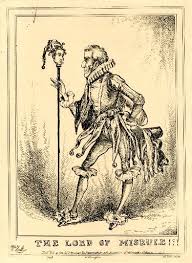
All Hallows was also a time for election of “mock kings,” “lords of revels,” or “kings of misrule.” These lords would reign over the revels season through Christmas and Twelfth Night (5 January, another night of inversion and misrule), often ending their reigns at Candlemas (2 February) or Shrovetide (which had–and has–perhaps the greatest association with carnival and misrule).

31st October was a time of the carnivalesque, of festivities and the appointment of Lords of Misrule. In some parts of the UK November 4th is still marked as ‘mischief day’.

The Lords of Misrule would reign until at least Twelfth Night on January 5th and often until Lent.

They were not always as disruptive as they might sound. They were often a way of providing a safety valve in society to mock authority and important figures without actually in anyway challenging them. The reversal of roles, masks and rebellion were often play acting.

For example in Henry V Shakespeare depicted Sir John Falstaff as the Lord of Misrule. Falstaff is well loved Shakespearan character but I don’t think anyone expects him to lead a riot or a revolt.

That wasn’t always true though. Sometimes the Lords of Misrule genuinely did represent an element of the World Turned Upside Down or at least the potential for it. Winter parades through the streets could lead to confrontations with authority.

I was born on 31st October 1956 but it would be reasonable to say that the event that shaped my outlook on life was not the above but the fact that it was the date Russian tanks rolled into Budapest to crush the Hungarian Revolution, followed by the Allied invasion of Suez

Turning the World Upside Down does not come out of the barrel of a T54 tank or a Western war plane at Halloween or at any other time.

Articles

The Spectator claims the People’s Vote march was 150,000 strong

In Uncategorized on October 31, 2018 by kmflett

Spectator claims People’s Vote march was 150,000 strong

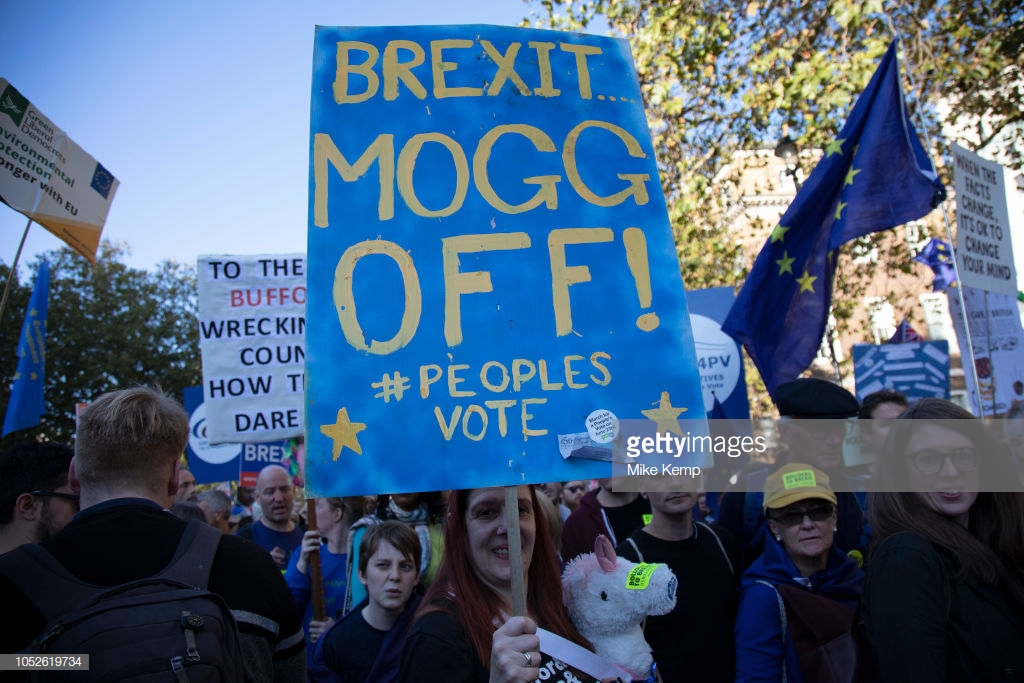
The Peoples Vote March For The Future on 20th October 2018 in London, United Kingdom. More than an estimated 500,000 people marched on Parliament to demand their democratic voice to be heard in a landmark demonstration billed as the most important protest of a generation. As the date of the UKs Brexit from the European Union, the protesters gathered in their tens of thousands to make political leaders take notice and to give the British public a vote on the final Brexit deal. (photo by Mike Kemp/In Pictures via Getty Images)

I wasn’t on the People’s Vote march in central London a week last Saturday as I wasn’t in London (& I live primarily in London so I was out of the Capital for a reason).

I voted remain and I have sympathy with the idea of a People’s Vote on Brexit terms. I have no sympathy with just having another Referendum because some people voted the ‘wrong’ way last time. Frankly I’d prefer a General Election.

However while I want to make clear my view this is not centrally relevant to this post. According to Charles Moore in the Spectator (a pro-Brexit come what may organ) the numbers on the march were no more than 150,000. He has no evidence for this beyond his personal prejudice that there cant surely be that many people prepared to march on Brexit.

There can of course and while the 750,000 figure remains conjecture it clearly was a very large march. The time taken to reach the end point in Parliament Square (where it was reached) underlines the point as does photographic evidence.

Tories have form on this. They have been underplaying the size of protests since the Chartists gathered on Kennington Common on 10th April 1848 to demand the vote. They are still at it.

Charles Moore, The Spectator

https://www.spectator.co.uk/2018/10/george-orwells-legacy-has-been-monopolised-by-the-left/

If you think about it, it is obvious that The People’s Vote march last Saturday in London could not have been attended by 750,000 people, as its organisers allege. That is the equivalent of every man, woman and child in Edinburgh, Oxford and Cambridge (to take three Remain-voting cities). Sky News reported that the organisers claimed more than 500,000 (itself a preposterous figure), and by Monday this had swollen in most reports by 250,000. Only the Sunday Telegraph mentioned that such estimates are dubious. It was a big march, certainly (and mostly an amiable one), but visibly much smaller than the march against the Iraq war in 2003 (two million claimed by the organisers, probably more like 300,000) and the Countryside Alliance’s Liberty and Livelihood March of 2002 (organisers and police roughly agreed on 400,000). Of course, I do not know how many were there on Saturday (I would guess about 150,000), but nor does anyone. And that is the point. Earlier this year, I checked with the Metropolitan Police. They told me they no longer produce their own estimates of crowd numbers, leaving it to organisers to announce the figures. This cop-out (mot juste) makes it much more likely that the march’s numbers will be successfully exaggerated for propaganda reasons because there is no objective check. The police would be the right people to provide one because, for public order reasons, they need to know about crowd sizes, and they have the helicopters. Numbers are the most important propaganda element in almost any demonstration, yet they have been allowed to become fictional.

Articles

Hagrid & Lord Sugar tie for Most Scary Beard of Halloween Title

In Uncategorized on October 31, 2018 by kmflett

Beard Liberation Front

PRESS RELEASE 31st October

contact Keith Flett 07803 167266

HAGRID & LORD SUGAR TIE FOR MOST SCARY BEARD OF HALLOWEEN TITLE

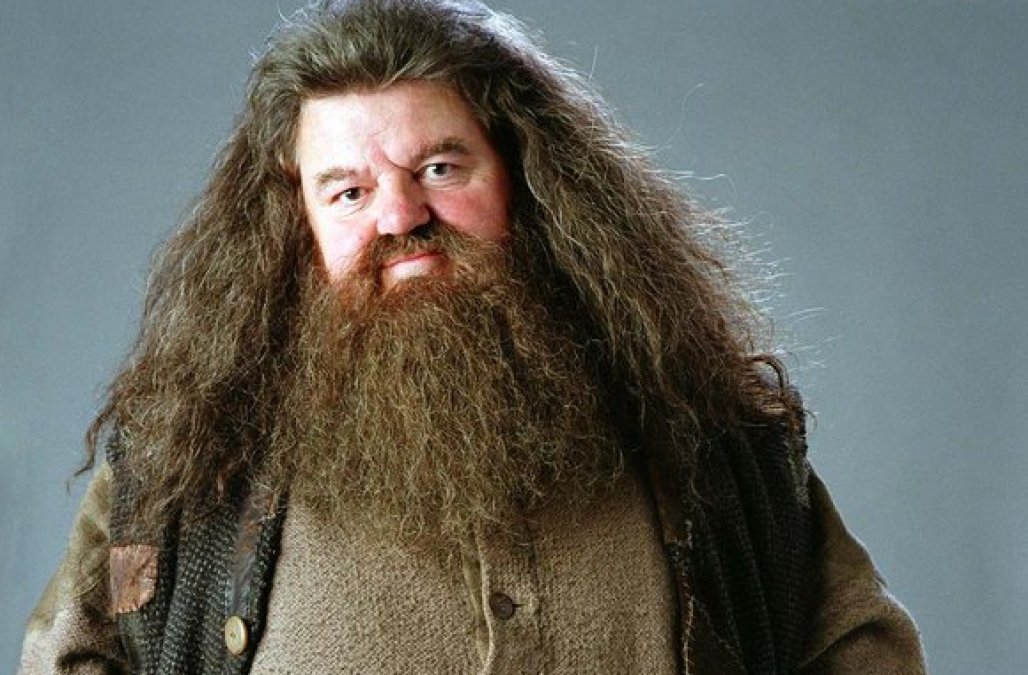
The Beard Liberation Front, the informal network of beard wearers, which campaigns against irrational prejudice against the hirsute, has said that the poll for the Scary Beard of Halloween 2018 title has ended in a tie between Apprentice supremo Lord Sugar and Harry Potter character Hagrid.

The campaigners say it was certainly Lord Sugar’s gruff demeanour on The Apprentice that got him votes, while Hagrid, noted for his friendly persona in J K Rowling’s books, simply has a potentially scary beard on  a moonless night, at least when portrayed by Robbie Coltrane

The 2017 winner was Richard Branson

The title, awarded each year on October 31st, takes a wry look at Halloween festivities by identifying the scariest beard in the public eye. The winner invariably succeeds by the narrowest crack of a squeaky floorboard.

The BLF does not generally believe that beards are scary a view promoted by generations of pogonophobes.

It is accepted though that on a dark moonless night as a beard looms through the gloom, nerves may rise a little as to what lies behind the beard.

BLF Organiser Keith Flett said of course none of the beards on the shortlist were genuinely scary. But come Halloween things can look a little different…

Scary Beard of Halloween 2018

Richard Branson

Sean Dyce

Noel Edmonds

Rubeus Hagrid

David Letterman

George RR Martin

Alan Moore

Lord Sugar

Antony Worrall Thompson