The Beard Liberation Front, the informal network of beard wearers, has said that with heavy down pours of rain forecast for much of the UK the hirsute need to take care to avoid possible beard rot.
The campaign group says that after a prolonged period of damp to wet weather the beard may become water logged and beard rot may set in.
Precautions are advised and the obvious way to keep the beard dry and avoid the danger of beard rot is to wrap it in a scarf or cover it with a snood to protect against the rain. Alternatively a special beard umbrella can be used.
The campaigners say that careful marination in a glass of imperial stout may also ‘wet proof’ follicles against the rain but this is entirely optional
If the beard does become water logged gently drying it through with a hair dryer as soon as possible is recommended.
BLF organiser Keith Flett said, we urge extra vigilance in respect of damp and wet at the moment. Once beard rot sets in the beard is unlikely to survive. Wrapping the beard in a scarf is prudent
Tony Blair has been making another of his rare but frequent public interventions (Sunday Times 7th July). Mainly he is raising again one of his favourite nostrums of digital ID cards. Even he admits that this can be controversial and therefore warrants discussion.
He does however touch on other issues.
He warns the new Government to ‘avoid any vulnerability of wokeism’. As he doesnt say what he thinks this it could be difficult.
He also suggests that the ‘Muslim challenge’ ‘is a topic requiring its own special analysis’
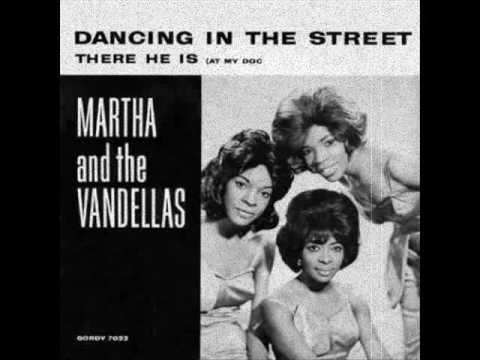
From Martha Reeves to France on July 7th: dancing in the streets
Before the age of visual mass broadcast media- initially TV- significant events, for example Labour’s 1945 Election victory were celebrated by huge numbers in the streets.
Street protests and demonstrations didn’t go away as television to a degree ‘privatised’ leisure but the physical act of political celebration seemed to diminish.
Tony Blair’s Election victory in May 1997 was certainly celebrated, as much for the end of the Tories as for what was to come perhaps, but the crowds outside Downing St were modest and perhaps not entirely spontaneous. The same was true of Keir Starmer’s arrival there on 5th July
Few crowds are entirely or event mostly spontaneous (even if the organisers are unknown) but if large numbers turn up that is another matter.
There is an historical benchmark for such occasions and it is whether or not people were to be found dancing in the streets.
Barbara Ehrenreich has written a book about dancing being an expression of collective joy stretching back to ancient societies.
Ehrenreich uses primarily an anthropological framework for her commentary. It is clear that people coming together in a crowd to mark important occasions and to celebrate in certain ways such as dancing and music is a very old tradition indeed.
In more recent times this became in many cases celebration through the rituals of Carnival, a moment when traditional constraints to behaviour could be loosened.
Not all such occasions have been expressions of collective joy which opened towards the political left. The English tradition of Rough Music which was certainly a collective expression of a popular mood as a crowd gathered to make a noise and focus on those who had transgressed expected behaviour in some ways, was sometimes reactionary.
The modern usage of the term has been more specific and can probably be dated back to the Martha Reeves and the Vandellas 1964 Tamla Motown record Dancing in the Streets.
The song was a massive hit for the group and Motown and is still played over 50 years after its release.
Yet the meaning of the song was both disputed and perhaps left deliberately unclear.
When Martha Reeves came to England it is suggested that a reporter asked her if the song was about riot. She replied that this was absurd. It was of course about having a celebratory party.
However when the oppressed in society decide to take action against their oppressors there is often a moment of celebration of collective power about it.
A view is that Dancing in the Streets was certainly about, for a wider public, enjoying yourself. It also sent a message to the substantial black audience for Motown records that getting out on the streets around the civil rights movement was not just appropriate but potentially enjoyable.
Since then the present author has heard numerous claims that people were dancing in the streets at this or that political event or occasion.
Until quite recently unless you were there in person it has been very difficult to prove.
The general view is that in societies where participation in formal politics has often been in decline it would seem exceptional that people could summon up sufficient enthusiasm to dance in the streets at a political event.
In 2024 social media comes to our aid. Of course careful checks are needed to make sure some twerp for their own reasons isn’t posting a clip of something that didn’t happen at that moment.
But if you check social media following the announcement the second round of voting for the French Parliament on 7th July you can find instances of people dancing in the street and, perhaps even better, of Jean Luc Melenchon leading a huge crowd in central Paris in singing the Internationale. It was rather a pity that didn’t also sing dancing in the street
Tony Blair, Digital ID Cards & the old Battersea Chartists of the 1880s
Tony Blair has been making another of his rare but regular political interventions. This time to remind us of his nostrum about the need for everyone to have a Digital ID Card. Blair suggested this while still in Government but it was not proceeded with by the Tory/LibDem regime after 2010.
Blair is promoting it again in a Sunday Times article (7th July) although by now even he realises its not going to happen, so simply argues that it should be discussed. In fact Jonathan Reynolds made clear it does not have Government support.
As Dylan noted, there is no success like failure, but failure is no success at all.
The phenomenon of the perpetually reappearing ex-leader is not unique to Labour. A whole chauffeur driven car full of ex-Tory leaders is available for comment.
However there is also a place in labour history for historical hangovers.
Some of the Chartists of the 1840s were still to be found active in a revived socialist politics in the 1880s. They were primarily followers of the Chartist Bronterre O’Brien who believed that currency reform was central to a fairer society.
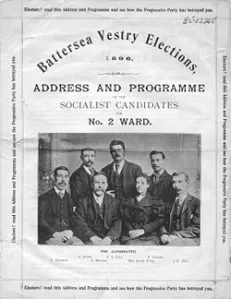
W S Sanders in his book Early Socialist Days, recalled branch life in the Battersea branch of Britain’s first Marxist organisation the Social Democratic Federation in the 1880s. The demands of the People’s Charter of 1838, suitably tweaked, were very much part of the SDF’s politics. The O’Brienite currency theory much less so.
Sanders notes that the old Chartists were seen as survivors from another age, listened to with interest by some, with frustration by others, but ultimately an anachronism.
On 4th July 2024 the Greens won four seats and it has sparked a further discussion on the left about whether the Green Party is a more amenable place to be for socialists than Starmer’s Labour. Individuals will take a view but I worked with the Green Party over many years as an officer of Haringey TUC. Indeed until recent decades they were often the only party on the left to appear on election ballot papers aside from Labour.
Certainly there were some good socialists there- not as many as some seem to think- and certainly people with progressive agendas who would be part of campaigns.
I took a note of the Green Party’s performance in North London on 4th July 2024(we can argue about what I’ve included as North London-the Greens also performed well in the two Hackney Constituencies). The results are striking. Every candidate saved their deposit even in Islington North where they did not campaign. There were a couple of second places and lots of thirds.
Parliamentary Democracy while important is not everything as many Greens appreciate but on this basis the Greens are a coming force somewhere on the left of the political spectrum. Where exactly remains to be seen. I’m not going into the downsides here- of which there are quite a few- because that’s not the purpose of this post!
Hornsey & Friern Barnet 3rd 14.5%
Holborn & St Pancras 3rd 10.4%
Hampstead & Highgate 3rd 13.7%
Islington North 3rd 5.4% (Greens did not campaign)
The new PM Keir Starmer has evaded analysis of where precisely he is coming from. A Blairite?, a Wilsonite? or something else. We may find out.
There are some things we do know about Starmer. He is an Arsenal season ticket holder, his father was a toolmaker and his mother a nurse and he used to be the DPP. He and certainly the factionalists around him like a good purge.
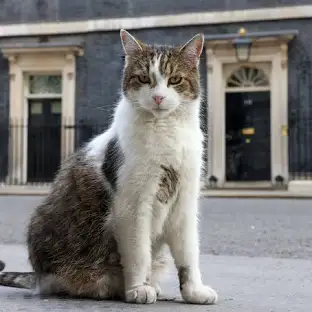
With this last point in mind the question must be asked is Larry the Cat set to be purged from Downing St?
Keir Starmer and family do have a cat called JoJo. In an interview in April he noted that his children were more friendly to the cat than they were to him. A familiar syndrome hardly unique to the Labour leader and PM.
Tom Baldwin’s biography of Starmer makes reference to him extracting JoJo from a fight in the back garden and getting a scratch on his thumb as a result.
Reports have suggested that Starmer intends to move JoJo from Kentish Town to Downing St.
Those familiar with cats will know the type, always up for an encounter with other cats and often provoking it. Will Starmer enforce peaceful co-existence between Larry and JoJo or will Larry be expelled?
Update
Victoria Starmer is quoted in the Sunday Times (7th July) as being concerned how Larry and JoJo will get along. Is it time for Sir Keir to appoint a Minister for Cat Conciliation?
It went unreported by the BBC but long standing Tory MP for South Borsetshire Bufton Tufton lost his seat to Labour’s Chris Archer on 4th July. He is a distant member of the Archers Dynasty and a so good fit for Starmer My Labour. The Ambridge Socialist candidate Sid Grundy came a creditable fourth behind the LibDem.
Alice and Drink: the class struggle continues
Alcoholism is a serious issue and needs to be taken seriously. The Archers has done that with Alice while also reminding us that most of Ambridge remains in the John Barleycorn frame of mind, whether its Brian with a malt, Lilleen with a G&T, the Grundy’s award winning cider or just at the Bull.
Behind this however lies a battle between the proletarian Carters and the ruling class Archers about who should be dealing with the matter and why more consideration is not given by the latter to young Martha.
Justin tries his hand at employee relations
Justin is not someone who believes in employee relations so when he stopped by to discuss with Alice her future at the stables he came straight to the point. She should just resign and save everyone more bother.Reasonably enough she declined so Justin then reminded her that she would be going to pay at statutory sick rate. Alice might want to look at her contract to see what it says on this.
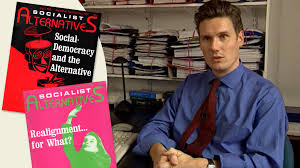
London Socialist Historians Group July 7th In the mid-1980s the Prime Minister Keir Starmer was one of a small team of people involved in writing and publishing a left-wing magazine, Socialist Alternatives.
It was not Trotskyist, although inspired by Michel Pablo a well known Trotskyist. Rather it looked at how to develop a red/green politics. While the matter occasionally surfaces in the right-wing media and is passed over in others, its also of interest to the left.
Of course Starmer with his stances on Gaza and fiscal rules can’t be seen as left, although in both he is somewhere in the mainstream of most Labour leaders with the exception of George Lansbury and Jeremy Corbyn.
In Tom Baldwin’s biography of Starmer he notes that while the PM doesn’t stand by everything he wrote then he does still see relevance in a red-green project.
People can take their own view. In May 2024 the Editor of Socialist Alternatives Benjamin Schoendorff spoke at a London Socialist Historians seminar. A recording is below.
Benjamin Schoendorff The Socialist Alternatives experiment: an 1980s attempt to search for a new revolutionary subject
The then Editor of Socialist Alternatives Benjamin Schoendorff looks at what the 1980s project was trying to achieve and reflects on the input of one of its most well-known contributors, Keir Starmer
Trade Unions in a Wapping World The struggle for workers control means.. effective defense of the unions, supporting national and local pickets and a principled advocacy of solidarity action.
Class, History & Geography in the General Election
A footnote that the socialist historian E P Thompson made to his A Psessay in Ephology about the 1959 General Election, though over 60 years old, does seem to capture quite well the relation between the media, leaders debate and opinion polls currently:
A psephologist is a man employed by the mass media to research into what people think the mass media has told them to think. An ephologist is a man employed by the ‘Observer’ or BBC to interpret the results of psephology and who makes an ephing good thing out of it
As it turned out all the polls with the marginal exception of YouGov overestimated Labour support but not the scale of victory. This may reflect issues with Voter ID, a turnout of 60% (one of the lowest since 1885) and antipathy among sections of Labour voters over changed Labour and Gaza. Four indy candidates focused on Palestine won seats. Did the polls reflect that?
The headlines generated by such polls often come with brief if unexplained historical references.
For example the Tories won fewer seats than at any Election for over a hundred years. References to the 1832 Election have a certain historical niche (see below) but that was fought on a very restricted franchise
The Labour majority was one of the largest the Party has ever achieved. That was not matched by the 9.7m votes received well below what Jeremy Corbyn got in 2017 and 2019. Of course Labour targeted seats they needed to win as opposed to safe seats. There was little sign of Labour in my constituency of Tottenham, and Labour activists posted on X mostly about being anywhere else, as did the candidate. As a result David Lammy’s majority was cut by 20%
Starmer goes on constantly about his changed Labour Party but it is not a new approach. Very similar wording was used by Blair in 1997. By change of course he means that he has purged much of the left from Labour. Purging voters is more difficult.
Jeremy Corbyn with a genuine campaign got a deserved victory in Islington North, itself a rare achievement for an independent. But canvassing showed that on the doorstep people supported Corbyn but of course have always voted Labour. Explaining that this time he is an independent candidate was crucial.
That underlines that despite Starmer, voting Labour for many people and in many areas remains a class vote. At least since Labour lost the 1959 Election pundits have been trying to argue that such a thing no longer exists.
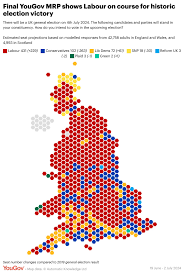
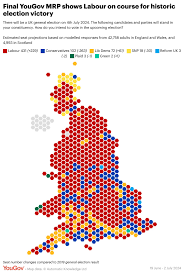
However if you look at the map closely associated with a pre-election YouGov poll it closely mirrors one that might have been found 60 years ago. Whatever Starmer’s changed Labour is about, the strongly working class areas of London, South Wales, the North-West and Tyneside are a sea of red just as they were in 1964.
The Tories ended up with 34 less than the 155 seats they won at the 1906 Election where they split over the issue of Free Trade. Perhaps more relevant but in a different way was that Election held after the 1832 Reform Act extended the franchise. The Tories lost and a complete rethink began. William Hulton the Magistrate who sent the Yeomanry in at Peterloo in 1819 was amongst those who began to organise grassroots Tory organisation.
Something similar might be expected for the Tories after July 4th combined perhaps with a further lurch to the right.
All this though represents a one-dimensional politics. The differences between Starmer and Sunak exist but are very much at a secondary level. Both back a capitalist market economy and a drive to war.
On that basis turn-out was low and the total share of the poll taken by Labour and the Tories was amongst lowest of recent times. There were many independent candidates standing some on socialist and Palestinian platforms. They could not rely on any media coverage but on organising locally and going door to door.
In the interests of wider democracy and socialist politics there were some decent votes and some victories . A landslide however does tend to sweep aside all. In this election matters were rather more complicated.
Not only were four independent MPs elected on broadly pro-Palestinian platforms but the Greens got 4 MPs. There is clearly interest from some sections of the left in the Greens. Having worked with them for many years in North London I’d suggest that like Labour they are party which has some socialists in it. Hopefully part of the solution…
An earlier version of this post appeared originally in the Morning Star