Comparing the 1832 Election with the 2024 Election
If you read attempts to put the 2024 Election into historical comparison, the 1832 Election comes up.
It is reportedly the worse Tory Election defeat since 1832 while the Times (6th July) claims Starmer has won on the lowest vote share since 1832.
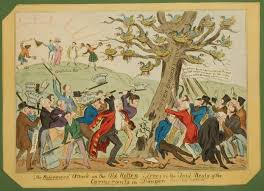
The 1832 Election was the first held on a slightly extended franchise arising from what is known as the Great Reform Act. The push for change had come particularly after 1819 led by working class radicals. 1832 was the result of middle class radicals capping the process. A £10 franchise was implemented meaning very limited numbers gained a vote.
The Election was won by Earl Grey (Whig, the Liberal Party was formed in 1859) and lost by the Duke of Wellington (Tory). There were around 800,000 votes 31,000 going to the Irish Repealers led by O’Connell.
The Whigs won 441 seats (67%) and the Tories 170 (29%)
Certainly the result made the Tories realise that they had to modernise their organisation. By 1834 in places like Lancashire grassroots Tory structures were formed (in this case by Hulton the Magistrate who sent the Yeomanry in at Peterloo in 1819).
The Whig administration that took office was responsible for the Poor Law (Workhouse) and despatching the Tolpuddle Martyrs to Australia in 1834. Such was where modernisation led.
E P Thompson in the Making of the English Working Class quotes a Macclesfield radical that ‘it mattered not to him whether he was governed by a boroughmonger or a whoremonger or a cheesemonger if the system of monopoly and corruption was still to be upheld’
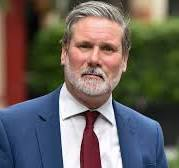
The Beard Liberation Front, the informal network of beard wearers, has called on Keir Starmer to show Labour has really changed and appoint a Minister with responsibility for hair and facial hair.
The Prime Minister is a regular visitor to the barbers and maintains an image enhancing hair style. However unlike his late father he has never been known to wear a beard.
The campaigners say that the Minister would be charged with ensuring that people can dress and appear as they want without Victorian style restrictions. There would also be a requirement to regulate the activities of barbers.
BLF Organiser Keith Flett said, The PM is very image conscious and in his changed Britain he needs to make sure that the matter is regulated and promoted at Ministerial level.
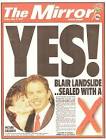
Labour won the Election on 4th July with 412 seats and a majority of 170. It was close to Blair’s win in 1997
The media, by contrast, noted that the 203 seats won in December 2019 was the lowest total since 1935.
One interesting measure is the total number of votes cast for Labour. This (fairly obviously) is not a guarantee of Electoral success but it does in a very broad way reflect a class vote and the depth of a Party’s support.
Labour won 9.7m votes on 4th July and an obvious reflection is that relative to seats won this reflects an unfair FPTP voting system. A point less heard is that whichever voting system is used has pluses and minuses. It’s a political choice.
If a vote for Labour is a class vote, and it is in many areas, the 2024 figure is less impressive than those achieved by Jeremy Corbyn in 2017 and 2019. Part of this relates to a low turnout of around 60%. Part of however relates to Labour’s strategy of targeting seats to win rather than building up votes in ‘safe’ seats.
One thought might be that this ‘safe’ support needs to further engaged with and organised to help secure a future Labour win. Its surely not about Westminster but about the grassroots in workplaces and communities across the country.
The Beard Liberation Front the informal network of beard wearers has said that its 4th July exit poll an extrapolation from the main poll suggests the Commons is on track for the most MPs with beards since 1945.
The rise in the numbers of Labour MPs is behind the prediction. Just as clean shaven Blairism could not stop Robin Cook and Frank Dobson so clean shaven Starmerism can’t prevent the rise of beard power in Labour’s Parliamentary ranks
Just as with George III’s celebration in 1809 there were some opponents. Unsurpringly these included William Morris writing in his magazaine Commonweal in June 1887 called it amongst many other things “monstrous stupidity …hideous, revolting, and vulgar tomfoolery ..a grievous mass of flunkeyism.” He suggested that “this loathsome subject of the jubilee is consigned to its due dust-heap….” But as Mike Benbough-Jackson commented in Jubilee Tribulations “Of course no one denied that there was opposition, mainly from Republicans and Irish Nationalists. Yet the very fact that dissent came from these quarters seems to render the event all the more successful. These were minority, sectional interests whose squawks made the lion’s roar sound all the louder.”
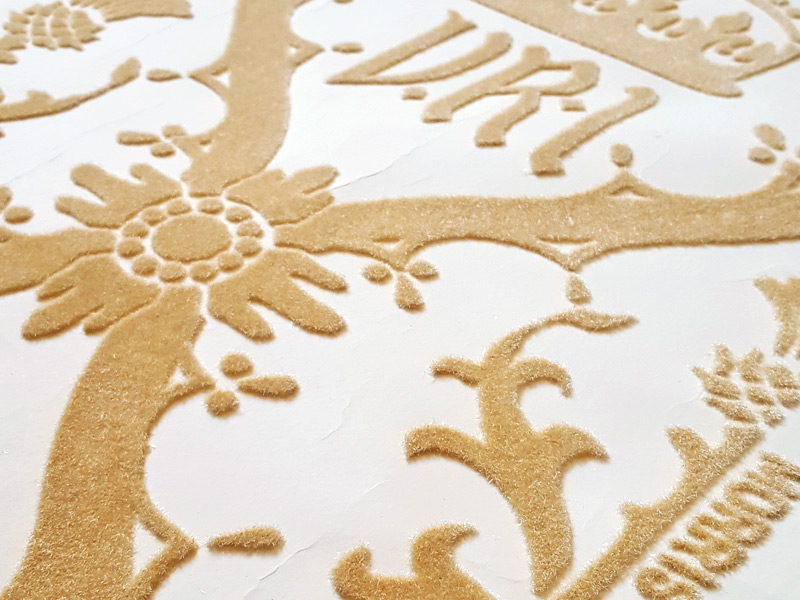
Queen Victoria must have been pleased with the results as in 1887, the Golden Jubilee year, Morris was commissioned to create a wallpaper for Balmoral Castle. Morris’s design was bright and classic. It is comprised of the royal cypher (Victoria Regina Imperatrix) and a Scottish thistle within large lozenges. It was produced in a fine merrino flock, fawn on a white ground. With its formal diaper design, and strong lines of symmetry it is quite unlike Morris’s own style and much more in keeping with the typical wallpapers of the period. Where the Morris signature style shines through is in its simplicity of form and its lack of attempt or desire to depict the pieces realistically.
The Chartists & the Suffragettes fought for the vote. Use it on 4th July
A General Election take place on 4th July. Some have argued that it is an election as decisive as that of 1945 or 1979.
That said, and I’m far from an obsessive about Parliamentary elections of any kind, participation in democratic elections is important as a principle.
It’s important because there is a hard right populist party in the field in the shape of ReformUK (which is actually a limited company not a Party) and the Tories are not too far removed from that agenda either. Even if you just cast a vote for any of the other parties it will make a point.
It’s also important because the Chartists fought for the right to vote for men, not finally achieved until 1918, and the Suffragettes did the same for women, achieved in 1928.
In the 205th anniversary year of Peterloo it’s important to remember the sacrifices that people made to win the vote and it’s also important to remember that even today in the US Trump is making extensive efforts to prevent working people from voting now echoed to some extent by the Tories here with PhotoID
So vote on 4th July. The fight to win you the vote in the first place means a lot and that means it’s worth exercising it to Kick Out The Tories
2ndMay 1997, bliss was it in that morning to be alive, & 5th July 2024?
As an historian I’m not keen on memory which I think is often unreliable, so my memories of May 1st and 2nd 1997 are unreliable.
Not surprisingly there have been numbers of memoirs of May 1st and 2nd 1997 on social media to go with those already published in print.
I’ve put together the below, which is not reliable in the specifics any more than any memory is to underline that even those on the left who were no fans of Blair before 1997 were very happy to see the end of the Tories. There was also a sense of hope.
Of course we knew Blair was not on the left, although he had been, sort of, rather more recently than Starmer (he was much younger of course) but the joy of ejecting the Tories after 18 years was considerable. This time it will be ‘only’ 14 years.
The archival world is currently in something of a turmoil moving away from the old print copies in libraries to digital back pages on-line (some chargeable some not). Even so I spent time in the British Library checking my back pages. I can’t find a Fletter criticising the new Labour Government until one in the Guardian at the 100 day mark.
On Thursday May 1st after voting Labour in Tottenham (the late Bernie Grant) I was on the May Day march organised as it still is by the London May Day Organising Committee. It was (I think) one of those years when it focused on NE London. I recall Clissold Park in Stoke Newington.
Later beer was involved, where I can’t really recall, but given the pubs in those days in North London it was probably the Tollgate-then a Wetherspoons in Turnpike Lane. Later still, there was a results party in Tottenham.
The result we were waiting for was Portillo in Enfield Southgate, a nearby constituency familiar to at least some of us. I had been out in that area in the previous few days and remember thinking- are these houses with two cars out at the front really going to vote Labour?
The answer was yes. The party was marked (in my memory) by someone- now a senior union official- shouting at regular intervals that we wanted Portillo out.
The morning brought a hangover but there was a 6am picket line to attend- bakers at Arnoutti in North Tottenham were out on strike. I attended and returned to bed.
Later it was off to Reading for the CAMRA beer festival. The sun was still shining and it was a pleasant later Friday afternoon. The festival was a much less extensive event (and much cheaper to get in) than it is now.
In those pre interwebs, pre mobile phone days, I was listening to Labour Cabinet appointments on a transistor radio. The world seem a slightly better place.
The Tories were out at last and clearly not coming back for a good while. Perhaps a change for the better was possible.
Class, History & Geography in the General Election
A footnote that the socialist historian E P Thompson made to his A Psessay in Ephology about the 1959 General Election, though over 60 years old, does seem to capture quite well the relation between the media, leaders debate and opinion polls currently:
A psephologist is a man employed by the mass media to research into what people think the mass media has told them to think. An ephologist is a man employed by the ‘Observer’ or BBC to interpret the results of psephology and who makes an ephing good thing out of it
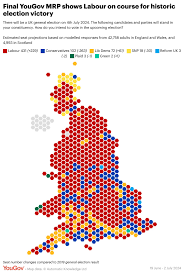
Polling outfit IPSOS has published an MRP poll which shows the current break down of support in each Constituency. For those who want the Tories out its good news. There is a Labour landslide coming with even hard right figures like Jenrik, Braverman and Truss not safe.
The headlines generated by such polls often come with brief if unexplained historical references.
For example the Tories are set to win fewer seats than at any Election for over a hundred years.
Meanwhile the projected Labour majority could be one of the largest the Party has ever achieved.
Starmer goes on constantly about his changed Labour Party but it is not a new approach. Very similar wording was used by Blair in 1997. By change of course he means that he has purged much of the left from Labour. Purging voters is more difficult.
Jeremy Corbyn looks to be in with a distinct chance of winning in Islington North, itself a rare achievement for an independent. But canvassing shows that on the doorstep people support Corbyn but of course have always voted Labour. Explaining that this time he is an independent candidate is crucial.
That underlines that despite Starmer voting Labour for many people and in many areas remains a class vote. At least since Labour lost the 1959 Election pundits have been trying to argue that such a thing no longer exists.
However if you look at the map closely associated with the IPOS poll it closely mirrors one that might have been found 60 years ago. Whatever Starmer’s changed Labour is about, the strongly working class areas of London, South Wales, the North-West and Tyneside are a sea of red just as they were in 1964.
The Tories may well end up with less than the 155 seats they won at the 1906 Election where they split over the issue of Free Trade. Perhaps more relevant is the Election held after the 1832 Reform Act extended the franchise. The Tories lost and a complete rethink began. William Hulton the Magistrate who sent the Yeomanry in at Peterloo in 1819 was amongst those who began to organise grassroots Tory organisation.
Something similar might be expected for the Tories after July 4th combined perhaps with a further lurch to the right.
All this though represents a one-dimensional politics. The differences between Starmer and Sunak exist but are very much at a secondary level. Both back a capitalist market economy and a drive to war.
On that basis turn-out is not likely to be high and the total share of the poll taken by Labour and the Tories is likely to be the lowest of recent times. There are many independent candidates standing some on socialist and Palestinian platforms. They cannot rely on any media coverage but on organising locally and going door to door.
In the interests of wider democracy and socialist politics let’s hope there are some decent votes. A landslide however does tend to sweep aside all
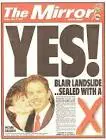
The S*n has has backed Starmer for PM as it did with Blair in 1997. Its Editorial is hardly full of praise for Starmer but the front page of the 4th July edition declares that the country needs a new manager (with a picture of Gareth Southgate). Murdoch does like to back a winner (and build on the relationship on the basis to his advantage)
I don’t read the S*n but I do cast an eye over the Times which is mostly just the S*n with longer paragraphs. The current Editor Tony Gallagher is a former S*n man. The best one could say about the paper’s numerous Editorials on Starmer and Labour policies is that they take the view that Labour will be elected and as many blocks as possible need to be in place to stop it doing anything at all. The Sunday Times has already backed Starmer.
The S*n and the Times no longer publish circulation figures but certainly the sales of the former are nothing like what they were in 1997. Influence lies elsewhere.
Starmer said he would not deal with the paper or write for it when he was elected leader but like everything else he has moved on from that. There are good reasons why a labour movement boycott of the paper remains in place.
Alastair Campbell has been too busy playing the bagpipes in Germany to comment so far but here is what he said before 1997:
As early as August 16th 1994 Alastair Campbell was recording in his diary:
‘I’d read an interview with Murdoch in Der Spiegel in which he said he could see himself backing Blair. TB said he was probably messing around. I wasn’t so sure. The right wing have had it with Major, and I think we can really make trouble. The aim should be to keep the left press on board, neutralise the Mail, and if possible get the S*n to back us’.
Keir Starmer frequently mentions that his father was a toolmaker, although likely in a small tool shop rather than the factory described below. A reminder though that toolmakers were union men (and sometimes women) often well read and quite often seeing things through a socialist perspective. They certainly don’t deserve the enormous condecension of posterity
The work environment of the toolmaker is, compared to that of men operating machines against the clock, quite conducive to reflection and conversation. The men I worked with were, for the most part, only interested in their personal lives, and in their working-class subculture which ranged from football to beer drinking, with a smattering of pigeon fancying and aggressive sexuality. They were not for the most part, thank God, made up of that mixture of piety and self-help which the Victorian middle classes so admired in the ‘superior artisan’. But quite a few had managed to steer a middle course between the excessively physical and the excessively Calvinistic aspects of working-class culture. And one such workmate, widely read and with considerable practical experience in workers’ organization, undertook my political education. He was about 50 years old, the son of an Irish docker and one of a very large family. He had left school during the First World War and managed to obtain a skilled apprenticeship, despite his background, because of the munitions boom. During the inter-war period he had suffered long spells of unemployment, and Love on the Dole was very much the story of his life. While a still very young man he had abandoned an ancestral faith in Rome, for a burning faith in socialism. For him, socialism was a religion far removed from the economic rationale of the Fabians.
Under his guidance I began to read my way through his personal library. I cut my teeth on a battered copy of Robert Blatchford’s Merry England, before grinding my way painfully through Engels’ Condition of the Working-Class in England. And under the pretence of consulting him about a tool I was making, we would discuss what I had read. Years later I understood how unfortunate the undergraduate is in trying to learn politics in a university. He will never savour a real educational experience such as I enjoyed
. Not only did I receive a wonderful introduction to the world of books, but my ‘mentor’ also persuaded me to join the union as a junior member. Not that I needed much persuasion, for I had long been fascinated by the huddled dinner-break meetings at which my benchmate, the shop steward, would make slightly pompous speeches. For me the union was never the purely economic institution concerned only with getting larger earnings that the middle-classes naively believe it to be. Certainly, the union was the organization which we looked to in the struggle to increase wages, but it was by no means its only function, and perhaps not even its prime function. For me the union was ‘us’ and ‘ours’. It stood between us and the power of the foreman and undermanagers to direct us at will. It was the collective instrument by which we asserted our right partly to control our daily destiny. The union stood between us and that concept of slavery and degradation called ‘managerial prerogative’. We never really believed that the union could do any more than hold the ring on the question of wage levels. If the union had really possessed that ‘dangerous power’ to ‘blackmail’ employers into paying high wages, so avidly believed by the middle classes, why then has the proportion of national income going to wage earners remained basically unchanged for more than a century? Indeed, one of the first political truths to hit me was the impotency of the trade union movement to change fundamentally the lot of the working class. For a change in ‘the system’ the movement would have to rely upon its child: the Labour Party. And every parent knows how difficult it is to fashion children in their own image.
The satisfaction membership of the union gave me cannot be separated from the satisfaction given me by membership of the workgroup. At the bottom of the instinct for trade unionism lies the instinct of the worker to be a fully integrated creative being, finding his salvation through work. Unfortunately, the normal lot of the industrial worker is a very unsatisfactory work experience of performing a fragmented task under conditions he can only marginally control. The union assists him in the struggle to assert his personality over these forces which threaten to disintegrate his wholeness. Fortunately, being an apprentice craftsman, I was saved from the type of work which so quickly destroys the creative personalities of so many industrial workers. My work was satisfying to a surprisingly high degree, and this was reinforced by the ‘intellectual’ discussions I was able to have with my ‘tutor’ without authority being able to detect them. A further factor which enabled me to reach out to that personal fulfilment denied to so many in that cavern of a factory was the making of ‘foreigners’.