Articles

‘Where the Isle of Wight leads the rest of Britain follows’ Hancock; Marx liked Ventnor

In Uncategorized on May 4, 2020 by kmflett

Chimnitz, St Boniface Gardens, Ventnor, Isle of Wight

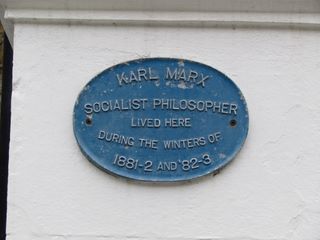
Marx spent months at the end of his life in 1882 and 1883 in Ventnor on the Isle of Wight. The area has not changed so much since he lived there and the house he stayed in, 1 St Boniface Gdns, which is in central Ventnor, has a plaque to mark his stay. Just six years later Churchill was in the town and the veteran Chartist George Julian Harney also visited. People came because of the temperate climate and the beneficial impact on their health particularly in the winter months.

Articles

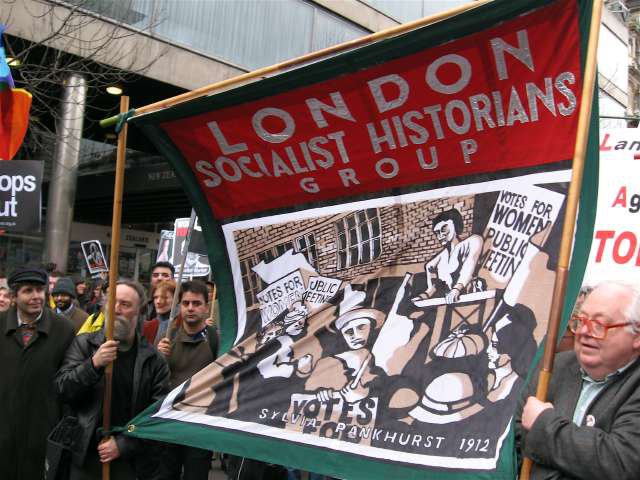
London Socialist Historians. Virtual summer term starts 4th May. Updated podcast links

In Uncategorized on May 4, 2020 by kmflett

London Socialist Historians

4th May

Summer Term 2020 Update on seminars, newsletter & activities

Ordinarily socialist history seminars for the summer term 2020 would have been starting on Monday 4th and continuing every couple of weeks into June and the end of the 2019/20 academic year.

Its not quite ordinary inevitably because Monday May 4th would have been the May Day Bank Holiday (we’ll be marking May Day on the day itself as usual) but the Government changed that to Friday May 8th to mark VE Day.

However the Institute of Historical Research is currently closed and we are not able to hold seminars at the moment.

Apologies to those who were planning to attend the last seminar of the Spring Term on Monday March 16th, Rhys Williams on Tom Mann in Australia, which I cancelled at short notice but I think prudently so. We plan to re-arrange the seminar for the next time Rhys, who is based in Australia, is in the UK.

The summer term LSHG Newsletter will be produced as usual during May, perhaps a little later than usual as there are no seminars to publicise.

Dates for seminars for the academic year 2020/21 should be available during May. It is hoped to resume seminars from October 2020 but obviously it is too early yet to be definite on that. We have a number of papers and speakers on a waiting list!

There are a range of virtual socialist history activities currently being undertaken and details of these are probably best checked by following the London Socialist Historians twitter account @LSHGofficial and by visiting the website http://londonsocialisthistorians.blogspot.com/  where every issue of the Newsletter back to 1997 is now on-line.

You will also find, sadly, a brief appreciation of Neil Davidson who died on 3rd February. Neil was associated with the LSHG for over 20 years:

http://londonsocialisthistorians.blogspot.com/2020/05/neil-davidson.html

Finally there are some socialist history podcasts available on the IHR website. Below is a link to a seminar John Newsinger gave in November 2017 on Orwell and the left:

https://www.history.ac.uk/podcasts/revolution-labourism-orwell-and-left

and a link to Kevin Morgan on The Left and the Cult of the Individual, an ever present source of discussion!

https://www.history.ac.uk/podcasts/left-and-cult-individual

There is plenty for socialists to be doing even in times like these but history remains a vital context to current events.

Keith Flett, LSHG Convenor


Articles

US University shootings of students 4th May & 15th May 1970. Black Lives Matter

In Uncategorized on May 4, 2020 by kmflett

US University shootings of students 4th May & 15th May 1970: From Neil Young’s Ohio to Marvin Gaye’s What’s Going On?

On 4th May 1970 US National Guardsmen opened fire on students protesting about the US invasion of Cambodia. 4 were killed.

There is a useful Radio 4 Archive Hour programme narrated by Michael Goldfarb:

https://www.bbc.co.uk/programmes/m000htp7

The incident remains in the public eye 56 years on perhaps because Neil Young wrote what is one of the most well known modern protest songs about it, Ohio. David Crosby sang vocals and played rthym guitar and on the song’s fade can be heard saying ‘why’ and ‘how many more’

A few days later not far way at Jackson State University on 15th May troops opened fire again on students and killed two. Marvin Gaye’s What’s Going On is a protest song about both shootings and the wider issue of the Vietnam War.

However while Kent State University on 4th May is widely recalled, Jackson State just 11 days later is less so.

All lives matter in history, black and white

Kent State

https://en.wikipedia.org/wiki/Kent_State_shootings

Jackson State

https://en.wikipedia.org/wiki/Jackson_State_killings

Articles

The Lockdown beard must be the new normal for the future

In Uncategorized on May 4, 2020 by kmflett


Beard Liberation Front

4th May

Media Release

Contact Keith Flett 07803 167266

Working From Home beard: Week 7.Lockdown beard must be the new normal

The Beard Liberation Front, the informal network of beard wearers, has said that with many working from home, and barbers closed, the numbers of people growing beards has increased significantly. Unilever has reported a downturn in sales of razors due to people ‘shaving less’ underlining that lockdown beards are becoming permanent.

The campaigners say that with the 7th week of Lockdown now starting it is time to underline that there must be no going back to how things were before. The Lockdown beard must be the new normal and should be maintained even when restrictions ease.

It is appreciated that this may case issues for some barbers and the Beard Liberation Front will be pressing the Chancellor to provide a special fund to help them adjust their business to the new normal of beard wearing.

BLF Organiser Keith Flett, Lockdown has led to many changes in daily life quite a few of which are likely to be with us when matters eventually ease. Beards are here to stay.

Working From Home beard. How to maintain your beard

1 Check twice daily for any split ends or misplaced hairs and remove them

2 Wash & comb through the beard every day at least once, preferably more often.

3 To maintain hair quality beard oils or balms are used by some, while others marinate briefly in imperial stout or porter.

4 Occasional pruning will help to strengthen hair growth and make sure you desired style is maintained. Pruning where required and appropriate should be on a weekly review basis

5 Don’t forget to post the occasional picture of your well maintained beard on social media to encourage others.

Articles

Neil Davidson (1957-2020). Socialist activist and historian

In Uncategorized on May 3, 2020 by kmflett

Neil Davidson (1957-2020) Socialist activist & historian

I was very sorry to learn of the death of Neil Davidson at 62. I’d known Neil for many years as a socialist and historian and its fair to say that he was amongst the earliest supporters and contributors to the work of the London Socialist Historians Group, albeit of course as one of our friends in the north.

He spoke at the 2010 conference on the vote. A synopsis is below and remains very relevant 10 years on. He also spoke at the 2006 conference on the 50th anniversary of the events of 1956 and indeed at the conference that led to the People’s History of Riots book (CSP).

It wasn’t just the writing though. He had a distinctive speaking style and presence that always made a paper by him an eagerly awaited occasion.

I had read his FB posts on being treated for a brain illness and one always hopes that matters will turn out well as treatment continues. Sadly this is far from always the case.

Neil leaves a substantial legacy as an inspiring speaker and an incisive historian as well as of course a great socialist and comrade.


Synopsis of paper given at the London Socialist Historians conference on the Vote: What Went Wrong? Held at the Institute of Historical Research on 27th February 2010

Neil Davidson ‘Social Neoliberalism, “Regimes of Consolidation” and the Assault on Representative Democracy, 1989-2008’

Neoliberals claim that the establishment of free market policies will automatically produce comparably beneficial effects in other areas of social life. Not only are these claims false, neoliberalism also exacerbates all the inherent evils which capitalism involves in all its incarnations. Consequently, so long as citizens are able to vote, and as long as they have political parties prepared to represent their interests, however inadequately, for which to vote, there is always the possibility that the neoliberal order might be undermined. Neoclassical solutions to this dilemma were twofold. The first was to ensure that only sympathetic politicians are in control of the state, if necessary by non-democratic means. The Chilean option is not however the preferred one, mainly because of the many inconveniences which military and still more fascist dictatorships tend to involve for bourgeoisies themselves. The recognition that formal democracy was desirable, but that substantive democracy was problematic, suggested a second solution, that economic activity should be removed as far as possible from the responsibility of politicians who might be expected to deploy it for electoral purposes. One of the key successes that neoliberalism has achieved for capital has therefore been to render inconceivable alternatives to the economic policies established by the initial regimes of reorientation–or at any rate, alternatives to their left. Debates now have the quality of a shadow play, an empty ritual in which trivial or superficial differences are emphasised in order to give an impression of real alternatives and justify the continuation of party competition. The increasing irrelevance of politics has given rise to several clear trends across the West, including increasing voter volatility and decreasing partisanship, indicating that many of those electors still involved casting their vote do so–appropriately enough–on a consumer model of political choice, where participation is informed by media-driven perceptions of which result will be to their immediate personal benefit. Unsurprisingly, the numbers prepared to carry out even this minimal level of activity are declining. Central to this shift were the “regimes of consolidation”, formally characterised by social or liberal democratic rhetoric, which were able to incorporate the rhetoric of social solidarity while maintaining and even extending the essential components of neoliberalism. This apparent supplementing of the naked laws of the market was originally marketed as a “third way” between traditional social democracy and neoliberalism, but is more accurately described as “social neo-liberalism”, since it involves not a synthesis of the two, but an adaptation of the former to the latter. Their capitulation represented the final stage in the normalisation of neoliberalism: the point at which it became accepted, not as a temporary aberration associated with the programme of a particular political party, but the framework within which politics would henceforth be conducted. It remains to be seen whether it can survive the renewed onset of economic crisis. (470 words)

Articles

3rd May 1979. Tony Benn on Thatcher’s first Election victory: ‘most right-wing leader for 50 years’

In Uncategorized on May 3, 2020 by kmflett

On 3rd May 1979 there was a General Election. Jim Callaghan’s Labour Government had fallen on a vote of confidence (by one vote) at the end of March 1979.

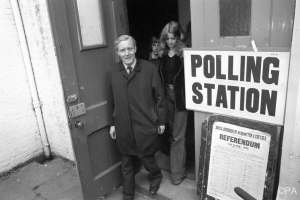
The Tories won 339 seats and Labour 269 seats (Liberals 11). Tony Benn wrote in his diary:

3rd May

My majority went down (in Bristol) from over 9,000 to 1,890; the Liberal vote slumped and the Tories picked up the extra votes.. I declined steadfastly to go on any of the Election post-mortem programmes. The media was utterly corrupt in this Election, trying to make it a media event

4th May

A dramatic day in British politics. The most right-wing Conservative Government and leader for 50 years; the first woman Prime Minister. I cannot absorb it all

Articles

The Ambridge Socialist. Ed & Emma secure the Grundy succession. Forward to the Ambridge Soviet

In Uncategorized on May 3, 2020 by kmflett

The Ambridge Socialist

3rd May

Life in Ambridge goes on..

The BBC has ceased its regular (recently 5 times a week) updates from Ambridge. They are planned to return on 25th May in a slightly different format. The difficulties are understood and one of those involved in the production of the Archers, Keri Davies, has given a useful and interesting interview about the process.

https://keridavies.wordpress.com/2020/04/26/keri-davies-q-and-a/

However life in Ambridge goes on and as the BBC ceased reports on 30th April a range of issues were left in progress:

Kirsty’s wedding to Moss: It remains unclear if Moss plans to continue with the wedding but no doubt complex calculations not centrally involving Kirsty are involved.

Moss & Gavin’s arrest: with Sergeant Knacker Burns on the case it could be years or never until this occurs but Gavin’s attempt to undermine Roy could backfire

Shula’s promotion: we await news of her rise in the Church…

Rewilding Ambridge: this appears to be a very long term project so a brief hiatus will probably find things much the same

Have Budget cuts mean the Archers shower is no more?

Ed & Emma are back together and living in a mobile home. The Ambridge Socialist welcomes this unreservedly. With Joe Grundy sadly gone and Eddie and Clarrie advancing in years the future of the Grundy Dynasty was in question. With the two back together once again we can see a time when the Grundy’s will be at the centre of the Ambridge Soviet and the Archer Dynasty will be dismantled.

In the meantime however a strictly practical matter. Ed and Emma had several romantic scenes at the end of April but concerningly none appeared to be in the shower, as is Archer’s tradition. Does the mobile home not have a shower? Or do BBC budget cuts mean shower scenes are things of the past even after the present crisis passes?

Which dynasty should rule Ambridge

Articles

205 years ago The Observer broke the law to report the trials of the Cato St conspirators

In Uncategorized on May 3, 2020 by kmflett

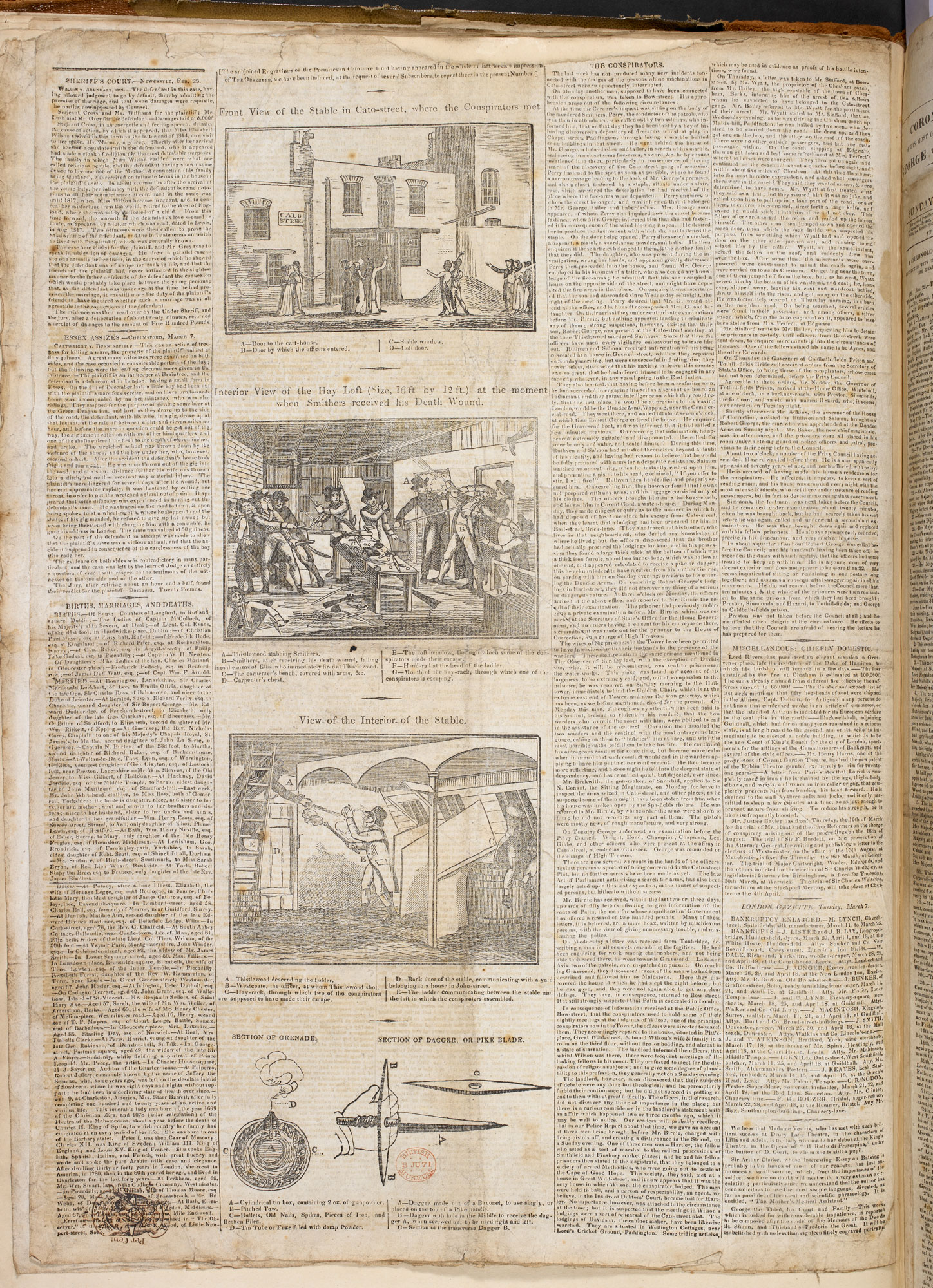
205 years ago on 23rd April 1820 the Observer reported the Cato St Trial, broke the law & struck a blow for press freedom

The Cato St Conspiracy was discovered on 23rd February 1820. It was part of a series of revolutionary attempts in the wake of the 1819 Peterloo Massacre.

Those arrested were tried in April 1820 at the Old Bailey.

Those accused including the leader of the conspiracy Arthur Thistlewood were tried separately.

The Government claimed that in order to avoid juries being prejudiced it was necessary to ban reporting of the trials until their conclusion.

This may have seemed sensible and operates still today. However the Government’s actual aim was nothing to do with protecting the jury. In fact the same jury was used in more than one of the trials and the evidence of State witnesses, carefully rehearsed, was the same in each trial.

The Government rather wished to avoid reporting of an uncomfortable fact. Namely that the aim of the conspiracy, to attack a Cabinet dinner, was the work of a Government spy Edwards. Edwards never appeared at the Old Bailey despite demands from the defence.

The Times published brief summaries of the trials as they took place but on Sunday 23rd April 1820 The Observer published a full account. The Editor W I Clement was fined £500 (almost £50k in 2025) for contempt and despite appeals the penalty remained.

The Government claimed they were protecting the jury while the Observer rightly noted that their action had quite other motives, namely as part of a campaign to suppress dissent after Peterloo.

The Cato St Conspiracy charges

  1. Conspiring to devise plans to subvert the Constitution. 2. Conspiring to levy war, and subvert the Constitution. 3. Conspiring to murder divers of the Privy Council. 4. Providing arms to murder divers of the Privy Council. 5. Providing arms and ammunition to levy war and subvert the Constitution. 6. Conspiring to seize cannon, arms and ammunition to arm themselves, and to levy war and subvert the Constitution. 7. Conspiring to burn houses and barracks, and to provide combustibles for that purpose. 8. Preparing addresses, &c. containing incitements to the King’s subjects to assist in levying war and subverting the Constitution. 9. Preparing an address to the King’s subjects, containing therein that their tyrants were destroyed, &c., to incite them to assist in levying war, and in subverting the Constitution. 10. Assembling themselves with arms, with intent to murder divers of the Privy Council, and to levy war, and subvert the Constitution. 11. Levying war.”

Articles

The names of Boris Johnson’s children: from Lettice to Wilfred. Progress in history

In Uncategorized on May 2, 2020 by kmflett

The lives of Boris Johnson’s children are of no public interest, unless they themselves decide to make it so, but their names as decide one hopes between Johnson and his partner of the moment have some passing note.

Sonia Purnell’s biography of Johnson, Just Boris, reports that he wanted to call his first child with his now ex-wife Marina Wheeler, Lettice. It is (of course) a Latin name used in Medieval English the modern translation of which is Letitia. Ms Wheeler’s preference won-out and the baby was named Lara.

His new baby with Carrie Symonds has been called Wilfred, Old English, which seems like a modest step forward from the Latin. Wilfrid (634-709) was an an Anglo-Saxon Saint and Bishop of York. The name fell into disuse but was revived from the nineteeth century on having nowadays perhaps an association with Victoriana.

Progress in history.

Articles

Keir Starmer & Patriotism: which side are you on?

In Uncategorized on May 2, 2020 by kmflett

Labour leader Keir Starmer opined briefly on patriotism on a Zoom call towards the end of April.

Unsurprisingly he said he was patriotic and the general drift was (I think) that wanting Britain to be better than it currently is, is patriotic. The unspoken (at least as yet) counterpoint to that is that whatever individual Tories may say the experience of the last 10 years suggests they do not want Britain to be better. They do want profits to be better though.

It is a view. Personally I’d start from the perspective that socialists are internationalists with strong interests across national boundaries.

The matter is complex though. During the Labour leadership contest Rebecca Long Bailey raised the point of progressive patriotism. Some views of mine that are here:

Progressive Patriotism: looking at the history beyond the headlines

It is a view that has support on the left but again there are others.

However Starmer was on a Zoom call and replying that well, its all very complicated and if the questioner could just read a book or two matters might be clearer, is not a satisfactory answer.

A post lockdown equivalent might be, being in a pub watching England playing football or cricket. They win. Do you cheer or just sit there?

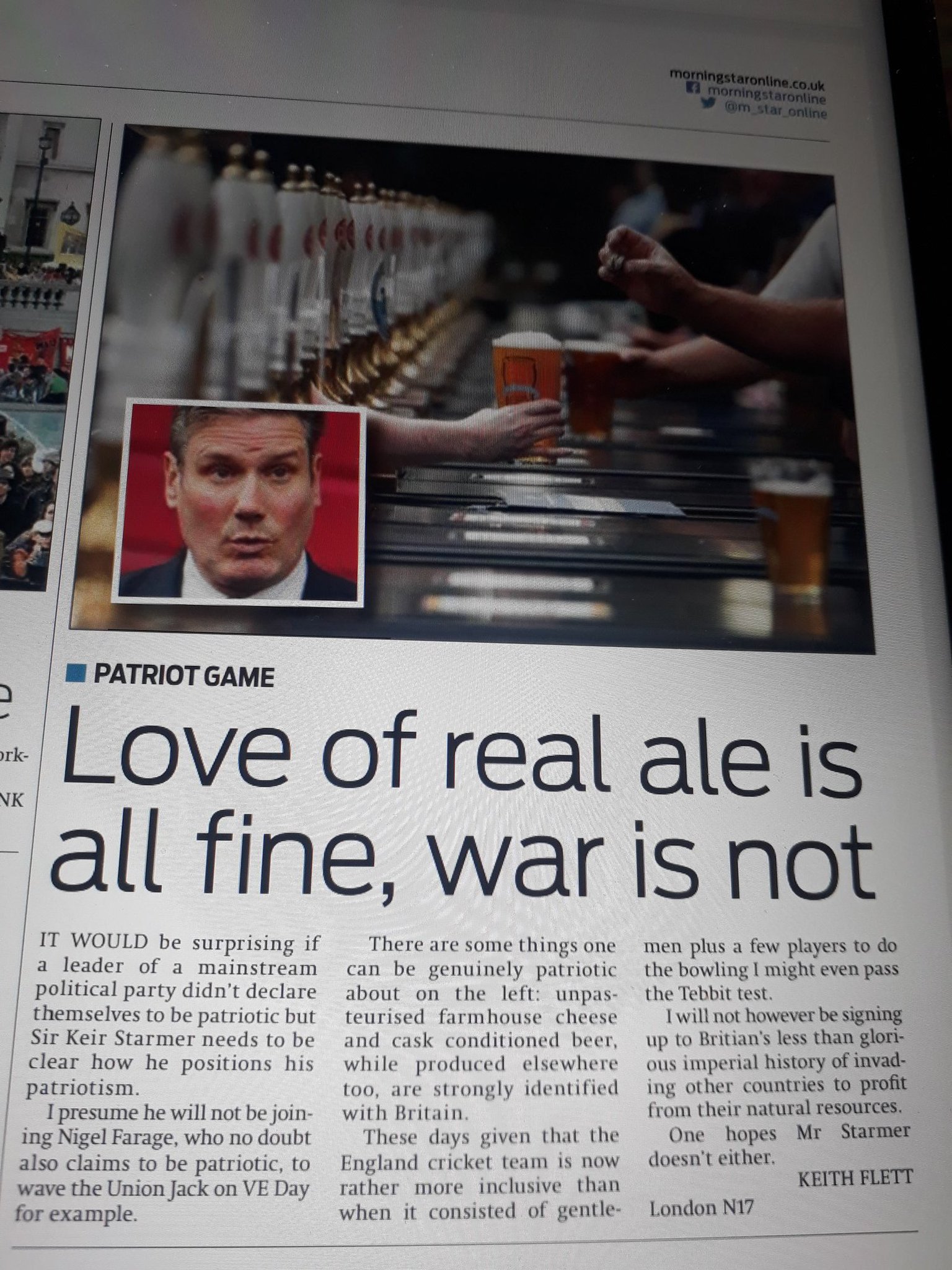
Anyway some very brief thoughts on patriotism can be found in the 2nd May issue of the Morning Star in the form of course of a fletter.

A summary is:

British cask beer: good

British farmhouse cheese: good

England & Wales cricket team: (probably) good

Imperialism and wars: no thanks.

Patriotism even simply expressed is complex