Articles

Class, Ethnicity, Housing, Epidemics & Death in London. From 1849 to 2020

In Uncategorized on May 2, 2020 by kmflett

Class, Ethnicity, Epidemics & Death in London. From Victorian times to 2020

Office for National Statistics analysis shows there were 55 deaths for every 100,000 people in the poorest parts of England, compared with 25 in the most wealthiest areas. BBC 1st May 2020

In 1849 Henry Mayhew started a series of articles for the Morning Chronicle which became London Labour and the London Poor.

He visited an area of Bermondsey in South London known as Jacob’s Island by the River Thames. In 2020 it is a cluster of upmarket residences near to London Bridge. Then it was a slum. 6,500 people had died in the area in the previous three months from cholera out of 12,800 in total. Mayhew wrote:

We might lay our fingers on the Ordnance map, and say here is the typhoid parish, and there the ward of cholera; for as truly as the West-end rejoices in the title of Belgravia, might the southern shores of the Thames be christened Pestilentia. As season follows season, so does disease follow disease in the quarters that may be more literally than metaphorically styled the plague-spots of London.

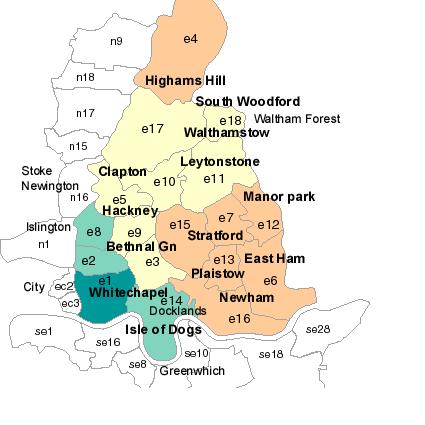
The pattern of poverty, housing & health continues 171 years on. The highest UK COVID-19 mortality rates per 100,000 population are in London: Newham 144.3; Brent 141.5;Hackney 127.4; Tower Hamlets 122.9 Haringey 119.3(Guardian 2nd May)

Philip Glanville, the Mayor of Hackney, has blamed “the links between inequality, poverty, ethnicity and health” for his borough’s death rate of 127 per 100,000. (Financial Times 2nd May)

Link to ONS statistics searchable by local authority area

https://www.ons.gov.uk/peoplepopulationandcommunity/birthsdeathsandmarriages/deaths/bulletins/deathsinvolvingcovid19bylocalareasanddeprivation/deathsoccurringbetween1marchand17april


Articles

Ambridge Socialist May Day edition. Down with the Archer Dynasty;Jail Moss; Forward to Socialism

In Uncategorized on May 1, 2020 by kmflett

The Ambridge Socialist

1st May 2020

Special May Day Edition

Down with Justin Elliott & the Archer Dynasty. Jail Moss. Forward to Socialism

The Ambridge Socialist hosted the traditional May Day gathering on the Village Green on Friday, although full social distancing is now observed in the village as of 19.15 hours on Thursday.

Veteran Secretary of Borsetshire Trades Council Bert Fry addressed the assembled throng via video-link and reminded us that the fight for socialism remains as relevant as ever. He also read a poem which we may publish in a future issue of the Ambridge Socialist.

After discussion the following Ambridge May Day resolution was unanimously agreed:

1 It is more than time to rid Ambridge of the exploiter class including Justin Elliott and the ruling Archer Dynasty

2 We demand the jailing of gangmaster Moss and his sidekick Gavin.

3 We call for genuinely affordable council housing to be built in Ambridge so that Emma and Ed don’t have to live in a mobile home.

At the conclusion of the rally many of the participants retired to a social gathering at the Grundy’s cider barn where various Wurzels songs about cider were sung along with the Red Flag

In Memoriam: Joe Grundy

This is the first Ambridge May Day in living memory which has not seen the traditional gathering on the village green addressed by Joe Grundy after he died in the village in October 2019. We will be raising a May Day glass in his memory tonight

Articles

136 years since the first London May Day marches (there were two)

In Uncategorized on May 1, 2020 by kmflett

136 years since the first London May Day marches

The celebration of May Day is a labour movement tradition. Yet as Eric Hobsbawm and Terence Ranger reminded us in a famous collection of studies, traditions are invented and May Day is no different.

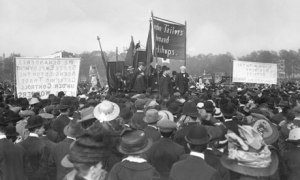
The first London May Day demonstrations were on Thursday May 1st and Sunday May 4th 1890 both in Hyde Park.

It might be thought that these very substantial protests, the Thursday demonstration involving a significant strike, marked a point on the development of May Day as we know it now.

That is not the case. In May 1889 there were no demonstrations, and that was also true for the earlier years of that decade.

The tradition of May Day was in fact invented by the Second International at its meeting in 1889. The idea was to mark the 1886 Haymarket Massacre in the US, where police shot down demonstrators.

This may have been in the minds of those who gathered for the first London May Day protests the following year. But the mobilising motif here was the fight for the legal 8 Hour Day.

It is useful to reflect that while celebrating the start of May is partly about the coming of Spring which has certainly always been with us, the human element of an event to mark the rising of labour is very much something that was deliberately conceived and built by a conference of activists. It struck a chord internationally and led to mass mobilisations on the streets. It is an important point for those who think that mobilising people can’t work.

Reynolds’s Newspaper reported that the first London May Day demonstration on May 1st 1890 was ‘only partial’. Nevertheless this was still sufficient to cause ‘upwards of 2000 constables’ to be ‘drafted into the West End during the afternoon’.

The march assembled at 3pm in Temple Gardens and proceeded to Hyde Park. It is a route still very familiar to demonstrators today, 136 years on.

The composition of the march was slightly different to the one that would have take place in London this May Day weekend however.  It consisted of mineral water workers, mathematical instrument makers, female envelope makers and jam and pickle makers amongst others.

This was a new tradition being forged so the banners themselves were also new. Reynolds’s reported that one read ‘those that dare not celebrate this day are slaves’ reflecting the fact that people had walked out of work to join it.

The march reached Hyde Park at 5pm and heard speakers including John Burns and William Morris from the socialist left of the movement.

The march on Sunday May 4th attracted the attention of Engels who noted that it was the ‘English proletariat rousing itself from forty years winter sleep’. Reynolds’s was at pains to point out that ‘there is a complete entente cordiale between the two organising committees and every wish to work in harmony on Sunday’.

The official organising committee in 1890 had not been able to take on board the demand for the 8 hour day although this followed in later years.


The following week on 11th May Reynolds’s reported that the London May Day march in 1890 had been the ‘most remarkable ever held in London’.

In 1891 Reynolds’s reported of the May Day march:  the working classes are becoming weary of the old party catchwords and shibboleths, the political chicanery which disgraces the administration of Great Britain and of the narrow and mean and personal and petty way in which the affairs of the nation are conducted.

A tradition had been invented that makes its impact still.

Articles

The Hidden, Chartist, History of May Day 1847

In Uncategorized on May 1, 2020 by kmflett

The first British labour movement May Day demonstrations took place in 1890 (there were two). It remains unclear who the rank and file activists were who built those occasions for the first time and perhaps in some ways why they did so.

There is more to the hidden tradition of May Day.

Long before the Second International proclaimed 1st May as workers day the Chartists were marking the occasions with a tweak on customary May Day celebrations.

The Chartist Land Plan was a strategy, which worked but in a limited way, of allowing industrial workers fed up with early capitalism to opt out and return to the land.

Several Land Settlements were built and worked but ultimately the plan was declared illegal. The idea of opting out of early capitalism was not encouraged.

The first settlement was at Heronsgate, renamed after the Chartist leader, O’Connorville. Its actually in Rickmansworth (and can be reached at a reasonable walk from the station). The Chartist houses remain although these days they are desirable dwellings.

On May Day 1847 a festival was held at O’Connorville.

A report noted:

A ballot was held to select the first thirty-five settlers, and they arrived on 1st May 1847. It was, according to O’Connor, ‘England’s “May Day” ‘, and a band struck up the tune ‘See the conquering heroes come’. At the official opening on 17th August 1847 O’Connor stood on a platform jubilantly waving a giant cabbage.

May Day was celebrated with dinner, tea and a concert and a ball at the schoolhouse. The local schoolmaster painted a mural facing the entrance to the hall depicting O’Connor’s presentation of the third petition to the House of Commons and farm labourers doing their work above the motto ‘speed the spade’

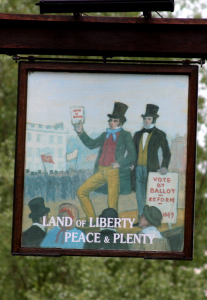
The settlement was and remains opposite a pub, these days called the Land of Liberty, Peace and Plenty. O’Connor warned against visiting in his speech on May Day 1847

There is a beer shop adjoining your land avoid it I beseech you as a pestilence

The CAMRA Award winning pub remains open, an ideal place perhaps to recall the pre-1890 traditions of May Day, although you’ll need to do it retrospectively in 2020

Articles

30th April 1978: Rocking Against Racism in Victoria Park Hackney. Still relevant

In Uncategorized on April 30, 2020 by kmflett


30th April 1978: Rocking Against Racism in Victoria Park Hackney. Still relevant

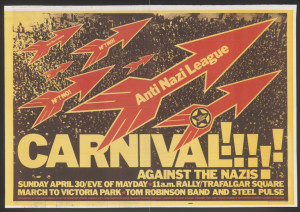
43 years ago a march made its (lengthy way) from Trafalgar Square via Bethnal Green Rd to Victoria Park in Hackney to protest against racism and fascism and in particular the National Front.

It probably wouldn’t be the route you’d take today designed as it was to confront the (considerable) support for the Front in Tower Hamlets and Hackney with a mass show of anti-racist strength. Of course there are still racists in East London but not so many currently.

In those days my preferred footwear were Doc Martens and leaving the house you’d always be on the look-out for a Fronter coming the other way. Eventually I moved to a (then) obscure part of Tottenham to feel safer but even now there is a bullet hole in the (fortunately double glazed) front window to mark where a passing fascist took a pot shot.

The Victoria Park Carnival marked what Victor Serge might have called the ‘birth of our power’. We didn’t expect 100,000 and while the Front had been physically confronted at Wood Green and Lewisham in 1978 mass mobilisation proved an effective way to marginalise them.

Building the Carnival required a lot of work on the ground. No social media or mobiles then. It required mass flyposting and leafleting often in areas where the Front had support.

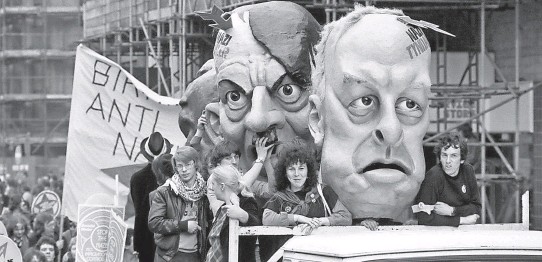
The paper mache heads of fascist leaders Tyndall and Webster that accompanied the march were designed by Fluck and Law (of Spitting Image). The posters were by the late David King.

Thousands of people (myself included) marched six miles from Trafalgar Square to Victoria Park where yet more thousands had gathered to hear X Ray Spex, Steel Pulse, Tom Robinson and the Clash

There is a film about the Carnival, arguing for its relevance today:

https://www.theguardian.com/film/2020/apr/30/echoes-of-todays-uk-revealed-in-rock-against-racisms-1970s-struggle?CMP=Share_iOSApp_Other&fbclid=IwAR0D1oF0U8YqF0jjPiIYhp8KxymmVIbbhV8fmq9GiNiq69mu1JZFMEzXulM

Articles

The Hundred & the ‘new normal’ of cricket

In Uncategorized on April 30, 2020 by kmflett

The Hundred & the ‘new normal’ of cricket

The postponement of The Hundred, the new 100 ball cricket contest between 8 city based teams (men’s and women’s teams)  that had attracted some terrestrial coverage from the BBC, has been announced.

It wont now start until 2021. I don’t think anyone pro or anti is likely to complain much. There are significant logistical problems with trying to run the 100 this year not least that its designed to attract crowds which in future (post-lockdown) circumstances this year are unlikely either to be allowed or want to come anyway.

I’m a fan of longer form cricket having watched it and listened to coverage of it on Test Match Special since the 1960s. I sometimes enjoy 50 and 20 over games but they are often too one-sided to reflect a true battle between bat and ball.

Of course The Hundred has its fans. Here is Michael Vaughan writing in the Telegraph recently:

After international cricket the Hundred is the most important aspect of the game – already it’s got £40 million from TV without anyone even seeing it. It’s a revenue stream to the game that will grow and when you come to negotiate the next round of deals in a few years then the Hundred will be worth a lot more than this time round – look at how rights for the Big Bash in Australia grew after it became established.

I’ve come to regard the Big Bash as almost unwatchable in recent seasons. It goes on forever, the composition of teams shifts perpetually as the series goes on and it seems to be more about six hitting than anything else.

It’s a spectacle certainly, but as sport I’m less sure.

The Hundred is seen as a brand, as a product which will bring money into a game that is struggling financially.

But if the world is to change after COVID-19, and it should, why assume that will continue. Why not look at ways of funding the bedrock of the game, County Cricket, that assumes playing sport of this kind is not primarily about turning a profit, but a public good. Something that many who will now find themselves working from home more can engage with in a social setting.

The Hundred belongs to the thinking of the pre-COVID-19 world. At the least its time to have a think about how relevant it will really be for the new normal.

Articles

Beard Liberation Front issues updated guide for May Day Beard Waggle: Social Distancing, Trimming & Masks

In Uncategorized on April 30, 2020 by kmflett

Beard Liberation Front

PRESS RELEASE 29th April

Contact Keith Flett      07803 167266

HIRSUTE PREPARE FOR TRADITIONAL, SOCIALLY DISTANCED, MAY DAY BEARD WAGGLE

Guidelines on Brexit Day Beard Waggle to levitate Nigel Farage out ...

The Beard Liberation Front, the informal network of beard wearers, has said that the ancient May Day tradition of Beard Waggling will be revived once again on Friday May 1st as, with the weather set reasonably fair in many areas, the hirsute will celebrate the coming of Spring by waggling their beards

The beard waggle, a traditional British May Day custom, involves shaking the beard vigorously from side to side and in doing so stimulating air currents that can cause objects to levitate slightly.

In 2020 beard wagglers are instructed to make sure that their beard waggling is socially distanced and that each waggler is at least six beard lengths away from anyone else.

A mask may also be warn and separate guidance will be issued on this

BLF Organiser Keith Flett, the Beard Waggle is one of the great May Day traditions but it went into decline with the rise of the safety razor. Now with the hipster culture of beards, the waggle is firmly back and is gaining in popularity each year, albeit this year it MUST be socially distanced and done as part of daily exercise in the UK.

Beard Liberation Front guide on how to train for May Day beard waggling

1] Ensure the beard is supple. This may be done by moistening is slightly with water or, if preferred, craft beer.

2] You may decide to trim the length of the beard to limit any particles the waggle may spread

3] If you wear a mask, make sure that some part of the beard is still visible. The tradition is for beard waggling. Masks have an important part in the wider tradition of charivari but are not specifically beard related.

3] Choose a suitable location to waggle, preferably in the sun rather than the shade. Keep distanced from other wagglers

4] Move the beard vigorously from side to side and then up and down while otherwise standing still. Repeat several times. You may prefer to wear a mask for this.

5] While waggling the traditional chant is, Hail the Beard, Hail Spring

6] Alternatively beard wagglers may simply intone Om, Om, Om

Articles

Tim Martin: The Thatcherite Hangover

In Uncategorized on April 30, 2020 by kmflett

Tim Martin: The Thatcherite Hangover

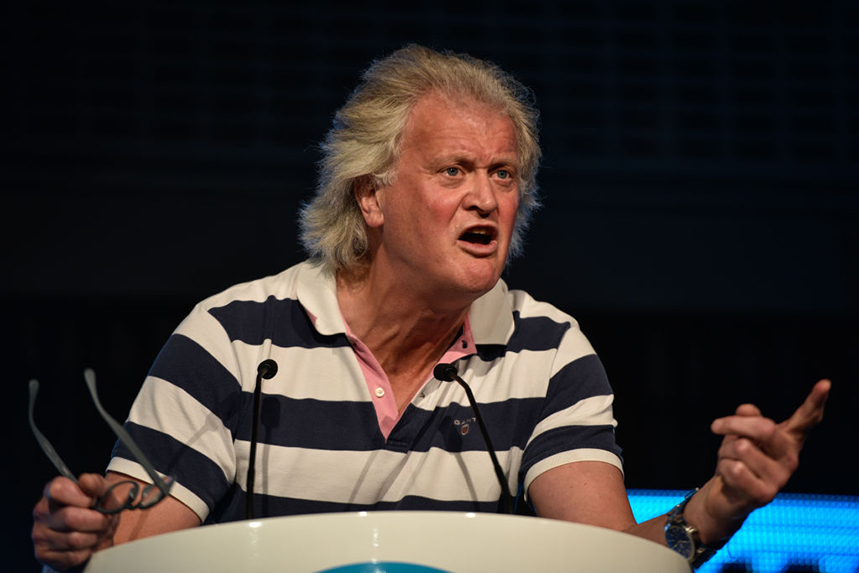
LONDON, ENGLAND – OCTOBER 18: Wetherspoons pub founder Tim Martin talks at a Brexit Party rally on October 18, 2019 in London, England. (Photo by Peter Summers/Getty Images)


Tim Martin has been in the news again and these days it’s rarely good news.

Martin told workers at his 850 strong Wetherspoons pub chain that he wouldnt pay them after the pubs shut due to the Coronavirus but they might find a job at Tesco. Indeed they might as it has reportedly been hiring 20,000 workers. It may not be an ideal employer but it recognises USDAW and pays the living wage which is more than Wetherspoons on both counts.

Fortunately the Bakers Union (BFAWU) who organise in Wetherspoons were on to it and forced a U-Turn on the wages issue.

Now he has announced a plan to re-open his pubs in or around June with no obvious clue as to what safety precautions will be in place for staff or customers

Tim Martin opened his first pub in Muswell Hill in the north London Borough of Haringey in 1979 and before expanding the Wetherspoons pub brand nationally he festooned the area with pubs converted from car showrooms and shops.

I certainly frequented that first pub and other Wetherspoons in the area and often ran across Tim Martin and chatted to him-about beer but certainly not politics.

His business model was successful for a reason.

In the 1970s many pubs sold only poor quality keg beer the result of a trend to monopoly in the brewing industry from the 1960s that had left Britain with just a few mega-breweries. They didn’t usually do much in the way of food and were often dominated by middle aged men with rather right-wing views.

Martin tried something different. He sold decent quality real ale at sharp prices and meals all day at reasonable prices too. His pubs didn’t have loud music, TVs or fruit machines. They were places where you went to have a chat or read a book.

As a result at that time in Wetherspoons pubs one could find a socially mixed clientele including far more women and ethnic minorities than might be usual in other pubs. They became often post-meeting gathering places for the left and trade unionists not least because as well as alcohol they also made a point of selling coffee and tea. In short a culture radically different to what Martin now stands for.

Fast forward four decades and things do look very different.

Tim Martin is no longer seen as someone who promotes a progressive model of pub-going.

Other pubs have caught up and passed his late 1970s business practices both in terms of the kind of beer and food sold but also in terms of being welcoming to people in the 2020s.

By contrast Martin has become closely associated with right-wing proponents of Brexit like Nigel Farage and Boris Johnson and has also become notorious as a poor employer even in an industry known for poor employment practice.

This then is a story of Thatcherism.

Martin started his Wetherspoons pub empire within a few months of Thatcher becoming Prime Minister in May 1979. Some of the free market changes that Thatcher’s Governments brought in helped Martin’s business. They boosted pub companies over the traditional brewery tied houses for example.

They also promoted a philosophy of individual freedoms (for some)which meant loosening restrictions on pubs. They could open all afternoon from 1988 for example.

No doubt these changes were welcomed by many but they came at a price. Pub workers for example doing long hours with low pay and in-secure employment, more recently often zero-hours contracts.

Perhaps Martin didn’t start off with these practices particularly in mind but over time his business came to depend and thrive on them. In due course he then came to publicly support the kind of Thatcherite politicians and policies that underwrote their continuation.

Articles

In World War One some pubs were nationalised. As Wetherspoons talks of re-opening time to do it again?

In Uncategorized on April 29, 2020 by kmflett

The nationalisation of pubs in World War One. An idea whose time has come again?
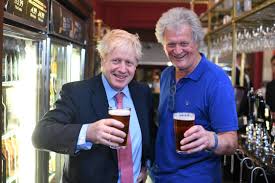
As Wetherspoons announces a plan to re-open its pubs in around or June (we’ll see…) perhaps its time to keep in mind the many calls that a post-COVID-19 world should not be the same as it was before.

Wetherspoons might be an ideal opportunity..

Among the long-reaching powers granted to the government by the 1914 Defence of the Realm Act was legislation regarding the selling and consuming of alcohol.

Licensing hours, the time when public houses were permitted to sell alcohol, had become more restrictive following the Intoxicating Liquor (Licensing) Bill of 1872. With the introduction of DORA they became stricter still. New laws meant that pubs were forced to close during the middle of the day to prevent all day drinking. The new hours saw establishments open initially between midday and 2:30pm, before staying closed until 6:30pm when they would then stay open until 9:30pm. Failure to observe these strict licensing hours saw landlords lose their licenses and pubs being forced to shut down.

Further to these licensing laws, additional restrictions were brought in regarding alcohol. Beer in particular was ordered to be ‘watered down‘ to make it less potent and reduce drunkenness. Additionally it became illegal to buy drinks for other people, thus ending the tradition of buying alcohol in rounds.

Roger Protz has highlighted how this fitted into Lloyd George’s long running temperance campaign. His particular dislike I suspect was that while he was of course a Liberal most brewers were supporters of and funders of the Tory Party (The Beerage)

https://protzonbeer.co.uk/features/2020/04/09/beer-and-pubs-in-the-firing-line

The Carlisle State Management Scheme. I suspect only those of a certain age and people who live in Carlisle will have heard of it now.

During World War One the Government became concerned in particular about the impact of drinking on arms manufacture. Whether as Protz rightly underlines this was a genuine concern or just part of Lloyd George’s longstanding antipathy to beer and pubs is another matter.

As a result in 1916 the Government took control of pubs and beer supply in three areas. By far the largest was Carlisle where several breweries were shut and the remaining one became a State controlled one. The same applied to pubs in the area.

The plan was not to stop drinking but to control it. The pub managers had no interest in maximising beer sales and rules were introduced to underline the point. Between 1916 and 1919 ‘treating’, the buying of rounds was not allowed for example.

However the beer quality was thought to be good, and numbers of the pubs were redesigned by Harry Redfern, an architect influenced by William Morris’s ideas on arts and crafts. The State Brewery made a profit in every year it operated. It was privatised by Heath’s Tory Government in 1973 and bought by an earlier incarnation of Theakstons.

Given the quality and strength of beer that was brewed under regulations brought in by the Defence of the Realm Act in 1914 the State Brewery may have been an improvement, although I dont have details of the strength of beer produced at Carlisle in the early years of the scheme.

A music hall song on post-1914 beer makes matters clear however:

Lloyd George’s Beer, Lloyd George’s Beer.

At the brewery, there’s nothing doing,

All the water works are brewing,

Lloyd George’s Beer, it isn’t dear.

Oh they say it’s a terrible war, oh law,

And there never was a war like this before,

But the worst thing that ever happened in this war

Is Lloyd George’s Beer.

Buy a lot of it, all they’ve got of it.

Dip your bread in it, Shove your head in it

From January to October,

And I’ll bet a penny that you’ll still be sober.

Another area of operation for the State Management Scheme was the area around the Royal Small Arms Factory at Enfield Lock.

Four public houses and an off-licence were involved.  According to the interwebs, the premises returned to private ownership in 1922-3. Three of the four have been identified Greyhound, Royal Small Arms Tavern (Rifles)- currently boarded up- and Ordnance(demolished 1920s). The fourth is tentatively identified as the Plough Inn, Sewardstone (a McMullens pub still open).

The Greyhound is a going concern run by Hertford brewer McMullen who note that they have owned the pub since 1923.

Where the beer came from for the Enfield pubs I haven’t managed to establish, perhaps it was sourced from the Carlisle brewery, but so far I have no solid evidence on that. It appears that the canteen built at the factory, in part to keep workers away from eating in pubs, was run by the brewers Trumans.

The current crisis is of course configured slightly differently. Many breweries are still brewing and there is no initiative to reduce quality or strength. However all pubs are closed.

Perhaps its time to have another go at a State Management scheme at least as a trial. How about nationalising Wetherspoons?

An earlier version of this post appeared on the Culture Matters website

https://www.culturematters.org.uk/

Carlisle State Management Scheme

https://thestatemanagementstory.org/


Articles

Boris Johnson’s babies: A final farewell to Thatcher’s Victorian Family Values

In Uncategorized on April 29, 2020 by kmflett

Boris Johnson’s babies: A final farewell to Thatcher’s Victorian Family Values

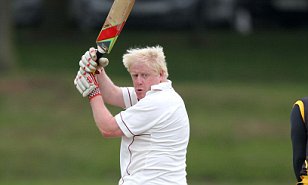
Mandatory Credit: Photo by Mike Savage/REX/Shutterstock (5016776o)
Boris Johnson MP in Bat
Lashings All Stars vs House of Commons & Lords cricket match, Maidstone, Britain – 30 Aug 2015

Carrie Symonds has given birth to a child who father is reliably informed to be Boris Johnson. The couple are not married, but so what?

As a lifelong socialist I’ve never supported the institution of marriage, but in a market capitalist society it is necessary to understand that it is meant to be part of the way the financial world works. These days, civil partnerships can provide a way around that.

Boris Johnson has (at least) six children and that is largely a matter for him and the partners he had them with. Certainly the lives of the children are of no public interest unless they themselves decide otherwise.

Its not possible to escape a wider perspective on the family here.

Mrs Thatcher promoted the idea of Victorian Values which definitely involved those related to family. While many on the left might, I’d suggest accurately, reflect that the main value involved here was hypocrisy, Thatcher did sack Cecil Parkinson in 1983. He was a Cabinet Minister who fathered a child with Flora Keays while still married to another woman.

Johnson seems to represent a very different set of Tory values.

His first marriage to  Allegra Mostyn-Owen ended in divorce in 1993 when the first of four children to Marina Wheeler was due. Johnson married Wheeler, a top ranking lawyer, and has only recently divorced her following his partnership with Carrie Symonds.

In the meantime he also fathered a child with Helen Macintyre in 2009, details of which were officially revealed after an Appeal Court ruling in 2013. It had resulted in Johnson being temporarily booted out of the home he shared with Marina Wheeler.

Its not the Tory Party of traditional values (arguably as above that was largely an ideological construct anyway).

I wouldn’t judge but a lot of the media do judge working class families with numbers of children, particularly if they require financial support.

That is perhaps where Johnson’s activities do meet the public domain.

He is reported to have fathered a child with right-wing journalist Petronella Wyatt but after informing her that he would not financially support the new baby she had a termination.

Johnson does, as far as is known, support his children which has certainly involved public school fees.

He has been paid a considerable salary by the Daily Telegraph (obviously not currently) and produces books for which he, again reportedly, gets sizeable advances on a regular basis. It is thought that at least some of his recent absences were about finishing a book he had been paid to write.

As a Tory PM Johnson will know that everything comes with a cost.