Articles

E P Thompson on why Peterloo was a turning point in British history

In Uncategorized on August 24, 2018 by kmflett

There has been an exchange between Daniel Finkelstein and ALan Rusbridger about whether Peterloo was or was not a turning point in British history and hence should or should not be included as a core part of the school history curriculum.

Why Alan Rusbridger is right & Daniel Finkelstein is wrong on the importance of Peterloo
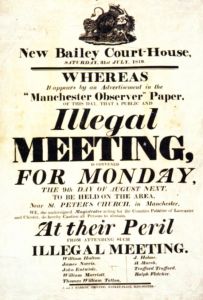
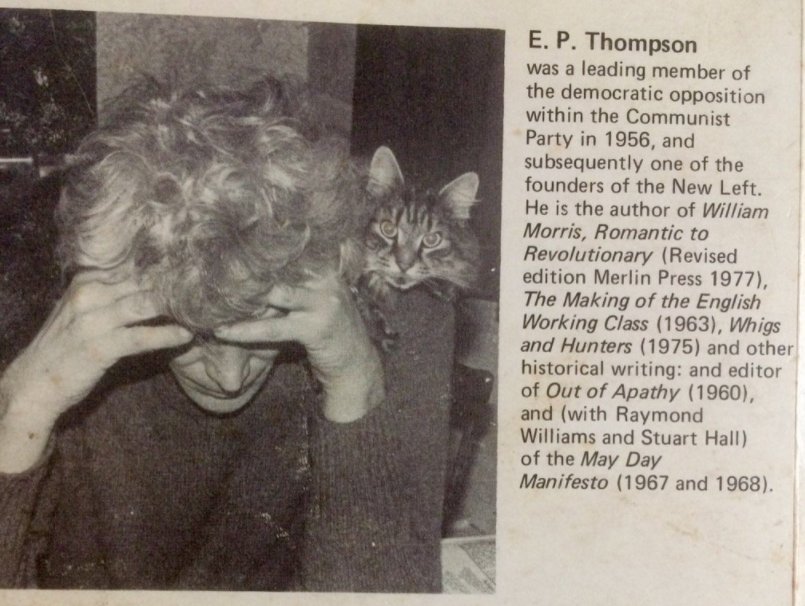
EP Thompson addressed the matter 60 years ago and below is an extract from the article where he did so:

The larger questions posed by Peterloo still remain unanswered. Why has the word echoed ever since in our history? How far was it a defeat, how far a moral victory? How far does it represent a turning-point, which forced the Whigs and the unrepresented middle-class to come forward as reformers “to rescue the multitude out of the hands of the Hunts and Thistlewoods”. (Life of Wilberforce, V, 37). How far did the revulsion which it caused restrain Old Corruption from using the same tactics between 1830 and 1832? If it was a victory for repression, why was the victory not complete? What toughness was there within our democratic traditions which enabled them to withstand the shock of Oliver and the Derby beheadings, August 16th and the Six Acts? How was it, despite these Acts, that Cobbett continued to write, and reformers to organise and meet?

Strikers or agricultural labourers might be fair game; but never since Peterloo has authority dared to use equal violence on a peaceful British crowd. Even Bloody Sunday saw a violence which was carefully controlled; the real thing has been reserved for Amritsar or Nicosia.

EP Thompson, God, King & Law. The New Reasoner Winter 1957/8

https://www.marxists.org/archive/thompson-ep/1957/peterloo.htm


Articles

Peterborough beer festival 2018: combined & uneven development in beer

In Uncategorized on August 24, 2018 by kmflett

Peterborough Beer Festival: combined & uneven development

I was at the Peterborough Beer Festival this week on Tuesday and Thursday. Held in tents on land by the river Nene in the city centre it is one of the biggest UK beer festivals and it has been going for over 40 years.

It is also as I’ve written before a rather unfashionable event amongst those who write about beer (though certainly not amongst the large numbers who attend). You can find much comment about the Great British Beer Festival held earlier in August (i.e I’m not going, I’m going but there are issues; actually there were some very good beers etc etc) but usually little or nothing about Peterborough.

So let me say straight away, there aren’t really that many beards and you’ll struggle to find people looking at their smartphones. Hackney it aint.

There are around 350 cask beers and there the picture is perhaps a little mixed. I tried and enjoyed a few (in thirds) but a whacky name, while it may be fine in a local pub, tells me nothing about the beer and CAMRA’s classification system and programme notes don’t always help as much as they might.

Still Peterborough is a place for combined and uneven development so the now officially named keykeg bar had 45 beers with 13 on at any one time. It seemed to be doing well. You know beers like Cloudwater, Track, Beavertown, Magic Rock, those names so familiar to CAMRA festivals…

There is ample seating and a decent range of food (including of course the incomparable Purely Pickled Eggs) and if you cant find beers to enjoy at Peterborough one wonders if you really do enjoy beer.

There is also a gin bar which seemed to be popular (I like malt whisky) and the whole event is about 10 minutes walk from the train station. If you are in Peterborough there is a very good craft beer bar, Stoneworks, right in the centre near the Cathedral and an equally good micro-pub, the Bumble Inn (now brewing) on the short walk from the station to the centre.

The beer festival is open all day on Friday and Saturday. You’ll enjoy the beer and also find out what people are up to outside of London..(good news, its not unpleasant)

http://www.peterborough-camra.org.uk/index.php?bf=1


Articles

Why Alan Rusbridger is right & Daniel Finkelstein is wrong on the importance of Peterloo

In Uncategorized on August 24, 2018 by kmflett

Why Alan Rusbridger is right & Daniel Finkelstein is wrong on the importance of Peterloo

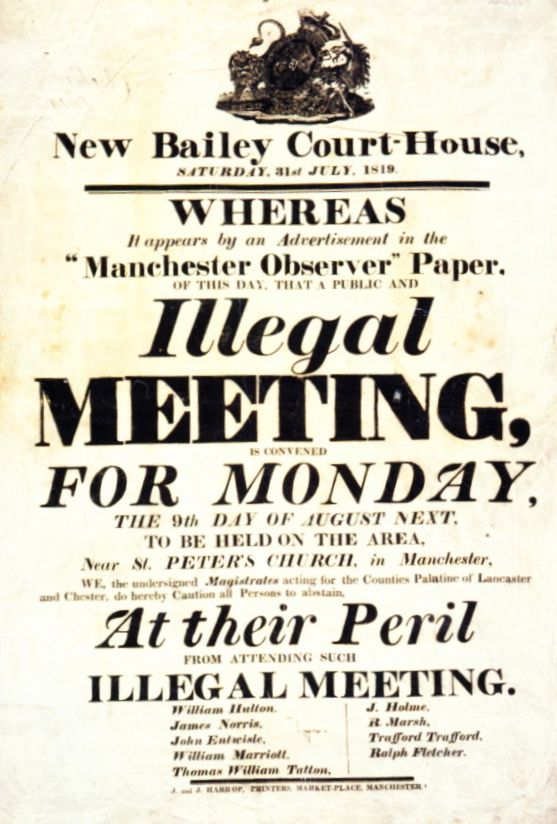
On, more or less, the 199th anniversary of Peterloo Danny Finkelstein has written about its importance in The Times. He was querying whether his son had been taught about it at school, which indeed he had, following the suggestion by Mike Leigh that many had not heard of Peterloo. Recent correspondence in The Guardian has also confirmed that many were taught about it, as I was myself. However that is rather different, as Finkelstein notes, from making it an essential part of the school history curriculum because it was (or was not) one of the events that made modern Britain.

Finkelstein does not in anyway underplay the significance of what took place in central Manchester on that August Monday in 1819. He does however suggest that it was a one-off with no further real significance.

Here I think he is wrong but fortunately former Editor of the Guardian Alan Rusbridger has already made the point, correctly, in my view, quoting EP Thompson. Thompson wrote about the importance of Peterloo in the Making of the English Working Class and was a robust pursuer of those who sought to downplay or revise what had happened.

The political repression of the Six Acts which followed Peterloo meant it was unlikely the event would or could be repeated. However when it came to 1832, and the first changes in the electoral system that led to Britain’s modern democracy, the Great Reform Act, the Government conceded the change rather than face down protesters. They did so again with the Second Reform Act in 1867 when the Army were called to deal with reform protesters in Hyde Park but did not act. Rather the Home Secretary resigned and further reform was carried.

That surely is why Peterloo deserves a place as core British history. It made the point that democratic protest needs to be dealt with democratically not by the armed force of the State.

——————————————————————————————————————————–

Daniel Finkelstein, The Times 21st August 2018 (extract)

Peterloo was a tragedy, an outrage and an emblem of the repressive conservative obstinacy of a privileged elite. What it was not, was a turning point in British history. You can argue that it should have been, or that you wish it was. But it wasn’t.

THE TIMES AND THE TRUTH ABOUT PETERLOO The Times August 23rd 2018

Sir, Daniel Finkelstein is dismissive of the argument that Peterloo was a turning point in British history. That was not the view of the great historian E P Thompson, who wrote in 1963: “Never since Peterloo has authority dared to use equal force against a peaceful British crowd.”

That the state in general dared not violently put down peaceful protest in this country after Peterloo was partly due to the press in general, and The Times in particular. “Peterloo,” wrote Haslam Mills in his centenary history of The Manchester Guardian in 1921, “is the debut of the reporter in English public life.” The Times’s own reporter at the event, John Tyas, ended up in jail that night. A Manchester businessman, John Edward Taylor, realised the authorities were likely to publish fake news about what had happened and wrote a full account of events, which he sent by night coach to The Times. The truth appeared in print within 48 hours of the massacre and, says Mills, was “never overtaken by the official version”.

Reading The Times’s extensive coverage over subsequent days, one is struck by admiration for the determination of the Times editor, Thomas Barnes, to establish the truth in the face of what might today be termed “alternative facts”. Taylor, too, saw the necessity of placing on record “facts, undeniable and decisive . . . truths which are impossible to gainsay”. The events of August 16, 1819, led him to found The Manchester Guardian 18 months later.

Peterloo is as telling an illustration as any of why good journalism is necessary. That seems to me an important thing to remember — and to celebrate.

Alan Rusbridger

Principal, Lady Margaret Hall, Oxford

Articles

Conker campaigners call for boycott of ‘World Conker Championships’

In Uncategorized on August 23, 2018 by kmflett

Campaign for Real Conkers

Press Release August 24th Contact Keith Flett, 07803 167266

Conker Campaigners call for boycott of ‘World Conker Championships’

The Campaign for Real Conkers, the group that opposes bans on conker playing, has said that with the 2018 conker playing season due to get underway on August Bank Holiday Monday it is for the first time calling for a boycott of the self-styled World Conker Championships which take place on 14th October.

The organisers of the Championships have claimed, without any evidence, that the warm summer has led to a shortage of British conkers. Even a cursory look at conker trees will show this is not the case.

They have also claimed that the heatwave has led to smaller conkers than usual. However conkers are not yet ripe enough to play games with and have in most cases not fallen from trees so this claim also appears to be false.

The campaign believes that conkers is a game that is free to all play and should also be free of rules and regulations whether imposed in contests or petty bureaucrats who argue wrongly that playing conkers is in some way dangerous.

Campaign organiser Keith Flett said, enough is enough when it comes to the World Conker Championships. Their absurd rules and statements are killing conkers as a grassroots game actually played by people rather than watched as some kind of spectator event.

The Campaign for Real Conkers promotes free for all conker playing across the UK an alternative event to the World Conker Championships on Sunday October 14th where it encourages people to have a go at playing conkers without the need for rules, regulations and teams.

Where We Stand

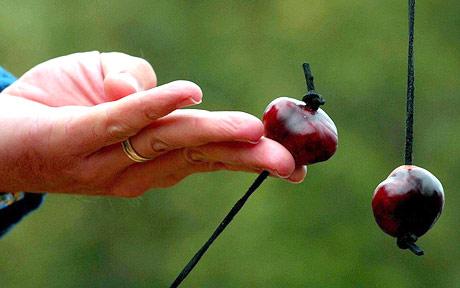
The CFRC believes that conkers is one of the few sports that can be played for free. All that is required is a conker and some string.

It is opposed to championships, rules, regulations and commercial sponsorship.

It seeks to encourage young people to play conkers. It should not be the preserve purely of those of mature years.

‘World Conker Championships’

https://www.worldconkerchampionships.com/


Articles

Beard Liberation Front says Beard of Summer Philip Ardagh’s trim has enhanced gravitas of his beard

In Uncategorized on August 23, 2018 by kmflett

Beard Liberation Front

Press release 23rd August

Contact Keith Flett    07803 167266

Beard Liberation Front says Beard of Summer Philip Ardagh’s beard trim has enhanced gravitas of his beard

The Beard Liberation Front, the informal network of beard wearers which campaigns against beardism, irrational prejudice against the hirsute, has said that a beard trim, for charitable purposes, by Beard of Summer Philip Ardagh has enhanced the gravitas of his beard.

The campaigners say that charitable endeavour is a BLF approved reason for trimming providing that the beard is immediately grown back to full strength and robustness again.

Philip Ardagh’s move comes before several appearances at the Edinburgh Book Festival over the August Bank Holiday weekend.

The BLF says that Mr Ardagh has trimmed his beard prudently and fully in-line with BLF guidelines and the result is a beard with enhanced gravitas.

BLF organiser Keith Flett said, beard wearing is in a general sense a charitable endeavour so trimming the beard for charity is generally welcomed by the BLF. We congratulate Philip Ardagh on the excellence of his trimming.


Articles

Historians say date of August Bank Holiday needs to be reviewed 52 years after it was changed

In Uncategorized on August 23, 2018 by kmflett

London Socialist Historians Group

Press Release 26th August

Contact Keith Flett 07803 167266

Historians say date of August Bank Holiday needs to be reviewed 52 years after it was changed.

The London Socialist Historians Group who organise the socialist history seminar at the Institute of Historical Research in central London have said that it may be time to take another look at the date of the August Bank Holiday, after the weather forecast for the weekend indicated a mixed feel to the weather.

The August Bank Holiday was set as the first Monday of the month by the 1871 Bank Holidays Act and only changed for an experimental period to the last Monday of the month in 1965.

The change was made permanent in 1971 and was primarily a result of pressure from the leisure industry who felt that a later holiday would extend the season.

The Bank Holiday in Scotland remains on the first Monday in August- this year on August 1st.

Before legislation in the late 1930s Bank Holidays were the only official paid holidays available to workers and were seen as a significant advance in working class leisure time.

The August Bank Holiday was the most popular of those agreed by the 1871 Act precisely because it was in summer and the weather was likely to be better for a trip out than the Easter holiday.

Railway companies ran excursions and extra trains to seaside destinations.

The historians say that the nature of holidays, although still strongly influenced by school terms, have changed considerably in the last 40 years with short breaks at home and abroad more popular.

However the weather and certainly the available sunlight hours are potentially better earlier in August in most areas of the UK early in the month.

LSHG Convenor Dr Keith Flett, said recent discussion of bank holidays has focused on whether the UK should have more, if May Day should be maintained and if there should be an autumn bank holiday. Yet there is something of an historical case now for looking again at the 1971 decision to change the August Bank Holiday from the start of the month to the end. Perhaps we should compromise and have both as the UK still has comparatively few public holidays.

Articles

Beard Liberation Front statement on decision of Beard of Summer Philip Ardagh to trim his beard

In Uncategorized on August 22, 2018 by kmflett

Beard Liberation Front

Press release 22nd August

Contact Keith Flett    07803 167266

Beard Liberation Front statement on decision of Beard of Summer Philip Ardagh to trim his beard

The Beard Liberation Front, the informal network of beard wearers which campaigns against beardism, irrational prejudice against the hirsute, has said that it is relaxed about the news (tweeted by the author on 22nd August) that Beard of Summer 2018 the author Philip Ardagh is set to trim his beard for charity.

The campaigners say that this is a BLF approved reason for trimming providing that the beard is immediately grown back to full strength and robustness again.

Philip Ardagh’s move comes before several appearances at the Edinburgh Book Festival over the August Bank Holiday weekend.

The BLF says that in order to avoid causing confusion and concern amongst his audiences who may not recognise him with his newly trimmed appearance it may be prudent for Mr Ardagh to consider wearing a false beard for public appearances. False beards made from organic knitted wool are accepted by the BLF in certain circumstances.

BLF organiser Keith Flett said, beard wearing is in a general sense a charitable endeavour so trimming the beard for charity is generally welcomed by the BLF. We do however usually expect to see evidence of re-growth within 7 days of the beard being trimmed.


Articles

Beard Liberation Front statement on decision of Beard of Summer Philip Ardagh to shave his beard

In Uncategorized on August 22, 2018 by kmflett

Beard Liberation Front

Press release 22nd August

Contact Keith Flett    07803 167266

Beard Liberation Front statement on decision of Beard of Summer Philip Ardagh to shave his beard

The Beard Liberation Front, the informal network of beard wearers which campaigns against beardism, irrational prejudice against the hirsute, has said that it is relaxed about the news (tweeted by the author on 22nd August) that Beard of Summer 2018 the author Philip Ardagh is set to shave his beard off for charity.

The campaigners say that this is a BLF approved reason for shaving providing that the beard is immediately grown back again.

Philip Ardagh’s move comes before several appearances at the Edinburgh Book Festival over the August Bank Holiday weekend.

The BLF says that in order to avoid causing confusion and concern amongst his audiences who may not recognise him it may be prudent for Mr Ardagh to consider wearing a false beard for public appearances. False beards made from organic knitted wool are accepted by the BLF in certain circumstances.

BLF organiser Keith Flett said, beard wearing is in a general sense a charitable endeavour so shaving the beard for charity is generally welcomed by the BLF. We do however usually expect to see evidence of re-growth within 7 days of the beard being shaved.


Articles

Campaigners declare Corbyn omelette is ‘beard friendly’

In Uncategorized on August 22, 2018 by kmflett

The Beard Liberation Front, the informal network of beard wearers, has said that after a thorough review it has declared the omelette that Labour leader Jeremy Corbyn tweeted a few days in support of National Allotment Week to be fully beard friendly.

Corbyn tweeted that he had made the omelette largely with produce from his North London allotment and it was certainly vegetarian friendly. However not all omelettes are beard friendly. Those made with meat or vegetables that do not bind the eggs together well can fall apart and end up in the beard.

By contrast it is clear that the omelette Corbyn had cooked was fully binded together by the allotment vegetables.

BLF Organiser Keith Flett said, we know that Jeremy Corbyn places a high priority on all his actions being beard friendly and his omelette is no exception

Articles

Tony Benn on the Russians in Prague, 22nd August 1968

In Uncategorized on August 22, 2018 by kmflett

Tony Benn on Prague 22nd August 1968

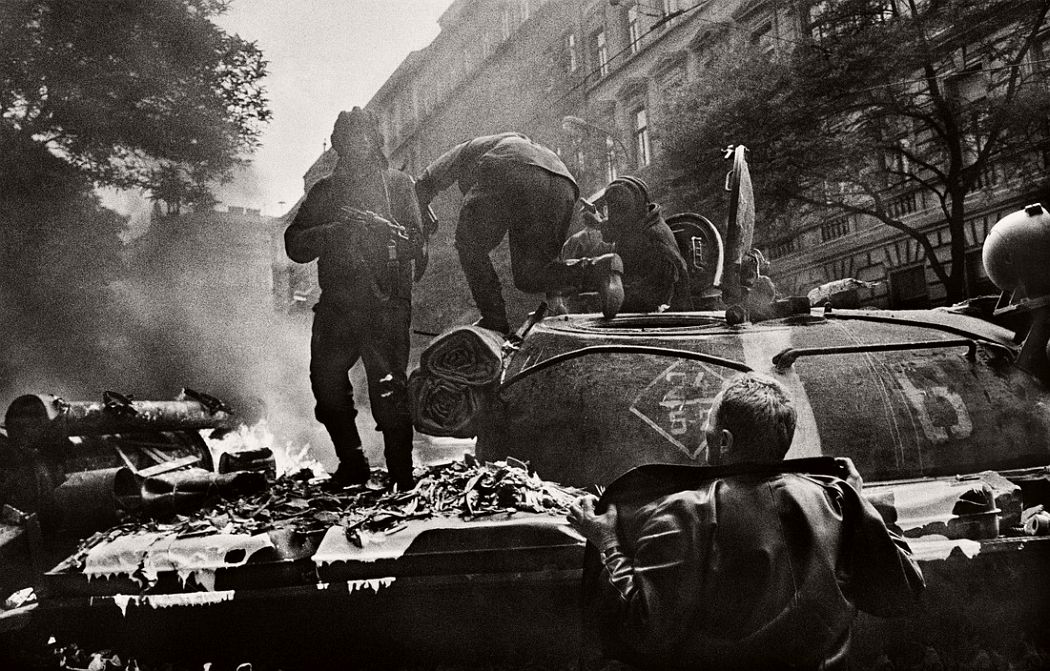
CZECHOSLOVAKIA. Prague. August 1968. Invasion by Warsaw Pact troops near the Radio headquarters.

The convention appears more or less defunct but 55 years ago during the summer Parliamentary recess politicians mostly just went on holiday. Hence Tony Benn’s Diaries are invariably extremely thin for August in any given year.

55 years ago is a little different. As the Russian tanks rolled into Prague the Labour Cabinet met on 22nd August 1968 and Benn recorded matters in his Diary:

Up at 5.30 and to London for Cabinet.

It was generally agreed that we didn’t want to interfere with trade with the Soviet Union because, even at the height of the Berlin Air Lift or the Hungarian situation, we had still traded with the Russians. But there was a very strong feeling that ministerial visits and exchanges would have to be checked.

… Dick Crossman thought we could do more, eg propaganda from the BBC. He is still the psychological warrior in moment of crisis.

…I did ask whether the hot line was being used and whether we had really taken into account the tremendous damage the Russians had done to the world Communist movement, which is completely split on this, with the British, French and Italian Communist Parties, and the Chinese, denouncing it.

But it was an unsatisfactory position. We agreed that Parliament would be recalled on Monday. There wasn’t much we could do but we felt we owed to the Czechs to show that we did care.

Back to Stansgate.

There were protests from the left about the Russian action which I’ll post on separately