The politics of protest: the ‘mob’ versus the ‘crowd’.
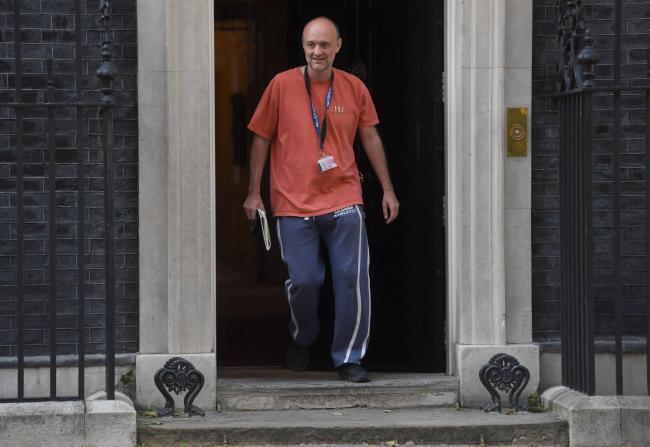
Recent events have again raised the issue of whether people protesting in the streets are a mob or a crowd. The letter below, published in the Guardian, about a small protest outside of Dominic Cummings North London house, makes the distinction. In this case there was no mob and arguably not even a crowd.
Protesting outside the house of someone who has transgressed many people’s understanding of what might be termed a ‘moral economy’ is a British tradition stretching back over many centuries. It was not however by any means always politically progressive, so controversy over it is also something not recent.
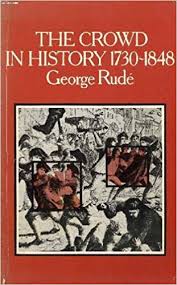
People outside Dominic Cummings house on Monday should in my view be seen as ‘legitimate protesters’ and not a mob. The use of the term mob to characterise popular protest dates back at least to Edmund Burke’s view of the French Revolution. As the great historian of nineteenth century protest George Rude underlined what reactionaries thought was a mob was in many cases simply a peaceful crowd making reasonable points. If one wants to look for a mob, the activities of the Bullingdon Club are a good place to start.
Events in the US provide a much wider canvass to issues of the politics of protest but a summary of the mob v crowd debate is here:
While George Rude saw in a protest up to a riot the work of the crowd, and broadly progressive intentions and outcomes, E.P. Thompson was less happy with this formulation. He suggested that riots could also contain reactionary elements and the crowd involved in the Gordon Riots would be an obvious example.
I would take Thompson’s side in that debate (if only just) but underline the point above that while we may accept that there may be reactionary elements in crowds which can get involved in riots this doesn’t alter the fact that they happen and need to be understood
E.P. Thompson’s work on food riots points to the reality that the threat of a riot was often more effective than an actual riot. It could cause a reduction in the price of bread or the distribution of hoarded food. When riots did occur very much the same impact was to be found. Hidden food was seized and distributed at low price.
There were other, more obviously political riots, often associated with the Chartists. The Chartists were an organised political force that most certainly did not support riots. It was rather the wider Chartist crowd that participated in such activities, often after provocation from the authorities.
_________________________________________________________________________________
Marina Hyde, in her excellent article about the Dominic Cummings scandal (The truth about why Cummings hasn’t gone: Johnson is too terrified to sack him, 26 May), mentions her concerns about an angry “mob” outside his home. As one of the protesters who went there on Monday, I would like to clear up this aspect of Cummings’ misinformation campaign: there was no “mob” of protesters outside his home, though there was perhaps a “mob” of paparazzi.
On Monday, there was – at our peak – a handful of protesters quietly standing around and socially distanced on the pavement. A few of us had placards. Nobody was chanting. The police facilitating the protest confirmed we were not breaking the law and were very friendly to us. They also told us there hadn’t been a protesting presence outside Cummings’ home over recent days.
When Cummings returned from his press conference, having brazenly insulted our intelligence, quite understandably he was briefly shouted at as he entered his home and the paparazzi pressed in. One of our number swore, which, given his behaviour, didn’t seem that outrageous. Of course, it was this moment of high drama and jostling that made the evening news bulletins. Once he got inside we shut up, and shortly after that we all went home as it was getting dark.
The paparazzi were perhaps more mob-like, but in my view the man has brought that level of scrutiny on himself and it is by no means disproportionate to his crime. Please don’t allow Mr Cummings to weaponise this legitimate protest by evoking images of misbehaving protesters. We, as with the lockdown, obeyed the rules. (Guardian Letters)