Articles

E P Thompson & the clocks going forward

In Uncategorized on March 30, 2019 by kmflett

EP Thompson & the clocks going forward

Clocks have gone forward or back in Britain to mark summer or winter time for around a century. There are debates about how daylight is lost or gained as a result and the impact of this and these continue.

Behind that however lies an industrial obsession with time and the market capitalist idea that time is money.

A common theme of the clocks going forward for summer is that those who are not working overnight will get one less hour in bed. The subtext there is perhaps whether an hour lost is necessarily such a bad idea.

After all from the 1880s the labour movement campaigned for the 8 hour working day, which is also meant 8 hours for recreation and 8 hours for rest.

EP Thompson’s Time, Work Discipline which appeared in Past and Present in 1967, just over 50 years ago, remains a foundation text.

To give a brief flavour, he writes of ‘Smilesian snippets about humble men who by rising early and diligence, made good’. He continues that as workers secured reductions in working hours moralists became concerned that ‘manual workers after concluding their work were left with several hours in the day to be spent nearly as they please’.

So that one hour lost means that pub opening time is in fact one hour nearer on this particular Sunday..

Articles

Chartism & the London Black Chartist leader in 1848 William Cuffay on ITV

In Uncategorized on March 30, 2019 by kmflett

We have reached series 3 of the ITV drama Victoria, which is about,er, Queen Victoria.

If you are interested in her many of her letters are on-line and transcribed to make them easier to read.

Series 3 Episode 1 of Victoria (Sundays ITV 9pm or on-line for a month) sees the programme reaching 1848.

Obviously it is mainly about the Royals and is not that accurate historically (again check Victoria’s letters for an easy to access original source). However the black Chartist leader William Cuffay, who was the organiser of the demonstration on 10th April 1848 on Kennington Common does feature (played by the young black actor C J Beckford). Cuffay did not lead a militant demonstration to the gates of Buckingham Palace as the programme suggested on 24th March but for those of us who have argued that he was a good deal more important in 1848 than some histories have allowed his prominence in the programme is welcome.

Cuffay and Chartism also featured in Series 3 Episode 2 on Sunday 31st March.

The historical accuracy of this programme was rather less than Episode 1 but as someone noted on social media why would one expect TV historical fiction to be accurate. Both Cuffay and Feargus O’Connor feature again. The latter seems to be played as a pacifist rather than a leader anxious to avoid confrontation with the State.

The discovery of guns at a Chartist meeting place and the role of police spy has its place in the historiography of 1848 but not on April 10th.

The actual rally on Kennington Common is not shown and since the series is about Victoria the Queen’s role in affairs is probably somewhat overplayed. Her correspondence (see above) does not suggest any great regard for either the Chartists or democracy.

It is certainly true that the Duke of Wellington was keen to display and perhaps use military force on April 10th and, one way or another, that didnt happen. The Chartists presented the petition (the largest until the current one on Revoking Article 50) but they did not walk with it over Waterloo Bridge. It was conveyed in carriages.

Still any focus on the events of that revolutionary year, 1848, provokes some interest.

Articles

Big Beer: is it back to the 1960s?

In Uncategorized on March 30, 2019 by kmflett

Big Beer: is it back to the 1960s?

Roger Protz has noted of the strategy of Big Beer: “First Big Beer buys up a swathe of independent breweries. Now it’s attempting to control the natural ingredients used to make beer. The power of these global behemoths is frightening and has to be vigorously resisted….

Big Beer is on the march, and we risk losing our wealth of choice to merely the illusion of it. Not only are consumers being misled, but these global brewers are changing the very character of the beers they buy and driving genuine independents out of business….

The question of what the strategy of Big Beer in the 2020s has been sharply focused again by Kirin’s takeover of Magic Rock with more buy-outs rumoured.

I agree with Protz that the aim of Big Beer is to control the market and in doing so to mass market beers which will claim to be ‘craft’ but will be of lower quality and more bland than ‘genuine’ products. That process will usually take time. It is the outcome of a series of decisions that big businesses make about cost savings and efficiencies in order to retain or boost profit levels (EBITDA).

It would be a mistake I suspect however simply to expect a re-run of the 1960s. In that period regional and smaller brewers, often those which had failed to invest or keep pace with changing markets for various reasons (but not always) were swallowed up and closed. Their beers, or at least their best-selling beers, were produced elsewhere in much larger breweries. At the same time the Big Six, Watneys, Whitbreads and the like sought to monopolise not just beer production but beer sales. They did that by growing pub estates and making sure only their products could be obtained in wide geographic areas- Watneys in East Anglia for example.

I don’t think the 2020s will look quite like that. For a start Big Beer is now definitively global. It has no specific interest in shutting down a brewery it buys and brewing the beer elsewhere because where would that be? Nor does it have a huge interest in owning pubs. What it does have an interest in is making it financially attractive for pubs to carry its products and not those of genuine independents.

Moreover unlike the 1960s its not really about reducing beer ranges and promoting a few big brands. These already exist. The problem is that the profit to made out of them by Big Beer is not as high as it was, while the profit out of the (much smaller) craft beer market is higher.

The Big Beer combination there then could be to reduce the cost of making craft beers they acquire (and in doing so make an inferior product) and to seek to make them as widely available as they can.

That means of course not just pubs but supermarkets, restaurants, cafes. The shape of the beer market looks a bit different in that respect to the 1960s.

A preliminary summary might be (and these are very preliminary thoughts) that the broad trends that Big Beer pursued in the 1960s remain but that the context of the 2020s is somewhat different.

What is missing in the above is the input of an independent campaigning voice for beer drinkers. CAMRA arose out of the impact of Big Beer in the 1960s. Its still around but can it, or others grapple with Big Beer 2020s style?


Articles

Magic Rock sell to Lion/Kirin. Big Beer marches on

In Uncategorized on March 29, 2019 by kmflett

The news that Magic Rock was planning to sell to Lion/Kirin is perhaps not totally unexpected given the usual craft beer rumour mill, although to be honest it might have been one of  another half a dozen or so well known UK craft breweries as much as Magic Rock.

The details are here:

https://www.magicrockbrewing.com/blog/next-step-in-the-magic-journey/

Leaving aside a slight penchant for rather outdated management speak phrases (I can supply up to the moment phrases free of charge) the case put forward makes decent business sense. Magic Rock want to expand and they need investment. Where to get it from? A bank is a possibility, while bank robbery is not legal. Crowd funding another and getting investment from a multinational company keen to expand its market reach another.

I must admit that after Camden, Beavertown and Fourpure I thought that international Big Beer might have done with the UK market for a bit. Then came Asahi’s takeover of Fullers and now this. Obviously I was wrong, as I often am.

Does it matter? I dont fetishise independent business. I’m not sure its possible to argue small business good, big business bad in a general sense. The issue is the logic of capital. Big business is driven to compete, to cut costs, to look for efficiencies or to face takeover or demise itself.

The Big Beer takeovers of the 1960s followed that pattern and led to widespread brewery closures and a focus on a few heavily promoted beer brands. The logic described above suggests that could happen again. There is one issue with that for Big Beer. Is that what the market wants, and if it is, is it not the case that the likes of ABI already churn out enough of bland beer and lager to keep its fans happy anyway? If so there is no market advantage in BIg Beer 2020s style following the model of Big Beer 1960s style.

But without doubt for those who like well made, interesting and perhaps slightly quirky beer, there could be trouble ahead.

I wont be stopping drinking Magic Rock beer or visiting their Huddersfield tap btw. After all the beer remains excellent and there is more to life, thankfully, than the logic of capital.

Articles

66 years since the first CND Aldermaston to London march. Fri 27- Mon 30th March 1959

In Uncategorized on March 29, 2019 by kmflett

66 years since the first CND Aldermaston to London march

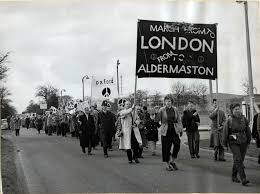
Easter 2025 falls well into April but in 1959 it was on the last weekend of March reminding us that it is 66 years since the first Aldermaston to London march organised by CND which took place from 27th-30th March 1959.

There had been a march at Easter 1958 supported by the new CND but organised by local direct action groups. It had gone from London to the Atomic Weapons Establishment as Aldermaston. The demand in 1959 however remained the same: ban the bomb.

The route from Aldermaston to London through Berkshire and West London to central London was 54 miles. By the third march in 1960 many thousands were involved in marching but 1959 still had significant numbers.

The sheer logistics of organising the march are detailed in the biography of CND organiser Peggy Duff, Left, Left, Left. Church Halls and community spaces had to be organised with the help of local churches, Labour Party branches and trade unions. People had rough and ready overnight accommodation and something to eat.

When the 1959 march arrived in Trafalgar Square for a rally on Easter Monday 1959 the supporting crowd had swelled to at least 60,000, although CND claimed 100,000. Whatever the reality it was one of the largest protests London had seen at that point in the twentieth century. Larger protests were to come.

Tony Benn’s diary makes no mention of the first Easter CND march from London to Aldermaston in 1958.

However when the march reversed direction in 1959 and went to London, Benn was there.

Benn wrote in his Diary for March 30th 1959

Took they boys to watch the Aldermaston marchers as they came in. They were 1,500 strong at Trafalgar Square and had Frank Cousins amongst them. The movement is a force to be reckoned with.

A representative of the White Defence League was there with some Fascist propaganda. Mosley is standing in North Kensington at the next Election.

Benn was a mainstream Labour figure in the late 1950s and certainly not an active CND supporter. His presence is a reminder that CND represented a new form of protest and the rise of a left-wing protest culture which particularly gathered support among young people. It was estimated that 40% of those on the early marches were under 21 years old, an echo perhaps of today’s climate and Palestinian protests.

The presence in 1959 of fascist protesters reminds us too that unfortunately the threat of such groups is nothing new.

An earlier version of this post first appeared in the Morning Star

Articles

Gramsci on the House of Commons & Brexit

In Uncategorized on March 27, 2019 by kmflett

The crisis consists precisely in the fact that the old is dying and the new cannot be born; in this interregnum a great variety of morbid symptoms appear. (Prison Notebooks)

Articles

The Beard Power drawings: the final vote

In Uncategorized on March 27, 2019 by kmflett

1                                                  2                                                  3

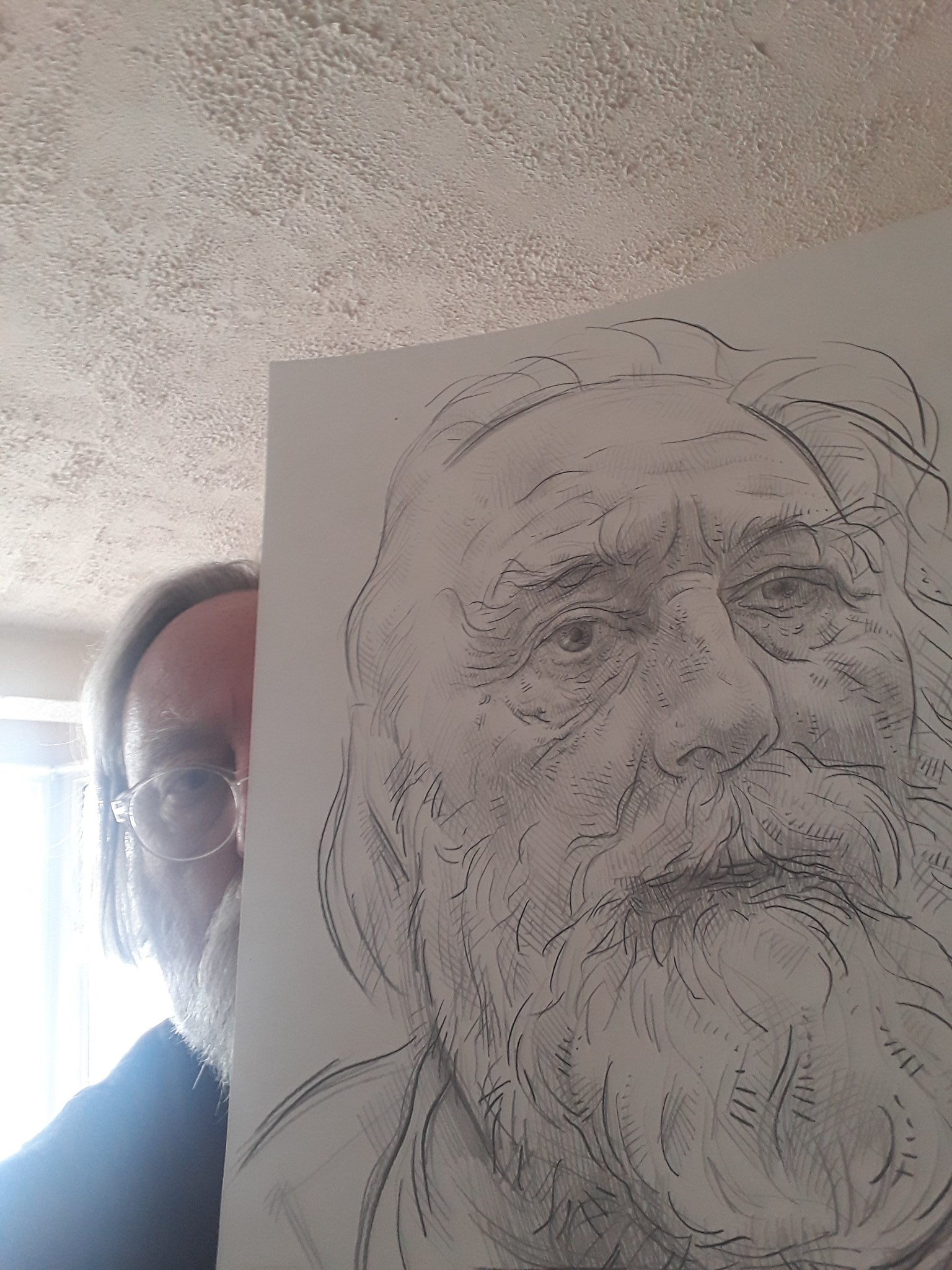
My thanks to the artist Daniel Fooks (@DanielFooksArt) for these drawings of me, which reflect of course the stresses and strains on the beard of organising the Beard Liberation Front.

Daniel’s view is that the first drawing looks like a cross between Santa and Brahms. The second he thinks is more Victor Hugo although I can see a very slight likeness to the veteran Arsenal supporter Michael Rosen. The third is as yet uncategorised.

Daniel tweaked the images further to underline the element of hirsute gravitas we I now have the final drawings (modelled above by myself…)

He doesnt always draw people with beards but has captured some of the best known hirsute figures in British life from the author and broadcaster Michael Rosen to Labour leader Jeremy Corbyn

Now is its your turn. Which beard best represents an image of hirsute gravitas and beard power?

Closes midnight 28th March

PS: dont take it too seriously….

Articles

Once Again on the size of the People’s Vote on 23rd March 2019

In Uncategorized on March 27, 2019 by kmflett

Once Again on the size of the People’s Vote march on 23rd March 2019
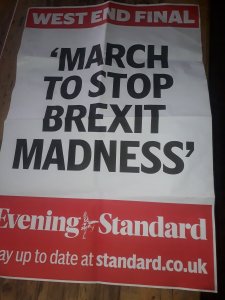
I was not able due to other commitments to pay more than passing direct attention to the People’s Vote in central London on 23rd March.

As might be expected I’m no fan of the named organisers but that is hardly the point. A very large demonstration brings all sorts of people and ideas onto the streets and opens up possibilities.

The organisers pre-claimed the march would be a million strong and repeated that afterwards as well. To be fair with such a large march over a relatively short distance ending up in a restricted space it’s very difficult to tell. My general views on the size of protests are here:

Once again on the size of protests: the People’s Vote march 23rd March

There were some slightly odd claims. One twitter post showed the Mall full for a Royal event in a previous summer and claimed this was the march. Who knows what that was about. Likewise there was some twitter comment that the police had said the march was 1.5-2 million strong. I could find no verification of this and it was also odd because in recent times the police, mainly I think for resource reasons, have given up attempting to assess the size of protests.

There were as ever agendas running. One was that it was the biggest ever UK protest, bigger than the 2003 Iraq War march. I think it’s fair to say that this line was largely promoted by those who ignored the 2003 march at the time.

A right-wing commentator claimed that protest marches are never as big as they were claimed to be, probably I suspect because they can’t cope intellectually with the possibility that large numbers can mobilise for reasons they don’t like.

My thanks to Hazel Potter for drawing my attention to a further estimate based on the views of Professor Keith Still at Manchester Met University.

https://fullfact.org/europe/peoples-vote-march-count/

Professor Still is an expert in crowd science, risk analysis to you and me, and by the look of it does valuable work in this area:

https://www.gkstill.com/

I’m afraid however it is of limited worth in assessing the size of protests, for which some history and some social movement theory are probably more important than crowd science.

Anyone who has attended protests over the years will know that the biggest risk, depending on what the protest is, is not the numbers attending but being whacked by a police officer.

That said the use of the well-known crowd formula of no more than 2 to 4 people per square metre (it was square yard back in the day) really does not give accurate protest numbers.

The historian David Large applied it to the Chartist demonstration for the vote on Kennington Common on 10th April 1848 and came out with a number so low that it almost rivalled the official estimates which were simply made up beforehand to minimise the impact of the protest.

I doubt if the March 23rd gathering was as large as the 2003 Stop the War Iraq which needed two different departure points to make sure it got going at all. I’m not sure it’s a competition.

More relevant is that ALL the largest protest marches in British history have taken place since 1968 when the October 1968 anti-Vietnam War demonstration was considered the largest ever at a claimed 100,000. Perhaps this is a more interesting thing to ponder than precisely how large the People’s Vote protest was, beyond very large.



Articles

Before the Revoke Article 50 petition: how the Government reacted to the Chartist petition for the vote April 10 1848

In Uncategorized on March 27, 2019 by kmflett

Before the Revoke Article 50 petition, how the Government reacted to the Chartist petition of 1848

The Revoke Article 50 petition is now the largest ever in Parliamentary history. It has the advantage of course of people being able to independently e-mail their support rather than to having to physically sign it. Likewise the organisers don’t have to check or count the support. This is done automatically by the petitions system

The previous largest petition in Parliamentary history, that of the Chartists on 10th April 1848 had none of these advantages.

Signatures had to be collected, and often from people who were not used to signing their own names. The Parliamentary authorities in 1848 took a dim view of women (who did not have the vote) signing at all.

The Chartist leader Feargus O’Connor MP claimed the petition contained 5,706,000 signatures. Given that the total population of the UK in 1851 was a little over 15 million this was a huge number.

It was disputed by the House of Commons authorities. A special team had been set up in November 1847 to review petitions presented to the House and in this case 13 clerks had been employed from April 10th to April 13th to count the signatures.

Mr Thornley for the Committee reported that they believed the petition contained 1,975,496 genuine signatures.

In the Chartist Northern Star of 22nd April O’Connor underlined that the Parliamentary authorities claim to have scrutinised the petition thoroughly did not stack up.

He noted that the 13 clerks had worked a total of 17 working hours from the presentation of the petition on 10th April at 5pm to the Commons debate on 13th April at noon. This would have required each clerk to count 8,860 names in an hour, that is 150 every minute.

In short the Petition was misrepresented and left to lie on the table (that is not debated at the time).

These days the Government can send a direct response to petition signers and it has: everyone who has signed has received an e-mail stating that there is no intention to revoke Article 50.

It may be gathered that Governments do not like the expression of democratic sentiment that very large petitions represent.


Articles

Ranking Roger 1963-2019: From Thatcher’s Swamped to Theresa May’s Hostile Environment: Stand Down Tories

In Uncategorized on March 26, 2019 by kmflett

Ranking Roger 1963-2019. From Thatcher’s Swamped to May’s Hostile Environment: Stand Down Tories

Ranking Roger former lead of The Beat has died at the far too early age of 56.

The original Beat split up in 1983 so is this just a bit of cultural history now? Sadly and definitely not.

The Beat were of course on Two Tone, deliberately focused on black and white coming together to fight the racists.

Before the 1979 General Election Tory leader Margaret Thatcher had made a speech claiming that people felt ‘swamped’ by those of a ‘different culture’.

The official Thatcher Foundation archive detail is here:

https://www.margaretthatcher.org/document/103485

Fast Forward 40 years and we find as Tory Prime Minister Theresa May, architect of the hostile environment towards ethnic minorities, a policy which led directly to the abuse of numbers of the Windrush generation, rightfully in the UK but harassed by the authorities.

Neither Mrs Thatcher or Theresa May I suspect owned or own any Beat records…